Why Does a Straw Look Bent in Water?
A straw in a glass looks broken at the surface, but it is straight. Light changes direction as it leaves the water, and Snell's law gives the exact amount.
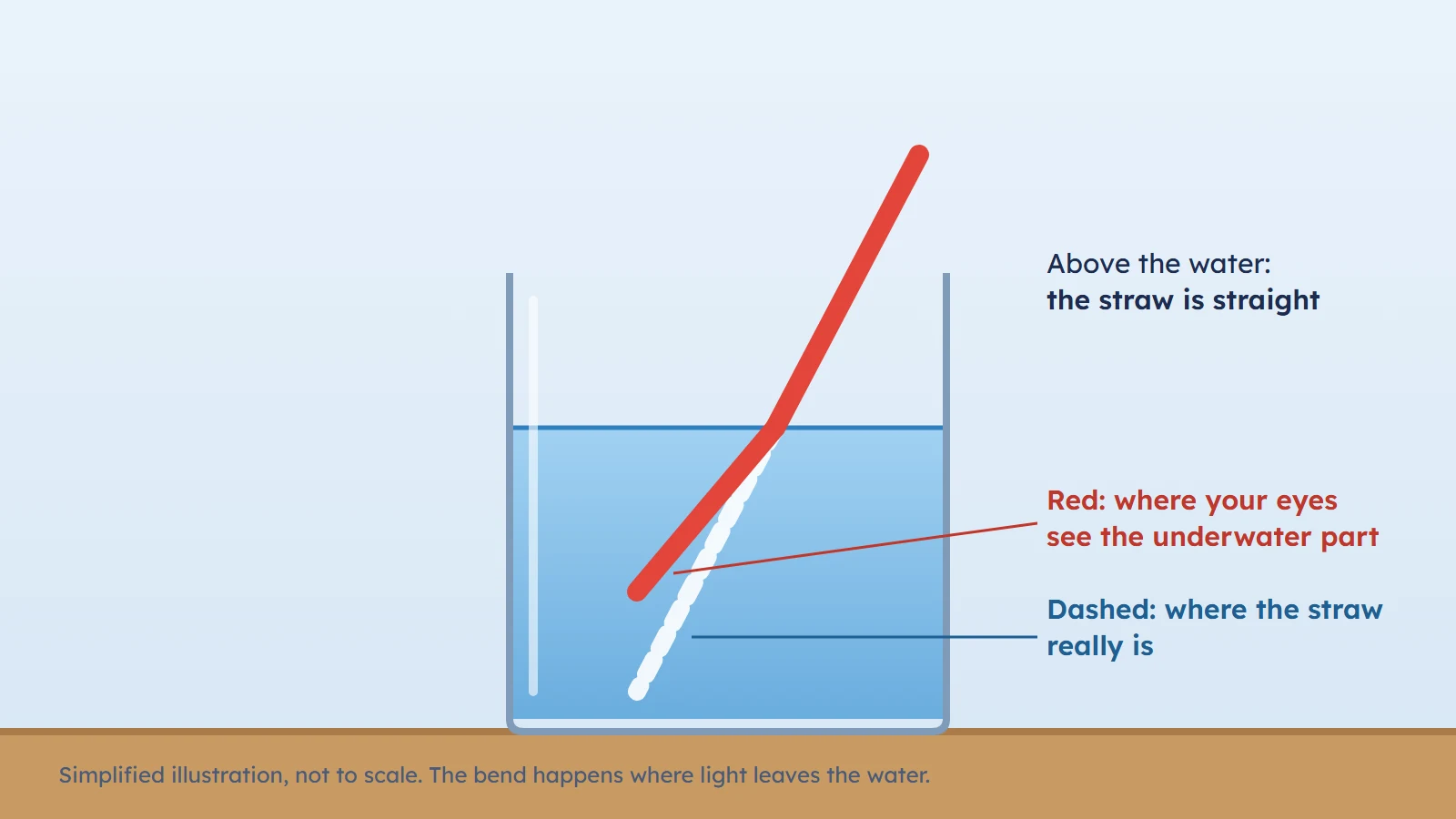
Put a straw into a glass of water and it seems to snap at the surface, as if the bottom half has moved to one side. Pull it out and it is perfectly straight. So what is happening in the glass? The straw has not changed shape. The light coming from its underwater part has changed direction.
The short answer: Light changes speed when it moves from water into air, and that change bends its path at the surface. Your eye reads the light as if it came in a straight line, so the underwater part seems to be in a different place. Snell’s law gives the exact bend: with water’s index of refraction at 1.333, light at 30° in the water leaves at about 41.8° in the air.[1][2]
Light bends when it changes speed
Refraction is “the bending of a wave when it enters a medium where its speed is different.”[2] Water slows light down compared with air, so light crossing the surface changes direction. The HyperPhysics table lists the index of refraction of water as 1.33, and air as almost exactly 1.00.[3]
The direction of the change follows a rule. When light slows down, its path moves closer to the perpendicular, which is the line standing straight out from the surface. When it speeds up on the way out, it moves away from the perpendicular.[1] Science Learning Hub says that when light enters a more dense substance, it “bends” more towards the normal line.[4]
Why the straw looks broken
The light from the underwater part of the straw travels up through the water and bends at the surface. Your eyes receive that light and place the straw where the light appears to come from. Because the light has bent, the underwater part appears to be shifted. OpenStax physics makes the same point about fish: you may see “the same fish appearing to be in two different places,” because “light coming from the fish to us changes direction when it leaves the tank.”[1]
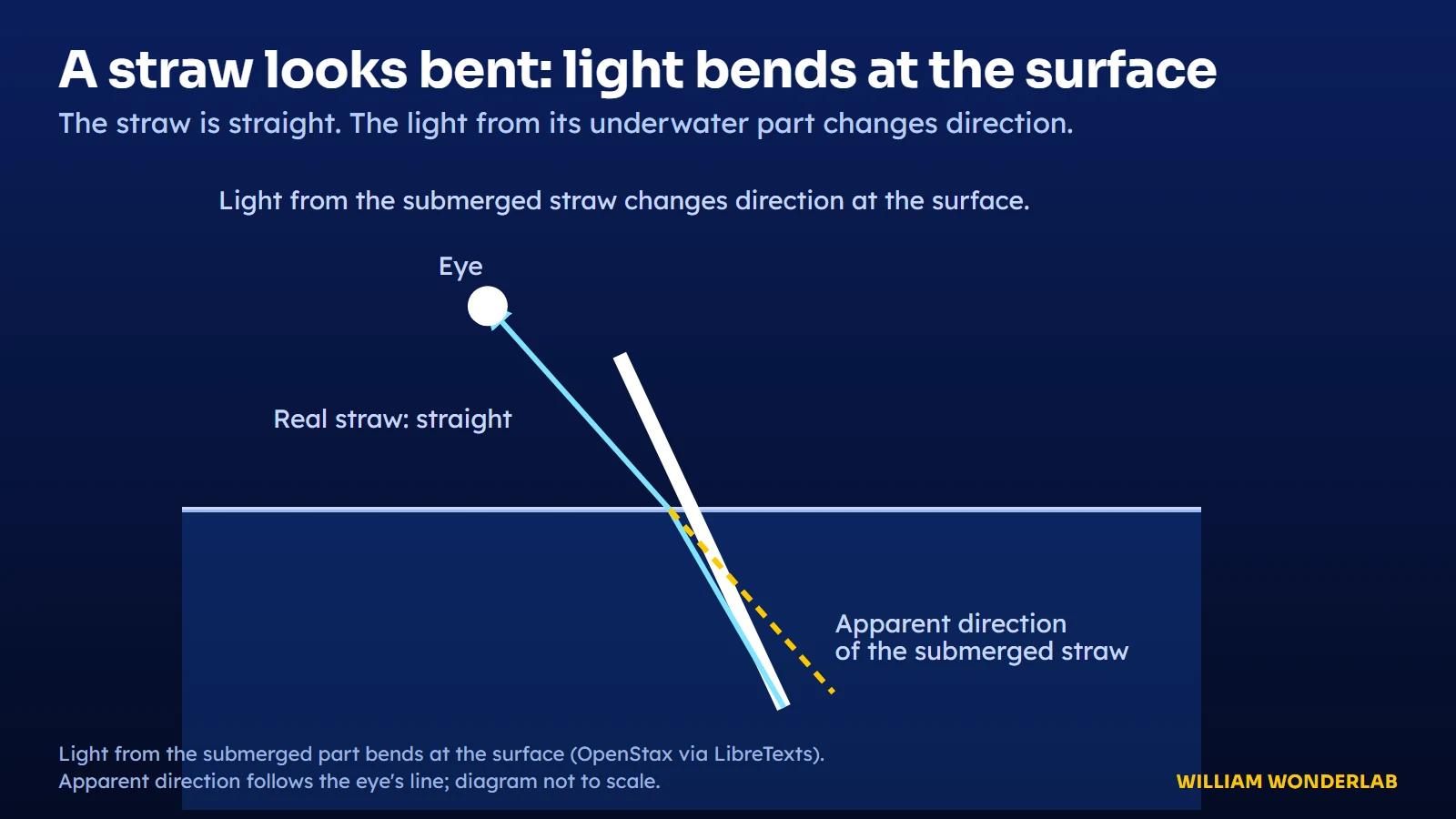
The straw itself is straight, as the solid line shows. The dashed line shows the direction your eye places the underwater part, which is tilted more than the straw.
Snell’s law: the exact bend
The rule that links the two angles is Snell’s law: n₁ sin θ₁ = n₂ sin θ₂. Here n is the index of refraction and θ is measured from the perpendicular.[1] Using water (n = 1.333) and air (n = 1.00), the calculation is short. It is worked through in the Go deeper section below.
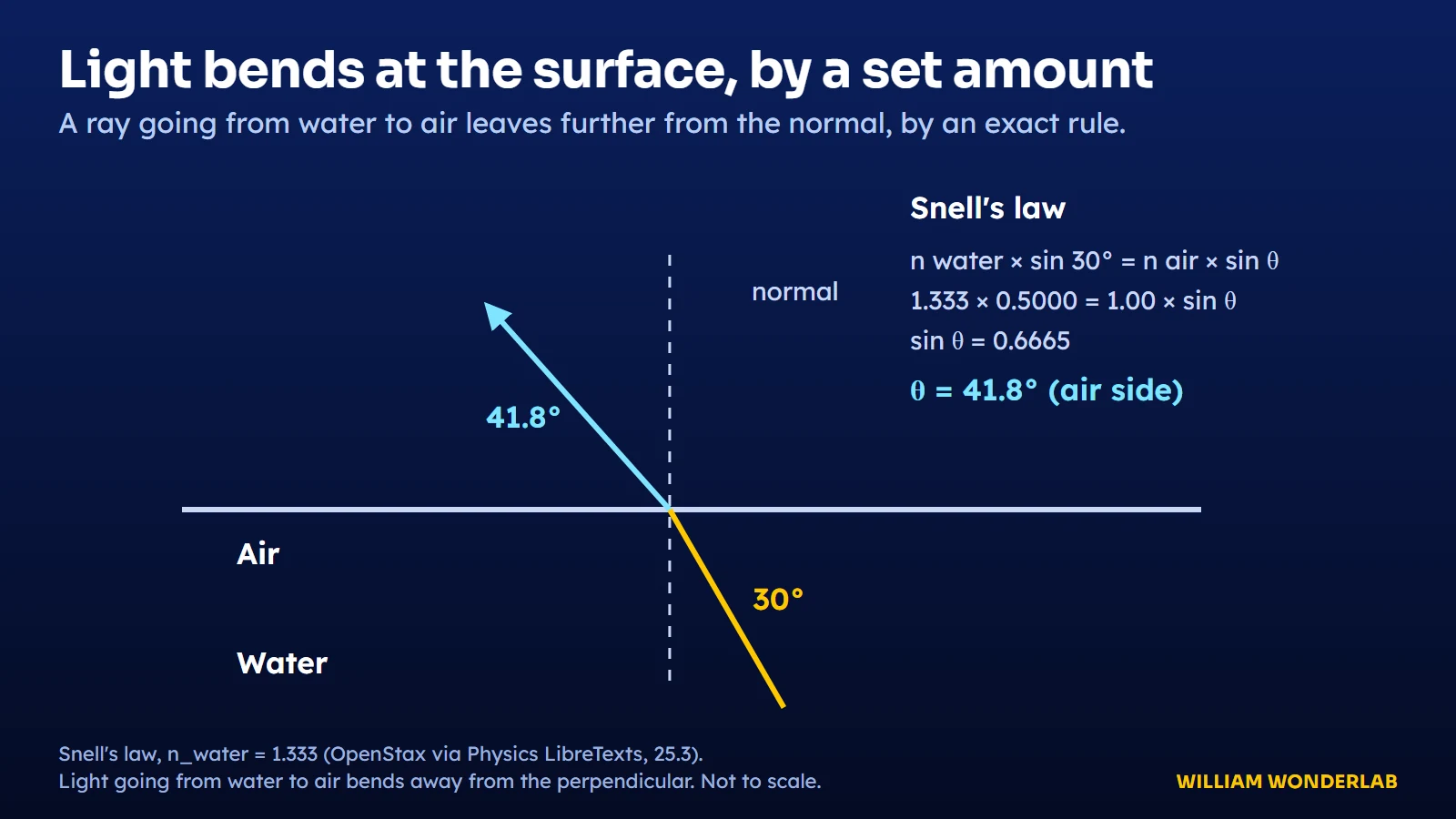
The diagram shows one ray from the straw to the surface. The ray meets the surface 30° from the perpendicular inside the water. In the air it bends away and leaves at a larger angle, 41.8°, which is the angle the eye receives.
Snell’s law explains the sharp bend. It also tells you that the apparent direction of the straw depends on where you stand: from a different angle, the bend looks different.
Try it: a straw in a glass
This is a proposed at-home activity. It is not something that was done for this article.
You need: a clear glass, a plastic straw, water, and a table that is dry and away from electrical outlets.
- Predict what the straw will look like at the surface when you put it into the glass, and whether the bend is at the water line.
- Fill the glass about two-thirds full and place the straw in at a slant.
- Look at the straw from the side, then from above. Note where the bend seems to happen.
- Pull the straw out and check that it is straight. Write down what you saw.
What to expect: the part in the water looks shifted sideways at the surface, even though the straw is straight.
Safety first: Use a plastic straw and a plastic or sturdy glass. Keep the glass away from the edge of the table, dry the surface if you spill, and keep the glass away from electrical sockets, cords and phones. Do not drink from the glass afterwards. An adult should handle any glass that might break.
Go deeper: the angle arithmetic
Snell’s law step by step
Take light at 30° from the perpendicular inside the water.[1] The indices are n_water = 1.333 and n_air = 1.00.[3]
- Start with Snell’s law: n_water × sin θ_water = n_air × sin θ_air
- Substitute: 1.333 × sin 30° = 1.00 × sin θ_air
- sin 30° = 0.5000, so 1.333 × 0.5000 = 0.6665
- θ_air = arcsin(0.6665) ≈ 41.8°
The light leaves the water 11.8° further from the perpendicular than it arrived. That is the sharp bend at the surface.
Frequently asked questions
Is the straw bent?
No. Pull it out of the water and it is straight. The bend is in the light, not in the straw.[1]
Why does the straw look broken at the water line?
Light from the submerged part bends as it crosses the surface. The underwater part then appears in a different place from where it really is.[1]
Does a straw look bent in every liquid?
The effect depends on how much each material slows light. Water’s index of 1.33 is the value used in this article.[3]
Why does it look different from another angle?
Snell’s law gives the bend for each ray. The angle you view from changes which ray reaches your eye, so the apparent position changes too.[1]
The big idea
Light bends, not the straw. Water slows light, so light from the underwater part bends at the surface. Snell’s law gives the angle, and your eyes place the straw where the bent light seems to come from.
Related reading
More from William Wonderlab:
Explore more from scientists:
- The Law of Refraction (Physics LibreTexts, OpenStax)
- Refraction (HyperPhysics, Georgia State University)
- Indices of Refraction (HyperPhysics, Georgia State University)
- Refraction of light (Science Learning Hub, University of Waikato)
References
[1] OpenStax via Physics LibreTexts, “25.3: The Law of Refraction” (accessed 25 October 2026)
[2] HyperPhysics, Georgia State University, “Refraction” (accessed 25 October 2026)
[3] HyperPhysics, Georgia State University, “Indices of Refraction” (accessed 25 October 2026)
[4] Science Learning Hub, University of Waikato, “Refraction of light” (accessed 25 October 2026)
Keep exploring
Now try the science yourself
Reading is a great start. Experimenting is even better: these interactive models use the same science as this article.