Why Does Hot Metal Glow Red?
Hot metal glows because heat makes its atoms vibrate and give off light. The colour moves from dull red to white as the metal gets hotter.
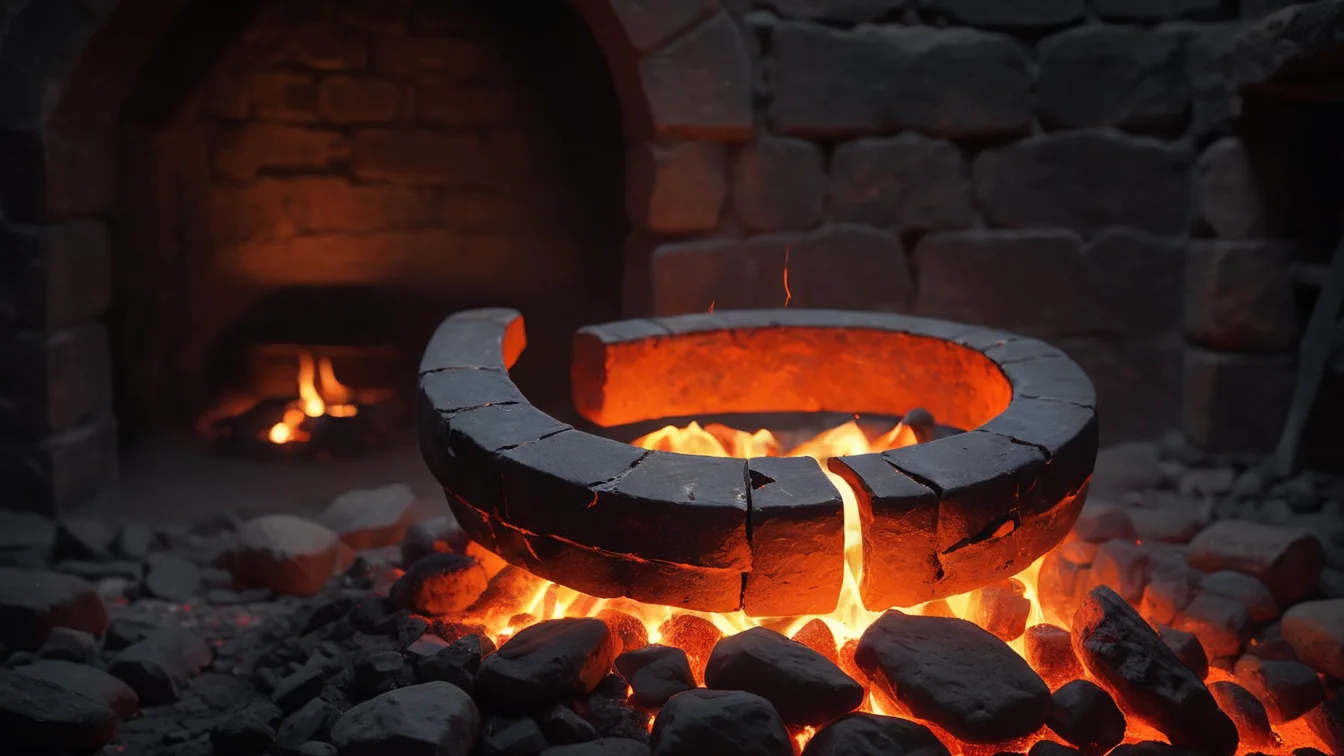
Picture a blacksmith’s iron horseshoe in a hot fire. As it heats, its colour changes: first a dull red, then orange, then yellow, and finally almost white. Why does heating metal make it glow at all, and why does the colour change?
The short answer: Every hot object gives off thermal radiation, which is energy that travels as waves.[1] As metal heats up, its atoms vibrate harder and give off more of that energy as light.[2] The colour moves from dull red, through orange and yellow, to white as the temperature rises, so colour gives a rough clue to how hot the metal is.[2][3]
Everything warm gives off thermal radiation
Thermal radiation is energy that travels as waves. Physics textbooks put it this way: “All bodies emit electromagnetic radiation over a range of wavelengths.”[1] A wavelength is the distance from the top of one wave to the top of the next, a bit like the gap between ripples on a pond. Light is one kind of this radiation, and each colour of light has its own wavelength.
Most of this energy is invisible to us. A simplified picture: an object at room temperature looks black, because most of the energy it gives off is infrared, a kind of light our eyes cannot see.[3] So even a cold piece of metal is giving off energy. It is just mostly the kind we cannot see.
Atoms that jiggle faster
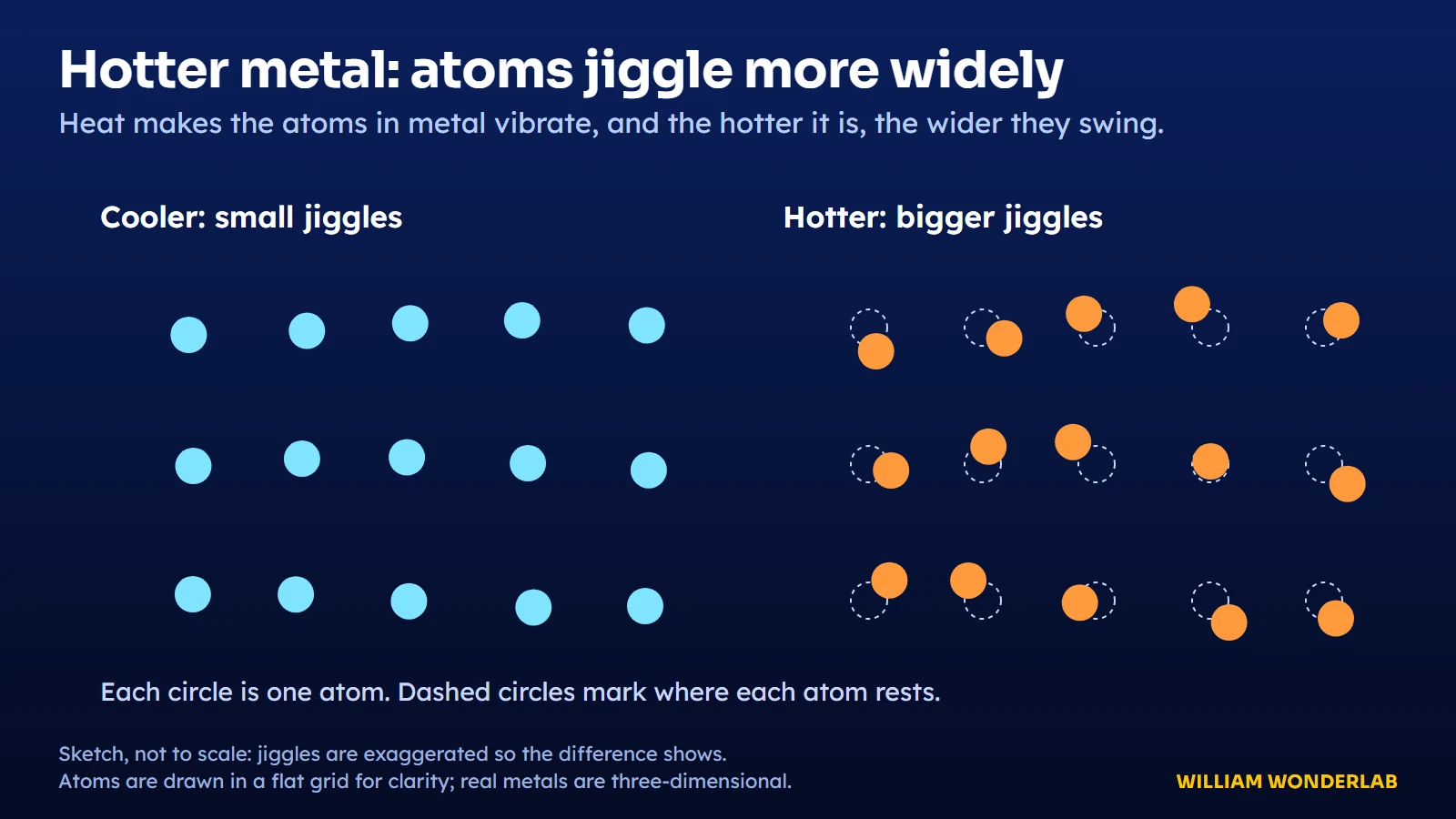
Metal is made of atoms, and heat makes those atoms vibrate. The hotter the metal, the harder they jiggle. One science education site describes it this way: “Incandescent light is produced when hot matter releases parts of its thermal vibration energy as photons.”[2]
A photon is a tiny packet of light energy. Picture a jiggling atom sending out a small packet of light each time it gives up some of its energy. Real metals are more complicated than this, but the core idea is simple: more jiggling means more energy given off, and some of that energy comes out as light.
Why red comes first, and white comes last
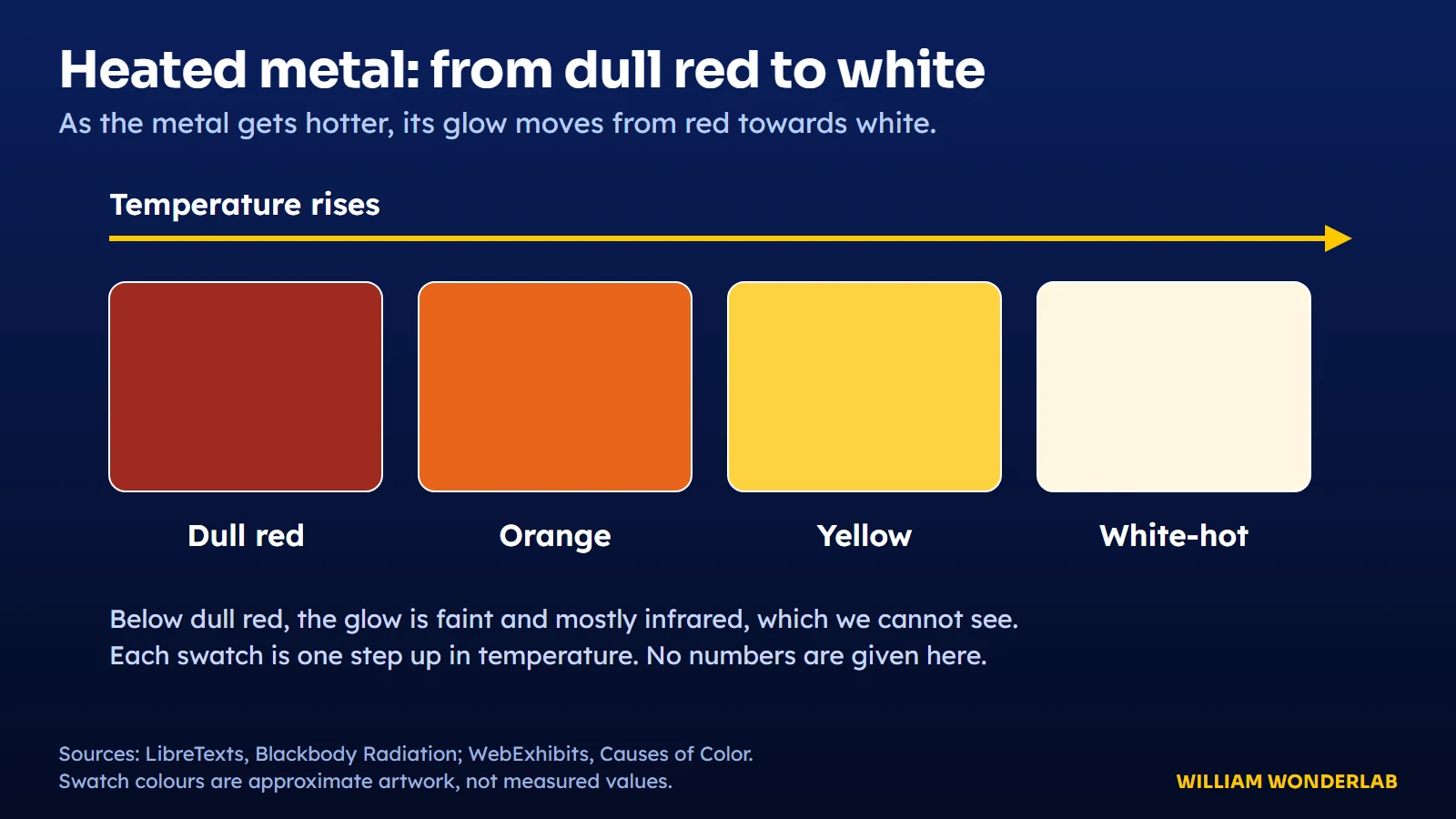
When metal is only a little hotter than the room, it looks dull red. As its temperature rises further, the colour moves through orange and yellow, and eventually it looks white.[3] An iron bar follows the same sequence: it glows red first and then white as its temperature goes up.[2]
An astronomy education site makes the same point with a heated plate: “When you heat the plate up a little, it begins to glow a dull red.”[4]
Why does the colour change? Physicists describe glowing objects with an idealised model, and in that model the peak of the light moves to shorter wavelengths as the object gets hotter: “When the temperature of a blackbody radiator increases, the overall radiated energy increases and the peak of the radiation curve moves to shorter wavelengths.”[5] In plain terms, the hotter the metal, the more energy it gives off, and more of that energy sits in the shorter, bluer part of the light. Mixing all those colours together looks white to our eyes.
Colour is a rough guide, not a thermometer
The idealised model says the light depends on the temperature, not on what the object is made of: “The radiation of a blackbody radiator is produced by the thermal activity of the material, not the nature of the material.”[3]
Real metals are not perfect examples of that model. So treat the colour as a rough guide to temperature, not a precise thermometer.
Stars glow the same way
The same physics works on a much bigger scale. Stars are close to the model, and their colour tells us about their temperature: “Stars approximate blackbody radiators and their visible color depends upon the temperature of the radiator.”[5] NASA puts the link with the peak like this: “The cooler the object, the longer the wavelength at which most of the radiation is emitted.”[6]
Everyday examples
A poker left in a fire follows the same rule as the horseshoe. It gives off thermal radiation the whole time it is hot, and once it is hot enough, some of that energy becomes visible light.[2]
Now picture the horseshoe lifted out of the fire and set on an anvil to cool. The sequence runs in reverse. The yellow fades to orange, the orange fades to dull red, and once the red has gone, most of what is left is infrared.[3]

Please do not try to heat metal at home to see this for yourself. Forges and torches are dangerous, so enjoy the idea through pictures and let the explanation do the work.
Go deeper: Wien’s law and the arithmetic
A simple rule for the peak
Physicists describe the shift with a rule called Wien’s law. HyperPhysics explains it this way: “the product of the peak wavelength and the temperature is found to be a constant.”[5]
Here is the arithmetic. Call the peak wavelength λ and the temperature T. If λ × T stays constant, then a rise in T must be matched by a fall in λ. The two move in opposite directions: hotter means a shorter peak wavelength, which is the shift from red towards white described above. The rule is for the idealised model, so real metals will differ in detail.
Why the colour is only a clue
NASA notes that “The peak wavelength helps determine an object’s color.”[6] The peak is one feature of the light, not the whole story. The idealised model is also a simplification. Together, these mean colour is a clue to temperature, not a measurement.
Frequently asked questions
Why does metal glow red when it is heated?
Heat makes the atoms in the metal vibrate, and some of that energy comes out as light. When the metal is a little hotter than the room, the first visible glow is dull red.[2][3]
Does the colour give the exact temperature?
No. Colour is a rough guide. The glow is described by an idealised model, and real metals are not perfect examples of it.[3]
Why does hot metal turn white?
As the temperature keeps rising, the colour moves through yellow and on to white, because the peak of the light moves to shorter wavelengths.[3][5]
Does metal need a flame to glow?
No. Any object gives off thermal radiation, and the glow comes from the metal’s own heat. A fire is only one way of heating it.[1][2]
Why does a star glow in colours?
A star’s colour depends on its temperature, because stars are close to the idealised model. The cooler the object, the longer the wavelength at which most of its radiation is emitted.[5][6]
The big idea
Hot means light. Heated metal gives off thermal radiation. As its atoms vibrate harder, the glow moves from dull red through orange and yellow to white, so the colour is a rough clue to temperature.
Related reading
More from William Wonderlab:
Explore more from scientists:
- Multiwavelength Milky Way: Radiation Laws (NASA)
- Wien’s Displacement Law (HyperPhysics, Georgia State University)
- Causes of Color: Chapter 3 (WebExhibits)
References
[1] LibreTexts Physics, “6.2: Blackbody Radiation” (accessed 26 October 2026)
[2] WebExhibits, “Causes of Color” (chapter 3) (accessed 26 October 2026)
[3] LibreTexts Chemistry (DePaul University), “7.1: Blackbody Radiation” (accessed 26 October 2026)
[4] Sloan Digital Sky Survey, Voyages, “Color and Temperature” (accessed 26 October 2026)
[5] HyperPhysics, Georgia State University, “Wien’s Displacement Law” (accessed 26 October 2026)
[6] NASA, “Multiwavelength Milky Way: Radiation Laws” (accessed 26 October 2026)