Why Is Snow White?
Snow is made of clear ice, but its many tiny crystals and air gaps scatter light in every direction. Here is how that makes snow look white.
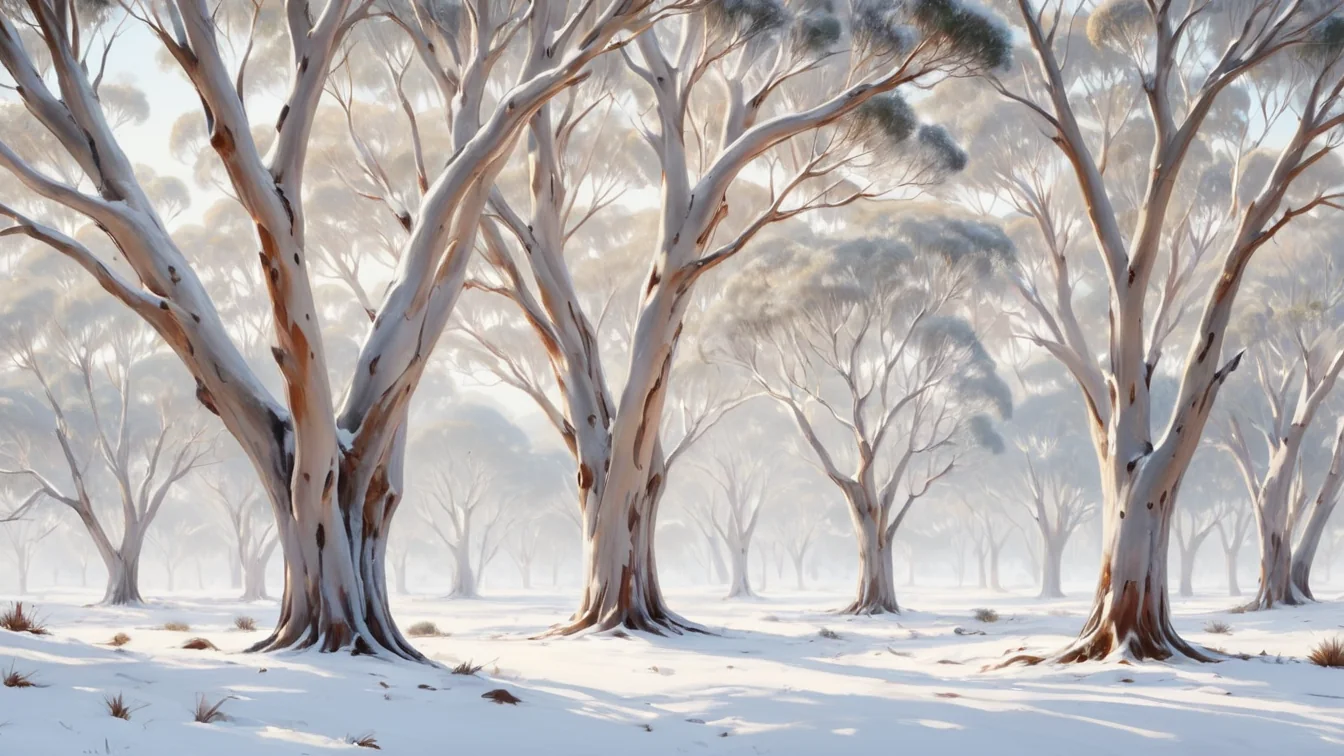
Scoop up a handful of snow and it looks bright white. Now look at an icicle or a clear ice cube. It is also frozen water, yet it looks see-through. So why does the same substance look so different?
The short answer: Snow is made of ice crystals with air gaps between them.[1][2] Light that enters snow bounces off many ice and air surfaces and is sent off in every direction.[3] Snow does not absorb one colour of light more than another, so all the colours come back out together, and the mixture looks white.[2]
Snow is ice, arranged differently
Snow forms in clouds. The National Snow and Ice Data Center (NSIDC) puts it simply: “Snowflakes are clusters of ice crystals that fall from a cloud.”[1]
An ice crystal is a small, solid piece of ice with its own shape. A snowflake is a cluster of many of these crystals, and the gaps between them hold air. The University of Wisconsin-La Crosse describes snow as “a bunch of ice crystals stuck together in a very complex arrangement,” with “ice crystals and air pockets” throughout.[2]
Think of a heap of rice. Each grain is solid, but the heap is full of gaps. Snow is similar: solid pieces with air in between.
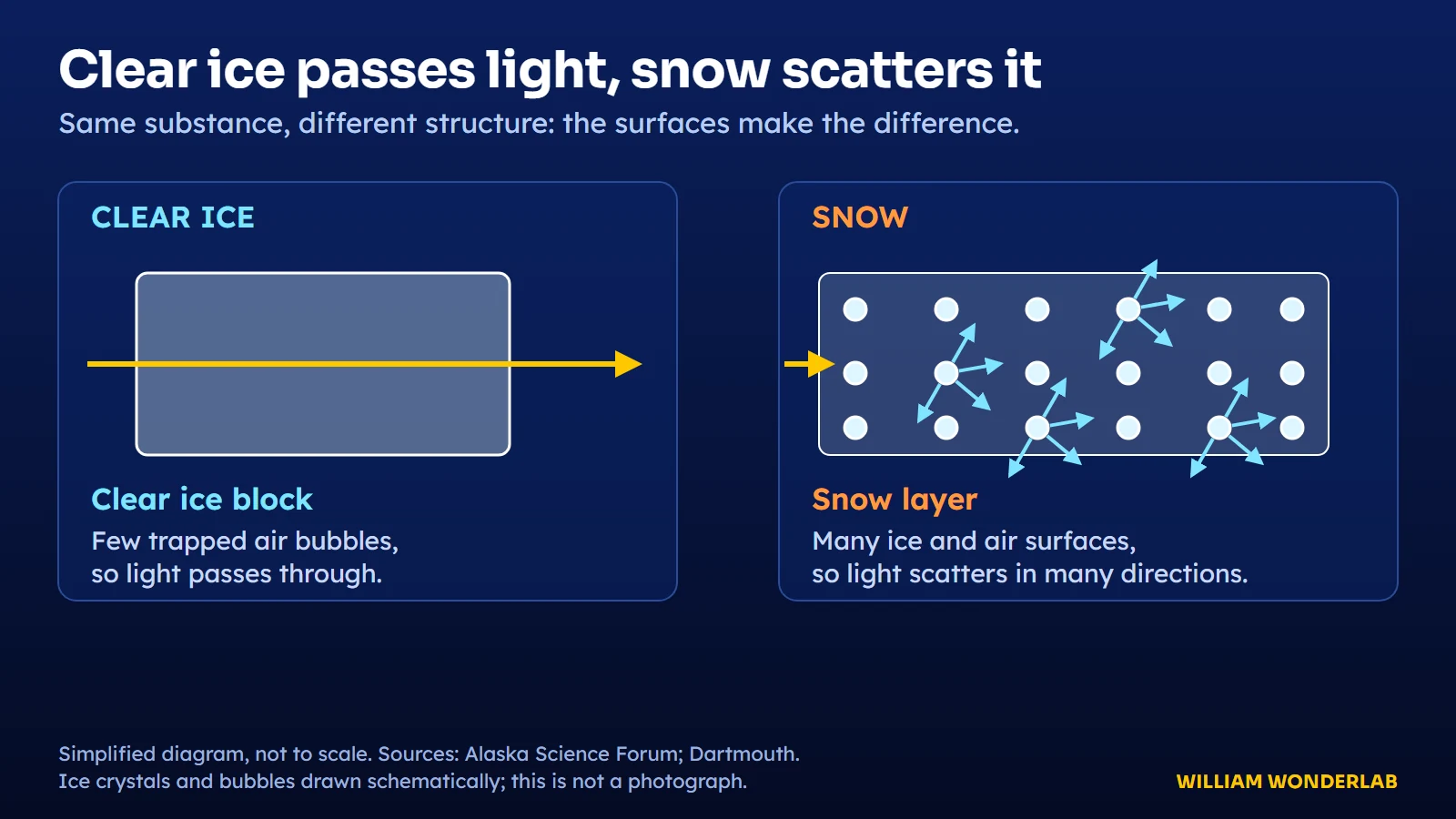
A solid block of ice is different. It has few gaps, so it has far fewer surfaces where light can be sent off in a new direction.
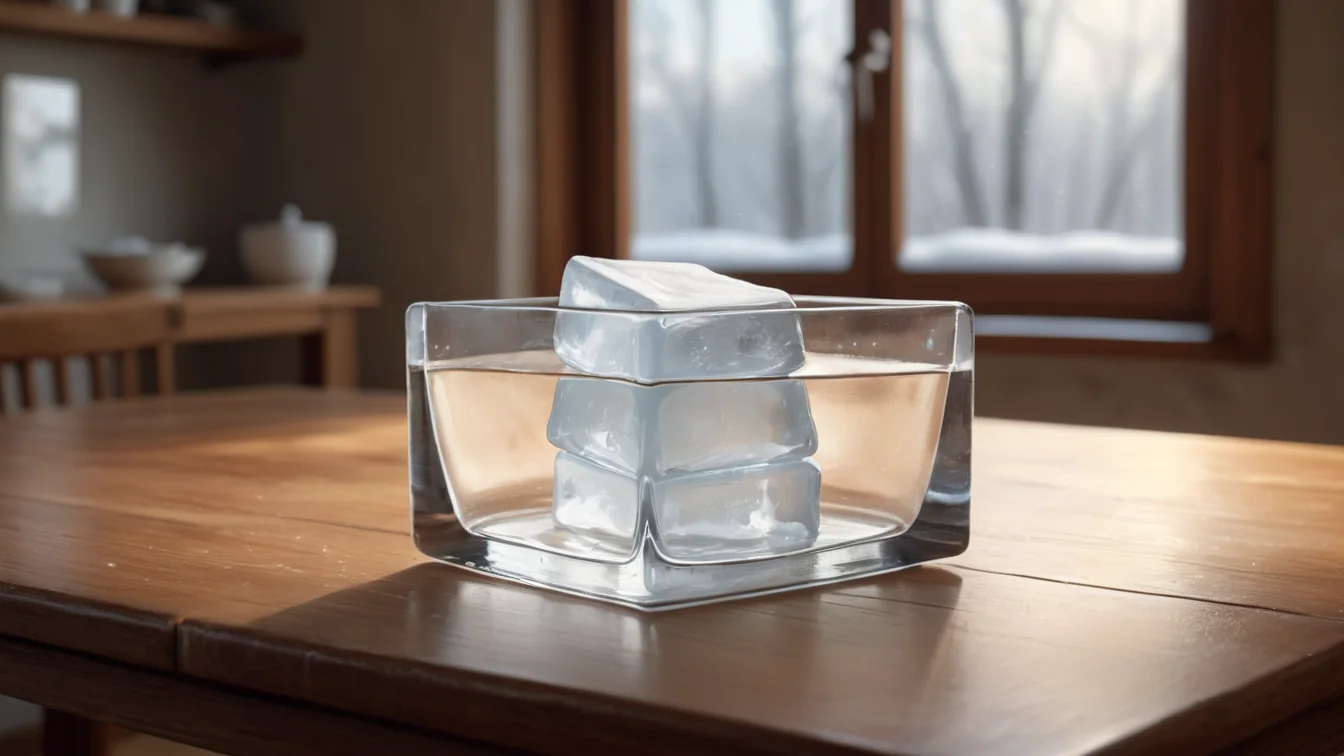
Light bounces around inside snow
Sunlight is a mix of colours. Mark Serreze, director of the National Snow and Ice Data Center, explains that sunlight “emits all colors of the visible spectrum: red, orange, yellow, blue, green, indigo, and violet.”[3]
Here is what happens when that light reaches snow. The university article describes it this way: “When light goes into snow, it hits all those ice crystals and air pockets, and bounces around and some comes back out.”[2]
A simplified picture helps. Imagine a ball thrown into a room full of boxes. It hits one box, bounces to another, and eventually finds its way back out of the door. Light in snow behaves in a similar way, with many small bounces before it returns to your eyes.
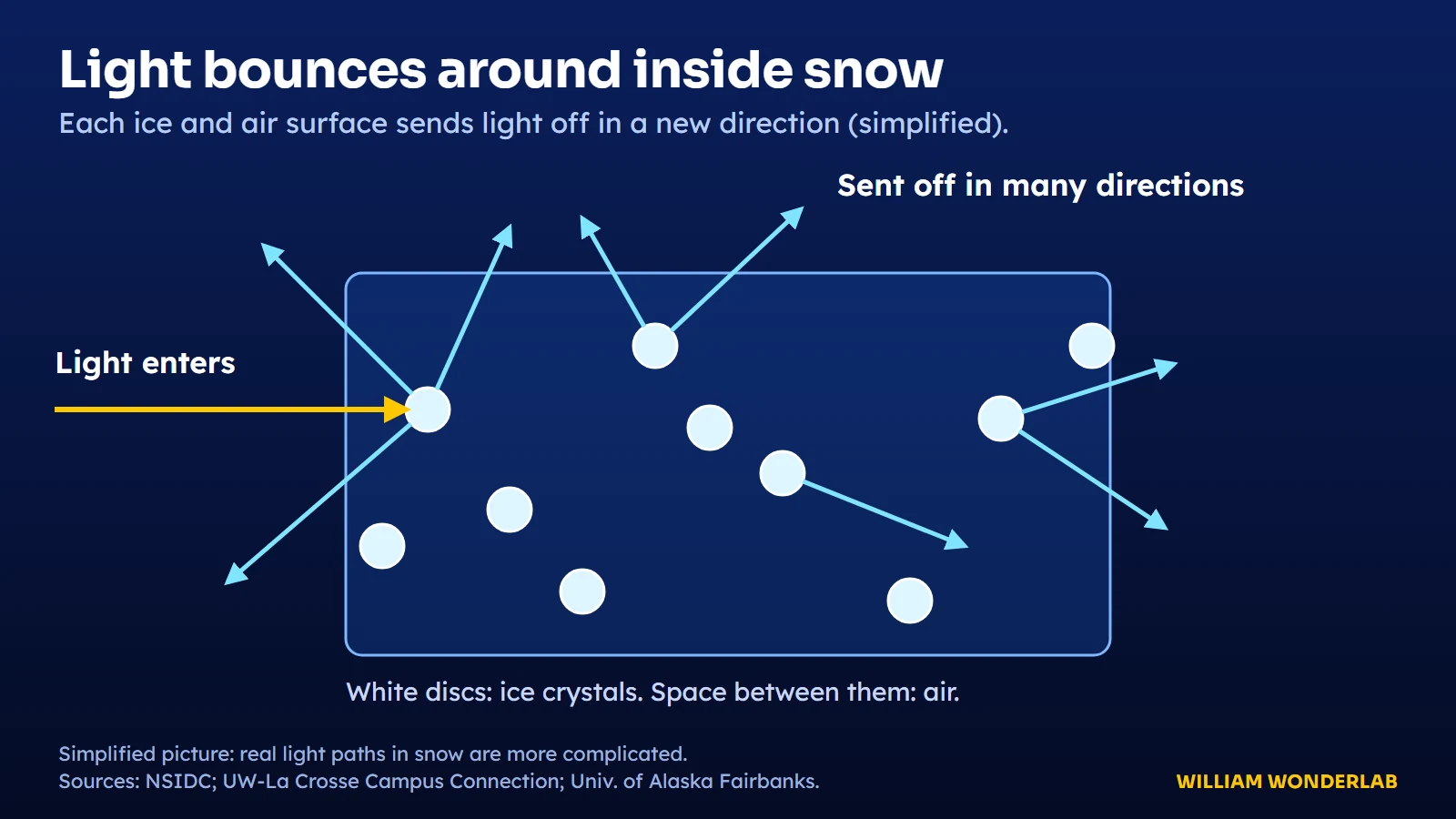
Why the colours mix to white
To scatter light means to send it off in many different directions. Popular Science, in its article on why snow is white, explains that each multi-sided ice crystal, or snowflake, scatters the colours a little like a tiny prism. It adds that all those colours shine equally in all directions, so the light leaves the snow from every side.[3]
The Alaska Science Forum, published by the University of Alaska Fairbanks, makes the same point about the size of ice grains: “because of the large size of snow grains and ice crystals, all wavelengths of visible light are scattered equally.”[4] A wavelength is the distance from one peak of a light wave to the next, and each colour has its own. Because all of them are scattered equally, no colour is left behind.
So snow is not white because it contains a white substance. The white comes from how light is scattered. When every colour returns in roughly the same mix, your eyes read the combined light as white.
Why a solid block of ice looks clear
Ice that has trapped air in it looks cloudy. Erland Schulson, an engineering professor at Dartmouth, puts it this way: “Cloudy ice is cloudy because of air, entrapped air”. He adds that “The air bubbles actually scatter light.”[5]
The Alaska Science Forum describes what happens inside the ice: “Light will travel only a short distance before it is scattered by the bubbles and reflected back out.”[4]
Put these ideas together. A clear block of ice has few trapped bubbles, so light can travel further through it before anything scatters it. A simplified picture is that light mostly passes straight through. A cloudy or crushed mass of ice has many more surfaces, so the light is scattered back out instead.
Did you know? Thick, pure ice can look blue. The Alaska Science Forum notes that “It takes an appreciable thickness of pure ice to absorb enough red light so that only the blue is transmitted.”[4]
Try it: clear ice or crushed ice?
This is a proposed at-home activity. Try this with an adult.
You need: one clear ice cube from a tray, a spoonful of crushed ice or fresh snow from the freezer, a dark plate, and a sealed freezer bag with a towel if you need to crush the ice.
- Predict which will look whiter: the solid cube or the crushed ice.
- With an adult, place the cube and the spoonful side by side on the dark plate. Look at both from above and from the side, near a bright window or lamp.
- Write down what you see and whether it matched your prediction.
What to expect: Compare your results with the ideas above. Many small pieces with gaps should look whiter than a single solid block.
Safety first: A grown-up should handle the freezer and make any crushed ice. If you crush ice, put it in a sealed freezer bag, wrap the bag in a towel, and tap it gently with a rolling pin. Do not use sharp tools. Keep the ice away from your mouth, and do not eat the ice used in this test. Wipe up any spills straight away so no one slips, and keep the plate away from the edge of the bench. Wash your hands after handling the ice.
Go deeper: scattering and the path of light
How the number of surfaces matters
Each time light reaches a boundary between ice and air, it can be sent off in a new direction.[2] The Alaska Science Forum describes the same effect in ice full of bubbles: light “will travel only a short distance before it is scattered by the bubbles and reflected back out.”[4] Snow has an even larger number of ice and air boundaries packed close together. Applying the same idea to snow is a simplified picture, not a measurement.
A solid block has far fewer boundaries. Light can travel much further before it changes direction, so the block looks clear.
Crushed ice
Crushed ice is many small pieces with gaps between them, much like snow. This is a simplified picture: the same idea of many surfaces scattering light applies.
Frequently asked questions
Why is snow white if it is made of clear ice?
Snow is made of ice crystals and air pockets. Light bounces off these many surfaces and comes back out. Snow does not absorb one colour more than another, so the mixture looks white.[2]
Does snow have a white colour of its own?
Not in the way paint does. The white comes from how light is scattered, and snow does not absorb one colour of light more than another.[2]
Why is a solid block of ice clear?
A solid block with few trapped air bubbles gives light few places to scatter, so light can pass through it. Ice that is cloudy has trapped air in it.[5]
Why does crushed ice also look white?
Crushed ice is many small pieces with air gaps between them. This is a simplified picture, but the same idea applies: many surfaces scatter light in different directions.
Why does a solid ice block look blue when it is very thick?
When light passes through thick, pure ice, the red light is absorbed while the blue is transmitted, which is why such ice can look blue.[4]
Is snow only white because of the ice?
No. The ice is clear, and the white comes from the crystals and air gaps scattering light in every direction.[3]
The big idea
Many surfaces scatter light, and the mixed colours look white. Snow is clear ice arranged with air gaps. Light bounces off its ice and air surfaces in every direction, and the colours come back together as white.
Related reading
More from William Wonderlab:
Explore more from scientists:
- Snow (National Snow and Ice Data Center, Learn)
- Why is snow white? (UW-La Crosse Campus Connection)
- Blue snow and ice (Alaska Science Forum, University of Alaska Fairbanks)
References
[1] National Snow and Ice Data Center (NSIDC), “Snow”, Learn: Parts of the Cryosphere (accessed 26 October 2026)
[2] University of Wisconsin-La Crosse, Campus Connection, “Why is snow white?” (accessed 26 October 2026)
[3] Popular Science, “Snow isn’t actually white” (quoting Mark Serreze, director of NSIDC) (accessed 26 October 2026)
[4] University of Alaska Fairbanks, Geophysical Institute, Alaska Science Forum, “Blue snow and ice” (Larry Gedney) (accessed 26 October 2026)
[5] Dartmouth College, “Ode to Ice” (Erland Schulson, Thayer School of Engineering) (accessed 26 October 2026)