How Does a Thermometer Work?
A thermometer measures temperature by using a material that changes in a predictable way as it warms or cools. Here is how the classic liquid thermometer does it.
How hot is it today? You might check a weather app, a car dashboard or a thermometer on the wall without thinking about how it knows. A thermometer turns temperature, which is how hot or cold something is, into a number you can read.
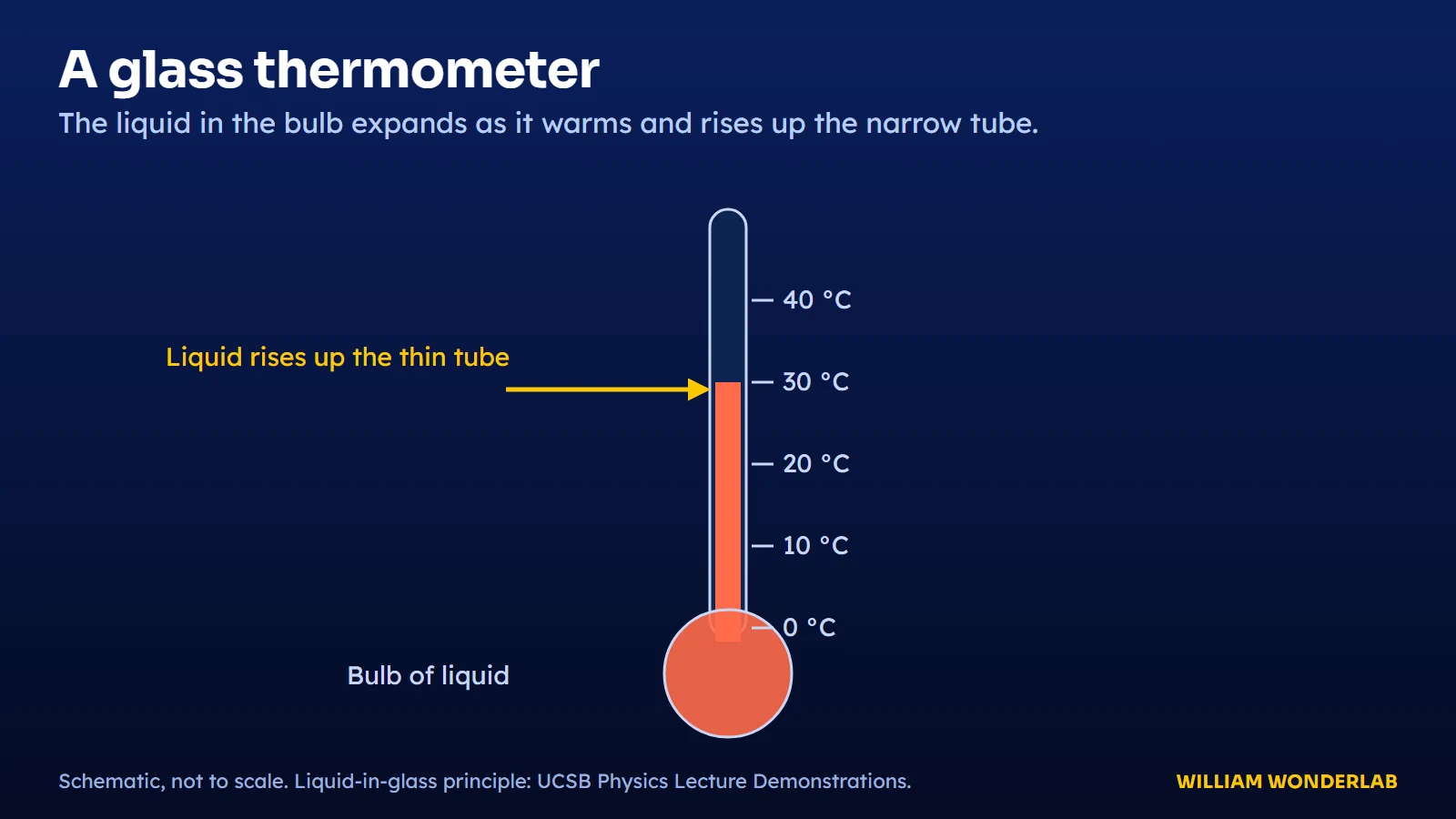
The short answer: Many thermometers work because a liquid takes up more space when it gets warmer. The liquid rises up a very narrow glass tube, and a scale beside the tube turns that height into a temperature.[1] Many weather stations now use electronic sensors instead, and the Bureau of Meteorology says these send their readings electronically.[2]
Liquids take up more room when they warm
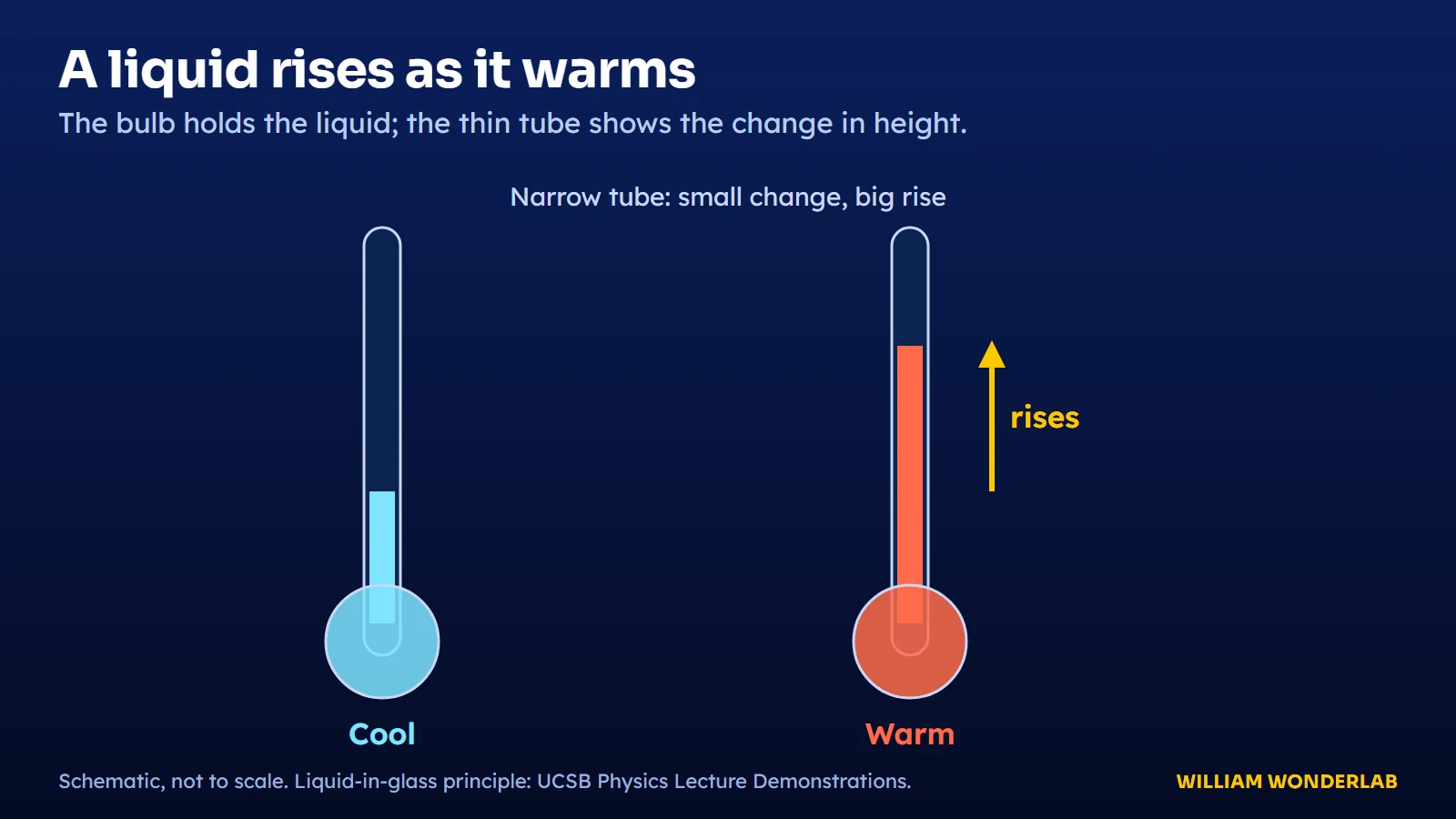
The key idea is called expansion. A liquid that is warmed spreads out and needs more room, and a liquid that is cooled shrinks. A physics lecture resource at the University of California, Santa Barbara puts it this way: “The expansion and contraction that liquids undergo as the temperature changes is the basis for liquid-in-glass thermometers.”[1]
The narrow tube makes small changes easy to see
A liquid-in-glass thermometer has a small bulb of liquid at the bottom, joined to a long, very thin tube. The UCSB resource describes it as “a small liquid-filled bulb at the bottom, fused to a capillary into which the liquid can expand.”[1] The thin tube is called a capillary.
Here is why the tube is so thin. Imagine pouring the same extra amount of liquid into a wide bowl and then into a drinking straw. In the bowl, the level barely moves. In the straw, the same extra amount makes the level climb a long way. The narrow tube turns a tiny change in volume into a clear change in height. As the UCSB resource says, “As the temperature changes, the height of the column of liquid in the capillary changes.”[1]
Reading the scale
The glass tube has a scale marked along it. When the liquid rises, the top of the column lines up with a higher number. Scales are marked by calibration: the thermometer is compared against known reference temperatures, so each height matches a temperature.
Why not use water? Water behaves in an unusual way near freezing. HyperPhysics at Georgia State University explains that “at about 4°C it reaches a maximum density and then decreases in density as it approaches the freezing point.”[3] Because of this, water does not expand in a simple, steady way across the whole temperature range, so it is a poor choice for a thermometer.
Why most thermometers use alcohol, not mercury
Early thermometers often used mercury, a metal that is liquid at room temperature. The UCSB resource explains that the liquid in most such thermometers is usually either mercury or some type of alcohol, “usually dyed red to make it easier to see.”[1] Today alcohol is more common, for a safety reason: “Because mercury presents a potential hazard if the thermometer breaks, alcohol thermometers have become far more common.”[1]
Old mercury thermometers should never be opened, broken or used for a project. If one breaks, keep people and pets away from the spill and ask your local council or a poisons information service how to dispose of it safely.
The alcohol used in a thermometer also expands more than the glass around it. The University of Kentucky’s physics notes describe it this way: “The red liquid (which is colored alcohol) expands much more than the glass tube that holds it.”[4]
Electronic thermometers and weather stations
Many weather stations no longer read a glass tube by eye. The Bureau of Meteorology explains that “these days we have automatic thermometers that send in the information electronically.”[2] That means a sensor measures the temperature, and the reading is sent to a computer or a screen, so people do not have to read a scale by hand.
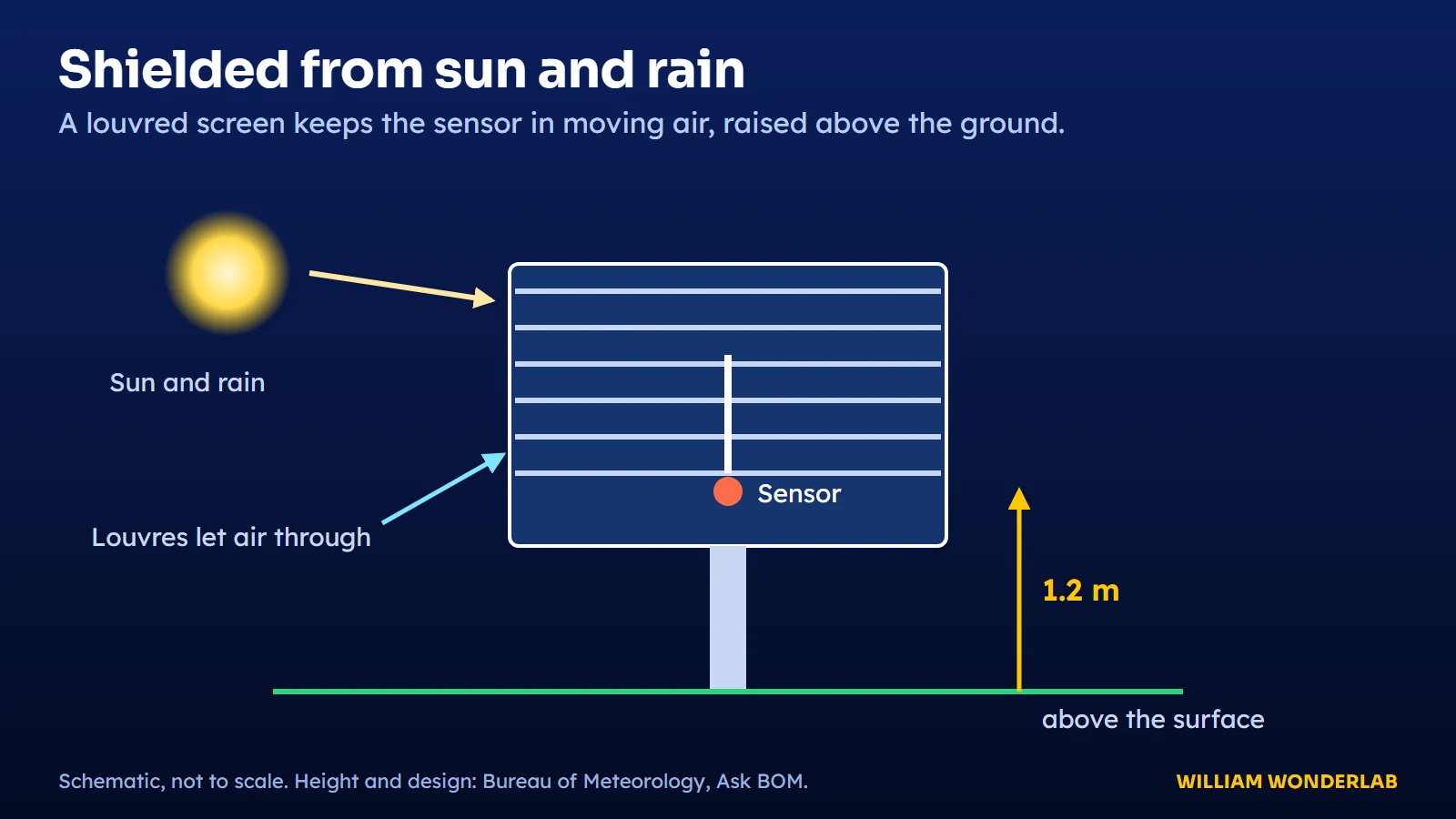
Did you know? Weather stations keep their thermometers inside a louvred box, called a Stevenson screen, so that sun and rain do not reach the sensor directly.[2]
Why the thermometer sits in a box
A sensor exposed to rain and direct sunlight would not measure the air alone. The Bureau of Meteorology explains that “A Stevenson screen is basically a box with louvres that allow air to circulate around the thermometer inside, while protecting it from outside elements like rain and direct sunlight.”[2]
The Bureau also says the screen is raised so that “the thermometer is 1.2 m above the surface.”[2] The louvres let air move past the thermometer while keeping the sun and rain off it.
Try it: a bottle thermometer
This is a proposed at-home activity, not a real laboratory experiment. It shows the expansion idea with simple materials. It is not a calibrated instrument, so do not use it to measure anything important.
You need: a small clean plastic bottle, a drinking straw, modelling clay, a few drops of food colouring, a marker or a strip of tape, a bowl of cool tap water and a second bowl of warm tap water.
- Fill the bottle to the top with water and add a few drops of food colouring.
- Push the straw into the bottle’s opening so that some coloured water rises into the straw. Seal around the straw with modelling clay so no air can get in or out.
- Stand the bottle in the bowl of cool tap water. Wait a few minutes, then mark the level in the straw with a strip of tape.
- Move the bottle to the bowl of warm tap water. An adult should check that the water feels comfortably warm, not hot. Wait a few minutes and mark the new level.
- Compare the two marks. Predict first: do you expect the level to rise or fall in the warm water?
What to expect: the coloured water should move up the straw in the warmer bowl. The plastic bottle can also flex a little, so the result is only a rough demonstration.
Safety first: Use tap water only. Never use boiling or very hot water, and never use a microwave to warm the water. An adult should check the water temperature and handle the bowls. Keep food colouring away from eyes and clothing, and wipe up spills straight away. Do not put the straw or the bottle in your mouth. Do this activity with an adult.
Go deeper: why the expansion is not always simple
The special case of water
Water is useful in daily life, but it is a poor choice for a thermometer. Its density peaks at about 4 °C, and below that temperature it becomes less dense again as it approaches freezing.[3] Because its expansion does not follow one steady pattern across that range, it cannot give an even scale.
Frequently asked questions
Why does the liquid go up the tube when it gets warm?
The liquid expands as it warms, so it needs more space. The narrow tube means that the extra volume shows up as a clear rise in the column.[1]
Are mercury thermometers still used?
Alcohol thermometers have become far more common than mercury ones because mercury is a hazard if a thermometer breaks.[1] Old mercury thermometers should be handled through your local council rather than opened at home.
Do all thermometers use liquid?
No. Many weather stations use electronic thermometers that send their readings electronically.[2]
Why should a thermometer be kept out of direct sun?
Sunlight can warm the sensor more than the surrounding air. The Bureau of Meteorology’s screen protects the thermometer from direct sunlight and rain, so the reading reflects the air.[2]
Can I trust a homemade thermometer?
Not for anything important. A bottle thermometer shows the idea of expansion, but it is not calibrated against a reference and the plastic can flex.
The big idea
Materials that change predictably with temperature can measure it. In a classic thermometer, a liquid grows as it warms and rises up a narrow tube. Electronic thermometers use other changes in the same spirit, and both need a scale or a calibration so the number means something.
Related reading
More from William Wonderlab:
Explore more from scientists:
- Liquid thermometers (University of California, Santa Barbara, Physics Lecture Demonstrations)
- Ask BOM: How is temperature measured? (Bureau of Meteorology)
References
[1] University of California, Santa Barbara, Physics Lecture Demonstrations, “48.03 Liquid thermometers” (accessed 25 October 2026)
[2] Bureau of Meteorology (Australia), “Ask BOM: How is temperature measured?” (accessed 25 October 2026)
[3] HyperPhysics, Georgia State University, “The Expansion of Water Upon Freezing” (accessed 25 October 2026)
[4] University of Kentucky, Department of Physics and Astronomy, “Thermal expansion” (Straley notes) (accessed 25 October 2026)