Why Do Clothes Fade in the Sun?
Sunlight carries energy that can change the dye molecules in fabric. Once they change, they absorb and reflect light differently, so the colour looks paler.
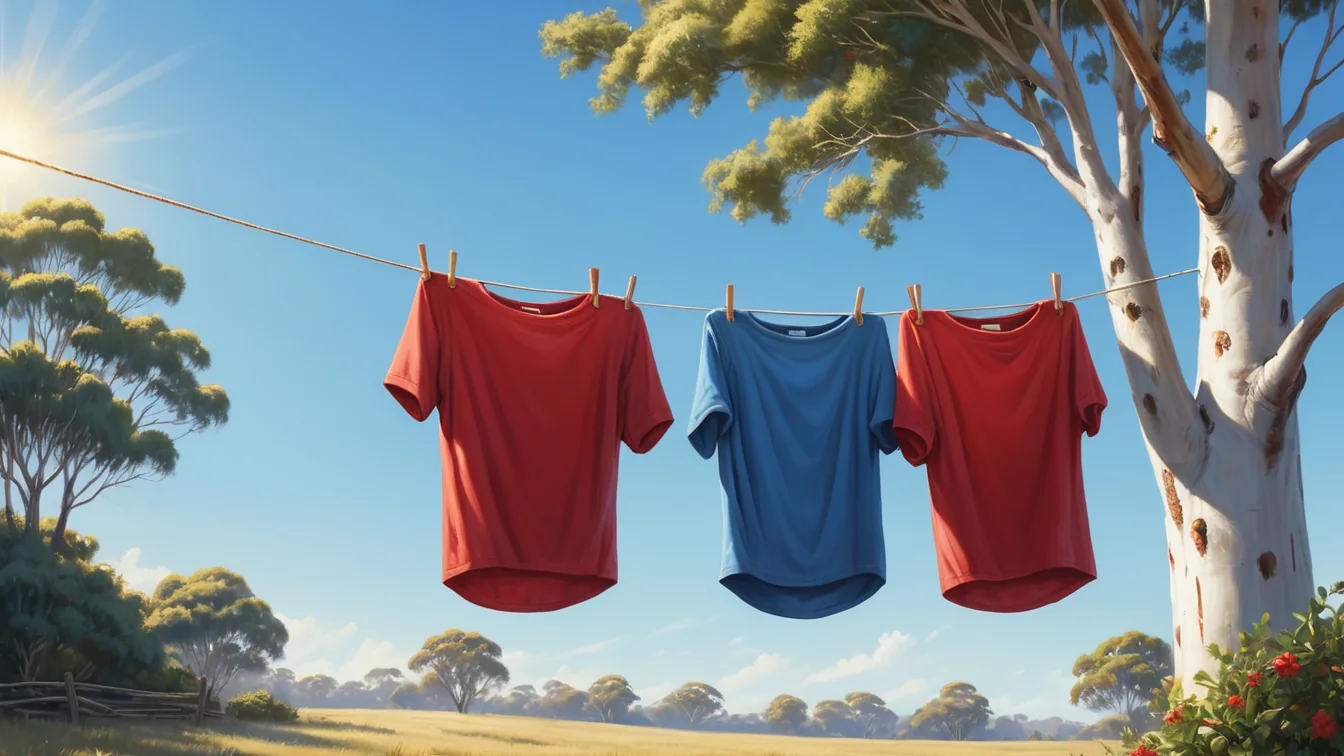
Hang a bright red shirt on the line for a summer and it may come down looking a little pinker and paler. Leave a curtain in a sunny window for years and its colour can change. Why does sunlight, which looks harmless, slowly take the colour out of clothes?
The short answer: Sunlight carries energy in its ultraviolet and visible light. Dye molecules in fabric can absorb some of that energy, and it can change their chemical structure. Once a dye molecule has changed, it absorbs and reflects light differently, so the colour looks weaker or shifts. A 2026 study of cotton fibres says that ultraviolet radiation, “particularly in the UV-A and UV-B ranges, has been identified as the most damaging to fibre structure and colour stability.”[1][2]
Light carries energy
Sunlight is a mix of wavelengths. Some of them, the ones we can see, make up the rainbow. Others, the ultraviolet (UV) rays, are invisible to us but still carry energy. A 2026 study of dyed cotton fibres says that “Solar radiation is known to initiate oxidative and photo-induced reactions in dyed fibres.”[1]
Think of light as a set of small packets of energy. When a packet is absorbed by a molecule, the molecule can use that energy to react in a new way. Most of the time, that reaction is harmless to the fabric. Sometimes it changes the dye.
Why a dye looks like a colour
A dye looks red, blue or green because of the light it absorbs and the light it sends back to your eyes. The 2026 study makes this point: “only absorption within the visible range directly determines the perceived colour.”[1] In simple terms, a red dye absorbs most of the other colours and reflects mostly red.
This is why fading is more than a loss of brightness. If the dye molecule changes shape, it may absorb different wavelengths. Then the light that reaches your eye is different, and the colour shifts as well as weakening.
What light does to the dye
When a dye molecule takes in light energy, it can break apart. A 2022 museum study of a historic curtain describes the process: “the color could change greatly, resulting from the chemical processes that occur on its exposure to light.”[3] Researchers in heritage science call light one of the most damaging agents for historic textiles: “the influence of light is one of the most detrimental degradation agents.”[3]
Another route involves oxygen. A 2018 lab study of a cyanine dye used in light-based cancer therapy, not a textile, found that “Interaction of singlet oxygen with the chromophores constitutes the major pathway of photodecomposition.”[4] A chromophore is the part of a dye molecule that absorbs light and gives the colour. In that study, a light-sensitive molecule called a photosensitiser produced singlet oxygen, which attacked the dye’s chain of linked atoms.
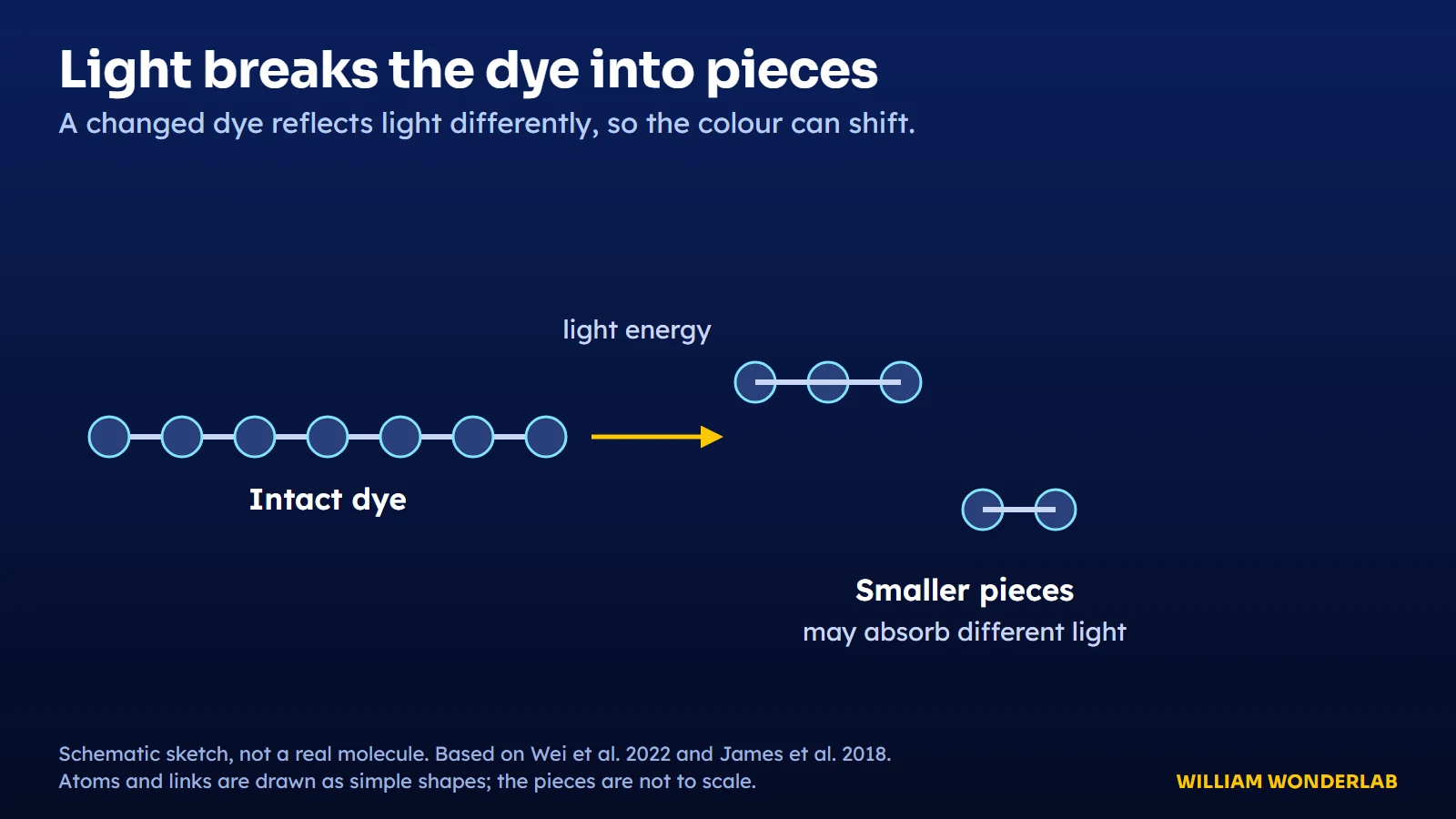
The picture above is a simplified sketch. It is not a real molecule. It shows the idea that light can break a dye into smaller pieces.
Why some colours last longer
Not all dyes fade at the same rate. A 2023 review of natural textile dyes lists several factors: “Textile color can be affected by various factors such as lighting, washing, rubbing and perspiration.”[5] The review also explains that lightfastness, or how well a colour resists light, is scored on the blue scale, “rated between 1 and 8.”[5] A higher number means the colour is more resistant to light.
So the same sunlight can affect one colour much more than another, because dyes differ in how well they resist light.
Why the fading is uneven
On a shirt hung on a line, one side can receive more direct light than the other. Light drives the change, so the side that gets more light has more chances for the dye to change. This is a simplified picture, not a measured result.
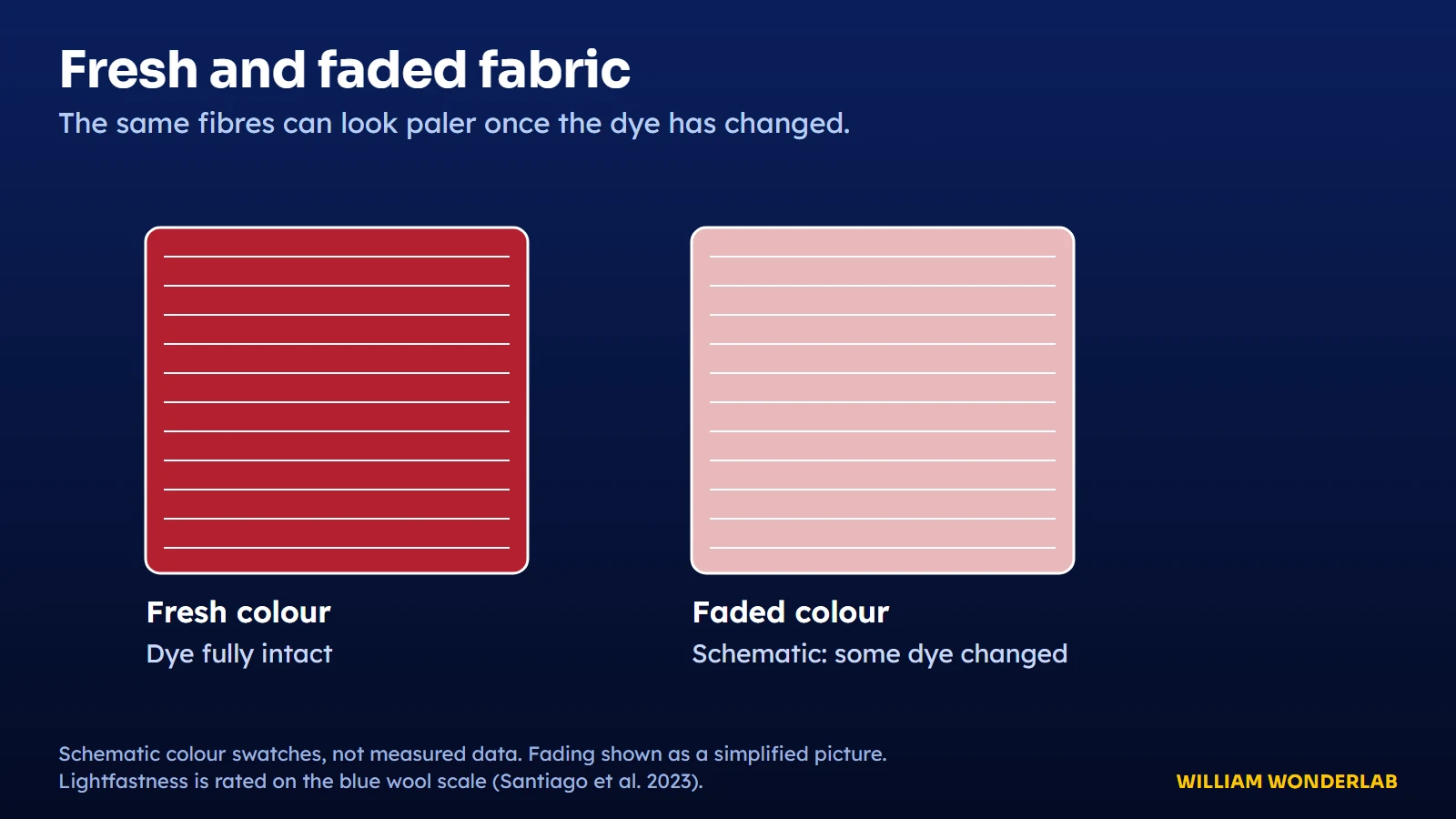
A museum study of a historic curtain found that its colour changed through chemical processes that occur on exposure to light.[3]
Try it: the sun test
This is a proposed at-home activity. Predict first: will the part of a coloured cotton scrap that is in the sun look different from the part that is covered after a week or two?
You need: a few scraps of plain coloured cotton, such as an old T-shirt cut into squares about 5 cm across, a piece of cardboard or foil, tape, a sunny spot outdoors and a notebook.
- Predict what will happen to the coloured scrap in the sun.
- Cut the scrap into squares. Keep one square as a control, stored indoors and away from light.
- Tape the cardboard over half of another square, so that half stays in shade and half is in the sun.
- Place the taped square in a sunny spot outside, and leave it there for one to two weeks. Bring it in at night.
- Compare the sunny half with the shaded half and with the control. Describe any difference in your notebook.
Safety first: An adult should choose the sunny spot and handle the scissors, tape and cardboard. Keep the test out of reach of pets and small children, and do not leave it on a hot surface, such as a car dashboard or a metal railing. Use sun protection when you are outside for long periods. Do not add any chemicals or dyes to the scraps.
Go deeper: colour and the molecule
Measuring the change
Scientists can track fading without relying only on sight. A 2024 study of fabric dyes exposed to sunlight found a steady decrease in the intensity of the dyes’ vibrational bands as light exposure increased, and that “As dyes fade, their chemical structure and consequently color changes.”[2] The change is a chemical one, not just a loss of strength in the colour.
A caution about the picture
Fading depends on many things, including the dye, the fibre and the light. The 2026 cotton study held temperature and humidity fixed in its chamber tests (35.5 °C and 70% relative humidity), so it cannot show how much heat or humidity adds to the effect of light.[1] Results from one dye or one test should not be treated as a rule for every fabric.
Frequently asked questions
Why do clothes fade in the sun?
Sunlight carries energy that can change dye molecules in fabric. Once a molecule changes, it absorbs and reflects light differently, so the colour looks weaker or shifts.[1][3]
Is it the heat that fades clothes?
Light is the agent linked to fading in these studies. Heat was held at a fixed level in the chamber tests, so how much heat alone adds to fading is not shown.[1]
Why do some colours last longer?
Lightfastness varies from one dye to another. A 2023 review of six natural dyes describes the blue scale as rating lightfastness from 1 (very poor) to 8 (excellent).[5]
Why does one side of a shirt fade more?
The side that gets more light has more chances for the dye to change, because light drives the change. This is a simplified picture, not a measured result.
Can you see a dye molecule change?
Not directly. Scientists use instruments, such as Raman spectroscopy, to measure how a dye’s molecular vibrations change as it fades.[2]
The big idea
Light changes the dye. Sunlight carries energy that can break down dye molecules in fabric. A changed molecule absorbs and reflects light differently, so the colour looks paler or shifts over time.
Related reading
More from William Wonderlab:
Explore more from scientists:
- Microscopic and Microspectrophotometric Evaluation of Colour Changes in Cotton Fibres Exposed to Natural and Artificial Solar Radiation (Polymers, 2026)
- Elucidation of the Effect of Solar Light on the Near-Infrared Excitation Raman Spectroscopy-Based Analysis of Fabric Dyes (Molecules, 2024)
References
[1] Wąs-Gubała, J., Sarnowska, W. and Feigel, B., “Microscopic and Microspectrophotometric Evaluation of Colour Changes in Cotton Fibres Exposed to Natural and Artificial Solar Radiation: Forensic Implications”, Polymers 18(10), 1178 (2026) (accessed 26 October 2026)
[2] Bober, S. and Kurouski, D., “Elucidation of the Effect of Solar Light on the Near-Infrared Excitation Raman Spectroscopy-Based Analysis of Fabric Dyes”, Molecules 29(21), 5177 (2024) (accessed 26 October 2026)
[3] Wei, L., Gu, A., Guo, Z., Ding, J., Jin, G. and Lei, Y., “An Integrated Study on the Fading Mechanism of Malachite Green Industrial Dye for the Marquisette Curtain in the Studio of Cleansing Fragrance, the Palace Museum (Beijing)”, Molecules (2022) (accessed 26 October 2026)
[4] James, N. S., Cheruku, R. R., Missert, J. R., Sunar, U. and Pandey, R. K., “Measurement of Cyanine Dye Photobleaching in Photosensitizer Cyanine Dye Conjugates Could Help in Optimizing Light Dosimetry for Improved Photodynamic Therapy of Cancer”, Molecules 23(8), 1842 (2018) (accessed 26 October 2026)
[5] Santiago, D., Cunha, J. and Cabral, I., “Chromatic and medicinal properties of six natural textile dyes: A review of eucalyptus, weld, madder, annatto, indigo and woad”, Heliyon (2023) (accessed 26 October 2026)