Can You See Electricity?
You cannot see electricity flowing, but you can see its effects: light from a lamp, the glow of a spark and the flash of lightning. Here is what is really happening.

Flip a switch and a lamp glows. Watch a storm and a bright crack of lightning splits the sky. People often say “I can see the electricity,” but is that true? The honest answer is that you can see the light and heat that electricity makes, but not the flow of electricity itself.
The short answer: You cannot see electricity moving through a wire. You see its effects. Electrons in a wire drift very slowly, but the signal that starts the flow travels at close to the speed of light. Visible sparks and lightning are the air itself glowing, which shows where the electricity is passing.[1][2]
What electricity is made of
Electricity in a wire is a flow of charge carried by electrons. Electrons are tiny particles that are present in the metal already. In a copper wire the free electrons are packed very densely: the Oxford physics notes give a number density of about 8.5 × 10²⁸ electrons per cubic metre.[3]
The electrons do not rush off in a straight line. Their average movement is called the drift velocity. Oxford puts it plainly: “Drift velocities in a conducting wire are typically very slow.”[3] HyperPhysics agrees that “the actual drift velocity of electrons through copper wires is very slow.”[1]
The signal is the fast part
If the electrons move so slowly, why does a lamp light up almost at once? HyperPhysics explains that “it is the change or ‘signal’ which propagates along wires at essentially the speed of light.”[1] The signal is the change that tells the electrons in the wire to start moving together. Every electron in the circuit responds almost at once, even though each one shifts only a tiny distance.[1]
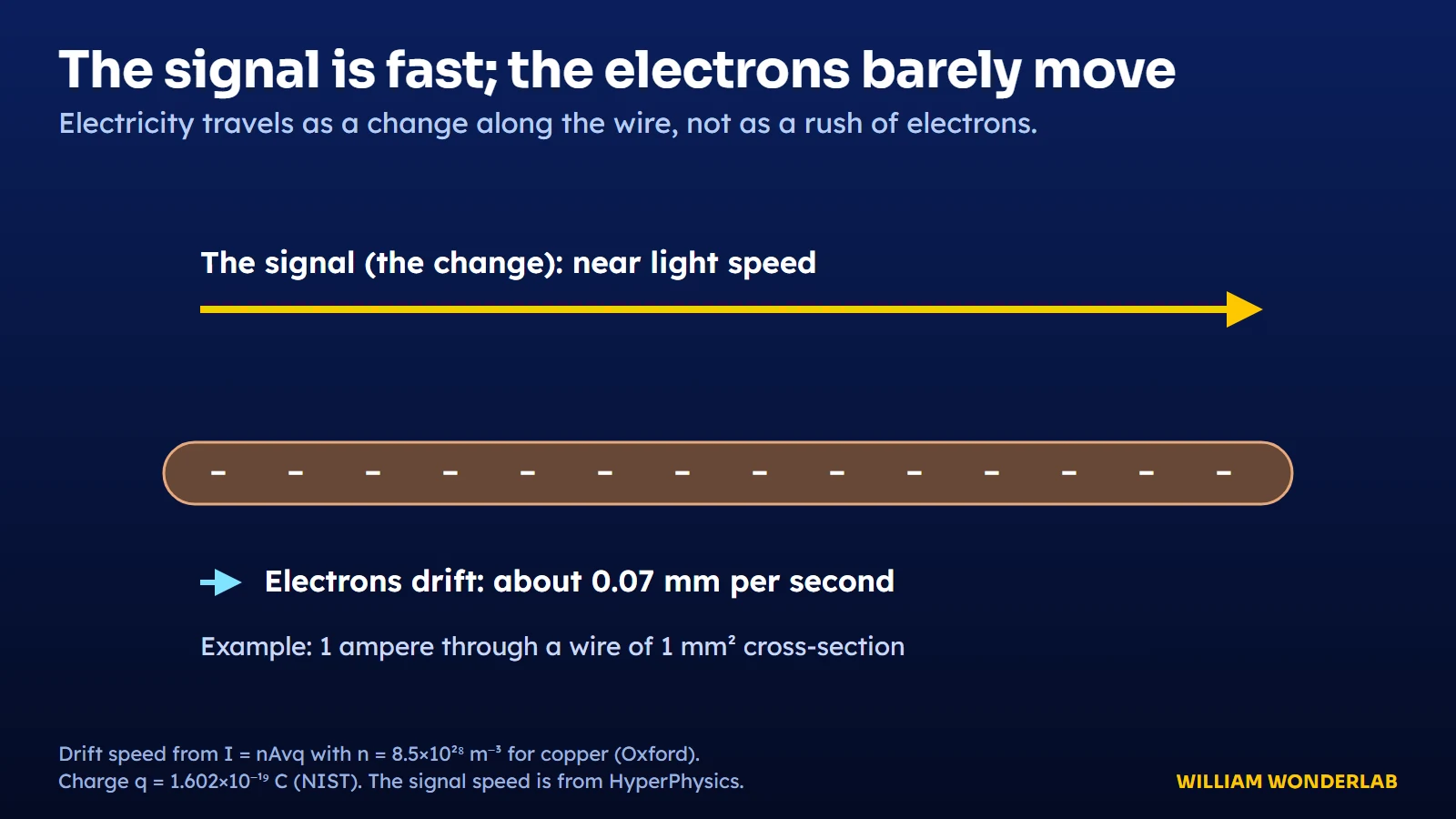
The diagram shows the two speeds. The signal is a long, fast arrow. The electrons are a short, slow drift.
How slow is the drift?
Oxford gives the link between current and drift: “the rate of flow of charge carriers is nAv, and the current is nAvq.”[3] Here I is the current in amperes, n is the number of electrons per cubic metre, A is the wire’s cross-section, v is the drift speed and q is the charge of one electron.
For one ampere through a copper wire with a cross-section of 1 mm²:
- n = 8.5 × 10²⁸ electrons per m³, and A = 1 mm² = 1 × 10⁻⁶ m²
- q = 1.602 × 10⁻¹⁹ C per electron, the elementary charge from the NIST value[4]
- v = I ÷ (n × A × q) = 1 ÷ (8.5 × 10²⁸ × 1 × 10⁻⁶ × 1.602 × 10⁻¹⁹)
- v ≈ 7.3 × 10⁻⁵ m/s, which is about 0.07 mm per second
The signal, however, travels at a large fraction of the speed of light. The electrons are not carrying the message quickly; they are just being pushed along everywhere at once.
What you can see: light and heat
A lamp does not show the electrons. It shows light from a glowing filament, or from a screen, which is produced by energy moving through the device. You are seeing the result of the electricity, not the moving charges.
Sparks are different. Georgia Tech’s physics text explains that “a strong electric field ionizes molecules of a normally neutral substance such as air.”[2] Once the air’s molecules are ionised, a path of glowing gas forms, and that glow is what you see. It is the air that lights up, not the wire.
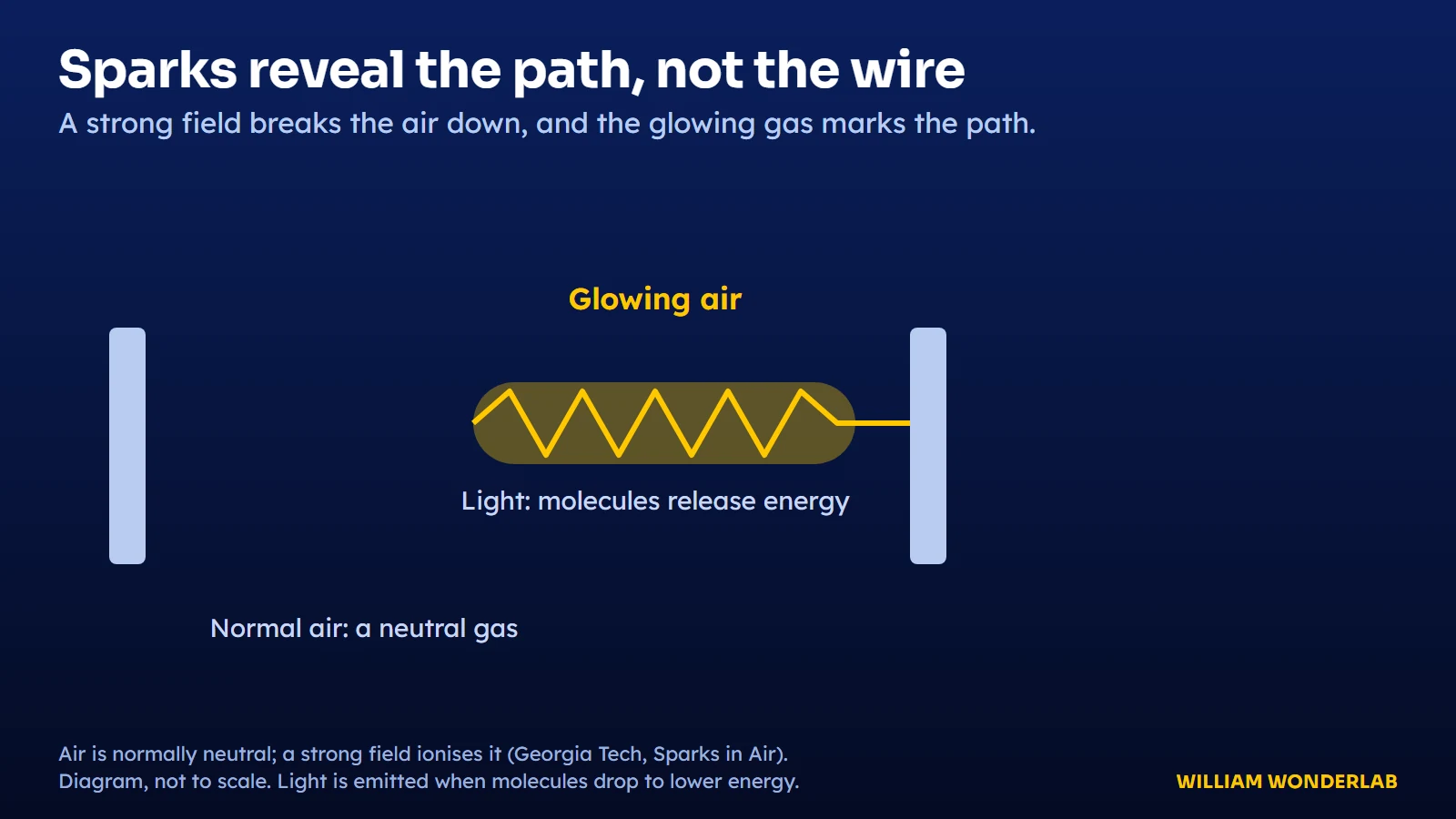
The text also explains where the light comes from: “Sparks produce light because when molecules recombine, they move to a lower energy state and emit the difference in energy as a photon.”[2] A photon is a tiny packet of light.
Did you know? Lightning is a much bigger spark. NOAA describes it as “a giant spark of electricity in the atmosphere between clouds, the air, or the ground.”[5] So the flash you see during a storm is the air glowing along a huge path.
Why people say “you can see electricity”
People are not wrong to say it. Electricity makes many things visible: a glowing bulb, a lightning bolt, the screen of a phone. In each case, you see the light or heat electricity creates, not the charge moving through the wire.
The same thing happens with water. You can see a river’s surface and its waves, but not every molecule travelling downstream. What you see is the effect of the water moving, not each particle. The comparison is a teaching analogy, not a measurement, but it helps to picture the difference.
Try it: spot the signs of electricity
This is a proposed at-home observation. It is not something that was done for this article. It involves looking only, not touching anything electrical.
You need: a room with a lamp, a window, and a phone or screen.
- Predict which things in the room are showing you electricity, and which are only showing you light from the sun.
- Turn a lamp on and off. Notice the light, and the warmth the bulb gives off after a few minutes.
- Look at a screen. Can you see the electricity or only the picture?
- Write down two things you can see that are caused by electricity, and one thing you cannot see.
What to expect: you will see light and heat from devices, not the moving charges.
Safety first: Never touch wires, sockets or plugs, and never open an appliance to look inside. Do not try to make sparks at home. Keep away from exposed cords. If you ever see a spark or smell burning from a power point, tell an adult and call an electrician. Lightning is dangerous, so stay indoors during a storm.
Go deeper: current, charge and the speed of the signal
Two speeds that do not conflict
A current of one ampere means one coulomb of charge passes a point every second. The electrons drift slowly because copper has so many free electrons. A small drift speed is enough to carry a large current. The signal, by contrast, is the electric field changing across the wire.[1][3]
Why the sum works
Using the Oxford relation I = nAvq, the drift speed is v = I ÷ (nAq).[3] Each value in the sum has a source: the density from Oxford, the elementary charge from NIST, and the one ampere and one square millimetre are the example values chosen for this calculation. Change any of them and the speed changes too. A thicker wire has a larger A, so the same current needs a slower drift.
Frequently asked questions
Can you see electric current?
No. Current is the flow of charge, which you cannot see directly. You can see light or sparks that electricity produces.[2]
Why does a lamp light almost instantly if electrons are slow?
Because the signal, which is the electric change, travels at essentially the speed of light along the wire. Every electron starts moving almost at once.[1]
Is a spark electricity?
A spark is electricity moving through air. The air breaks down and glows as its molecules release energy as light.[2]
Why is lightning visible?
Lightning is a very large spark, and what you see is the glowing air along its path.[5]
How fast do electrons move in a wire?
For one ampere in a copper wire of 1 mm², the drift speed is about 0.07 mm per second.[3][4]
The big idea
Electricity is seen by its effects. The electrons in a wire move very slowly. The signal that starts them moving travels almost at light speed. What glows is the light and heat made by devices, or the air itself when a spark or lightning passes.
Related reading
More from William Wonderlab:
Explore more from scientists:
- Microscopic View of Electric Current (HyperPhysics, Georgia State University)
- Sparks in Air (Georgia Tech Physics Book)
- Lightning (NOAA National Severe Storms Laboratory)
References
[1] HyperPhysics, Georgia State University, “Microscopic View of Electric Current” (accessed 25 October 2026)
[2] Georgia Institute of Technology, Physics Book, “Sparks in Air” (accessed 25 October 2026)
[3] University of Oxford, Department of Chemistry, “Electric current” (Physics for Chemists) (accessed 25 October 2026)
[4] NIST, CODATA value of the elementary charge e (accessed 25 October 2026)
[5] NOAA National Severe Storms Laboratory, “Lightning” (SVRWX101 education pages) (accessed 25 October 2026)