Why Does Lightning Come Before Thunder?
Light reaches your eyes almost at once, while sound takes time to travel. Count the seconds between flash and thunder to estimate distance, and go indoors when you hear thunder.

A storm lights up the sky, and a few seconds later the thunder rolls in. The flash and the bang come from the same lightning strike, so why do they arrive at different times? The answer is that light and sound travel at very different speeds.
The short answer: Light travels about a million times faster than sound. You see the flash almost as soon as it happens, but sound takes roughly 3 seconds to cover each kilometre in air.[1][2] So the gap between flash and thunder tells you how far away the strike was. If you can hear thunder, you are close enough to be struck, so go indoors.[3]
Light and sound travel at very different speeds
Lightning is “an electrical discharge that occurs within a cloud, between clouds, from clouds to the ground,” according to the Bureau of Meteorology.[4]
NOAA’s education team describes the speed gap simply: light “travels through the air roughly a million times faster than sound does.”[1] Sound travels about one third of a kilometre every second.[1]
Why the thunder arrives late
The thunder is not a separate event. The Bureau explains that lightning “heats the air around it to a temperature of approximately 30 000 °C.” This rapid heating makes the air expand extremely quickly in “a shock wave that we hear as thunder.”[4]
Because the flash reaches you almost at once, the delay you notice is the time the sound takes to travel through the air to your ears.
Count the seconds
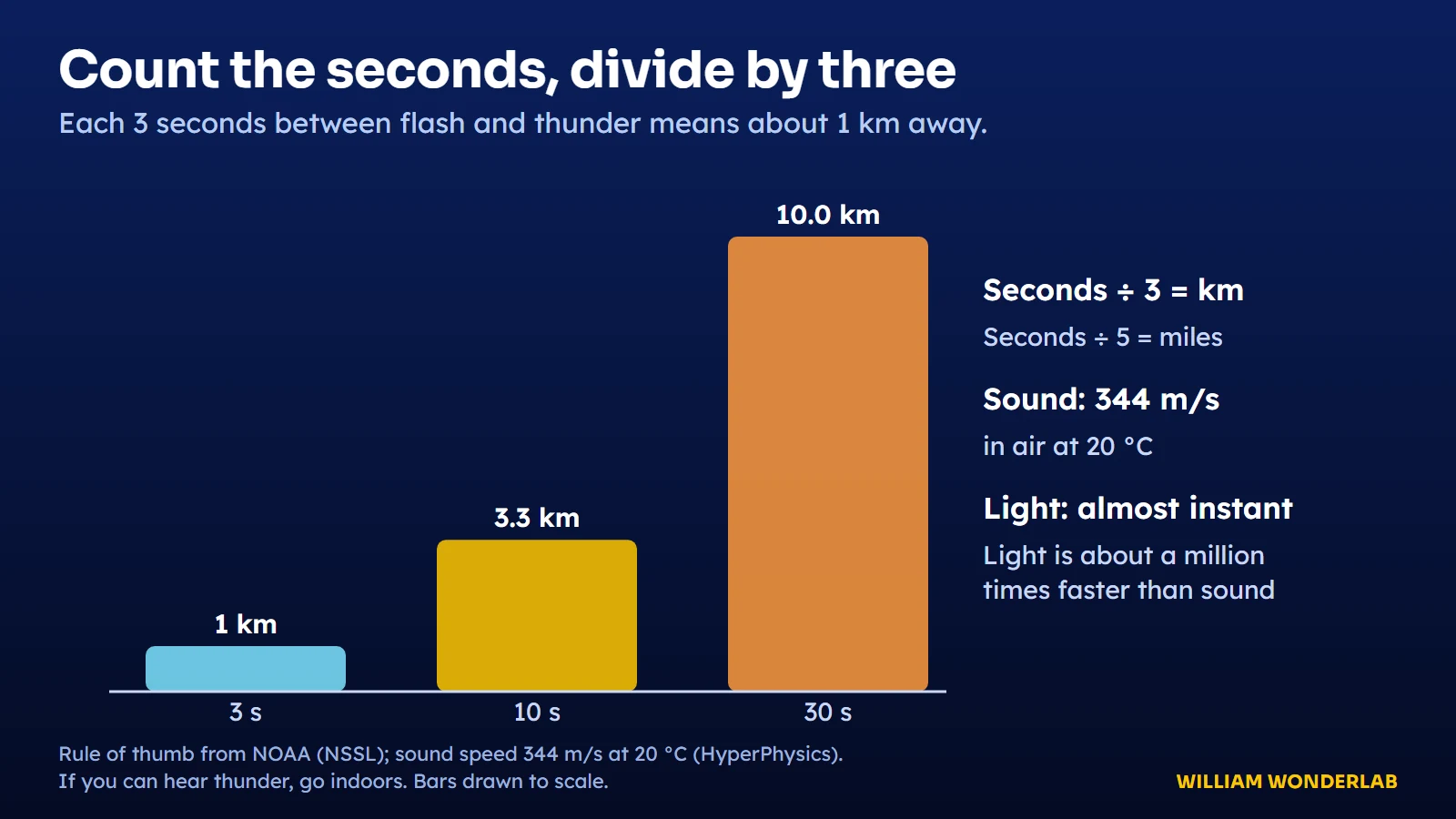
NOAA’s method is to “count the number of seconds from the time you see a flash until you hear thunder.”[1] Then divide:
- Seconds ÷ 3 gives the distance in kilometres.
- Seconds ÷ 5 gives the distance in miles.[1]
So a 10-second gap places the strike about 3.3 km away (10 ÷ 3 ≈ 3.3). A 30-second gap places it about 10 km away.
Why the count is only an estimate
The shortcut uses rounded numbers. At 20 °C, the speed of sound in air is 344 m/s.[2] That works out to about 2.9 seconds per kilometre, or about 4.7 seconds per mile. The NOAA rule of 5 seconds per mile is therefore a convenient rounding rather than an exact value.[2][1]
Thunder can be heard from a long way off
NOAA says that “Thunder can be heard up to 25 miles away from the lightning discharge.”[1] At 344 m/s, sound needs about 117 seconds, or nearly two minutes, to cover 25 miles (about 40 km).
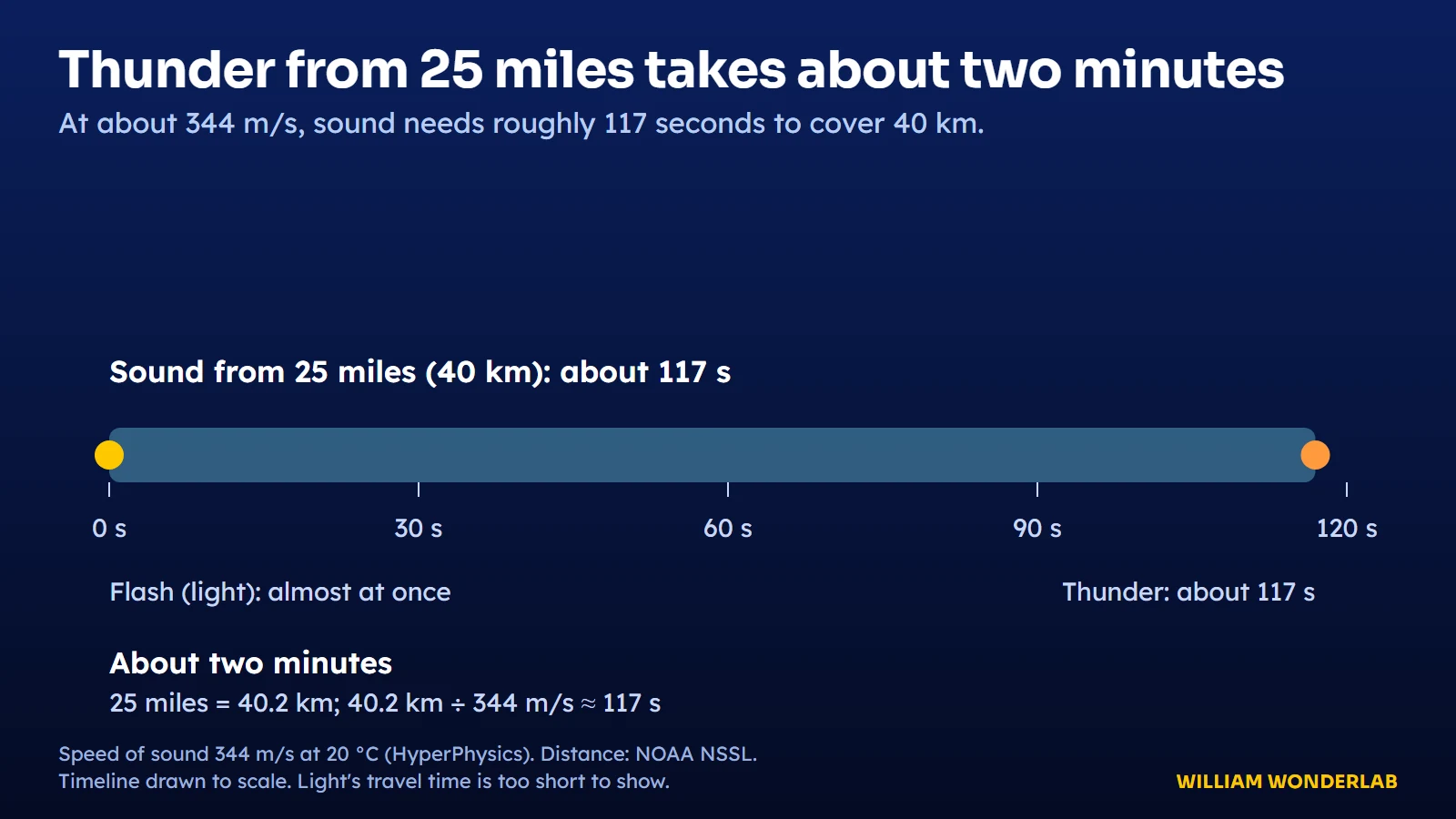
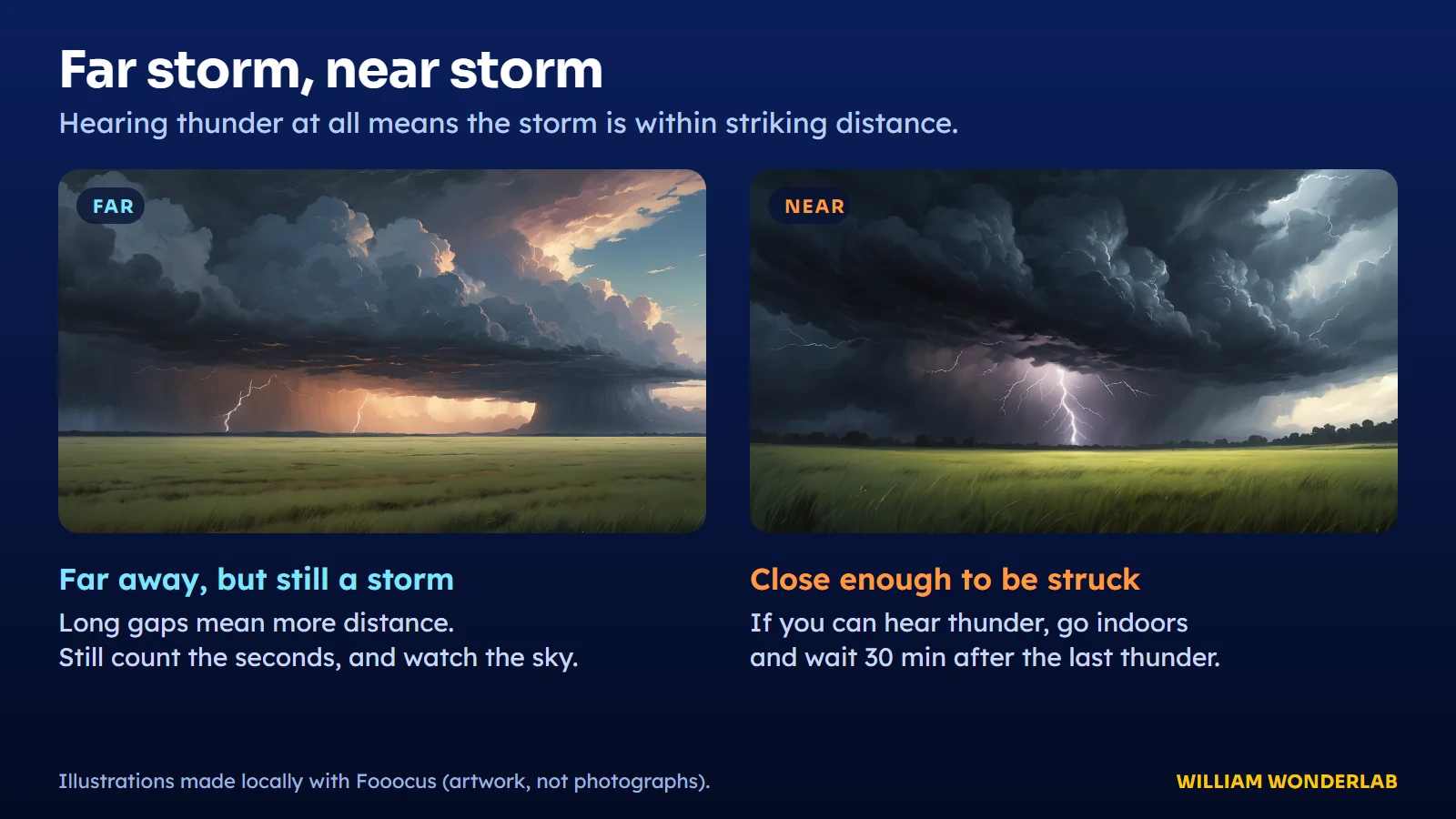
Thunder you can hear from far away is still a warning. As the NWS puts it, hearing thunder means the storm is within striking distance.[3]
If you hear thunder, go indoors
The National Weather Service gives a clear rule: “When Thunder Roars, Go Indoors.” It also says, “If you hear thunder, you are likely within striking distance of the storm.”[3]
The Bureau of Meteorology advises that you “stay inside and shelter well clear of windows, doors and skylights,” and “don’t use a landline telephone during a thunderstorm.” It also suggests you “avoid touching brick or concrete, or standing barefoot on concrete or tiled floors.”[4]
Waiting matters too. The NWS advises that you “wait 30 minutes after the last lightning or thunder before going back outside.”[5]
Did you know? Lightning heats the air around it to about 30 000 °C.[4] That heating is what makes the shock wave you hear as thunder.
Try it: time the sound of a clap
You need: a stopwatch or phone timer, a clear flat space such as a school oval, a helper, and a tape measure or a pacing count you trust.
- Measure out 300 m. A standard sports oval is a good place to do this, with the helper standing at the far end.
- The helper claps their hands once, loudly. You start the timer when you see the hands meet, and stop it when you hear the clap.
- Repeat the test three times and record each time.
- Average your results and compare with the prediction: 300 m ÷ 344 m/s ≈ 0.87 seconds.
What to expect: the timed gap should be roughly 0.9 seconds. Reaction time adds some error, so the average of several tries is more useful than one result.
Safety first: Only do this in calm, dry weather with no storm forecast. If you see lightning or hear thunder at any point, stop straight away and go indoors, and wait 30 minutes after the last thunder before going back out. Choose an open space away from trees, fences, poles, overhead wires and roads. Clap only with your hands, and keep an adult involved in the activity.
Go deeper: the numbers behind the gap
Working out the distance
If the gap is 9 seconds, then 9 ÷ 3 = 3 km. If the gap is 15 seconds, then 15 ÷ 3 = 5 km. Each answer is an estimate, because the shortcut rounds the speed of sound.[1][2]
The 344 m/s value is for 20 °C. NASA’s sound lesson says that “the speed of sound depends on the state of the gas–more specifically, the square root of the temperature of the gas.”[6] Its formula uses absolute temperature, so sound travels faster in warmer air and slower in cooler air.[6]
Why the 30-minute wait
The NWS asks people to wait 30 minutes after the last lightning or thunder before going back outside.[5] It is a safety margin set by the agency, not a calculation from the physics in this article.
Frequently asked questions
Why do you see lightning before you hear thunder?
Light travels roughly a million times faster than sound, so the flash reaches you almost at once. Sound takes roughly 3 seconds to travel each kilometre.[1][2]
How far away was the strike if the gap is 9 seconds?
About 3 km, using the NOAA rule of seconds divided by 3.[1]
Can thunder be heard from far away?
Yes. NOAA says thunder can be heard up to 25 miles from the lightning discharge.[1]
Does hearing thunder mean I am in danger?
Yes. If you hear thunder, you are likely within striking distance of the storm, so go indoors.[3]
When can I go back outside?
Wait 30 minutes after the last lightning or thunder, according to the NWS.[5]
What is thunder?
Thunder is the sound of air that lightning has heated and expanded very quickly. The Bureau describes it as a shock wave.[4]
The big idea
Light is almost instant; sound is not. Sound takes about 3 seconds to cover each kilometre in air. If you can hear thunder, the storm is close enough to strike, so go indoors and wait 30 minutes after the last thunder.
Related reading
More from William Wonderlab:
Explore more from scientists:
- Lightning, NOAA National Severe Storms Laboratory (education)
- Lightning Safety, US National Weather Service
- A bolt from the blue: what is lightning? (Bureau of Meteorology)
References
[1] NOAA National Severe Storms Laboratory, “Lightning” (SVRWX101 education page) (accessed 25 October 2026)
[2] HyperPhysics, Georgia State University, “Speed of Sound” (accessed 25 October 2026)
[3] US National Weather Service, “Lightning Safety” (accessed 25 October 2026)
[4] Bureau of Meteorology (Australia), “A bolt from the blue: what is lightning?” (accessed 25 October 2026)
[5] US National Weather Service, “Lightning Safety Overview” (accessed 25 October 2026)
[6] NASA Glenn Research Center, “Speed of Sound” (accessed 25 October 2026)
Keep exploring
Now try the science yourself
Reading is a great start. Experimenting is even better: these interactive models use the same science as this article.