Do Heavy Things Fall Faster Than Light Things?
Without air, a heavy hammer and a light feather fall at the same rate. NASA tested this on the Moon, and air explains why the feather is slower on Earth.

Picture a heavy hammer and a light feather held at the same height. Drop them together and which one hits the ground first? Most people say the hammer, and it feels like common sense. But on the Moon, NASA’s astronauts showed that the answer is different, and the reason tells us what air is doing on Earth.
The short answer: Without air to push on them, heavy and light objects fall at the same rate in the same gravity. On the Moon, Apollo 15’s commander dropped a hammer and a feather together, and they reached the surface at the same time.[1][2] On Earth, air pushes harder against the feather, so it falls more slowly. That is air resistance, not weight.[3][5]
What Galileo noticed
Long before spaceflight, Galileo argued that heavier objects do not fall faster than lighter ones when air is taken out of the picture. NASA’s Apollo 15 report puts it this way: “as Galileo had concluded hundreds of years before – all objects released together fall at the same rate regardless of mass.”[2]
The idea sounds strange only because air is always present on Earth. Galileo’s argument is about the fall itself, and the Moon offers a rare place to test it.
The Moon test
At the end of the final Apollo 15 moonwalk, Commander David Scott dropped two things at the same time. NASA’s account says that “he held out a geologic hammer and a feather and dropped them at the same time.”[1]
Why was the Moon the right place? NASA explains: “Because they were essentially in a vacuum, there was no air resistance.”[1] Joe Allen, writing in the Apollo 15 science report, recorded that “the objects were observed to undergo the same acceleration and strike the lunar surface simultaneously.”[2]
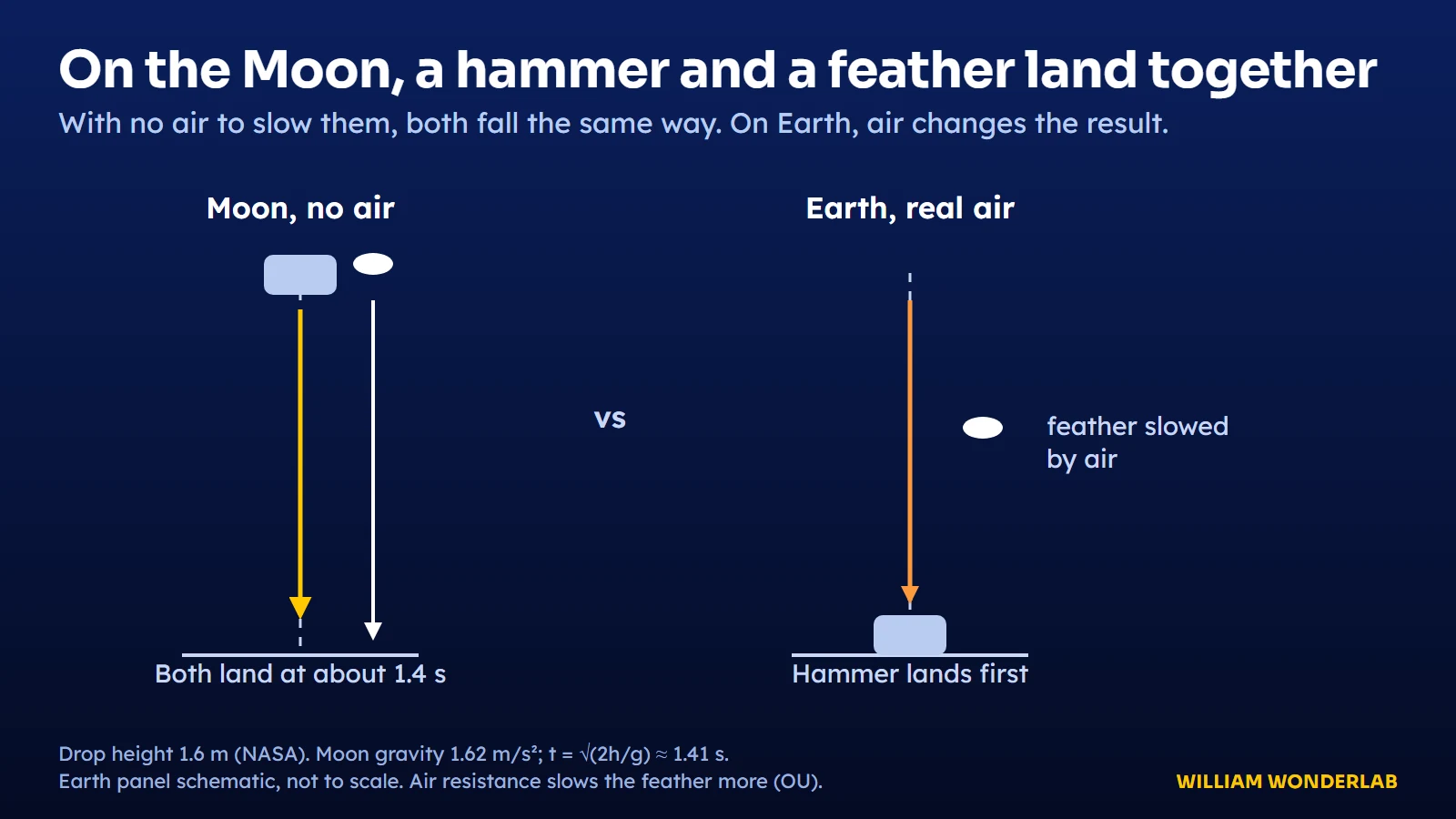
The diagram shows the test on the left. Both objects land together. On Earth, with air present, the hammer lands first, because air slows the feather more.[3]
Why gravity does not pick a winner
Gravity pulls on every object. A heavier hammer is pulled harder, but it is also harder to get moving, and the two effects cancel for a fall with no air. The result is that both objects speed up at the same rate.[2] NASA’s Moon fact sheet gives the Moon’s surface gravity as 1.62 metres per second squared, and Earth’s as 9.80.[4] Both objects in the test speed up at the Moon’s lower rate, so they take longer to land than they would on Earth, but they still land together.
Air resistance on Earth
On Earth, the air is not empty. Falling objects push air out of the way, and the air pushes back. NASA defines drag as “aerodynamic resistance to the motion of the object through the fluid.”[5] The same source notes that “there are many factors that affect the magnitude of the drag.”[5]
The Open University’s explanation of the same test says that “the hammer would hit the ground first because the feather would be slowed down more by air resistance.”[3] The feather is light, so the air’s push is large compared with its weight. The hammer is heavy, so the same push matters much less.
Did you know? The Moon has virtually no atmosphere. The Open University notes that “as the Moon has virtually no atmosphere, there is virtually no air resistance.”[3] That is why the Moon is the cleanest place to compare falling objects.
Try it: paper, flat and crumpled
This is a proposed at-home activity. It is not something that was done for this article.
You need: two sheets of the same paper, a stable step or table, and an adult to watch.
- Predict which sheet will land first if you drop a flat sheet and a sheet crumpled into a tight ball from the same height.
- Hold both sheets at the same height, shoulder level, and let go at the same moment.
- Watch which one lands first, and whether the flat sheet drifts.
- Try it again and see if the result is the same. Explain the result using air resistance.
What to expect: the crumpled ball should land first, because its shape gives less air resistance for the same mass. This shows the air effect, not the gravity effect.
Safety first: Drop objects from shoulder height only, on a clear floor, and keep the area below free of people and pets. Do not climb on a chair, stool or ladder to drop anything. Never drop heavy objects, such as a real hammer, to test this idea. An adult should watch.
Go deeper: the falling-time calculation
How long does the drop take?
For an object dropped from rest, the height fallen is h = ½gt². Solving for t gives t = √(2h/g).[2][4]
NASA’s report gives the drop height as about 1.6 metres.[2] Using the Moon’s surface gravity, g = 1.62 m/s²:
- t = √(2 × 1.6 ÷ 1.62) = √(3.2 ÷ 1.62) = √1.975 ≈ 1.41 seconds
For comparison, the same drop on Earth without air, using g = 9.80 m/s²:
- t = √(2 × 1.6 ÷ 9.80) = √(3.2 ÷ 9.80) = √0.327 ≈ 0.57 seconds
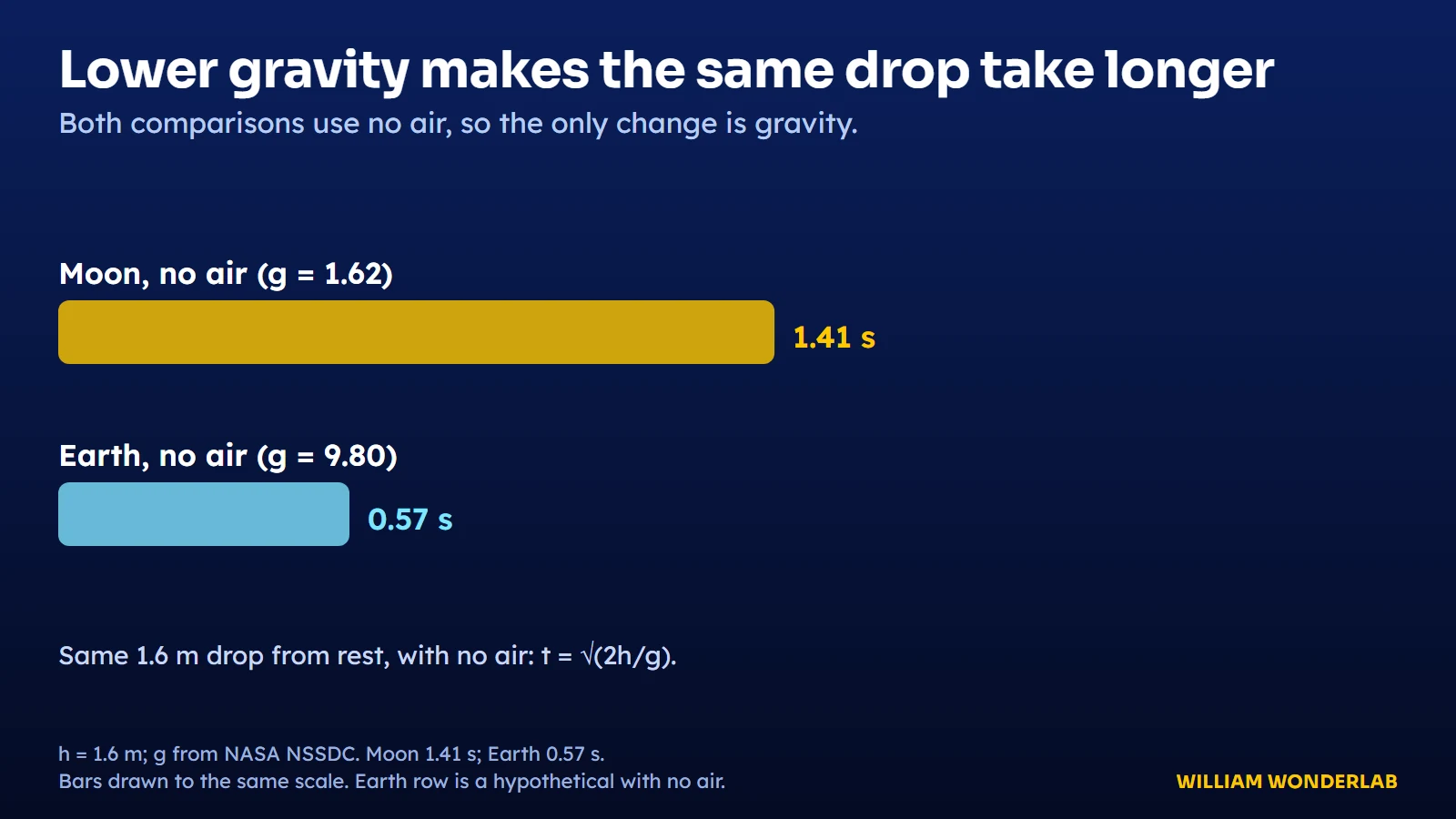
The calculation shows why the Moon is slower. It does not change the key point: on the Moon, neither object gets a head start.
Why the feather is different on Earth
The air’s push depends on the object’s shape and speed as well as its mass. A flat feather gets slowed by the air much more than a dense hammer does, and this is why the two results separate on Earth.[3][5] The calculation above uses no air at all, so it describes the Moon test and a hypothetical Earth drop without air.
Frequently asked questions
Do heavy things fall faster than light things?
Not when air is removed. With no air, a heavy and a light object fall at the same rate in the same gravity.[2]
Did the hammer and feather really land together on the Moon?
NASA reports that the objects “strike the lunar surface simultaneously.”[2]
Why does a feather fall so slowly on Earth?
Air pushes against it. Because the feather is light, that push slows it much more than the same push slows a heavy object.[3][5]
Is the Moon’s gravity the same as Earth’s?
No. The Moon’s surface gravity is about 1.62 metres per second squared, compared with about 9.80 on Earth.[4]
Why did Galileo think all objects fall the same way?
He reasoned that, without air, the difference in mass should not change the rate of fall. NASA cites this conclusion in its account of the Moon test.[2]
The big idea
Air, not weight, makes the difference. Gravity makes heavy and light things speed up at the same rate. On the Moon there is no air to slow the feather, so the hammer and feather land together.
Related reading
More from William Wonderlab:
Explore more from scientists:
- The Apollo 15 Hammer-Feather Drop (NASA Science)
- Apollo 15 Hammer-Feather Drop (NASA NSSDC)
- Moon Fact Sheet (NASA NSSDC)
References
[1] NASA Science, “The Apollo 15 Hammer-Feather Drop” (accessed 25 October 2026)
[2] NASA National Space Science Data Center, “Apollo 15 Hammer-Feather Drop” (quoting the Apollo 15 Preliminary Science Report, NASA SP-289) (accessed 25 October 2026)
[3] The Open University, OpenLearn, “Moons of our Solar System” (Week 4, section 3.3) (accessed 25 October 2026)
[4] NASA National Space Science Data Center, “Moon Fact Sheet” (accessed 25 October 2026)
[5] NASA Glenn Research Center, “What is Drag?” (Beginner’s Guide to Aeronautics) (accessed 25 October 2026)