How Do Noise-Cancelling Headphones Work?
Noise-cancelling headphones listen to the sound around you, then play back a copy that is flipped upside down. When the two waves meet at your ear, they largely cancel out.
Put on a pair of noise-cancelling headphones on a noisy bus and the rumble often fades into a murmur. Nothing has been stuffed into your ears to block it. So how can a pair of headphones make a sound quieter by adding more sound?
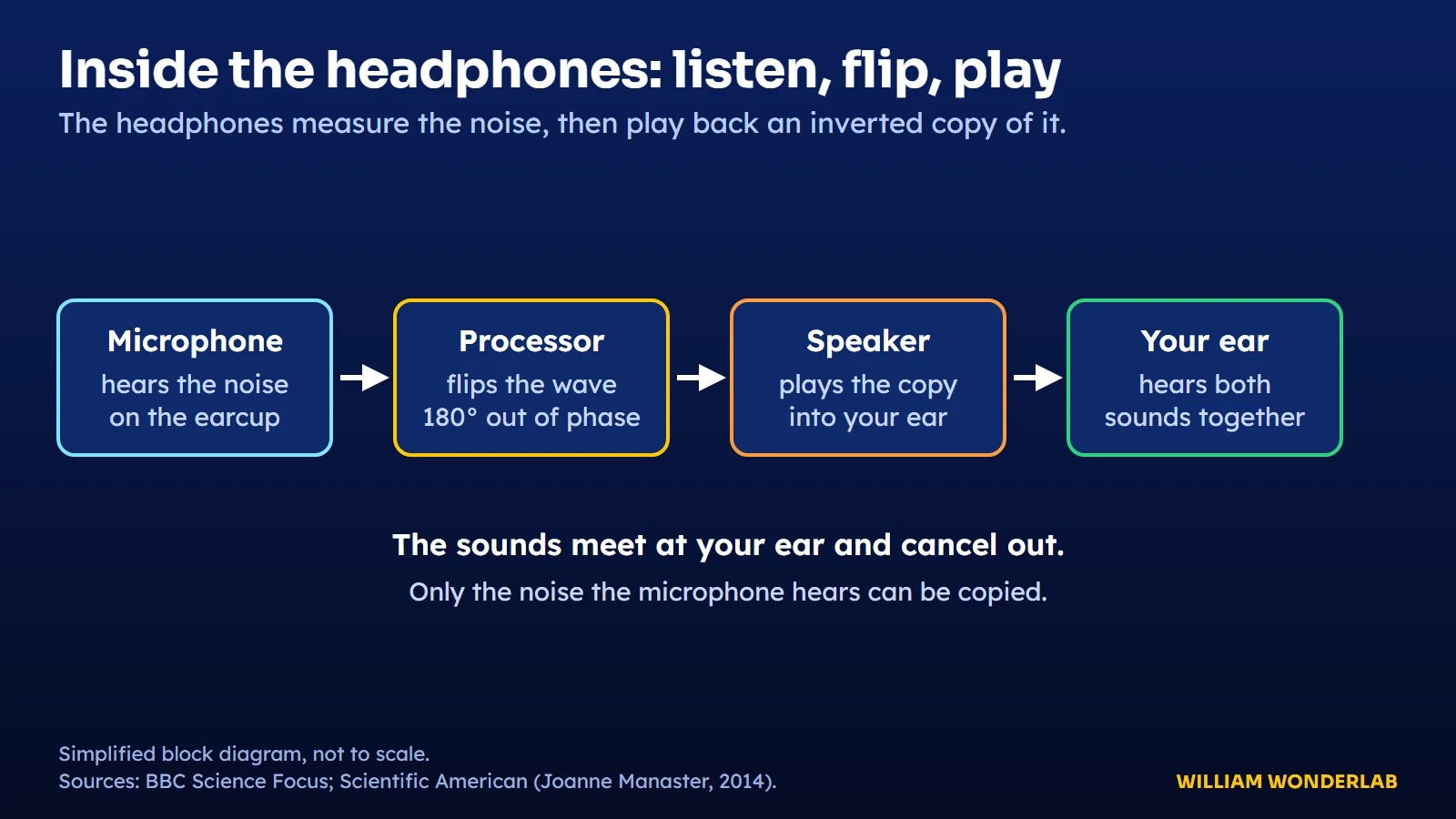
The short answer: The headphones use a small microphone to hear the sound around you. An electronic circuit makes a copy of that sound that is flipped upside down, and a speaker plays it. When the two waves meet at your ear, they cancel each other out. This is called destructive interference.[1][2][3]
Sound is a wave
Sound travels through air as a wave. A wave is a repeating pattern that carries energy from one place to another, like the ripples that spread across a pond after you drop in a stone.
When two waves are in the same place at the same time, they do not simply bump into each other and stop. They add together. HyperPhysics, a physics reference from Georgia State University, puts it this way: “Two traveling waves which exist in the same medium will interfere with each other.”[1]
Adding waves: when they reinforce and when they cancel
Two waves can add in two ways. HyperPhysics explains: “If their amplitudes add, the interference is said to be constructive interference.” The amplitude is the height of the wave from its middle line to its peak. Two peaks that line up make a taller peak.
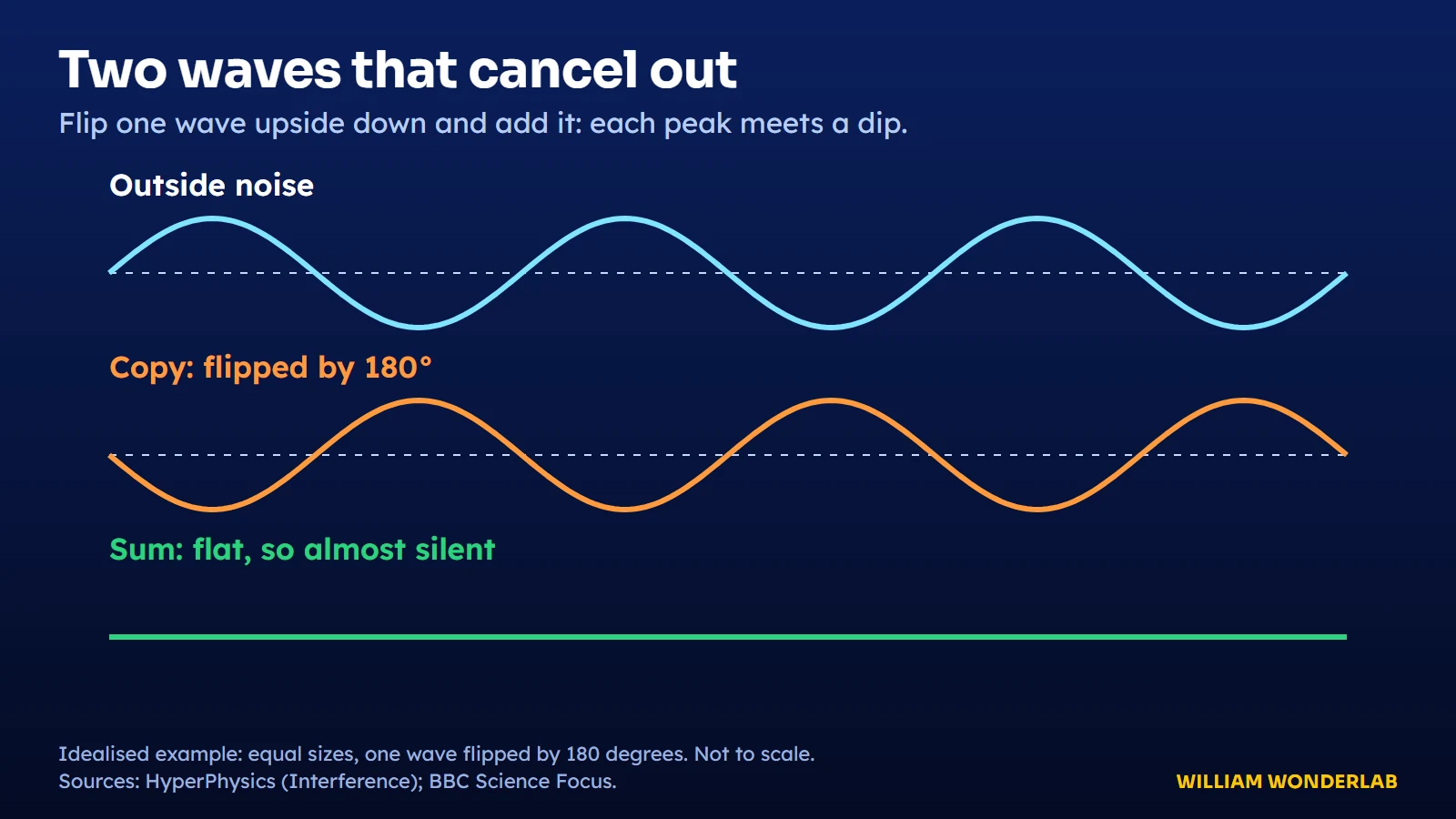
The other case is destructive interference. HyperPhysics says this happens “if they are ‘out of phase’ and subtract.”[1] Phase describes where a wave is in its repeating cycle. HyperPhysics notes that “a full period of the sine wave will correspond to a complete circle or 360 degrees.”[1] A wave that is 180 degrees out of phase is exactly half a cycle behind. Its peaks sit on the other wave’s dips, so the two subtract.
The diagram below shows the idea. The top wave is the outside noise. The middle wave is the same noise flipped upside down, so it is 180 degrees out of phase. The bottom line shows the total.
The microphone hears the noise first
Noise-cancelling headphones need to know what the noise sounds like before they can fight it. Science Focus describes the first step: “First, there is a microphone on the earcup to listen out for annoying external sound.”[2]
The microphone is the starting point of the whole process. If it cannot hear the noise, the headphones have no copy to make.
The speaker plays an opposite wave
Next, an electronic circuit processes the signal from the microphone. Science Focus says the headphones create “an opposing sound wave that mimics the noise you want to get rid of, but just 180° out of phase.”[2] Scientific American describes the same step: “A noise-cancellation speaker emits a sound wave with the same amplitude but with inverted phase.”[3]
In other words, the copy has the same size as the noise but the opposite direction. Where the noise pushes air forward, the copy pulls it back.
Why the two sounds cancel at your ear
When the outside noise and the copy reach your ear at the same time, they combine. Scientific American explains: “The waves combine to form a new wave, in a process called interference, and effectively cancel each other out.”[3] Science Focus adds that “when one sound wave is at its highest peak, the other is at its lowest.”[2]
That is why the result can be much quieter than either sound on its own. The cancellation only works for the part of the sound the microphone can hear and the circuit can copy, so it is never a perfect match in practice. Science Focus notes that the system “works best with lower frequencies, like transport noise.”[2]
Did you know? Two waves of the same size that are exactly 180 degrees out of phase add up to zero at every moment. You can see this in the diagram, where the bottom line stays flat.[1]
Everyday examples
These examples are hypothetical, to help you picture the idea:
- A bus engine’s hum. A steady, low rumble is a sound the microphone can track, so there is a clear wave to copy.
- A fridge or fan. A constant whirr is the kind of steady sound a copy flipped upside down can be matched against.
Hearing safety: quieter is kinder to your ears
Noise cancelling is useful for hearing safety because it can reduce the need to turn up the volume. The World Health Organization (WHO) explains that “the higher the level of sound and longer the duration, the greater the risk of hearing loss.”[4]
WHO recommends “Use well-fitted, and noise cancelling headphones to reduce the need to raise volume in noisy situations.”[4] It also suggests a practical limit: “setting your device’s volume level to no more than 60% of maximum.”[4] WHO gives this example: “you can safely listen to a sound level of 80dB for up to 40 hours a week.”[4]
Headphones are not a replacement for turning the volume down. In very loud places, WHO advises that you “use ear protectors such as earplugs.”[4]
Go deeper: the maths of cancelling
Adding the two waves
Take a noise that pushes the air by +1 at one moment. The copy pushes by −1 at the same moment, because it is 180 degrees out of phase. The total is:
- +1 + (−1) = 0
The same is true at every moment, so the total stays at zero. This is why the bottom line in the diagram is flat. Real headphones cannot match a sound perfectly, so some sound still gets through.
Why timing matters
A 180 degree shift is exactly half of a full cycle, because 180 ÷ 360 = 0.5. This means the copy must arrive at your ear at exactly the right moment. If the timing drifts, the peaks no longer meet the dips, and the sounds stop cancelling as well.
Frequently asked questions
Do noise-cancelling headphones fight sound with sound?
Yes. They play a copy of the outside noise that is out of phase with it, so the two waves cancel where they meet.[2][3]
Can they remove every sound?
No. They work best on sounds that the microphone can hear clearly and the circuit can copy. A copy is never a perfect match, so some sound still gets through.
Can you still hear music through them?
Yes. The headphones reduce the outside noise. They do not switch off the sound you are listening to, and the goal is to make the noise around you quieter.
Do noise-cancelling headphones protect my hearing?
They can help you avoid turning the volume up in a noisy place. WHO still advises keeping the volume at no more than 60% of maximum and using earplugs in very loud places.[4]
Why is the copy flipped upside down?
A wave flipped by 180 degrees is out of phase with the original. When the two meet, their peaks and dips line up in opposite ways, so they subtract.[1][2]
The big idea
Two sounds, flipped and combined. A microphone hears the noise, a circuit flips it, and a speaker plays it back. At your ear, the two waves meet and cancel out, so the noise you hear is much weaker.
Related reading
More from William Wonderlab:
- Why Does Lightning Come Before Thunder?
- Why Do Soap Bubbles Have Rainbow Colours?
- How Do Batteries Store Energy?
Explore more from scientists:
- Superposition and interference (HyperPhysics, Georgia State University)
- How do noise-cancelling headphones cancel sounds? (BBC Science Focus)
- Deafness and hearing loss: Safe listening (World Health Organization)
References
[1] Georgia State University, HyperPhysics, “Interference” (accessed 25 October 2026)
[2] BBC Science Focus, “How do noise-cancelling headphones cancel sounds?” (accessed 25 October 2026)
[3] Scientific American, Joanne Manaster, “How do Active Noise Canceling Headphones Work?” (accessed 25 October 2026)
[4] World Health Organization, “Deafness and hearing loss: Safe listening” (accessed 25 October 2026)