How Can a Heavy Steel Ship Float?
A steel ship floats because its average density, including the air inside its hull, is less than water. It pushes aside water that weighs as much as the ship.

A steel anchor drops straight to the bottom. Yet a steel ship, carrying cargo and crew, sits happily on the surface of the harbour. It seems to break the rule that heavy things sink. The answer is that a ship is not a solid lump of steel. Its shape and the air inside it change what really matters, which is the average density of the whole ship.
The basic idea of floating is the same one that explains why ice floats. If you want that version first, read Why Does Ice Float? This article focuses on the ship.
The short answer: A ship floats when its average density, counting the air inside its hull, is less than the density of water. It pushes aside a volume of water whose weight equals its own weight, and that upward push, the buoyant force, holds it up.[1][2][3]
The steel is not the whole story
It is easy to think that a ship’s material decides whether it floats. Physics Van, the University of Illinois physics question service, gives a different answer: “The reason that a steel boat can float is because the boat isn’t made entirely of steel.”[4]
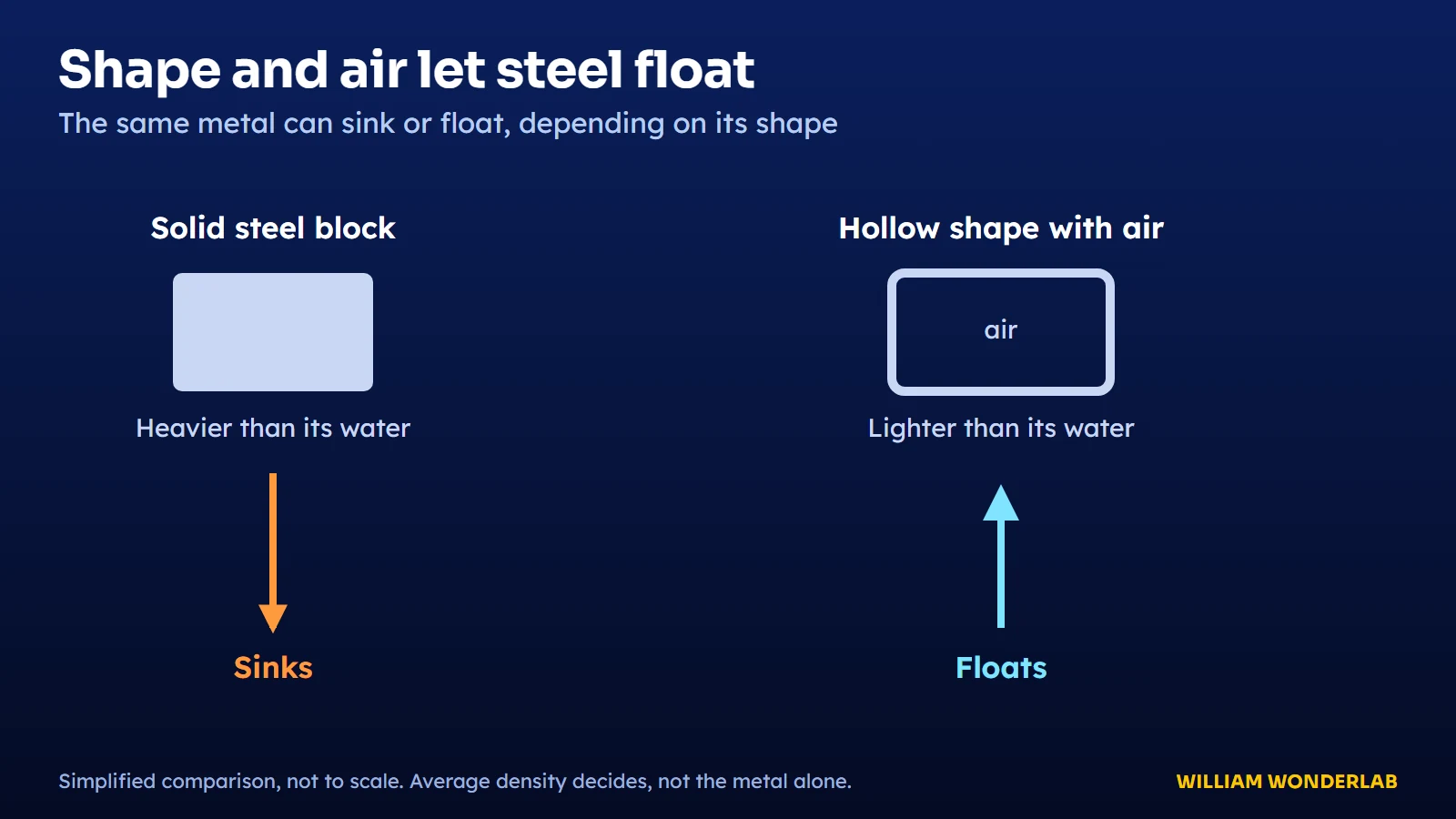
What matters is how much of the ship’s space is filled with metal and how much is filled with air. A solid steel block sinks, but a hollow steel shape can float, because most of its volume is air.
Archimedes and the water a ship pushes aside
The principle is named after the Greek thinker Archimedes, who described the push that water gives to anything placed in it. You do not need the history to understand the idea, only the rule. NASA’s buoyancy lesson states: “the buoyant force on a submerged object is equal to the weight of the fluid that is displaced by the object.”[1]
Physics Van puts the same idea more simply: “Archimedes’ Principle states that the buoyant force on something is equal to the weight of the water that is displaced.”[2] Displaced means pushed out of the way. When a ship sits in the water, the hull shoves a volume of water aside, and the weight of that displaced water is what pushes the ship up.
Physics Van’s answer on ships adds the key test: “Whether or not a ship sinks or floats is determined by both its total weight and the weight of water it displaces.”[3]
Average density counts the air
Average density is the total mass of an object divided by the total volume it takes up. For a ship, the volume includes the enclosed spaces inside the hull, not just the metal. Physics Van notes that “real ships have lots of air inside, so they weigh less than the same volume of water, so they float.”[3]
Water has a density of about 1 gram per cubic centimetre, which the USGS gives as “1 gram per cubic centimeter (1 g/cm3)” for water.[5] That is the same as 1,000 kilograms per cubic metre. A ship with an average density below this figure will float.
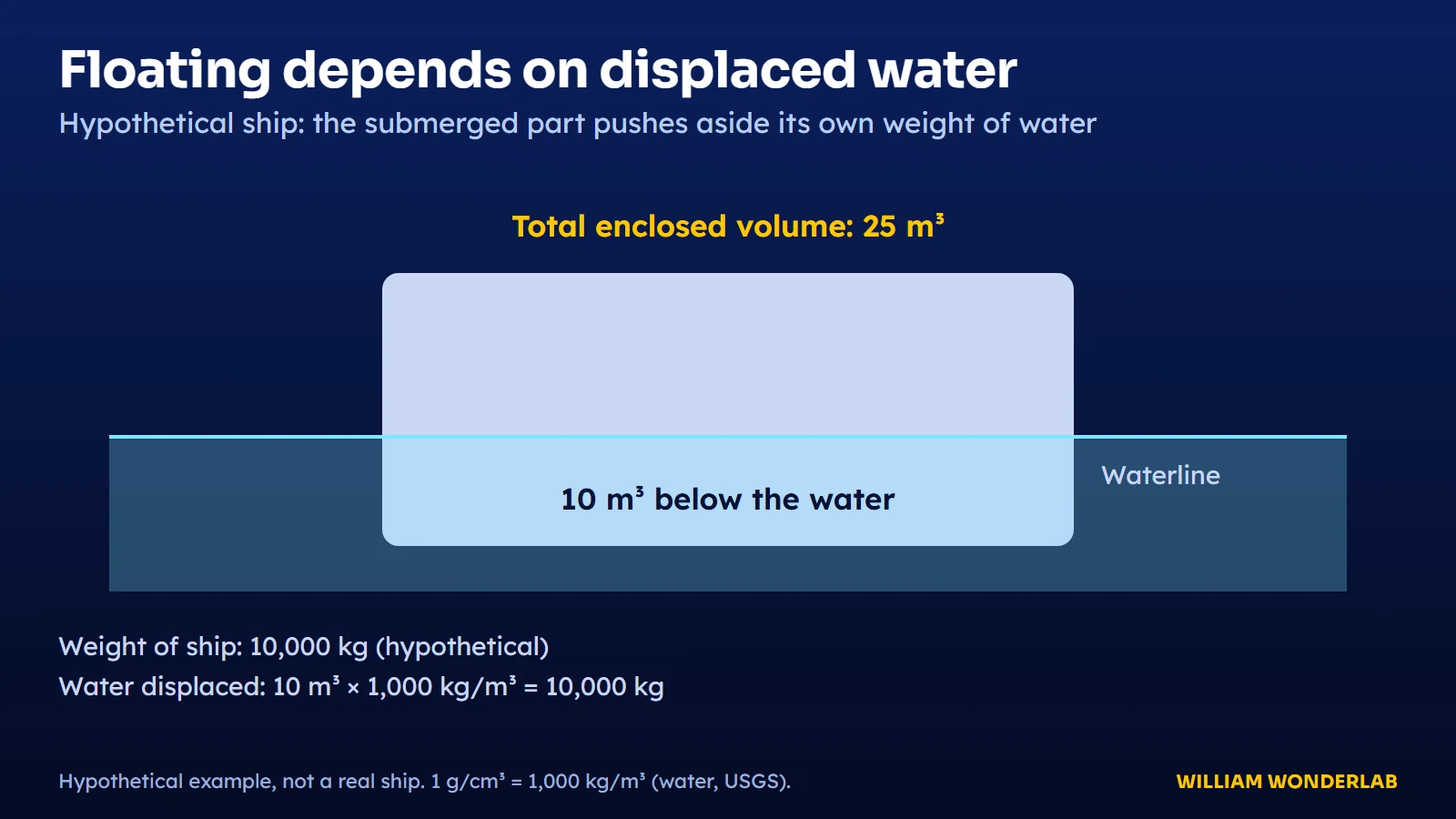
The diagram shows a hypothetical ship. Only the part below the waterline displaces water, and the water it pushes aside weighs the same as the whole ship. The numbers are invented to show the arithmetic, not taken from a real vessel.
A worked example
Imagine a hypothetical ship with a mass of 10,000 kilograms, and an enclosed volume of 25 cubic metres.
- Average density = 10,000 kg ÷ 25 m³ = 400 kg/m³, which is 0.4 g/cm³. That is less than water’s 1 g/cm³, so the ship floats.
- The part below the waterline must displace water weighing 10,000 kg. At 1,000 kg per cubic metre, that is 10,000 ÷ 1,000 = 10 m³ of water.
- So 10 of the ship’s 25 cubic metres sit below the water, about 40 per cent of its enclosed volume, and the rest sits above it.
The buoyant force on the ship equals its weight. The ship is neither sinking nor rising, which is the balance that keeps it floating.
Why a ship can sink if water gets in
The air inside a hull is what keeps the average density low. If water gets in, it takes the place of the air. Physics Van explains that “some of the water could seep in over the top, taking the place of some of the air and making the total density higher.”[4]
A higher average density means the ship sits lower in the water. Once the average density rises above that of water, the ship sinks. This is why ships are built to keep water out.
Did you know? The same metal can sink as a block and float as a hollow shape. Only the shape and the air inside change, not the steel itself.[4]
Everyday examples
- A hollow bowl and a ball of foil. The same foil that sinks as a tight ball can float as a bowl, because the bowl traps air. This is the activity below.
- Heavy loads on hollow shapes. Physics Van says “boats stay afloat with heavy loads because they’re hollow; they aren’t solid hunks of wood or metal.”[3]
- Ice on water. Ice floats for a related reason, because its average density is lower than water’s, as explained in Why Does Ice Float?
Try it: a foil bowl or a foil ball
This is a proposed at-home activity. It is a simple test of shape and air, not a measured experiment.
You need: two equal pieces of aluminium foil, a sink or basin with a little cool tap water, and a paper towel.
- Predict what will happen to a tight foil ball and to a foil bowl made from the same amount of foil.
- Shape one piece into a tight ball. Shape the other into a bowl with raised sides, to trap air inside.
- Place the ball gently on the water. Wait a few seconds and watch.
- Place the bowl gently on the water and watch again.
- Write down what you saw. Think about whether the bowl’s air lowered its average density.
Safety first: Use a sink or basin with a small amount of cool water, and keep the taps running gently. Fold all foil edges over so they are not sharp. Wipe up any spilt water straight away, because a wet floor is slippery. Do not use hot water. An adult should supervise, especially with younger scientists, and everyone should wash their hands afterwards.
Go deeper: the balance of forces
Why a floating ship stays still
A floating ship does not sink or rise, so the forces on it balance. The upward buoyant force equals the ship’s weight. The weight of the displaced water is the same as that buoyant force, as the NASA and Physics Van statements above describe.[1][2]
Converting units
A gram per cubic centimetre is the same as a kilogram per cubic metre, because 1 cubic metre is one million cubic centimetres and 1 kilogram is one thousand grams. So 1 g/cm³ × 1,000,000 cm³ per m³ ÷ 1,000 g per kg = 1,000 kg/m³.[5]
Frequently asked questions
What is the buoyant force?
It is the upward push from a fluid. For a floating object, it equals the weight of the fluid the object pushes aside.[1][2]
Does a ship float because it is light?
Not only that. Whether it floats depends on its total weight compared with the weight of the water it displaces.[3]
Why does a steel ship float if steel sinks?
Because the ship is not solid steel. The air inside the hull keeps its average density below water’s.[4]
Can a ship sink if water gets inside?
Yes. Water that fills the spaces with air raises the average density, and the ship can sink.[4]
Does the same idea explain ice?
Yes. The basic idea of average density and buoyancy is the same, and the ice article explains that version: Why Does Ice Float?
The big idea
Shape and air decide floating. A ship floats because the water it pushes aside weighs as much as the ship, and because its average density, including the air, is lower than water’s.
Related reading
More from William Wonderlab:
Explore more from scientists:
- Buoyancy: Archimedes Principle (NASA Glenn Research Center)
- Floating Steel (Physics Van, University of Illinois)
- Water Density (USGS Water Science School)
References
[1] NASA Glenn Research Center, “Buoyancy: Archimedes Principle” (accessed 25 October 2026)
[2] University of Illinois Physics Van, “Archimedes Principle Examples” (accessed 25 October 2026)
[3] University of Illinois Physics Van, “Why do Ships Float? Why Don’t They Sink?” (accessed 25 October 2026)
[4] University of Illinois Physics Van, “Floating Steel” (accessed 25 October 2026)
[5] US Geological Survey (USGS), Water Science School, “Water Density” (accessed 25 October 2026)
Keep exploring
Now try the science yourself
Reading is a great start. Experimenting is even better: these interactive models use the same science as this article.