Why Does Ice Float?
Ice floats because it is less dense than liquid water. Here is what happens as water freezes, and why an iceberg shows only its tip.
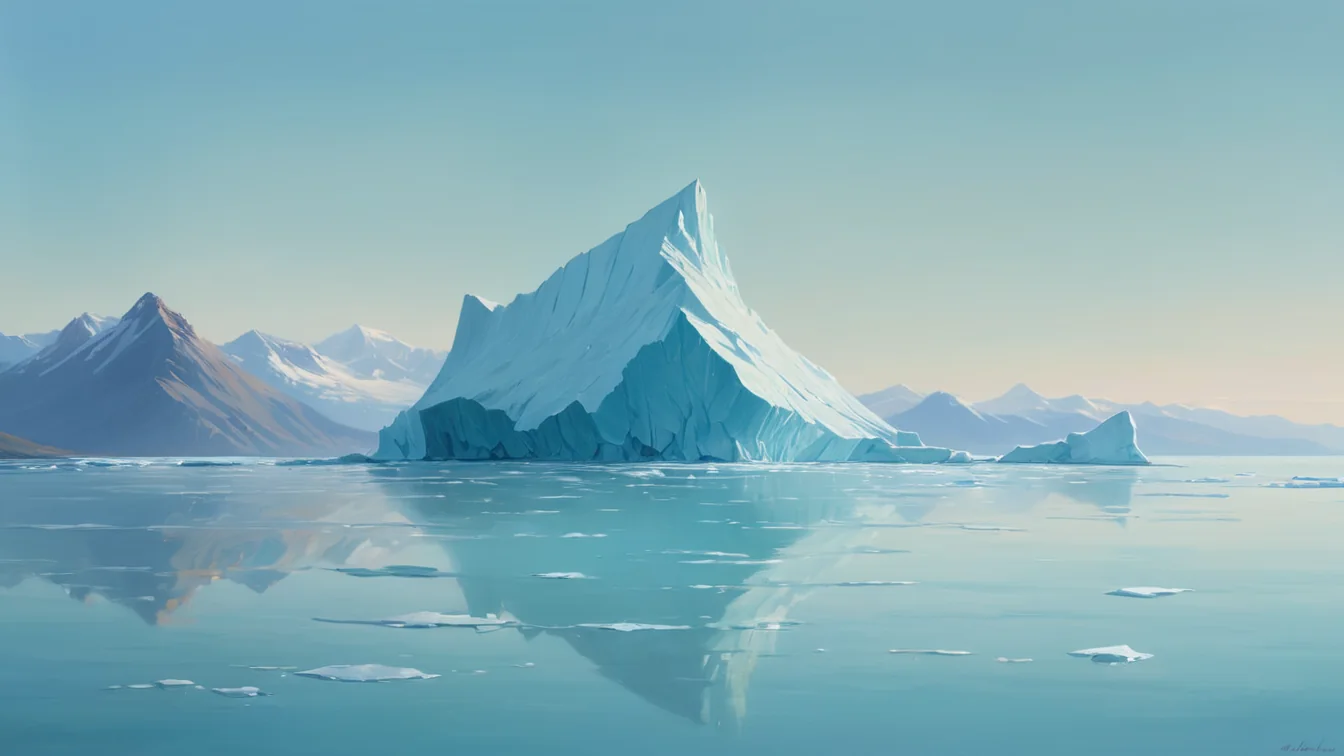
Drop a pebble into a pond and it sinks. Drop an ice cube into a glass of water and it bobs at the surface. Icebergs drift past with most of their bulk hidden underwater. So why does frozen water behave so differently from the stone?
The short answer: Ice floats because it is less dense than liquid water. Freezing makes water’s density drop by about 9 per cent, so the same amount of water takes up more room as ice. A floating ice block therefore sits with about 90 per cent of its volume under the surface.[1][2]
Density: how much mass fits in a space
Density tells you how much mass is packed into a given volume. Liquid water at 0 °C has a density of about 1 gram per cubic centimetre, or 0.99987 g/cm³ to be precise.[1]
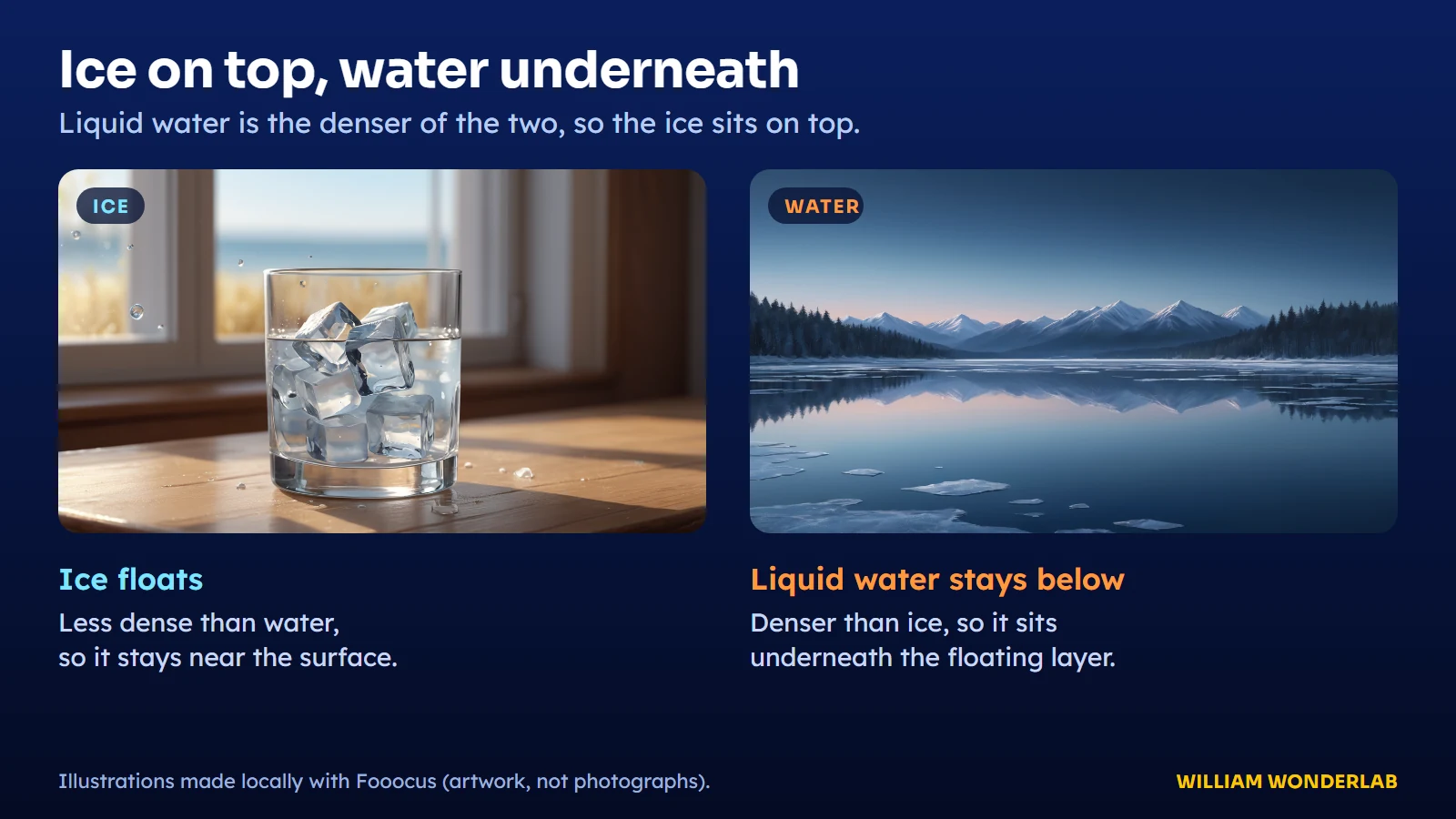
When water freezes, the density drops. The USGS puts it plainly: “Ice is less dense than liquid water which is why your ice cubes float in your glass.”[1]
Water is densest just above freezing
You might expect water to keep getting denser as it cools all the way to freezing. It does not. At about 4 °C, water reaches its maximum density, and then its density decreases as it approaches the freezing point.[3]
So the coldest water is not the densest water.
Why ice takes up more space
When water freezes, its molecules lock into a regular pattern. HyperPhysics describes the result: water “crystallizes into an open hexagonal form,” and this “hexagonal lattice contains more space than the liquid state.”[3]
Science Learning Hub, the New Zealand science education site, describes the same structure: “When water freezes at 0°C, a rigid open lattice (like a web) of hydrogen-bonded molecules is formed.” It adds: “It is this open structure that makes ice less dense than liquid water.”[4]
The extra space is why ice is less dense. The same molecules, packed in an open pattern, need a bigger volume.
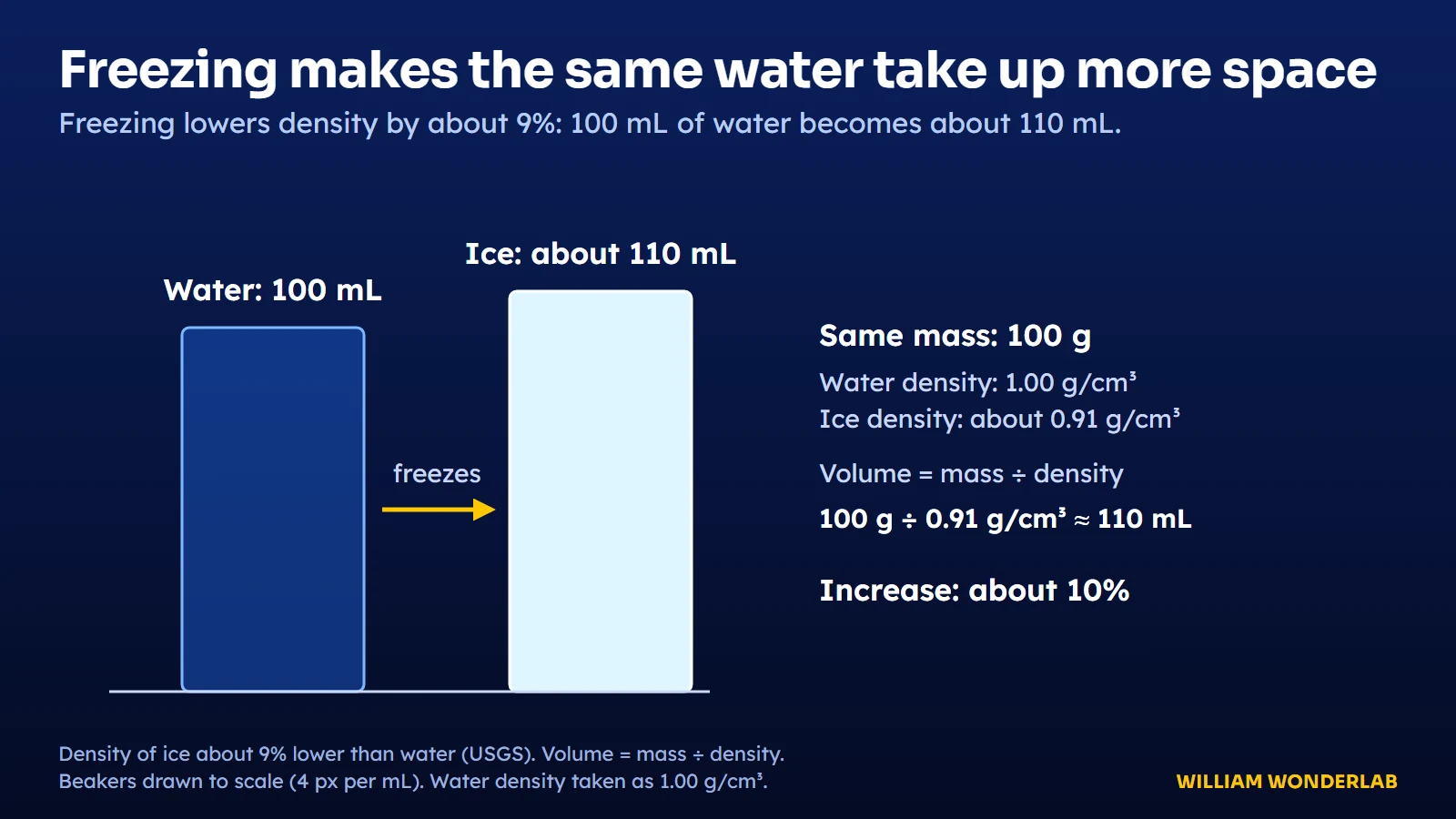
The USGS gives the size of the change: “Upon freezing, the density of ice decreases by about 9 percent.”[1] Using that figure, a fixed mass of water takes up about 10 per cent more volume once it freezes: 1 ÷ 0.91 ≈ 1.10.
Floating: the 90 per cent rule
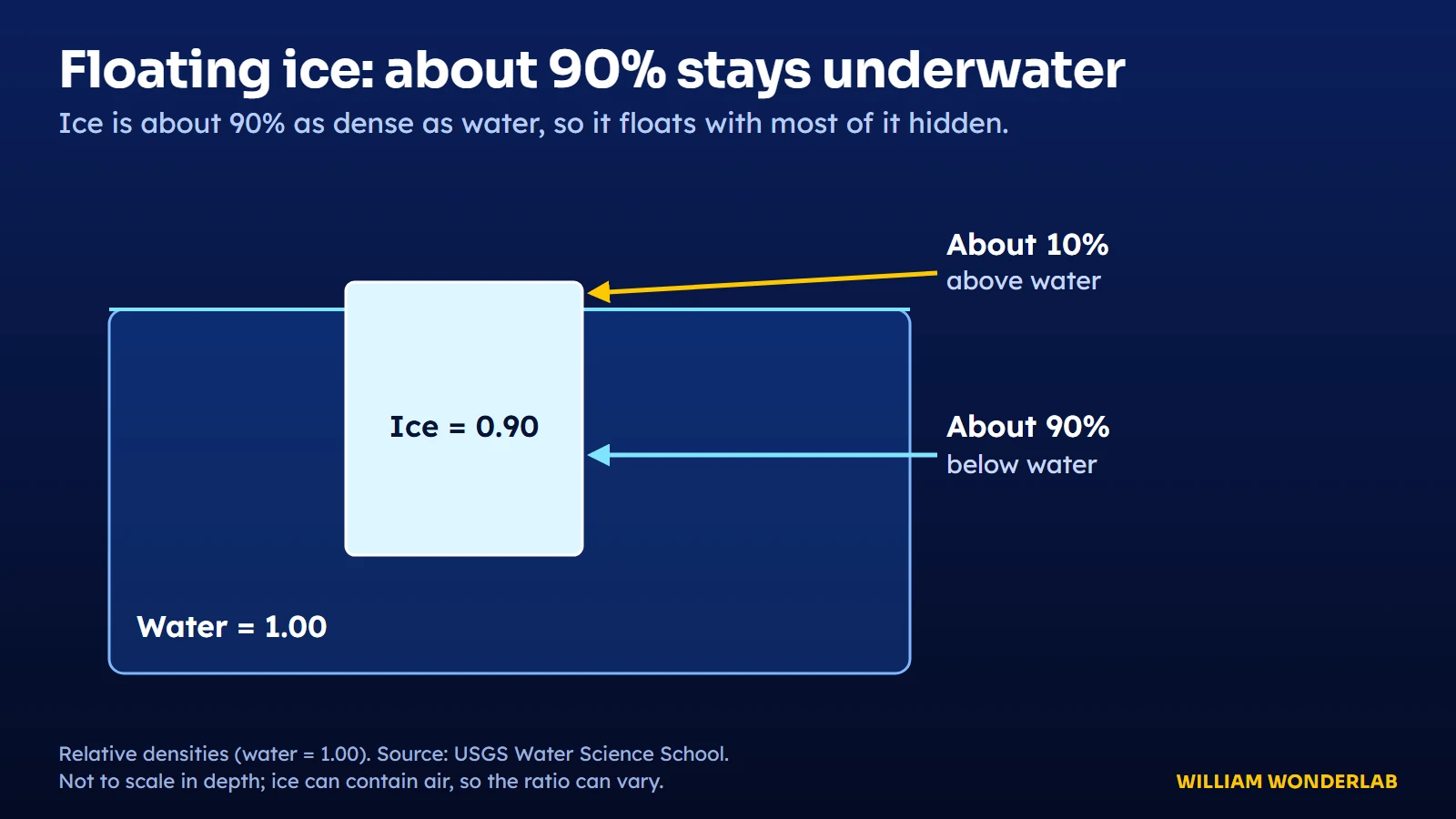
If ice is about 90 per cent as dense as water, then a floating block has about 90 per cent of its volume below the surface. The USGS says that “about 10 percent of an ice cube (or iceberg) will be above the water line.”[1]
NASA’s buoyancy lesson gives the principle behind this: “the buoyant force on a submerged object is equal to the weight of the fluid that is displaced by the object.”[5] A floating block is neither sinking nor rising, so the upward push must balance its weight.
The diagram below shows the proportions. Most of the block is hidden, and only a thin top layer breaks the surface.
Icebergs: most of the ice is out of sight
An iceberg is a large floating chunk of ice. Because ice is less dense than water, most of it sits below the waterline. The USGS states that “Ninety percent of an iceberg is below the waterline.”[2]
So when you see the tip of an iceberg from a boat, you are looking at roughly a tenth of its volume.
Everyday examples
- Ice cubes in a drink. Each cube floats with most of its bulk under the surface, and the top pokes out.
- Icebergs at sea. The visible tip is a small part of the whole.
- Lakes in winter. Freezing starts at the top: “the surface of rivers, lakes and other water bodies freeze from the top down.”[6]
- Ice with air in it. The 90 per cent figure is a typical value. The USGS notes the ratio “can vary because ice can contain air.”[1] Ice of a special kind can even be denser than normal water: “Ice floats on water because it is less dense, but ice of a special kind can be denser than normal water.”[7]
Did you know? Water is not densest at its freezing point. It is densest at about 4 °C, so water just above freezing is slightly less dense than water at 4 °C.[3]
Is it because ice is lighter?
Not quite. Ice is not lighter than water in the sense of having less mass. The same mass of ice simply occupies more space, which makes it less dense.[1]
Try it: predict, then float
You need: a clear glass, cool tap water, two ice cubes, a pencil and a strip of paper.
- Predict what will happen when you drop an ice cube into the glass of water.
- Half-fill the glass with cool tap water, then drop in the ice cubes. Watch which way they move.
- Mark the water level on the outside of the glass with a strip of paper or a pencil line before the ice goes in, then compare it once the ice has melted.
- Write down what you saw. Did the ice float the way you predicted?
What to expect: the ice cubes stay near the surface with most of their bulk under the water.
Safety first: Use cool tap water, not hot water, and keep the glass away from the edge of the bench so it cannot be knocked over. Wipe up any spills straight away so no one slips. Do not put ice or the glass near your mouth, and never drink from the test glass afterwards. A grown-up should handle the freezer and any tools used to crush ice. Younger scientists should do this with an adult.
Go deeper: density, mass and volume
A calculation you can check
Take 100 mL of liquid water at 0 °C. Its mass is about 100 g, because its density is about 1 g/cm³.[1] When it freezes, its density falls by about 9 per cent, so ice has a density of about 0.91 g/cm³ (this is calculated from the 9 per cent figure, not measured).
Volume is mass divided by density:
- Volume of ice = 100 g ÷ 0.91 g/cm³ ≈ 110 cm³, or about 110 mL.
- Increase in volume = (110 − 100) ÷ 100 ≈ 10 per cent.
So 100 mL of water becomes about 110 mL of ice. Because the ice has a lower density than the water, it floats.
Why the 90 per cent figure can vary
The USGS notes that the ice-to-water ratio “can vary because ice can contain air.”[1] The 90 per cent figure is therefore an approximate guide, not a fixed rule for every block.
Frequently asked questions
Why does ice float on water?
Ice is less dense than liquid water, so it floats. Freezing lowers the density of water by about 9 per cent.[1]
Is ice lighter than water?
Ice does not have less mass for the same amount of water. It takes up more space for the same mass, so its density is lower.[1]
Why does only the tip of an iceberg show?
About 90 per cent of an iceberg is below the waterline, so most of it is out of sight.[2]
Does every block of ice float with exactly 90 per cent underwater?
No. The 90 per cent figure is typical. Ice that contains air can float differently, because the ratio of densities can vary.[1]
Why is water densest at 4 °C and not at freezing?
Water reaches its maximum density at about 4 °C. As it approaches freezing, it becomes less dense again.[3]
What happens to the molecules when water freezes?
They arrange into an open hexagonal pattern that contains more space than the liquid, which lowers the density.[3]
The big idea
Less dense, so it floats. Water spreads out as it freezes. The same mass takes up about 10 per cent more room, so ice rests on top of the water with most of its volume underneath.
Related reading
More from William Wonderlab:
Explore more from scientists:
- Water Density (USGS Water Science School)
- Ninety percent of an iceberg is below the waterline (USGS)
- The Expansion of Water Upon Freezing (HyperPhysics, Georgia State University)
References
[1] US Geological Survey (USGS), Water Science School, “Water Density” (accessed 25 October 2026)
[2] US Geological Survey (USGS), “Ninety percent of an iceberg is below the waterline” (accessed 25 October 2026)
[3] HyperPhysics, Georgia State University, “The Expansion of Water Upon Freezing” (accessed 25 October 2026)
[4] Science Learning Hub (New Zealand), “Water density” (accessed 25 October 2026)
[5] NASA Glenn Research Center, “Buoyancy: Archimedes Principle” (accessed 25 October 2026)
[6] Science Learning Hub (New Zealand), “Water” (accessed 25 October 2026)
[7] US Geological Survey (USGS), “Heavy Ice” (image page, Water Science School) (accessed 25 October 2026)
Keep exploring
Now try the science yourself
Reading is a great start. Experimenting is even better: these interactive models use the same science as this article.