Why Is Glass See-Through?
Glass lets visible light pass because its electrons cannot absorb visible light energy. Its disordered structure also avoids scattering light the way crystals do.
Look through a window and you can see the street. Yet a stone wall blocks the view completely. Both are solid, so why does one let light through and the other does not?
The short answer: Visible light passes through glass because glass does not absorb visible light. Its electrons do not have an energy step that matches the energy of visible light, and its disordered structure does not scatter light the way many crystals do.[1]
Light is a stream of energy packets
Light is made of tiny packets of energy called photons. Each colour of visible light has its own energy. Red has less energy than blue, and ultraviolet light has more energy than either.
A material blocks light when its electrons can absorb a photon. An electron can only jump to a higher level if the photon brings exactly the right amount of energy. If the energy does not match, the photon is not absorbed and passes on.
Glass is an amorphous solid
Glass is a solid, but it is not a crystal. Its atoms do not follow the neat repeating pattern found in a crystal of salt or diamond. Scientists call this an amorphous solid. The word “amorphous” means “without a regular form” here: the pattern is not repeated.
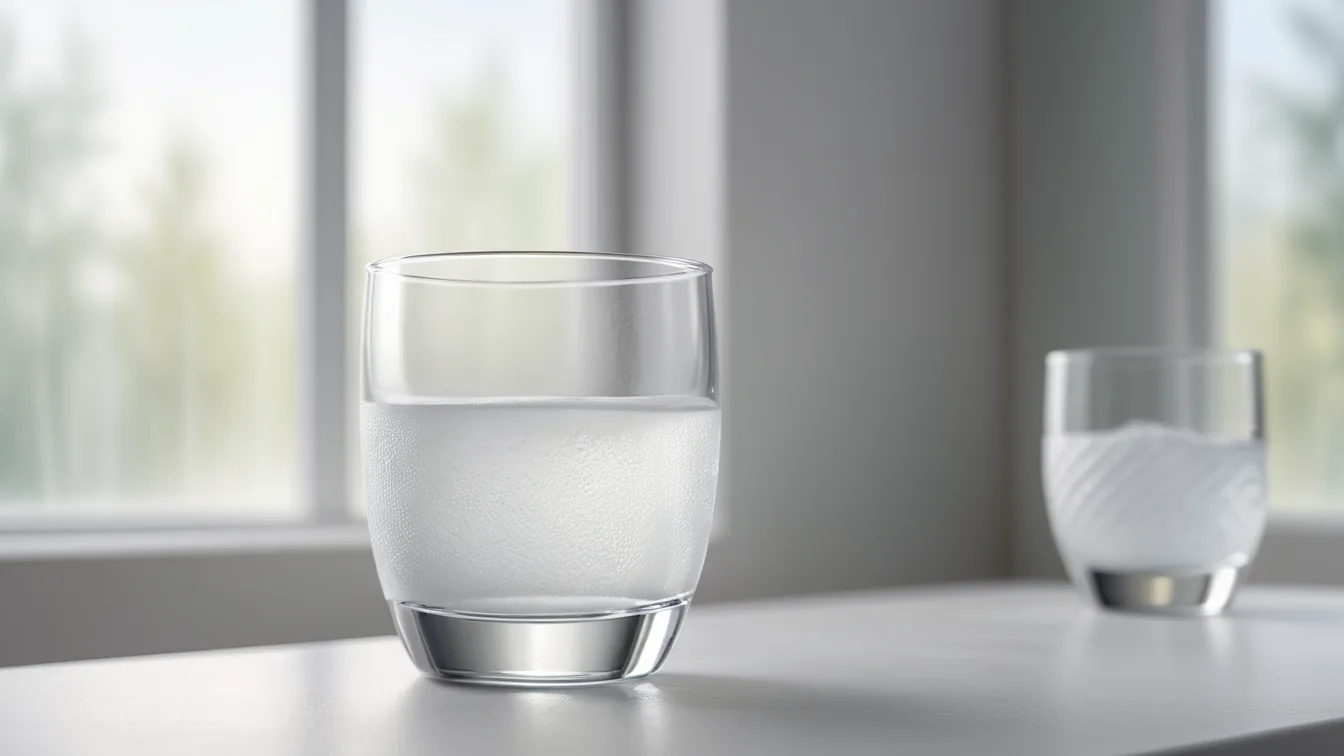
A popular myth says glass is a slow liquid. Scientific American, discussing the myth, describes glass as “an amorphous solid—a state somewhere between those two states of matter.”[2] Mark Ediger, a chemistry professor at the University of Wisconsin-Madison, explains the key feature: “Amorphous means it doesn’t have that long-range order.”[2]
A Penn State materials course page explains the difference from water: “Unlike water, though, liquid silicon dioxide does not reform into a crystal solid when it cools.”[1]
Why visible light gets through
The band structure of a material describes which energy levels its electrons can occupy. A Penn State materials page explains that the amorphous structure of glass “breaks up the band structure of SiO2,” so there are no electron energy levels that visible light can excite.[1]
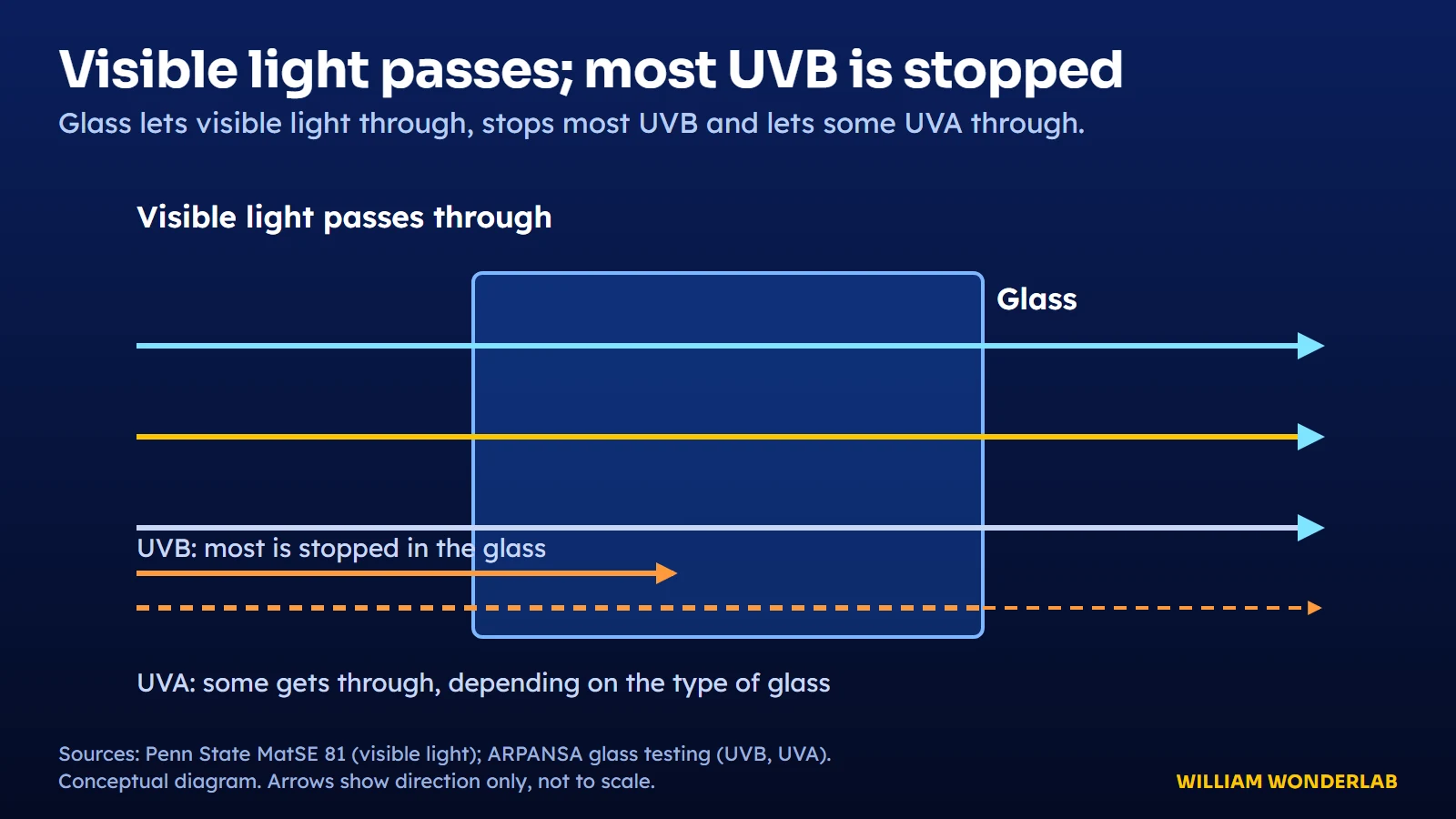
The page puts it simply: “the rows are so far apart that a photon of visible light can’t provide enough energy for an electron to jump between them.”[1] The same page adds that “Photons from ultraviolet light, on the other hand, give just the right amount of energy, and are absorbed.”[1] Australia’s radiation safety agency, ARPANSA, says glass typically “blocks out most UVB radiation” but “allows UVA radiation to penetrate to varying degrees, depending on the type of glass.”[4] So window glass stops most of one kind of ultraviolet light (UVB) but can let some of another kind (UVA) through, while visible light passes easily.
The diagram below shows the idea. Visible photons pass straight through. Most UVB is stopped inside the glass, and some UVA can get through, depending on the type of glass.
Why disorder helps the light pass
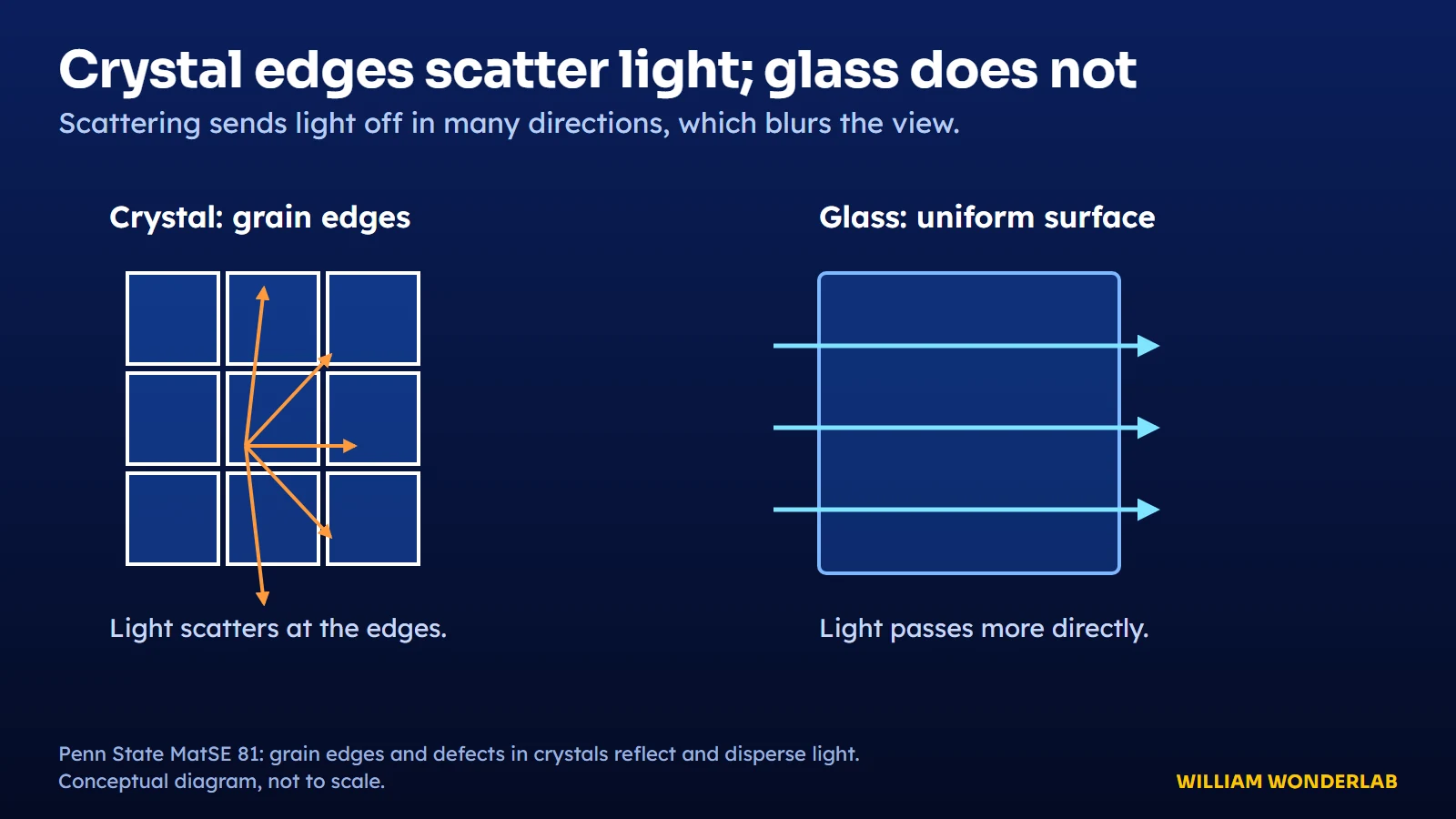
Light can also be scattered. Scattering is when light bounces off small bumps and edges and goes in random directions. A crystal is full of tiny seams where one region meets another, and light can be scattered at those edges.
The Penn State page describes this in a crystal: “the edges of the rigidly formed grains and smaller defects within the crystal structure reflect and disperse light.” It then notes that in glass, “This makes the surface of glass uniform on a microscopic level.”[1] An open engineering textbook on glass, from Engineering LibreTexts, says that “grain boundaries reflect and/or scatter light in poly crystalline materials.” It also notes that “silica glass is transparent in the visible spectrum.”[3]
Because glass has no crystal grains, there are fewer places for light to scatter. The light passes through more directly, so the view is clear.
Try it: clear glass versus frosted glass
This is a proposed at-home activity, using two glasses or a clear glass and a frosted one.
You need: a clear drinking glass, a frosted or etched glass from the cupboard, a printed sheet with small text, and a torch or lamp.
- Predict which glass will let you read the text more clearly.
- Place the printed sheet on a table. Hold each glass in front of the text, then look through it.
- Compare how clear the words look through each glass. Note any cloudy or blurred areas.
- Explain the difference. Frosting makes the surface rough, so light scatters off many tiny bumps.
What to expect: the clear glass should let you read the words more sharply. The frosted glass should look cloudy, because its rough surface scatters the light.
Safety first: Use only glass that is not cracked or chipped, and put it down on a flat, stable surface. Do not hold the glass near your face, and never try to look at the lamp or torch directly. If a glass breaks, stop, keep everyone away from the pieces, and let an adult clean it up with gloves. Do not eat or drink from either glass during this test.
Go deeper: band gaps and amorphous structure
What a band gap is
A band gap is the energy range that electrons in a material cannot occupy. This is a simplified picture for a general reader, not a full explanation of solid-state physics. Light with energy in that range cannot be absorbed by the material’s electrons. The Penn State page describes glass as having no electronic states for visible light to excite electrons into, which is the same idea as a gap that visible light cannot cross.[1]
What glass is not
Glass is not a liquid that slowly flows. The Scientific American article notes that it is an amorphous solid rather than a supercooled liquid.[2]
Frequently asked questions
Why is glass see-through when stone is not?
Glass does not absorb visible light, and its disordered structure does not scatter it the way many crystals do. Stone contains crystals and minerals that absorb or scatter light.[1]
Is glass a liquid?
No. Glass is an amorphous solid. It is solid at room temperature, but its atoms lack the regular crystal pattern found in many solids.[2]
Why does frosted glass look cloudy?
A rough surface scatters light in many directions, so the view looks blurred. This is an everyday example of scattering.[1]
Does all glass block ultraviolet light?
No. ARPANSA says glass typically “blocks out most UVB radiation” but “allows UVA radiation to penetrate to varying degrees, depending on the type of glass.”[4] Different types of glass let through different amounts of ultraviolet light.
Why does glass not form a crystal?
When liquid silicon dioxide cools, it does not reform into a crystal solid, so glass keeps its disordered arrangement.[1]
The big idea
Glass lets visible light pass. Its electrons cannot absorb visible energy, and its disordered structure avoids the grain edges that scatter light in crystals.
Related reading
More from William Wonderlab:
- Why Does Metal Feel Colder Than Wood?
- Why Do Soap Bubbles Have Rainbow Colours?
- Why Is the Sky Blue?
Explore more from scientists:
- Why is Glass Transparent? (Penn State, MatSE 81)
- Fact or Fiction?: Glass Is a (Supercooled) Liquid (Scientific American)
References
[1] Pennsylvania State University, Materials Science and Engineering MatSE 81, “Why is Glass Transparent?” (accessed 25 October 2026)
[2] Ciara Curtin, “Fact or Fiction?: Glass Is a (Supercooled) Liquid”, Scientific American, quoting Mark Ediger, University of Wisconsin-Madison chemistry professor (accessed 25 October 2026)
[3] Engineering LibreTexts, “Glass (Amorphous Solids)” (accessed 25 October 2026)
[4] Australian Radiation Protection and Nuclear Safety Agency (ARPANSA), “Film, glass and materials testing” (accessed 26 October 2026)