Why Do Baking Soda and Vinegar Fizz?
Baking soda and vinegar fizz because an acid and a bicarbonate react to make carbon dioxide gas. The bubbles are that gas escaping from the mixture.
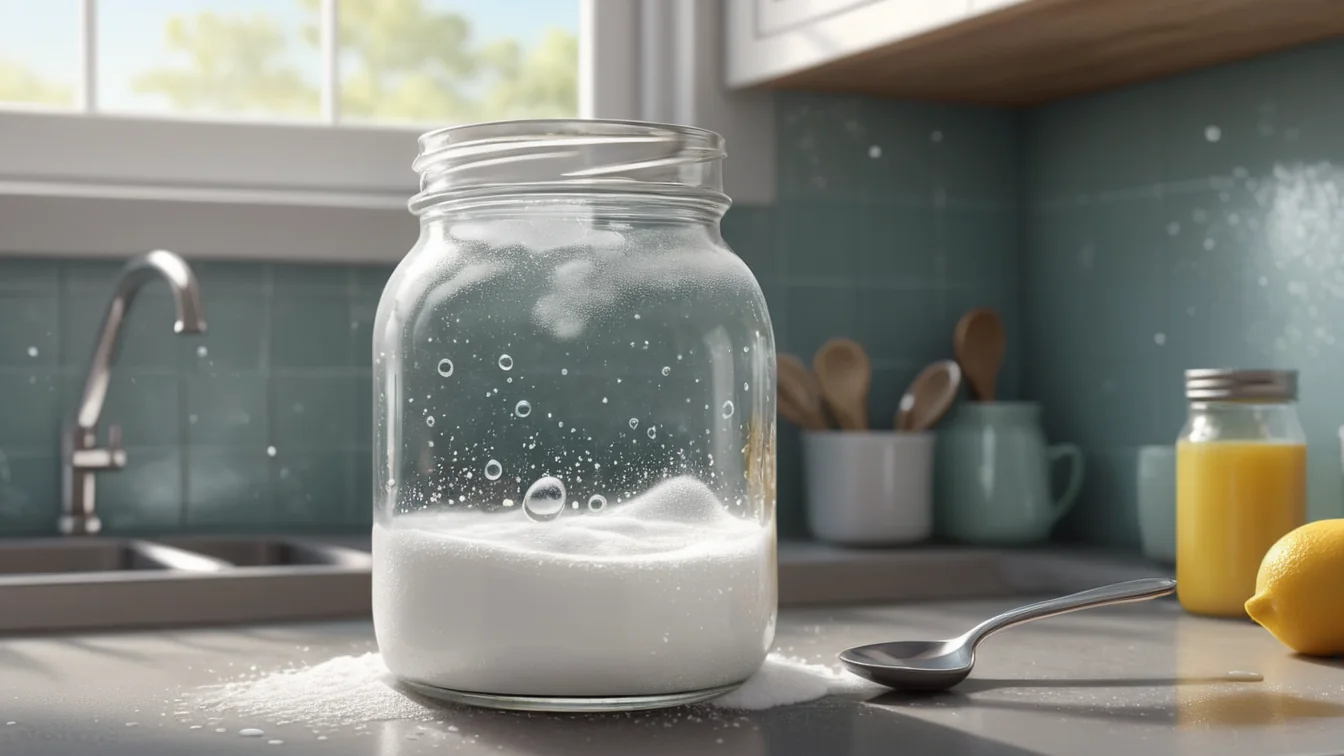
Pour vinegar onto baking soda and the mixture foams up in seconds. It looks as though something is boiling, but nothing has been heated. So what is making the fizz, and where does the gas come from?
The short answer: Baking soda is a base, and vinegar contains an acid. When they meet, they react and make carbon dioxide gas. The bubbles are that gas escaping from the liquid.[1][2]
Acids and bases in everyday life
An acid can give away a small particle called a proton, which is a hydrogen ion. A base can take that proton. The University of Maryland Eastern Shore chemistry course puts the standard definition this way: “acids and bases are proton donors and proton acceptors respectively according to the Brønsted-Lowry definition.”[3]
Vinegar’s sour taste comes from acetic acid. In water, acetic acid only partly breaks apart into ions. A University of Washington demonstration shows the equilibrium: CH₃COOH + H₂O ⇌ CH₃COO⁻ + H₃O⁺.[2] The H₃O⁺ is the hydrogen ion that the acid can pass on in a reaction.
Baking soda is sodium bicarbonate. It contains a bicarbonate part that can take up a hydrogen ion from an acid.

The reaction makes a gas
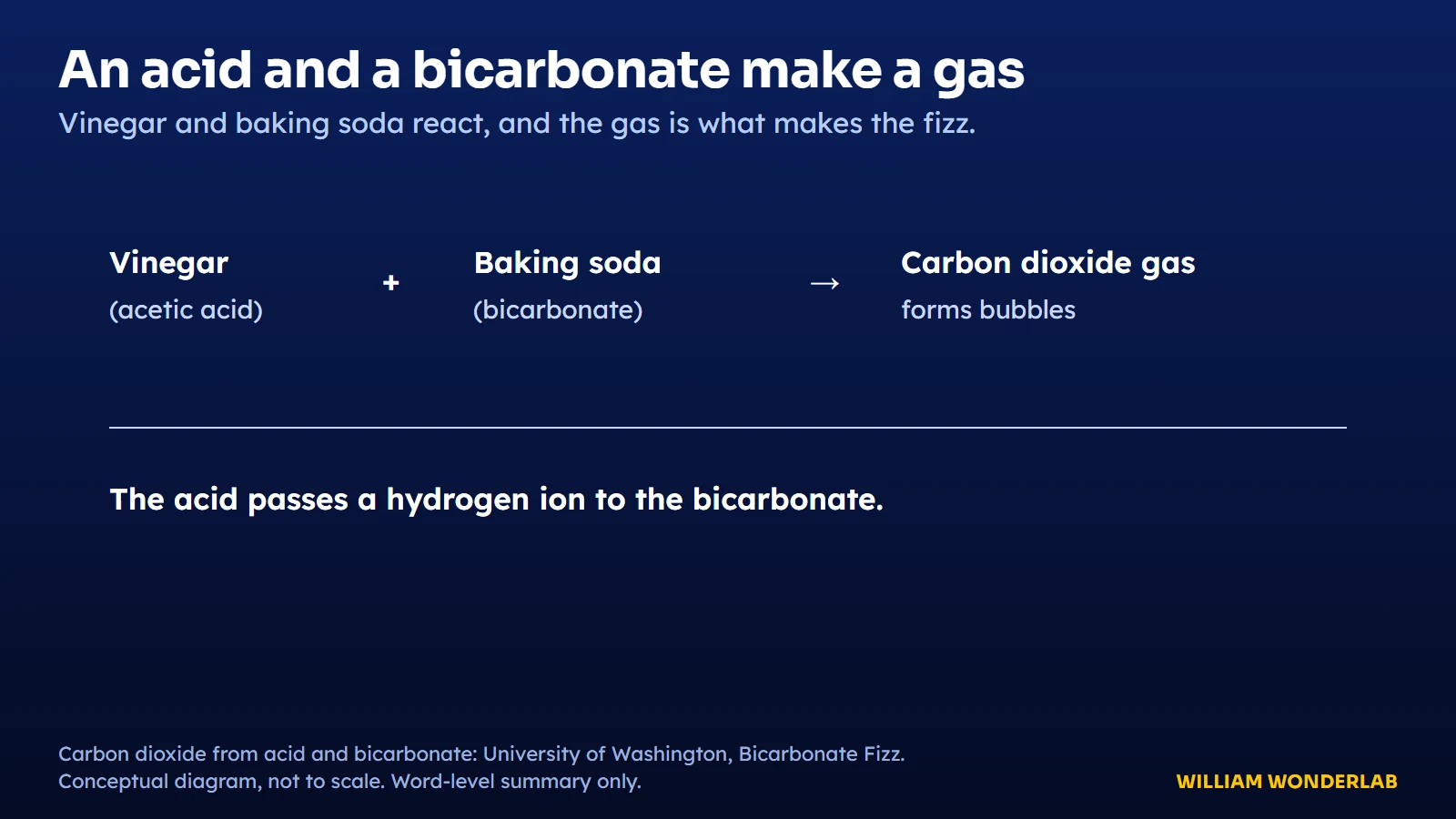
When acetic acid meets sodium bicarbonate, the acid passes a hydrogen ion to the bicarbonate. The reaction makes carbon dioxide gas.
A University of Washington demonstration uses the same kind of acid-and-bicarbonate reaction, with hydrochloric acid instead of vinegar. It describes that the solution “is reacted with hydrochloric acid to form carbon dioxide gas.”[1] The fizzing you see is that gas forming bubbles in the liquid and rising to the surface.
Why the bubbles appear
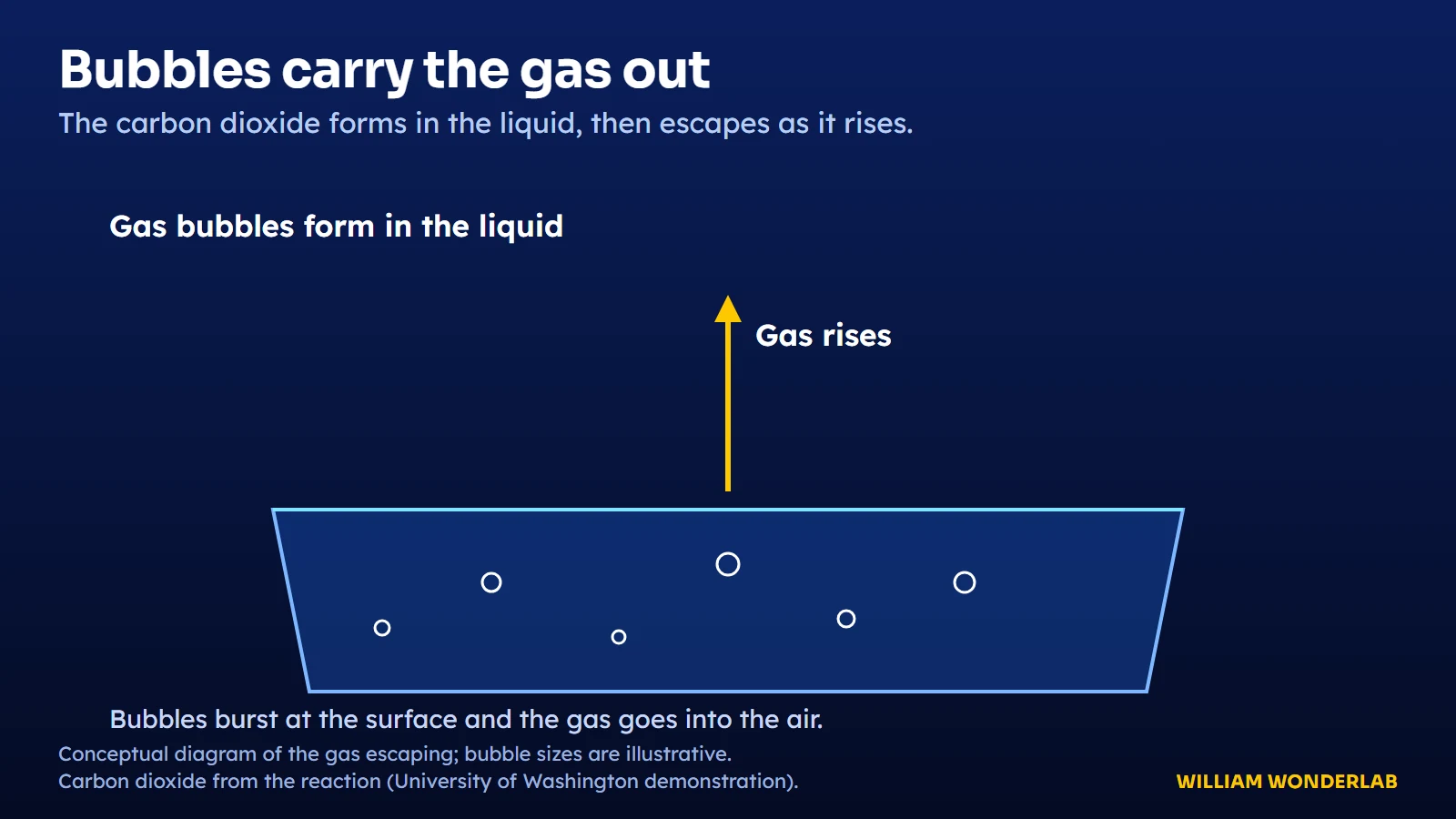
The gas forms inside the liquid, and bubbles appear as it collects and rises. When the bubbles reach the surface they burst and the gas goes into the air.
The same demonstration uses the gas to inflate a balloon: “The carbon dioxide produced blows up the balloon.”[1]
Did you know? The bubbles are not air. They are carbon dioxide made by the chemical reaction, so the fizz is the mixture making its own gas as it reacts.[1]
Why the mixture can look like it is boiling
Fizzing from a chemical reaction looks a bit like boiling, but it is not heating. The activity below uses no heat at all. The gas is made by the reaction between the acid and the bicarbonate.
The University of Washington demonstration also shows a colour change. It adds universal indicator, a dye that changes colour with acidity. In that demonstration, which uses hydrochloric acid rather than vinegar, the solution “fizzes and turns red.”[1] Vinegar is not shown to give the same colour change, so do not expect it at home.
Try it: a fizzing bowl
This is a proposed at-home activity using common kitchen items. An adult should be present, and the reaction should happen in an open bowl or tray.
You need: a bowl or baking tray, two tablespoons of baking soda, about half a cup of plain white vinegar, a measuring spoon, a small cup, safety glasses, and some paper towels.
- Predict what will happen when you add the vinegar to the baking soda. Write down whether you expect a lot or a little fizzing.
- Put the baking soda in the bowl. Put the vinegar in the cup.
- Put on safety glasses. Pour the vinegar onto the baking soda slowly, then watch the fizz.
- Count to thirty while the fizzing continues. Note whether the bubbles slow down as the reaction runs out.
- Compare the result with your prediction. Explain the bubbles using the words “carbon dioxide gas”.
What to expect: the mixture fizzes for a short time, then calms down once one of the ingredients is used up. Results depend on how much of each you use, so treat your notes as an observation rather than a measurement.
Safety first: Wear safety glasses for the whole activity, because vinegar can sting the eyes. If vinegar or baking soda gets in an eye, rinse it with clean water for several minutes and get advice. Use an open bowl or tray, and never seal the mixture in a bottle or container, because the gas needs somewhere to go. Do not taste, drink or eat the mixture. Wipe up spills at once so no one slips. Keep young children close, do this activity with an adult, and wash your hands afterwards.
Go deeper: acids, bases and gases
Why this is an acid-base reaction
Acid-base reactions are about moving protons. In this case, the acid gives a hydrogen ion to the bicarbonate. The Lumen Learning chapter on Brønsted-Lowry acids and bases describes the general pattern: “There is one acid and one base as reactants, and one acid and one base as products.”[3]
Why the same idea appears in fizzy drinks
The gas made here escapes as bubbles in the same way that dissolved gas does in a fizzy drink. You can read about that in What Makes the Bubbles in Fizzy Drinks?
Frequently asked questions
Is baking soda and vinegar a chemical reaction?
Yes. The acid and the bicarbonate react to make new substances, including carbon dioxide gas.[1][2]
Does the mixture need heat to fizz?
No. The activity needs no heating, and the gas is made by the reaction itself.
Why does the fizzing stop?
Once the bicarbonate or the acid has been used up, there is no more reaction to make gas.
The big idea
An acid meets a base, and a gas escapes. Vinegar’s acid and baking soda’s bicarbonate react to make carbon dioxide, which bubbles out as the fizz.
Related reading
More from William Wonderlab:
Explore more from scientists:
- Bicarbonate Fizz (University of Washington Department of Chemistry, lecture demonstration)
- Conductivity Change of Acetic Acid with Dilution (University of Washington, lecture demonstration)
- Brønsted-Lowry Acids and Bases (Lumen Learning, UMES Chemistry)
References
[1] University of Washington Department of Chemistry, “Bicarbonate Fizz” lecture demonstration (accessed 25 October 2026)
[2] University of Washington Department of Chemistry, “Conductivity Change of Acetic Acid with Dilution” lecture demonstration (accessed 25 October 2026)
[3] Lumen Learning (University of Maryland Eastern Shore chemistry course), “Brønsted-Lowry Acids and Bases” (accessed 25 October 2026)