Why Does Copper Turn Green?
A new copper object is shiny and brown-pink. Over time it reacts with the air and turns blue-green. That coating is called patina.
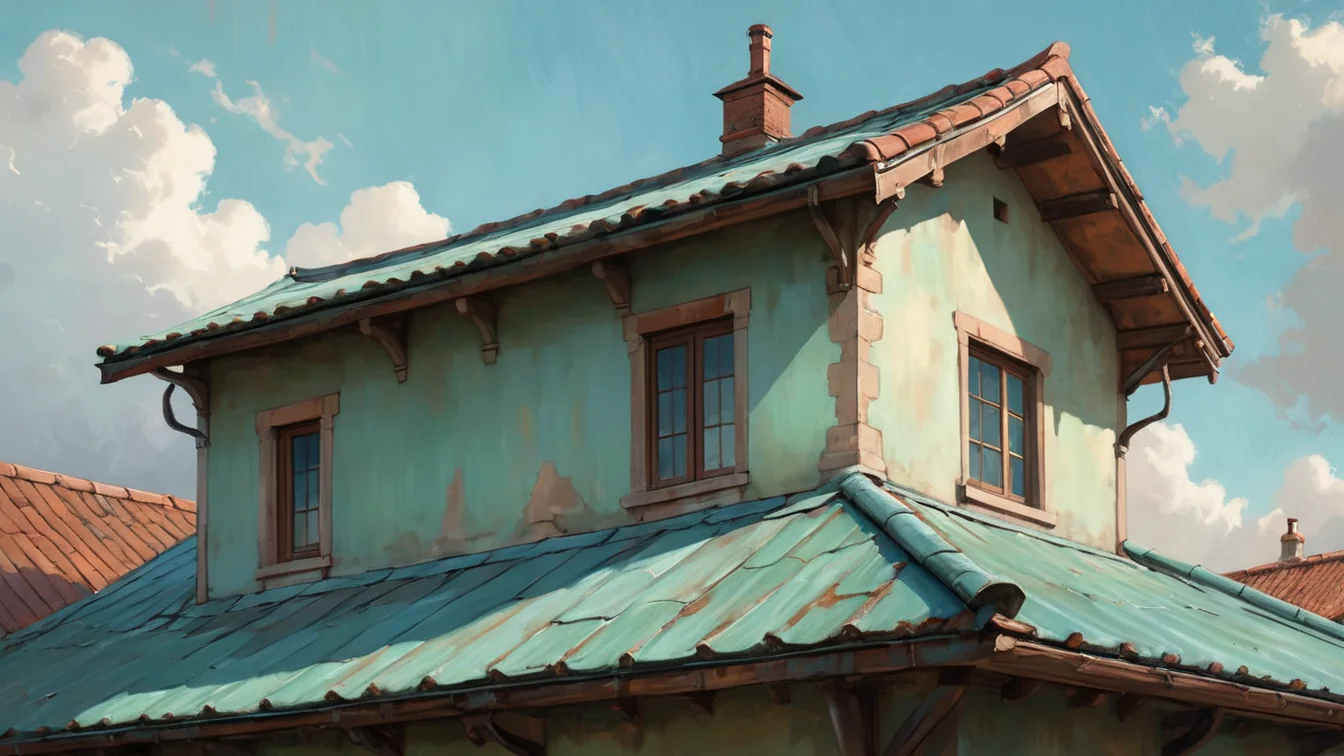
A new copper pipe or coin is shiny and pinkish-brown. Leave it outside for years and it can turn a blue-green colour, sometimes on the roofs of old buildings and on bronze statues. Nobody paints it. The colour simply appears. So what is happening to the copper?
The short answer: Copper reacts slowly with the air. First it forms a reddish copper oxide. Then that oxide reacts with carbon dioxide and water in the air and coats the surface with a blue-green layer called patina.[1][2]
Copper and the air
Copper is a metal that reacts with the air over time. The Royal Society of Chemistry’s education site notes that “copper and copper alloys like bronze will corrode with long exposure to the air.”[2] A bronze statue is a copper alloy, so it changes in the same way.
Chemists call this kind of change corrosion. The RSC page describes it as “the oxidation of copper; a chemical reaction between copper and oxygen in which copper oxide can be produced.”[2] In everyday words, the copper slowly combines with oxygen from the air, and the surface changes.
Corrosion does not happen in a flash. It is a slow process that can take many years outdoors.
From reddish oxide to blue-green patina
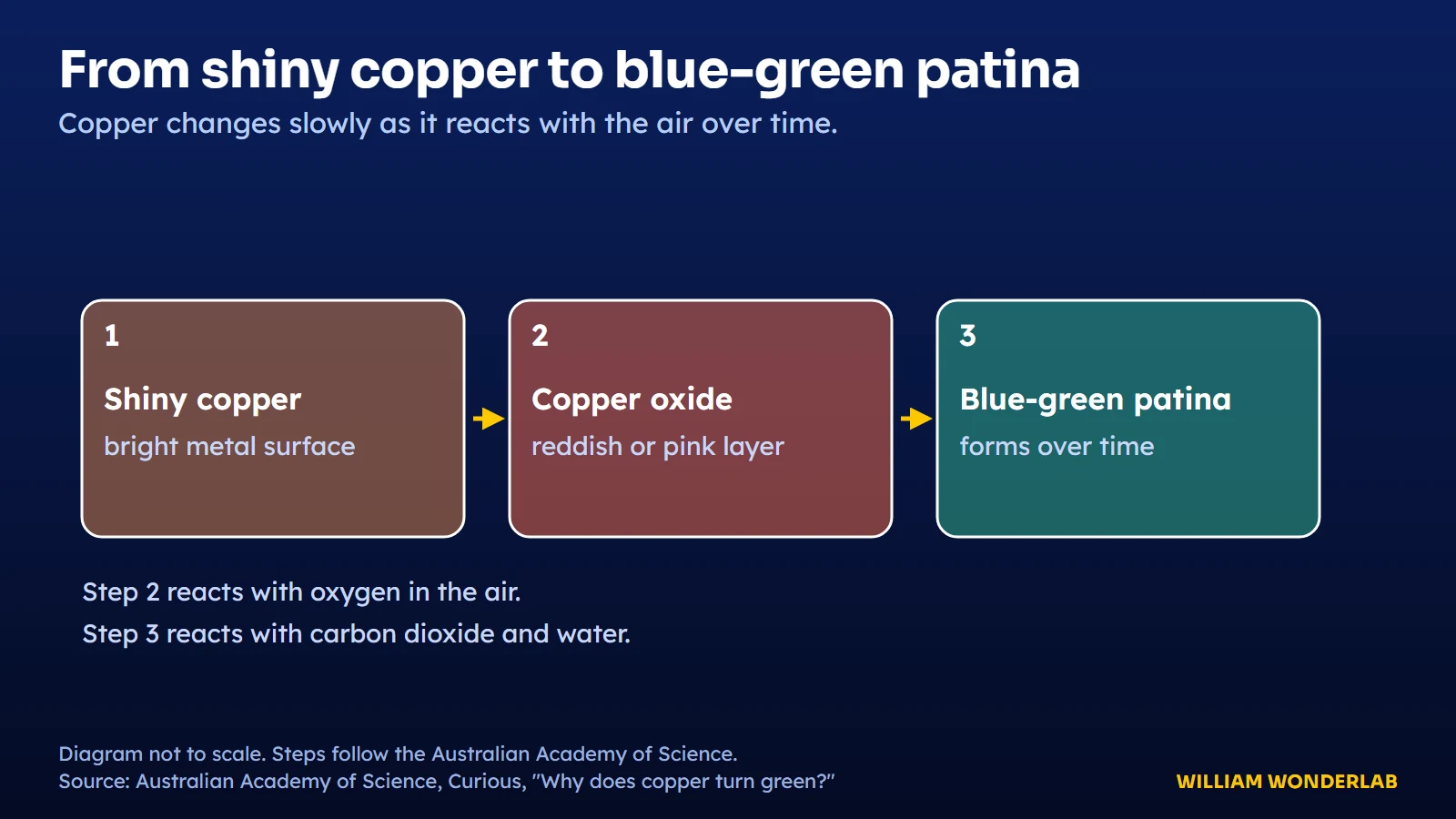
The Australian Academy of Science explains the change in steps. First, “copper will start to react with the oxygen in the air to form copper oxide.” The Academy’s equation labels this product as reddish or pink.[1]
The next step is the green colour. The Academy says that “as the copper oxide continues to react with carbon dioxide and water in the air,” the surface becomes coated “with that iconic blue-green patina colour.”[1] The Academy writes this step as a chemical equation, with copper oxide, carbon dioxide and water as the starting materials and the patina as the product.[1]
So the green is not paint and not dirt. It is a new chemical layer that forms on the surface of the copper, made of different copper compounds from the metal underneath.
Did you know? The Royal Society of Chemistry notes that the ancient Greeks and Romans deliberately corroded copper to make a pigment called verdigris.[2]
Verdigris is not the same as patina
People often use the word “verdigris” for the green on old copper. The RSC describes verdigris as a pigment that people deliberately made by corroding copper, and its resource links the process to a vinegar mixture.[2] In the strictest sense, the green on an outdoor roof or statue is a patina that formed naturally, not a pigment made in a workshop.
How long does it take?
The change is slow. The RSC describes copper and bronze corroding “with long exposure to the air,” which means the process needs time.[2]
The timing also depends on the object. The National Park Service says that “it took about thirty years for the Statue of Liberty to fully oxidize and form a patina.”[3] A Rice University chemistry page says that this kind of patina “is characteristic of objects that have had long exposure to the elements.”[4] The same page says the colour depends on the other anions present, and that in one restoration analysis the patina was mainly brochantite, a copper compound that contains sulfate.[4]
Everyday examples
- A new copper pipe. It looks bright and pinkish-brown. Over many years, exposure to air can change its surface.
- An old bronze statue. Bronze is a copper alloy, so the same slow corrosion can give it a green coating.[2]
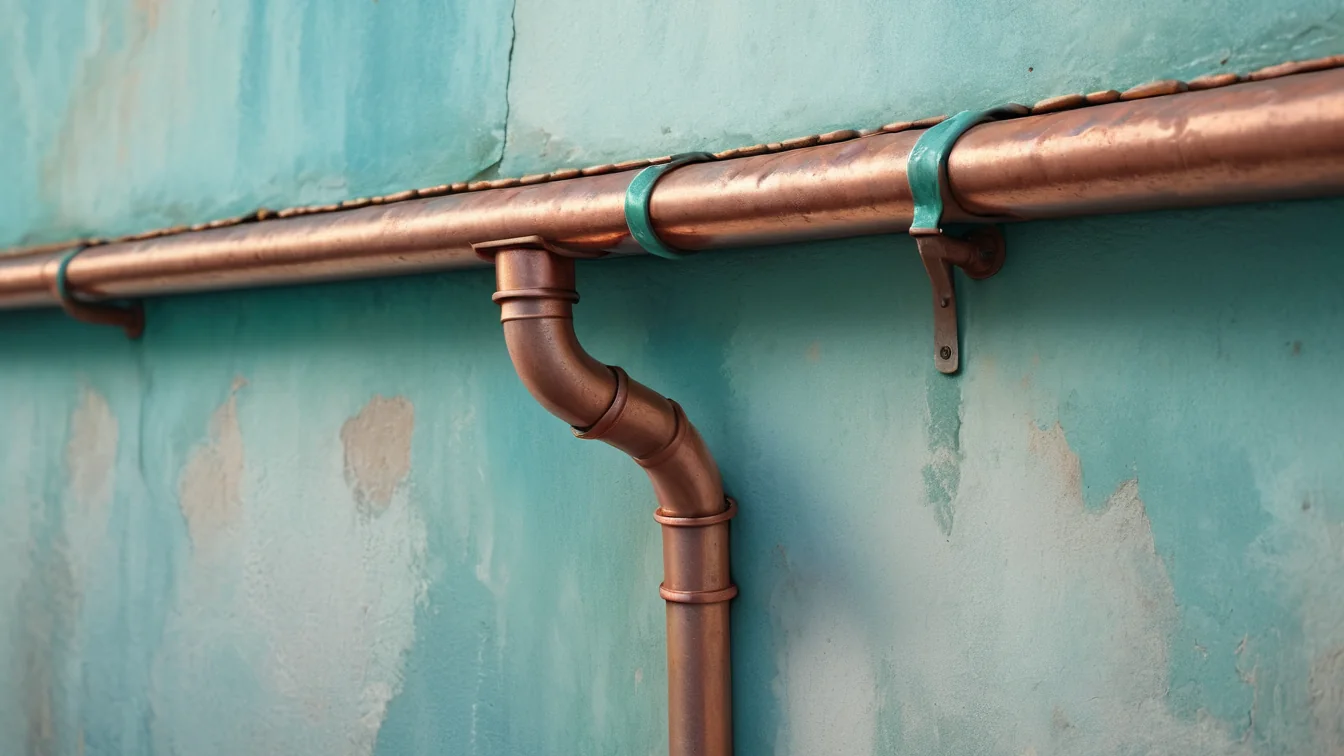
- A copper gutter and downpipe. The change is slow, so copper pipes can look brown-pink for a long time.
Try it: observe, do not touch
This is an observation activity only. You will look at copper or bronze that is already outside. You will not clean, scrub, or touch it with any chemicals.
You need: a notebook, a pencil, and a copper or bronze object that is already outside and safe to look at, such as a roof edge, a garden ornament or a statue in a public park.
- Predict what colour the metal will be. Is it shiny, brown, pink or green?
- Look at the object from a short distance. Note the colours, and where the green is strongest.
- Look for a sheltered part and an exposed part of the same object. Compare them.
- Write down what you noticed. Did the colour change where rain runs off? Did the sheltered part look different?
What to expect: exposed parts may look greener than parts that are sheltered from weather, but the amount of change depends on the object and the air where it sits.
Safety first: Do not climb, lean on or reach up to any roof, statue or structure to get a closer look. Observe only from the ground and from a safe distance. Do not scrub, scrape, or clean the metal, and do not use any chemicals. Keep to paths and public areas, and watch for traffic and uneven ground. Wash your hands after touching any outdoor metal. A grown-up should go with anyone under 12.
Go deeper: oxidation and the chemistry of patina
Oxidation
The RSC describes corrosion of copper as its oxidation, a reaction with oxygen.[2] Oxidation is a type of chemical reaction, and it is why copper changes colour over time.
Why the layer is blue-green
The Academy’s equations show the copper oxide reacting with carbon dioxide and water to make the blue-green product.[1] The colour comes from the new layer that forms on the surface of the copper.
Frequently asked questions
Why does copper turn green?
Copper reacts slowly with oxygen, carbon dioxide and water in the air. The reaction makes a blue-green layer on the surface, called patina.[1]
Is the green colour paint?
No. It is a chemical layer that forms on the copper itself.[1]
Is bronze different from copper?
Bronze is a copper alloy. The RSC notes that copper alloys like bronze also corrode with long exposure to the air.[2]
How long does it take?
The RSC describes copper and bronze corroding with long exposure to air, so the change is slow.[2]
The big idea
Air changes the surface. Copper reacts slowly with oxygen, carbon dioxide and water. The result is a blue-green patina on the metal.
Related reading
More from William Wonderlab:
Explore more from scientists:
- Australian Academy of Science, Curious: Why does copper turn green?
- Royal Society of Chemistry, Education: Verdigris copper
- National Park Service, Statue of Liberty: Frequently Asked Questions
References
[1] Australian Academy of Science, Curious, “Why does copper turn green?” (accessed 25 October 2026)
[2] Royal Society of Chemistry (education), “Verdigris copper” (accessed 25 October 2026)
[3] National Park Service, Statue of Liberty National Monument, “Frequently Asked Questions” (accessed 25 October 2026)
[4] Rice University, Chemart, “Sculpture” (accessed 25 October 2026)