How Does a Candle Burn?
A candle does not burn as a solid lump of wax. Heat melts the wax, the wick draws it upward, and the wax vapour is what burns in the flame.

A candle looks as if it is burning the solid block of wax underneath the flame. Yet solid wax does not catch fire in that way. Something else has to happen first, and it is explained in a famous series of lectures given by Michael Faraday at the Royal Institution.[1]
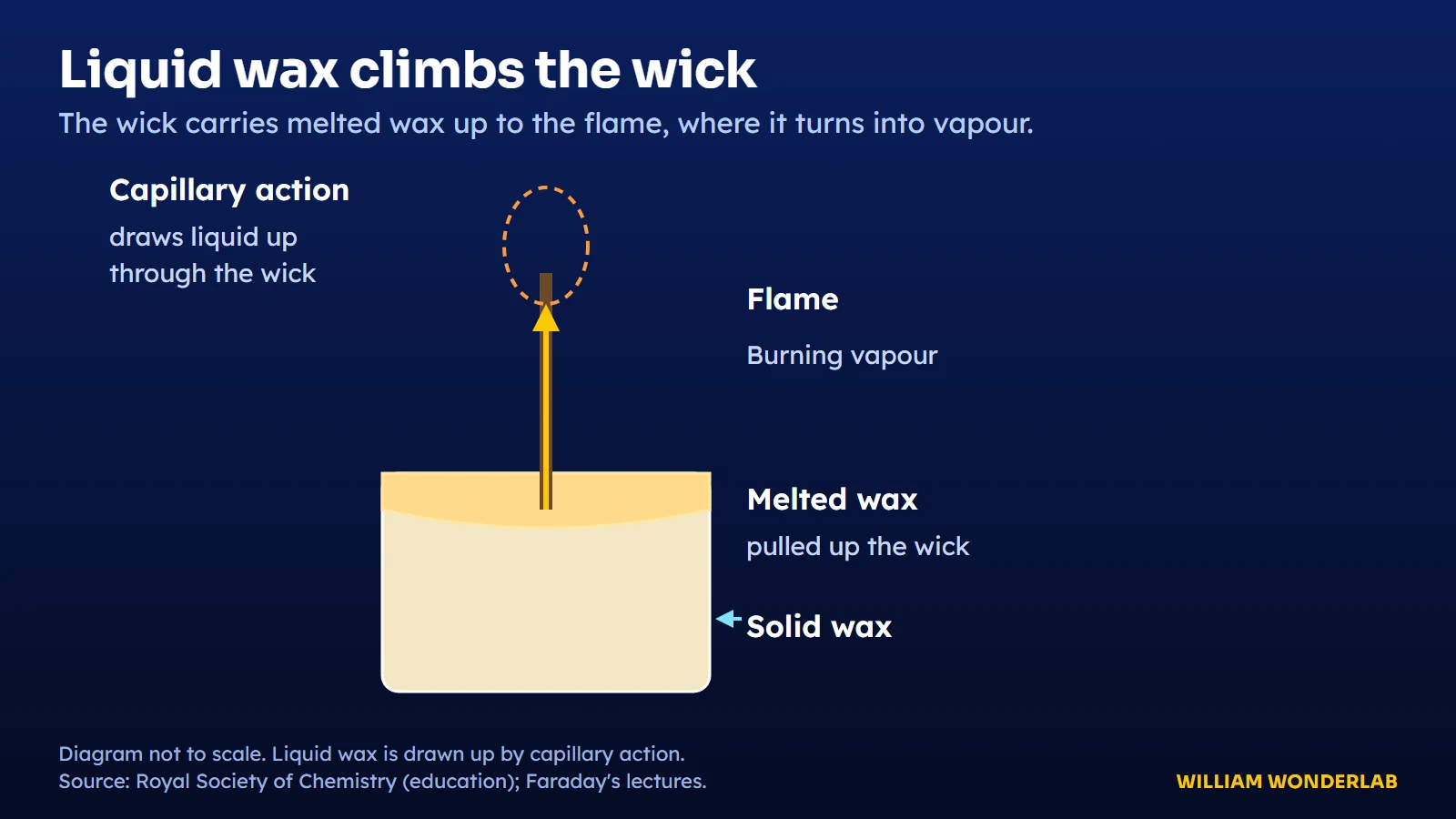
The short answer: The wick does not simply soak up a solid fuel and burn it. The heat of the flame melts the wax near the wick, capillary action draws the liquid wax up the wick, and the heat turns it into a gas. It is that wax vapour that burns.[1][2]
Solid wax has to melt first
Wax is a solid at room temperature. When you light a candle, the heat from the flame reaches the top of the wax. Near the wick, the wax softens and melts into a small pool. You can see this pool as the shiny, clear layer that surrounds the wick.
Faraday’s lectures describe the liquid moving upward. He wrote about the melted fuel in a candle: “In like manner the particles of melted tallow ascend the cotton and get to the top.”[2]
Capillary action: how the wick lifts the wax
The wick is a small cord of fibres. Liquid wax is drawn up through the tiny gaps between those fibres. Scientists call this capillary action. It is the same kind of effect that lets a paper towel soak up a spill.
Faraday explained the same idea in his own words: “It is by what is called capillary attraction that the fuel is conveyed to the part where combustion goes on.”[2] In other words, the wick is the delivery system. It carries the fuel from the pool of melted wax to the flame.
Wax vapour is what burns
The most surprising part of the story is that the liquid wax does not burn either. The Royal Society of Chemistry’s education site describes it plainly: “In a burning candle, wax is drawn up the wick by capillary action and evaporates, so what is burned is a gas.”[1]
The same page adds that “it is not liquid wax that burns.”[1] The flame is burning a cloud of gaseous wax just above the wick. Faraday described this too, writing that “in the middle of the flame, where the wick is, there is this combustible vapour.”[2]
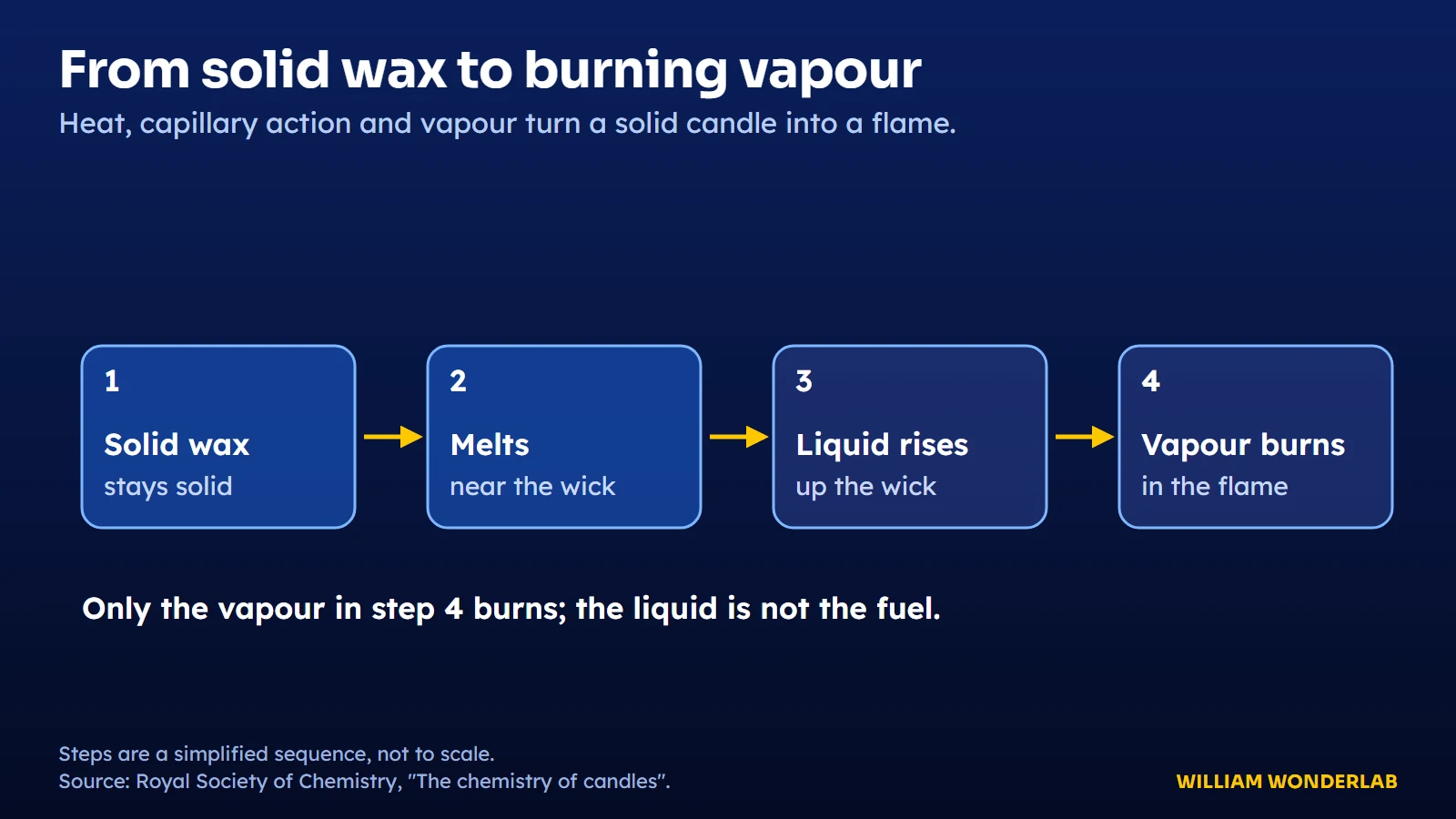
So a candle works like a small, steady production line. Heat melts the wax, the wick carries the liquid up, the heat turns it into vapour, and the vapour burns at the top of the wick.
Did you know? Faraday’s lectures on the candle were later published as a book, The Chemical History of a Candle (1861).[1]
A common mistake: the solid lump burns
It is easy to think that a candle burns its whole block of wax at once. It does not. The flame is burning vapour, and the solid wax lower down stays a solid until it is melted and drawn up the wick. The fuel that burns is the gas, not the lump.[1]
Everyday examples
- A paper towel soaking up a spill. The towel is made of fibres with tiny gaps, like the wick. The liquid climbs into the gaps and spreads.
- A melted pool around a candle. The shiny ring you see is the liquid wax waiting to be drawn up the wick.
- A candle that burns down. As the wax is used up, the level of the solid wax drops, and the candle becomes shorter.
Keep candles safe while they burn
A candle is an open flame, so it needs care. The Country Fire Authority (CFA), the fire service for Victoria, advises that you never leave candles burning without someone around.[3] It also says to keep candles at least one metre away from curtains and other objects that can catch fire, and to put them out before leaving home or going to sleep.[3]
Go deeper: reading Faraday for yourself
Why this lecture still matters
Faraday used one everyday object to explain a large scientific idea to a general audience. His lectures show how a candle can open the door to the chemistry of flames.[1]
Where to read the lectures
The 1908 edition of Faraday’s lectures, edited by William Crookes, is free on Project Gutenberg. Older readers who want Faraday’s own wording can start there. The Royal Society of Chemistry’s education article is a shorter guide to the same ideas.[1][2]
Frequently asked questions
Does a candle burn solid wax?
Not directly. Heat melts the wax near the wick, and the liquid is drawn up the wick and turned into vapour. The vapour is what burns.[1]
What is capillary action?
It is the way a liquid is drawn up through narrow gaps, such as the fibres of a wick. Faraday described it as the way fuel is carried to the flame.[2]
Why does a candle need a wick?
The wick carries the melted wax to the flame. Faraday called this capillary attraction.[2]
Did Faraday write about candles?
Yes. His lectures on the chemistry of a candle were given at the Royal Institution and later published as The Chemical History of a Candle.[1]
The big idea
The flame burns a gas. A candle works by melting its wax, drawing the liquid up the wick, turning it into vapour and burning the vapour.
Related reading
More from William Wonderlab:
Explore more from scientists:
- Royal Society of Chemistry: The Chemistry of Candles
- Michael Faraday, The Chemical History of a Candle (Project Gutenberg)
References
[1] Royal Society of Chemistry, Education, “The chemistry of candles” (accessed 25 October 2026)
[2] Michael Faraday, “The Chemical History of a Candle” (1908 edition, edited by William Crookes), Project Gutenberg (accessed 25 October 2026)
[3] Country Fire Authority (CFA), Victoria, “Candle, oil burner and incense safety” (accessed 25 October 2026)