How Does a Magnifying Glass Make Things Look Bigger?
A magnifying glass bends light as it passes through the curved glass. Hold it close to a small print and the letters look bigger, upright and clearer.
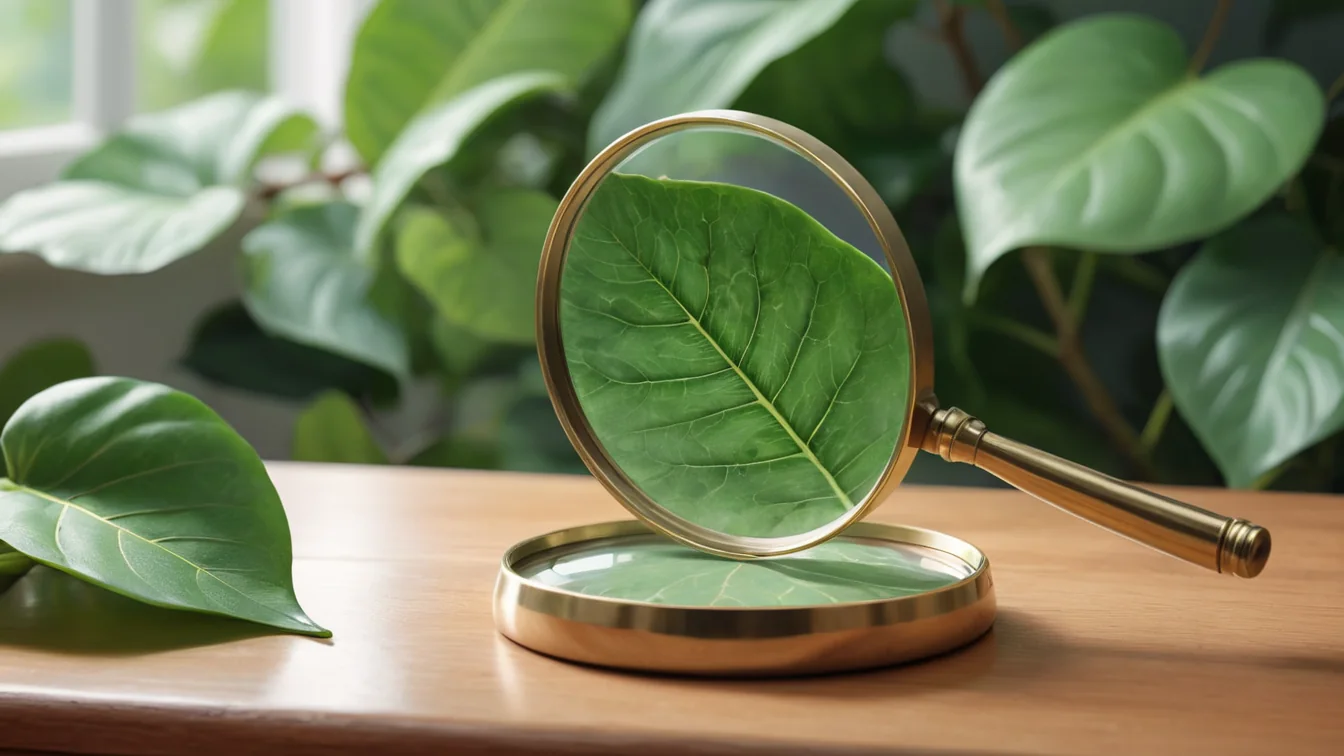
Hold a magnifying glass over a tiny printed word and the letters swell up, as if someone had made them bigger. The page has not changed, so what is happening between the glass and your eye?
The short answer: A magnifying glass is a convex lens, which is thicker in the middle than at the edges. It bends light as the light enters and leaves the glass. When the object is closer to the lens than its focal point, your eye sees an upright, enlarged image that appears to sit on the same side as the object.[1][2]
Light bends when it enters glass
Light usually travels in straight lines, but it changes direction when it moves from one material into another. Science Learning Hub, the New Zealand science education site, explains that “when light travels from air into water, it slows down, causing it to change direction slightly.” Glass also slows light down, so the same thing happens at the glass surface.[1]
This bending is called refraction.
Why the middle of the lens matters
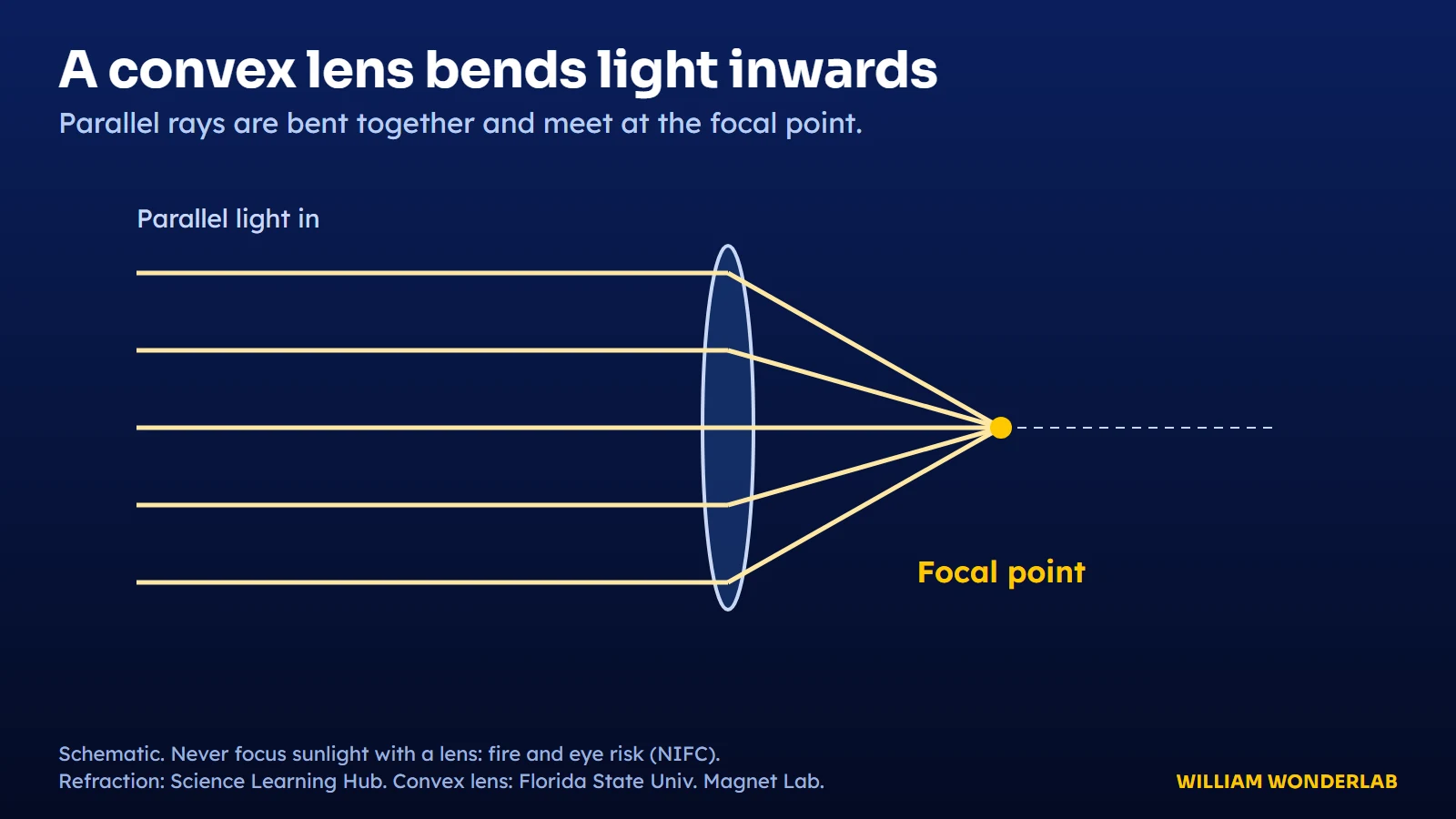
A magnifying glass is shaped so that the light bends together, not apart. The Florida State University Magnet Lab describes these lenses as “thicker at the center than the periphery,” and says that a common bi-convex lens “causes light rays to converge, or concentrate, to form a real image.”[3]
Science Learning Hub describes the path of light through this shape: “Each light ray entering a converging (convex) lens refracts inwards as it enters the lens and inwards again as it leaves.”[1] Light is bent inwards at the front surface and again at the back surface, so rays that start out parallel are pulled towards one point called the focal point.
The virtual image: bigger, upright, on the same side
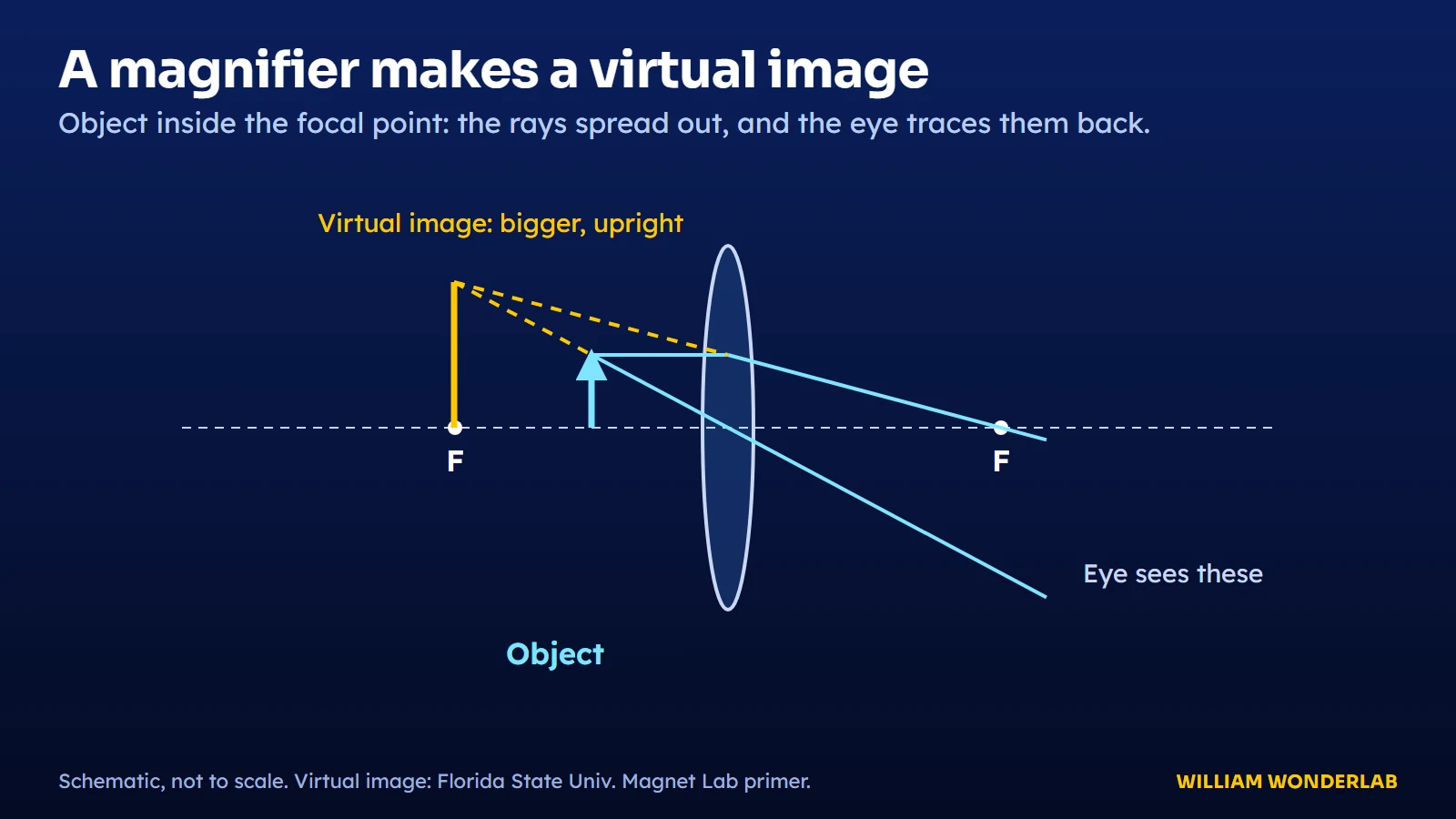
Here is the twist. When the object sits closer to the lens than the focal point, the rays leaving the lens spread out. They never actually meet on the far side. Your eye, though, traces the spreading rays back, and they seem to come from a larger picture of the object on the same side as the object.
Florida State University’s microscopy primer says it directly: “Magnifying glasses produce a virtual image that is magnified and upright.” It adds that the image “appears to be on the same side of the lens as the object.”[2] The image is “always” upright, not inverted, to the person looking through the lens.[2]
Because the rays never truly meet, a magnified image cannot be caught on a piece of paper or a screen. The FSU primer explains that a virtual image cannot be projected because the light does not converge at it.[2]
Why small print becomes easy to read
Very small details are hard to see at a normal distance. A magnifier makes the letter look bigger in your view, so you can read tiny print on a label, a stamp, a coin or a leaf.
Magnifiers are common in everyday life. People use them to read small print, check a stamp, look at the grain of wood, or examine a small insect. Each use relies on the same idea: a convex lens that shows a larger, upright image.
Did you know? A real image is different. Light rays that really meet at a focal point form an image that can be viewed on a screen. A magnifier does not produce that kind of image when used as a magnifier.[2]
Try it: explore what the lens shows
This is a proposed at-home activity. It works indoors with a printed page. Do not use sunlight for this activity.
You need: a small magnifying glass, a printed newspaper or book page with small letters, and a clean table indoors.
- Predict what the smallest letters will look like through the magnifier. Write your prediction down.
- Sit at a table indoors under a lamp, with the printed page flat in front of you. Hold the magnifier just above the letters and look through it.
- Slowly move the magnifier up and down, and watch the letters. Record what happens to their size and their clarity.
- Compare with the same letters seen without the magnifier. Did your prediction match?
What to expect: through the lens, the letters look bigger and upright. Moving the lens changes how clear the image looks, so note the distance where the letters are sharpest.
Safety first: Never use a magnifying glass to focus sunlight. The National Interagency Fire Center warns that “a magnifying glass lens has a convex shape, which bends the sunlight,” and that “all the sunlight hitting the lens is concentrated into one focal point,” which can start a fire. Its advice is to “Avoid focusing convex glass lens, curved mirror, or magnifying glass on dry objects.”[4] Keep the lens away from your eyes and face, and always supervise young children when they use magnifying glasses.[4]
Go deeper: focal points and virtual images
What is the focal point?
The focal point is the place where parallel rays of light converge after passing through a convex lens. The distance from the lens to that point is the focal length. The Florida State University Magnet Lab marks this point on its diagrams of a bi-convex lens, with the focal length shown as a separate distance.[3]
Why a virtual image looks bigger
When an object sits inside the focal length, the rays that leave the lens diverge. Your eye assumes light travels in straight lines, so it traces those diverging rays backwards. The backward lines meet at a point that is farther from the lens and larger than the object. That is the virtual image you see.[2]
Frequently asked questions
Is a magnifying glass a lens?
Yes. A magnifying glass is a convex lens, which is thicker in the middle than at the edges.[3]
Why is the image upright?
A magnifying glass forms an image that is upright, not inverted, when viewed through the lens.[2]
Can I project the image onto paper?
No. A magnifier produces a virtual image, and the light does not converge at a place where it could be caught on a screen.[2]
Can I use a magnifying glass to start a fire?
Please do not. Focusing sunlight through a magnifying glass can start a fire on dry material, so keep it away from dry objects and never focus sunlight with it.[4]
Does a magnifying glass make the object closer?
No. The object stays where it is. The lens changes the light that reaches your eye, so the object appears larger.[2]
The big idea
A magnifier bends light so your eye sees a bigger picture. A convex lens bends light inwards, and when the object is inside the focal length, the rays spread out. Your eye traces them back to a larger, upright virtual image on the same side as the object.
Related reading
More from William Wonderlab:
Explore more from scientists:
- Refraction of light (Science Learning Hub)
- Simple magnification (Florida State University, Magnet Lab Microscopy Primer)
References
[1] Science Learning Hub (New Zealand), “Refraction of light” (accessed 25 October 2026)
[2] Florida State University, National High Magnetic Field Laboratory, Microscopy Primer, “Simple Magnification” (accessed 25 October 2026)
[3] Florida State University, National High Magnetic Field Laboratory, “Introduction to Lenses” (Molecular Expressions) (accessed 25 October 2026)
[4] National Interagency Fire Center (US), “Wildfire Investigation” (accessed 25 October 2026)