What Is a Comet?
A comet is a frozen core of ice and dust. As it nears the Sun, the ice turns to gas, forming a glowing cloud and tails that point away from the Sun.
Most nights the sky looks the same from one week to the next. Then, every so often, a faint, fuzzy star appears with a long glowing tail. Comets are some of the oldest objects we can study. ESA describes them as “time capsules containing primitive material left over from the epoch when the Sun and its planets formed.”[2]
The short answer: A comet is a small body of frozen ice and dust. As it nears the Sun, its ice heats up and turns to gas, which forms a glowing cloud and tails. The tails point away from the Sun, whichever way the comet is moving.[1]
A frozen core
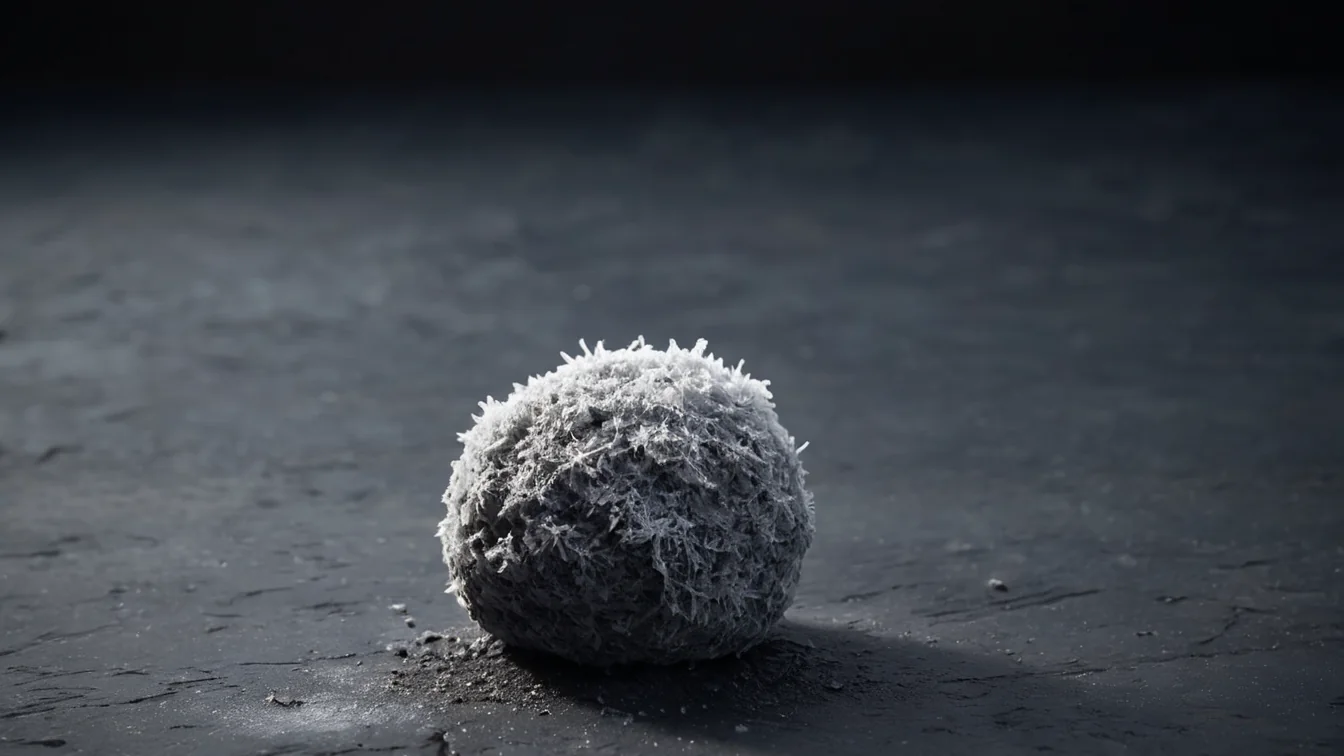
NASA’s Space Place explains the centre of a comet: “At the heart of every comet is a solid, frozen core called the nucleus.”[1] Many people call comets “dirty snowballs”, because the core is a mix of ice and dust. The Max Planck Institute for Solar System Research reports that comet 67P/Churyumov-Gerasimenko, studied by the Rosetta mission, sends out jets of dust and gas into space.[3] Those jets come from the nucleus itself.
Heating up: the coma
The change comes when a comet travels closer to the Sun. NASA says, “when a comet gets close to the Sun, it starts heating up.”[1] Then, “eventually, the ice begins to turn to gas.”[1]
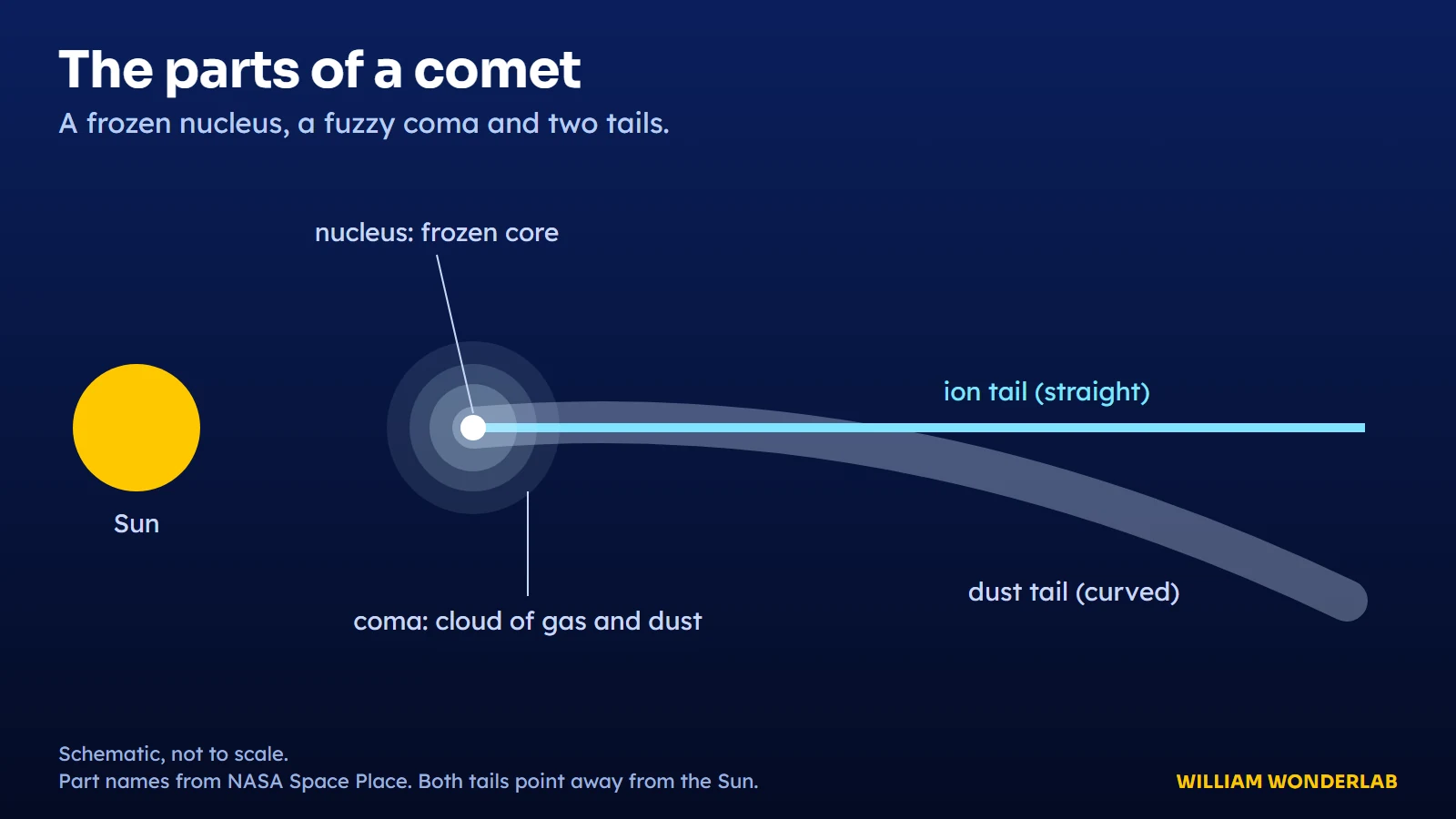
The gas and dust that escape from the nucleus form a cloud around it. NASA calls this “a huge, fuzzy cloud around the nucleus called the coma.”[1]
Two tails, two directions
A comet often has two tails, and they look different. NASA describes the dust tail as one that “traces a broad, gently curving path away from the Sun.”[1] The ion tail is the bluish one. NASA says it “always points directly away from the Sun.”[1]
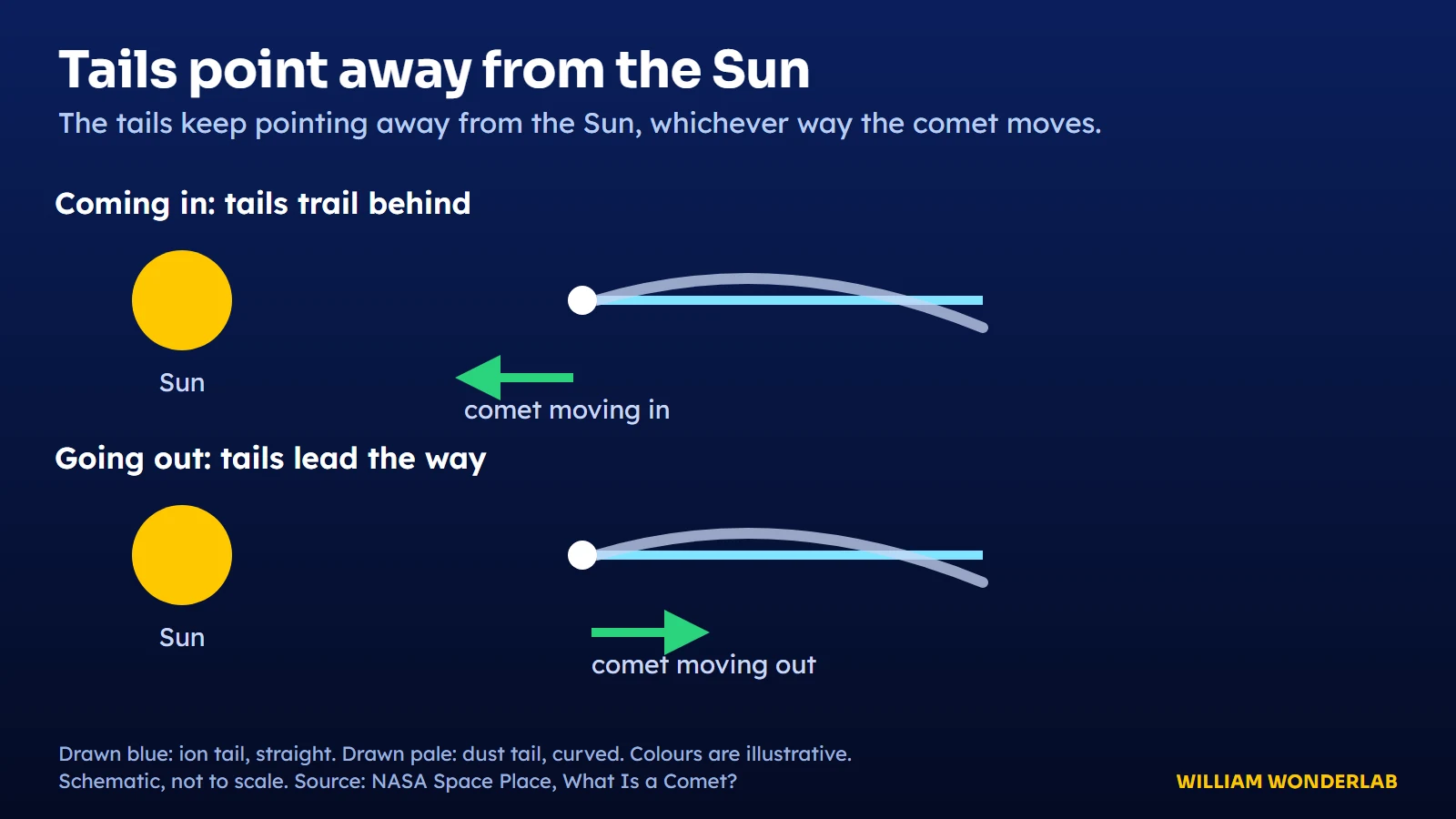
Because both tails point away from the Sun, the tail does not always trail behind the comet. Once a comet has passed the Sun and is heading back out, its tails point forwards, in the direction it is travelling.[1]
Try it: a dirty-snowball model
This is a proposed at-home activity. It is a rough model of a nucleus, not a real comet, and it does not show tails.
You need: a small paper cup, about 100 mL of water, a teaspoon of cocoa powder, a spoon, and a freezer. An adult should use the freezer.
- Stir the cocoa into the water until it looks like chocolate milk. Predict what will happen to the cocoa as the water freezes and then melts.
- An adult puts the cup in the freezer until the mixture is solid, which may take several hours.
- Take the cup out, let the ice soften a little, and peel away the paper. Set the frozen model on a plate by a sunny window.
- Watch as the ice melts. Note which part is left behind when the water has gone.
What to expect: The ice melts and leaves a dark, dusty layer on the plate. Real comets are a mix of ice and dust in a similar way, but the Sun’s heating in space is very different from a window, so compare the model with care.
Safety first: An adult should handle the freezer and remove the frozen cup. Do not put the cup in the microwave or near electrical sockets. Do not look straight at the Sun through the window or a lens, and do not put the model in direct, strong sunlight on a hot day. Wash your hands after handling the cocoa, and do not eat or drink the model.
Go deeper: the Rosetta mission
Visiting a comet
The European Space Agency’s Rosetta mission studied comet 67P/Churyumov-Gerasimenko. ESA says the mission was “the first to deploy a lander to a comet’s surface.”[4] The Max Planck Institute describes the same event: “an unmanned probe landed on a comet nucleus for the first time ever.”[3] The lander, Philae, reached the surface on 12 November 2014.[4]
Why the study matters
ESA describes comets as “time capsules” because they keep material from when the Sun and planets were forming.[2] By studying the gas, dust and structure of comet 67P, scientists can learn about the early Solar System. That makes comets useful evidence, not just a pretty sight in the sky.
Frequently asked questions
What is the solid part of a comet called?
It is the nucleus, a solid, frozen core.[1]
Why does a comet grow a tail?
As it gets close to the Sun, its ice heats up and turns to gas. The gas and dust escape and form a cloud and tails.[1]
Which way do comet tails point?
Away from the Sun. The ion tail always points directly away from it, and the dust tail curves away from it.[1]
Has a spacecraft landed on a comet?
Yes. The Rosetta mission delivered the Philae lander to comet 67P on 12 November 2014.[3][4]
Why are comets important to scientists?
They are time capsules that hold material from when the Sun and planets formed.[2]
The big idea
A frozen core makes a glowing visitor. A comet’s ice turns to gas as it nears the Sun, and the gas and dust stream away from the Sun to form its tails.
Related reading
More from William Wonderlab:
Explore more from scientists:
References
[1] NASA Space Place, “What Is a Comet?” (accessed 25 October 2026)
[2] European Space Agency (ESA), “Rosetta” (accessed 25 October 2026)
[3] Max Planck Institute for Solar System Research, “Rosetta” (accessed 25 October 2026)
[4] European Space Agency (ESA), “Rosetta” (mission timeline and Philae lander delivery, 12 November 2014) (accessed 25 October 2026)