Why Do You Lurch Forward When a Car Stops Suddenly?
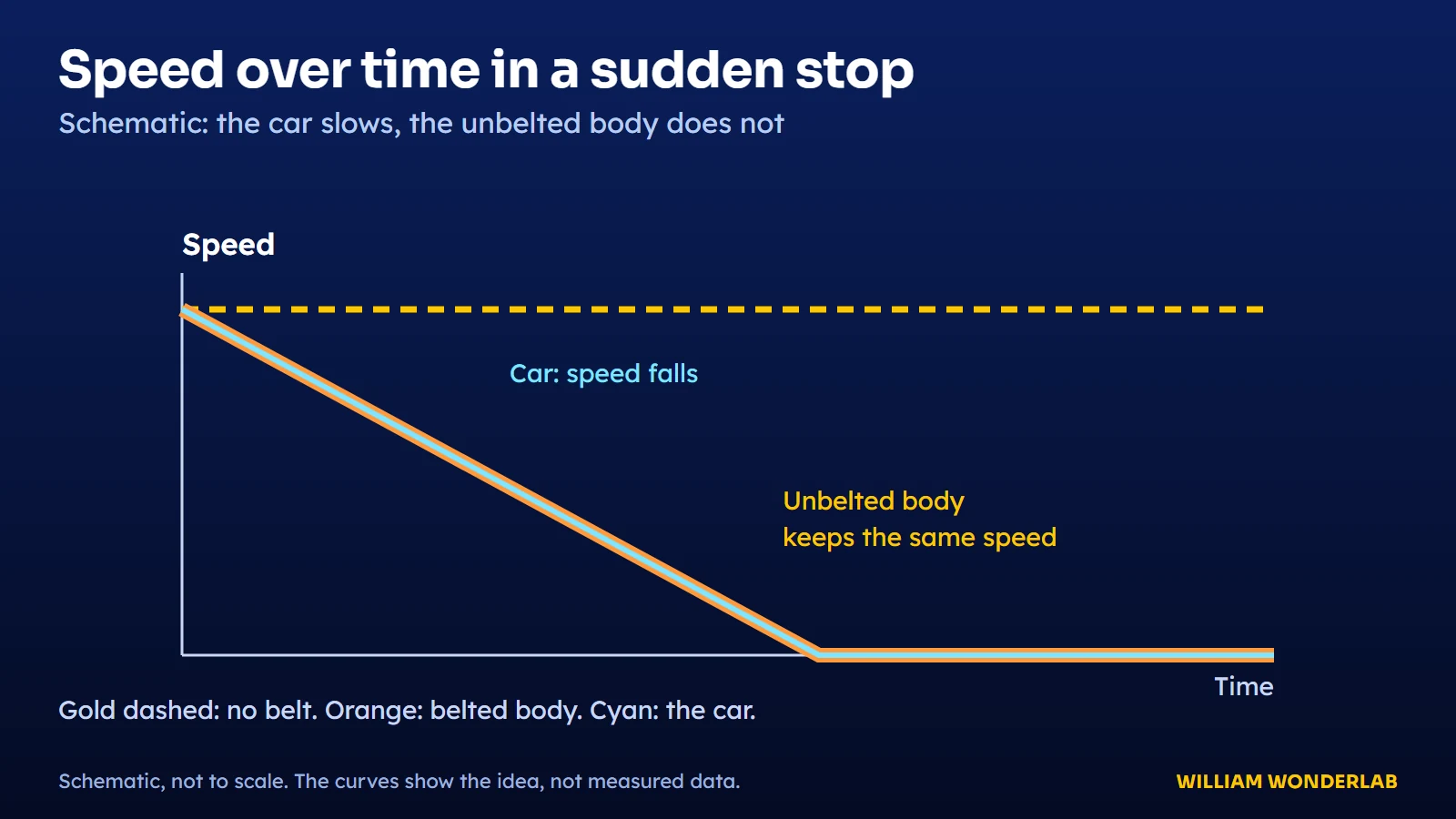
Your body keeps moving when the car slows, because of inertia. A seatbelt supplies the force that slows you down with the car.
You are sitting still in a moving car. The driver brakes hard, and your upper body seems to keep going, pulling you towards the front. It feels as if something pushed you forward, but nothing did. Nothing pushed you at all. Your body simply kept doing what it was already doing.
The short answer: Your body keeps moving at the same speed when the car slows, because of inertia: an object keeps doing what it is doing unless a force acts on it. A seatbelt is that force. It acts on you and slows you down with the car, which is why belts matter so much in a crash.[1][2][3]
Your body keeps going: inertia
NASA’s beginner’s guide to Newton’s laws states the first law this way: “An object at rest remains at rest, and an object in motion remains in motion at constant speed and in a straight line” “unless acted on by an unbalanced force.”[1] The same guide calls the tendency to resist changes in motion “inertia”: “This tendency to resist changes in a state of motion is inertia.”[1]
HyperPhysics, the physics reference from Georgia State University, puts it in a similar way: the first law “may be seen as a statement about inertia, that objects will remain in their state of motion” “unless a force acts to change the motion.”[2]
Inertia is not a push or a pull. It is the way things resist changes to the motion they already have. When the car slows, your body still has the motion it had a moment ago, so it continues forward relative to the seat.
Why the car slows but you do not
When the brakes act, they slow the car and the seat bolted to it. Your body is not bolted to anything. Until a force acts on it, it keeps the speed it had. The NASA K-12 Newton’s laws page states the same first law and adds: “This is normally taken as the definition of inertia.”[4]
So the lurch is not a sudden push from the front. It is the car slowing down while your body keeps its speed for a moment. Your body only slows when something pushes on it, such as the seat, the belt or the dashboard.
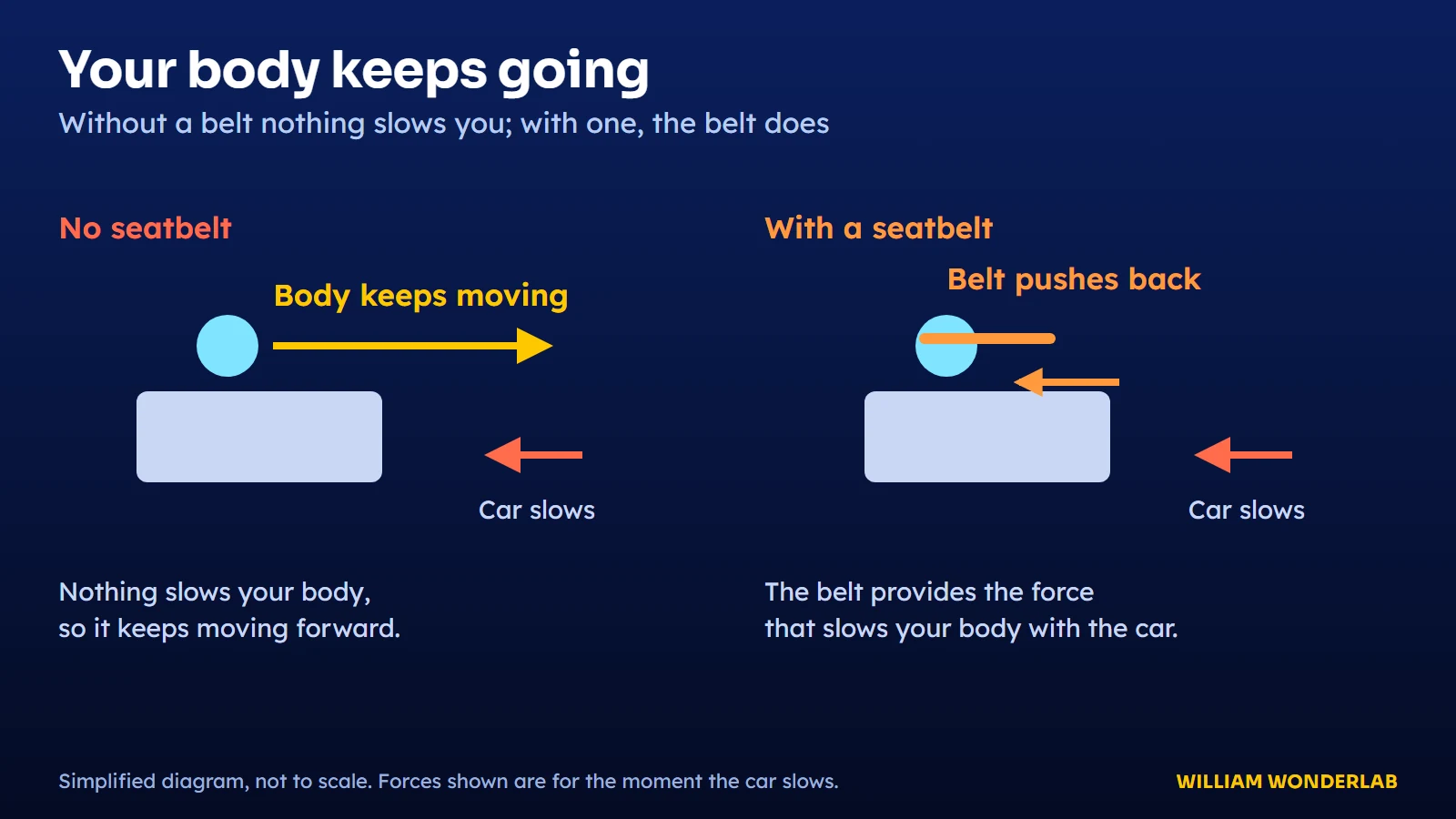
The diagram shows the two cases side by side. Without a belt, nothing acts on your body to slow it, so it keeps moving forward. With a belt, the belt pushes back on your body and supplies the force that slows you with the car.
What a seatbelt does
A seatbelt is the force that changes your motion. By Newton’s first law, your body keeps going until an unbalanced force acts on it, and the belt provides that force.[2]
The NSW Government’s road safety guidance states that “wearing a seatbelt is the most effective way to prevent the driver and passengers from being thrown around in the vehicle.”[3] Seatbelts also “double the chance of survival and reduce the risk of injury in a road crash.”[3] Queensland’s seatbelt rules page makes the same point about the risk of not belting up: drivers and passengers are “around nine times more likely to be killed in a road crash if they are not wearing” a seatbelt.[5]
The science point is simple: you cannot stop the car from slowing, but a belt helps make sure your body slows down with it.
Everyday examples
- A shaken hand. When you shake off water, the drops keep moving even though your hand changes direction. Inertia explains why they keep going.[1]
- A seated passenger. Your body goes on with its speed until the belt or seat acts on it. That is the same reasoning as the car diagram above.[2]
Did you know? NASA’s K-12 Newton’s laws page says that the statement about objects keeping their motion “is normally taken as the definition of inertia.”[4]
Try it: the coin on the card
This is a proposed at-home activity. It is a classic demonstration of inertia, not a measured experiment.
You need: a stiff card (such as a postcard), a small coin, a plastic cup and a table.
- Place the card on top of the cup, and balance the coin on the middle of the card.
- Predict what will happen to the coin if you flick the card sideways quickly.
- Flick the card sideways in one quick movement, and watch where the coin goes.
- Try a slower push and compare. Write down what you saw and why the coin behaved as it did.
Safety first: Keep coins away from young children, because a coin is a choking hazard. Use a plastic cup, not glass, and keep it on a flat table away from the table edge. Wipe up any spills straight away. An adult should supervise, especially with younger scientists, and everyone should wash their hands afterwards.
Go deeper: speed and the first law
Converting speed
Car speeds are often given in kilometres per hour. To find metres per second, divide by 3.6. For example, 50 km/h ÷ 3.6 = 13.9 metres per second, rounded.
What the law predicts
Newton’s first law says that a body keeps its speed in a straight line unless an unbalanced force acts on it.[1][2] A body moving at about 13.9 metres per second keeps that speed until something pushes on it. A seatbelt is the force that slows your body over the stopping time, so your body slows with the car.[2]
Frequently asked questions
Is something pushing you forward when the car stops?
No. Your body keeps its own speed, and the car slows around it. The lurch is the result of inertia.[1][2]
What is inertia?
The tendency to resist changes in motion. It is not a push or a pull; it describes how objects resist changes to their motion.[1]
Does a seatbelt pull you back?
A seatbelt supplies a force that acts on your body, slowing it with the car.[2][3]
Why are unbelted passengers at more risk?
Without a belt, nothing acts on the body to slow it, so it keeps moving. The NSW guidance says belts are the most effective way to stop people being thrown around the vehicle.[3]
Is inertia a force?
No. Inertia describes how an object resists changes to its motion, as the NASA guide explains.[1]
The big idea
Bodies keep moving until something acts on them. A sudden stop slows the car, not you. A seatbelt is the force that brings your body to a stop with the car.
Related reading
More from William Wonderlab:
Explore more from scientists:
- Newton’s Laws of Motion (NASA Glenn Research Center, Beginner’s Guide to Aeronautics)
- Newton’s Laws of Motion (NASA Glenn K-12)
- Newton’s First Law (HyperPhysics, Georgia State University)
- Seatbelts (NSW Government)
References
[1] NASA Glenn Research Center, “Newton’s Laws of Motion”, Beginner’s Guide to Aeronautics (accessed 25 October 2026)
[2] HyperPhysics, Georgia State University, “Newton’s First Law” (accessed 25 October 2026)
[3] NSW Government, “Seatbelts” (accessed 25 October 2026)
[4] NASA Glenn Research Center, “Newton’s Laws of Motion” (K-12) (accessed 25 October 2026)
[5] Queensland Government, “Seatbelt rules”, qld.gov.au (accessed 25 October 2026)