What Is the Milky Way?
The Milky Way is the galaxy our Sun belongs to, a spiral of stars about 100,000 light-years across. Here is how to find it from a dark sky.
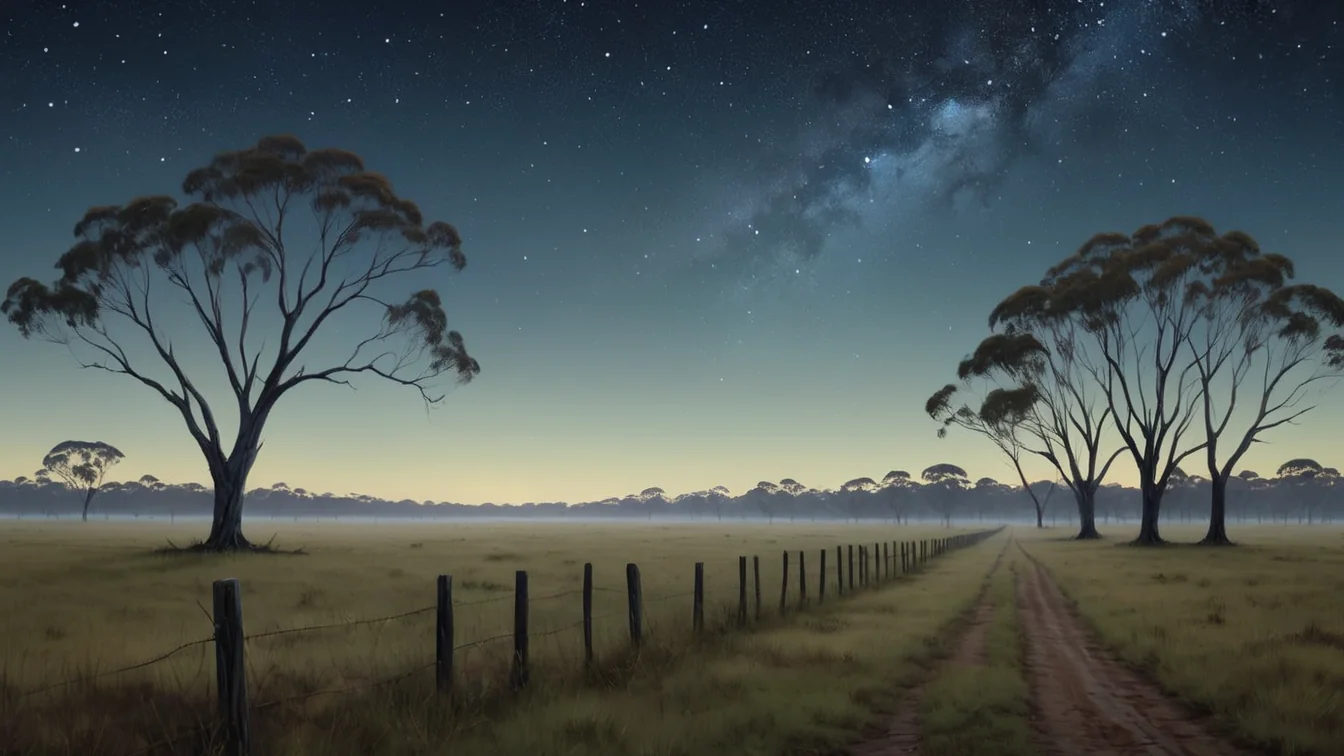
On a clear night far from town lights, a faint, cloudy band of light can cross the sky. In a city, the same sky often shows only a few bright stars, because the glow from streetlights and buildings hides the rest. The band is the Milky Way. It is not a cloud, and it is not the edge of the sky. It is the galaxy we live in.
The short answer: The Milky Way is our home galaxy, a spiral of stars about 100,000 light-years across. NASA estimates it contains 100 to 400 billion stars, and our Sun is one of them, on a small arm of the spiral.[1][2]
A spiral of stars
A galaxy is a huge group of stars held together by gravity. NASA describes the Milky Way’s “elegant spiral structure” as “dominated by just two arms.”[2] NASA describes the galaxy’s two major arms as attached to the ends of a thick central bar.[2] Treat the picture as a model of the galaxy, not a photograph.
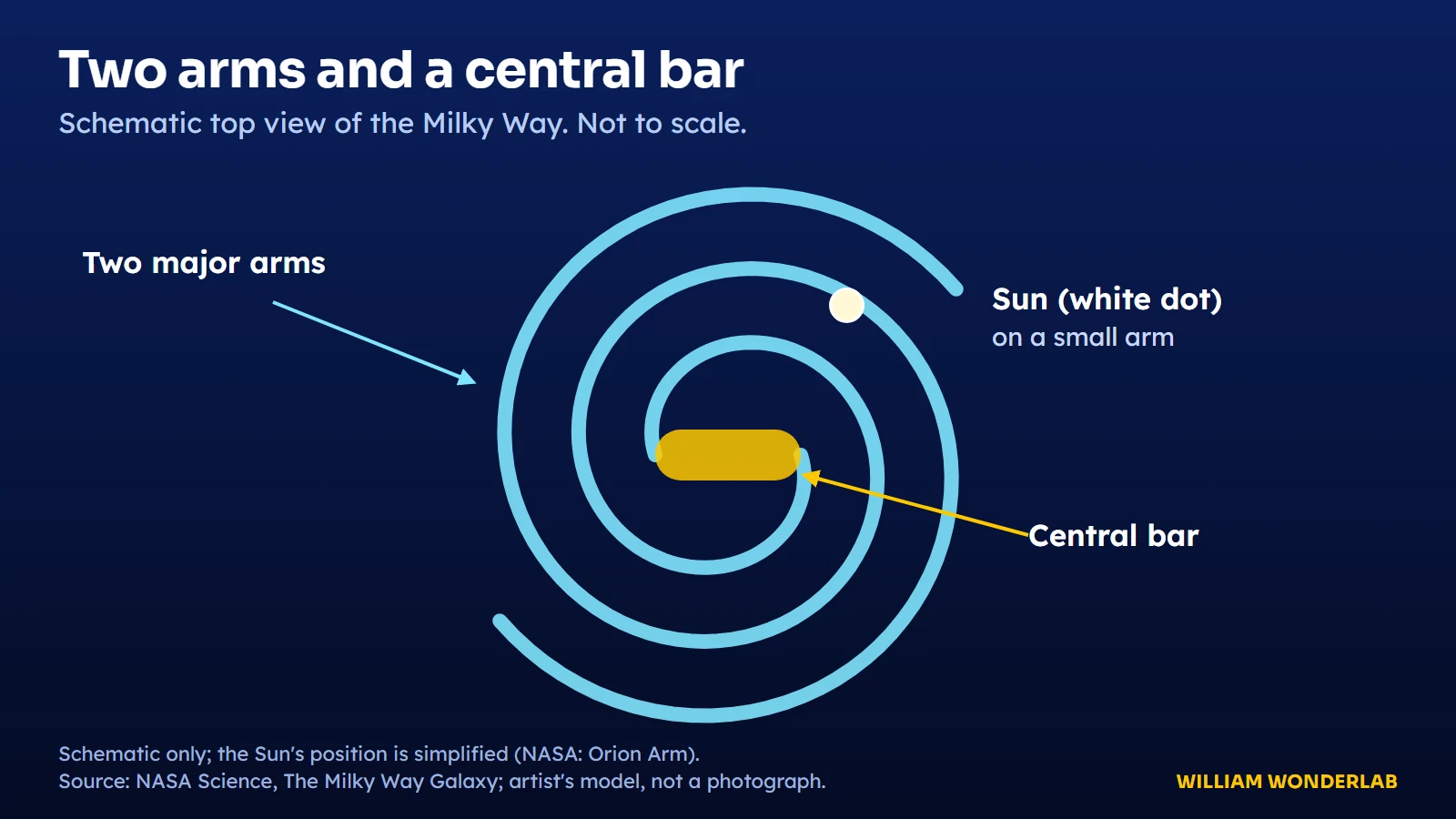
Think of a pinwheel with a bar through its middle. The arms curl outwards from the ends of the bar, and the stars are thickest in the arms.
How big is it?
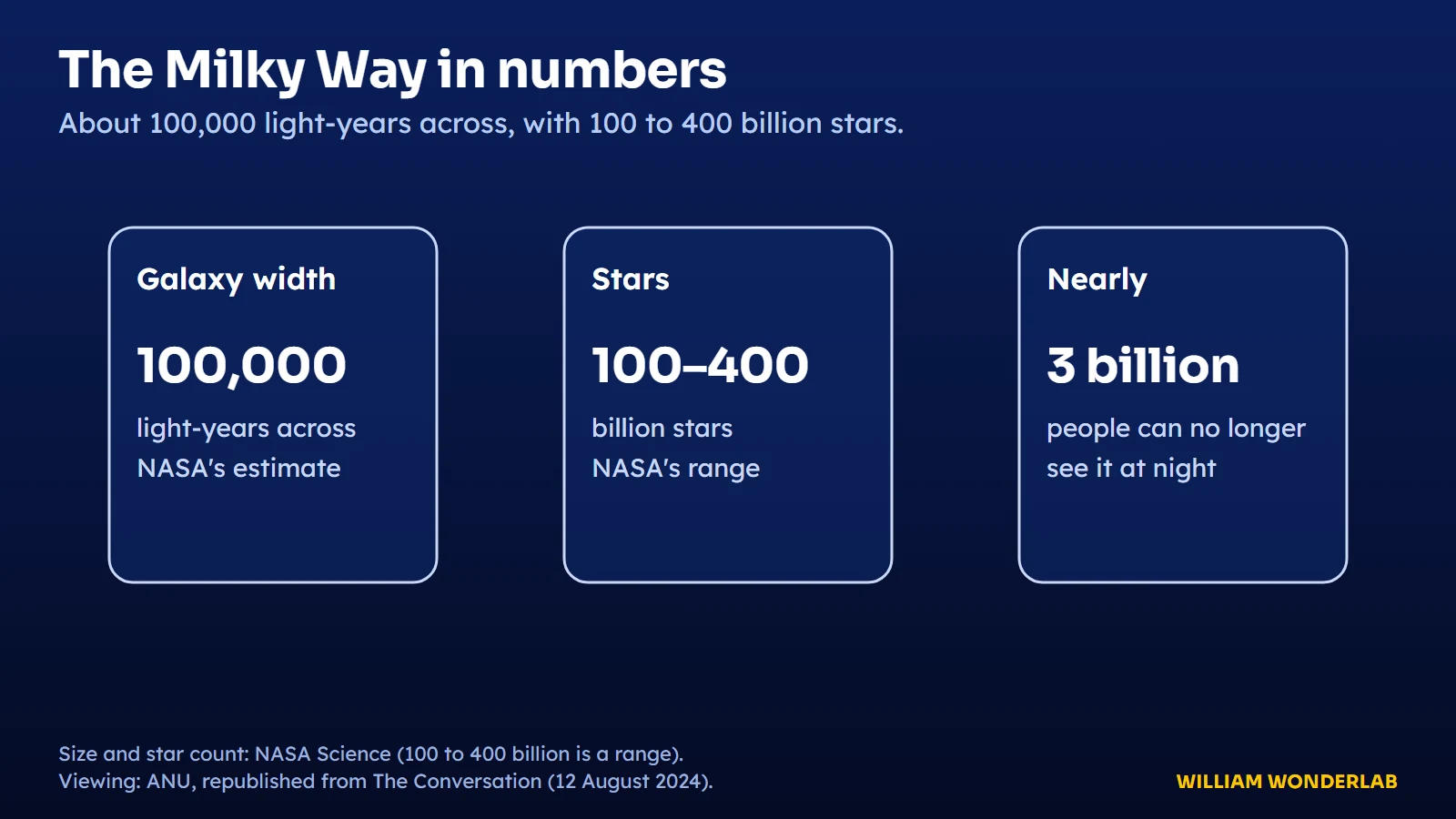
NASA says the Milky Way “is about 100,000 light-years across.”[1] A light-year is the distance that light travels in one year. Light is very fast, but the galaxy is so large that its width is measured in light-years, not kilometres.
NASA also estimates that the galaxy “probably contains 100 to 400 billion stars.”[1] NASA gives a range rather than a single number. That honest range shows how hard it is to count the faint, small stars that are the hardest to detect.
Where is our Sun?
We are not at the centre. NASA says that “our Sun lies near a small, partial arm called the Orion Arm.”[2] Living on that arm is a bit like living in a suburb rather than in the middle of a city.
From Earth, the Milky Way looks like a faint, milky band of light arcing across the entire sky.[3] NASA describes this band as marking the central disk of our home galaxy, seen edge on.[3] Because we look along that disk from inside it, the many faint stars along the line of sight blend into one band.
Why you need a dark sky
Light pollution is the main reason many people cannot see the Milky Way from home. A Conversation article, republished by the Australian National University, puts it plainly: “Light pollution is the culprit of this loss.”[4] The same article reports that “nearly 3 billion people can no longer see the Milky Way when they look skyward at night.”[4]
This is not only a city problem. The band is faint, so even a town’s glow can wash it out. Moving away from bright lights, for example into a national park, makes a big difference.
Indigenous astronomy: the Emu in the Sky
Aboriginal Australians have read the Milky Way for a very long time. The European Southern Observatory notes that “Aboriginal Australians are most likely the oldest practitioners of astronomy in the world.”[5]
One famous story is the Celestial Emu. The Ngarrngga project describes it as “an Aboriginal constellation shared by many communities across Australia.”[6] Many Aboriginal constellations use dark patches in the Milky Way rather than stars, and this one is made of dark spaces.[5] Several Aboriginal groups identify its head as the Coalsack Nebula, which sits next to the Southern Cross.[6]
The Coalsack is “an obscuring smudge across the Milky Way,” and ESO places it roughly 600 light-years from the Solar System.[5] Ngarrngga adds that “the Celestial Emu is a common and shared story between groups, often with slight differences.”[6] This article gives only a short overview. The stories belong to the communities that hold them, and readers are encouraged to learn from their own sources and Elders.
Try it: a night-sky sketch
This is a proposed at-home activity. Go to a dark place with an adult on a night when the Moon is not bright. Let your eyes adjust for several minutes without looking at a phone or torch. Then sketch the band of light and the brightest stars you can see. Repeat the sketch from a spot closer to town lights and compare the two drawings.
What to expect: The band should look clearer and brighter in the darker spot. Your view depends on the weather, the time of year and where you live, so do not worry if it looks different from the pictures.
Safety first: Go out only with an adult, and stay on paths or areas you already know. Use a torch with a red light or a dimmed setting, and walk slowly on uneven ground. Keep an eye out for vehicles, animals and water. Dress warmly and let someone know where you are going. Never look directly at the Sun, and never use binoculars or a telescope to look near the Sun.
Go deeper: the galaxy in numbers
Why the picture is an artist’s concept
We cannot step outside the Milky Way to take a photograph of it. From inside, astronomers study the galaxy by measuring the stars and gas around us, and pictures of its whole shape are models built from those measurements.[2]
Working with the numbers
NASA’s figure of about 100,000 light-years is the galaxy’s width.[1] Our Sun is not at the centre, but on a small arm,[2] so it is not in the middle of that width. Keep both numbers in mind when you picture the galaxy from inside.
Frequently asked questions
Is the Milky Way a cloud?
No. It is our galaxy, a spiral of stars. NASA describes its structure as a spiral with two arms.[2]
How many stars are in the Milky Way?
NASA estimates that the galaxy probably contains 100 to 400 billion stars.[1]
Where is our Sun in the Milky Way?
Near a small, partial arm called the Orion Arm, not at the centre.[2]
Can you see the Milky Way from Australia?
Yes, from a dark place away from town lights. Light pollution hides it from many people, which is why a dark sky matters.[4]
What is the Emu in the Sky?
It is an Aboriginal constellation made from dark patches in the Milky Way. Its head is the Coalsack Nebula, and many communities share versions of the story.[6][5]
The big idea
We live inside a giant spiral of stars. The Milky Way is our home galaxy. We see it as a band of light, and the glow from our towns and cities is what hides it.
Related reading
More from William Wonderlab:
Explore more from scientists:
References
[1] NASA Science, “Our Milky Way Galaxy: How Big is Space?” (accessed 25 October 2026)
[2] NASA Science, “The Milky Way Galaxy” (accessed 25 October 2026)
[3] NASA Science, “Galaxies” (accessed 25 October 2026)
[4] Australian National University, republished from The Conversation (12 August 2024), “Only 100 years ago the Milky Way was visible from central Paris” (accessed 25 October 2026)
[5] European Southern Observatory (ESO), “An Emu in the Sky over Paranal” (accessed 25 October 2026)
[6] Ngarrngga, “Case Study 1: The Celestial Emu” (accessed 25 October 2026)