Why Is the Sky Blue?
Sunlight looks white, yet the sky glows blue by day and orange at sunset. Here is what really happens when sunlight meets the air.

Look up on a clear day and the sky is a deep, bright blue. Yet the air around you looks completely clear, and sunlight itself looks white. A few hours later, at sunset, the very same sky can glow orange, gold and pink. So where do all these colours come from?
The short answer: Sunlight looks white, but it is really a mix of every colour of the rainbow. As sunlight passes through the air, tiny gas molecules scatter blue light around the sky much more strongly than red light. Wherever you look (away from the Sun), some of that scattered blue light is heading towards your eyes, so the whole sky looks blue.[1][2]
Sunlight is a mix of colours
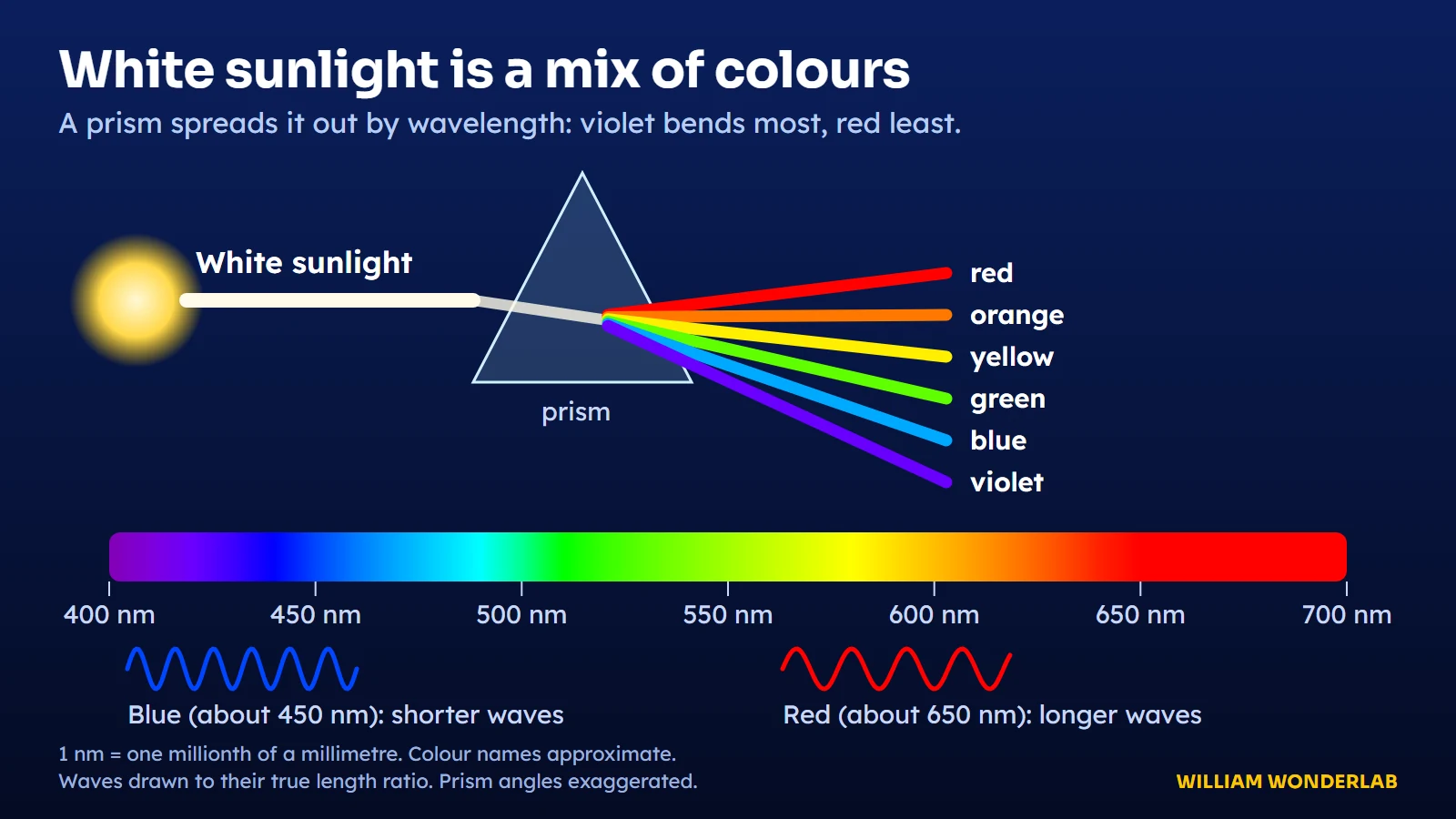
Sunlight looks white, but it is made of all the colours of the rainbow mixed together. A glass prism can spread that mix out so you can see the separate colours.[1]
Light travels as waves, and each colour has a different wavelength: the distance from one wave peak to the next.[2]
- Violet and blue light have the shortest wavelengths.
- Green and yellow are in the middle.
- Orange and red light have the longest wavelengths.
These waves are tiny. NASA says the human eye can usually detect wavelengths from about 380 nanometres (violet) to about 700 nanometres (red).[8] A nanometre is one millionth of a millimetre.
Air is full of tiny molecules
Air looks empty, but it is packed with gas molecules, mostly nitrogen and oxygen. Each one is far smaller than the wavelength of visible light.[2][4]
When sunlight bumps into one of these molecules, some of the light is sent off in a new direction. Scientists call this scattering. When the particles are much smaller than the light’s wavelength, it is called Rayleigh scattering, after the scientist Lord Rayleigh, who first described it in the 1870s.[2][3]
Blue light gets scattered the most
Here is the key idea: tiny molecules scatter short wavelengths much more strongly than long ones.[3] Blue light is scattered several times more than red light. The exact number depends on which shades you compare: the University of Twente works out about 5.5 times for one blue (425 nm) and one red (650 nm).[4]
So as sunlight streams through the atmosphere, blue light is bounced around in every direction. Look at any patch of clear sky away from the Sun and some of that scattered blue light is travelling straight towards your eyes. That is why the sky looks blue from almost every direction.[1]
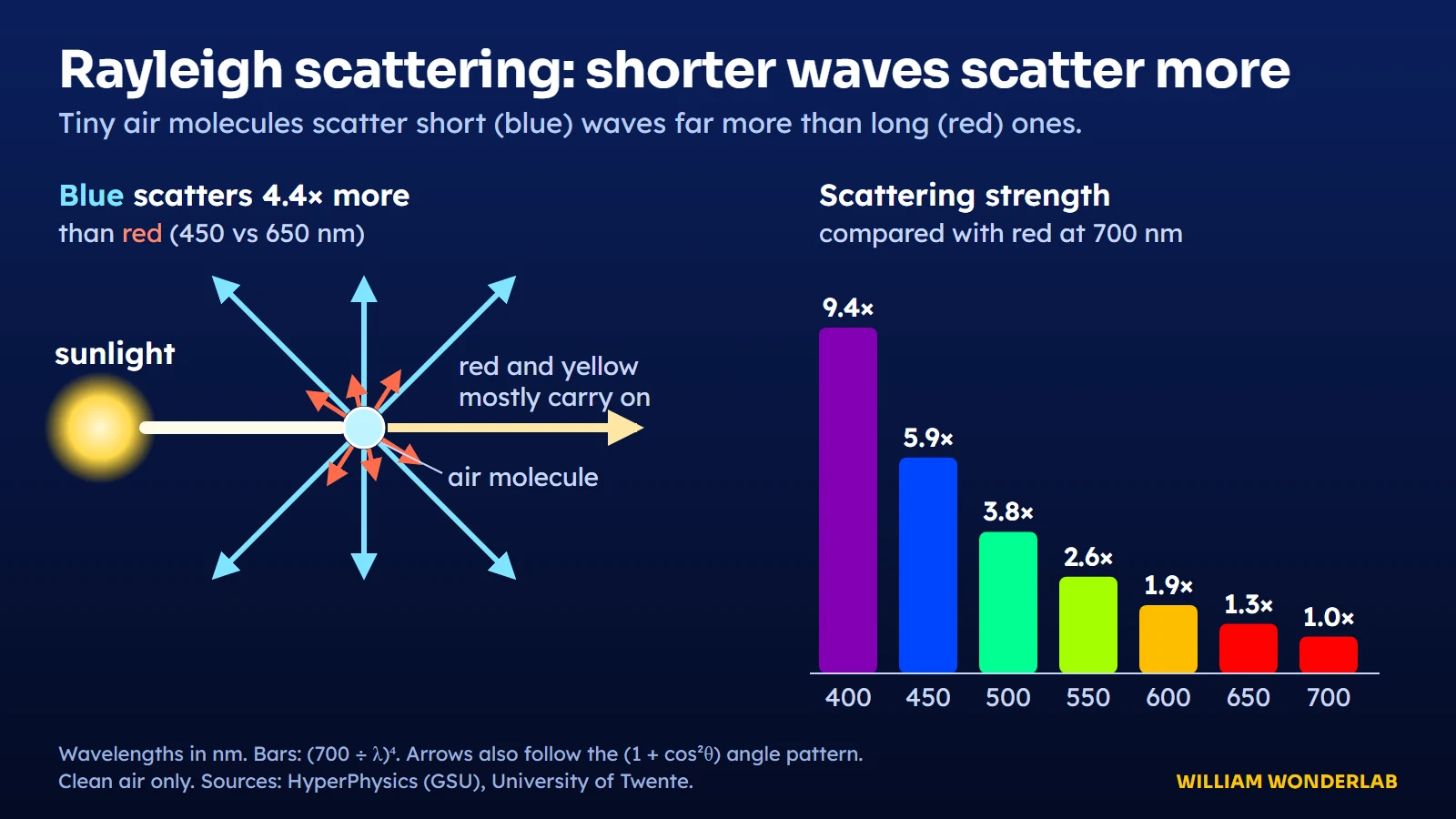
Most of the red and yellow light carries straight on. Air does scatter a little red light, just far less than blue.
Why isn’t the sky violet?
Violet light has an even shorter wavelength than blue, so it is scattered even more. So why don’t we see a violet sky? There are two main reasons:[2]
- Sunlight contains less violet light than blue light to begin with.
- Our eyes are much more sensitive to blue than to violet.
Our eyes blend all the scattered colours together, and the mix looks sky blue to us.
Why are sunsets orange and red?
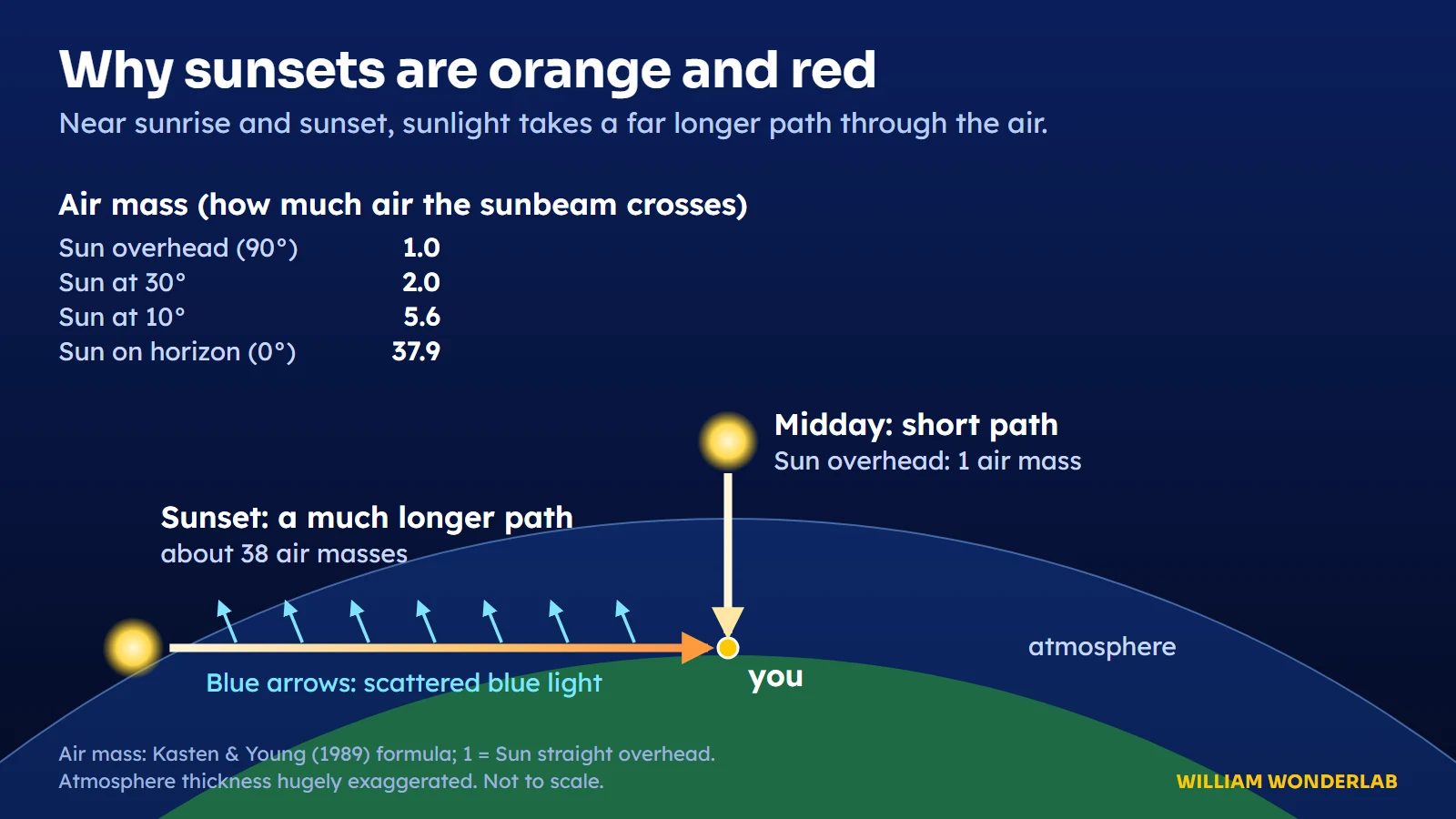
When the Sun is high in the sky, its light takes a fairly short path through the air to reach you. Near sunrise and sunset, the light comes in at a low slant and has to travel through much more of the atmosphere.[1][2]
Along that long path, so much blue light is scattered out of the direct beam that mostly yellow, orange and red light is left by the time it reaches your eyes.[1]
Dust, pollution and other tiny particles in the air (such as smoke) can change sunset colours too, by scattering even more blue light out of the beam.[1] After a major volcanic eruption, extra particles in the atmosphere can produce especially spectacular sunrises and sunsets.[2] That is one reason no two sunsets look exactly the same.
Sky clues you can spot every day
Once you know about scattering, you can see the science happening all around you.
- The sky is paler near the horizon. Scattered blue light from low in the sky has to pass through more air to reach you, and some of it is scattered away again, so the sky there looks paler or even whitish.[1][2]
- Mountain skies are a deeper blue. High up, there are fewer air molecules above you to scatter light, so the sky overhead can look very dark blue.[2]
- Clouds are white. Cloud droplets are much bigger than air molecules, and they scatter all colours about equally. All the colours mixed together look white.[5]
- Cloud bases can look grey. A cloud scatters much of the light back upwards and out to the sides, so less light reaches its underside.[5]
- Haze and smoke change the sky. Dust, pollution and smoke add other particles to the air, and NASA notes that these also scatter blue light.[1]
Is the sky blue because it reflects the ocean?
No! This is a very common myth. The blue comes from sunlight scattering off the air itself,[1] so it does not need an ocean nearby. That is why the sky is blue far inland too.
The ocean has its own, different reason for looking blue: water absorbs colours from the red part of the spectrum, which leaves more blue light for us to see.[6] Both are blue, but for different reasons.
Did you know? On Mars, NASA says the daytime sky looks orange or reddish. At sunset, the sky around the Sun turns blue-grey: the opposite of what happens on Earth.[1]
Try it: be a sky colour detective
You need: a notebook, coloured pencils and a clear day.
- Around the middle of the day, look at the sky high overhead, well away from the Sun. Colour in a square to match it.
- Now look at the sky just above the horizon. Colour in another square. Is it the same blue, or paler?
- If you can, repeat around sunset with an adult and draw how the colours change.
- Note any clouds, haze or smoke. Did they change what you saw?
What to expect: the sky overhead is usually a deeper blue than the sky near the horizon, which tends to look paler.
Safety first: never look directly at the Sun, not even at sunset, and never through binoculars, a telescope, a camera viewfinder or sunglasses. Always keep the Sun out of your view and observe the sky away from it. Younger scientists should do this activity with an adult.
Go deeper: the maths behind the colours
The inverse fourth power law
For particles much smaller than the wavelength of light, the brightness of the scattered light is proportional to 1/λ⁴, where λ (the Greek letter lambda) is the wavelength.[3][4]
That fourth power makes a big difference. Compare blue light at 450 nm with red light at 650 nm: (650 ÷ 450)⁴ ≈ 4.4, so blue is scattered about four times more strongly. Compare violet at 400 nm with red at 700 nm and the ratio is about 9.4.
Why a longer path changes the colour
Each stretch of air removes a fraction of the light from the direct sunbeam, and that fraction is larger for short wavelengths. Scientists describe how much air the light crosses with a number called air mass: 1 when the Sun is straight overhead, about 2 when the Sun is 30° above the horizon, and around 38 when the Sun sits on the horizon. These values come from a formula published by Fritz Kasten and Andrew Young in 1989.[7]
Because the losses multiply along the path, a beam that crosses 38 times as much air loses far more of its blue light than one that crosses only 1 air mass. What remains in the direct beam is shifted towards orange and red.
Why clouds are a different story
Rayleigh scattering applies when particles are much smaller than the wavelength. Cloud droplets are much larger, and they scatter all visible wavelengths about equally.[5] That gives white or grey clouds rather than blue ones. (Scientists often describe scattering by these larger particles with a more general theory called Mie scattering.)
Frequently asked questions
Why is the sky blue in simple words?
Sunlight contains every colour. Tiny air molecules scatter blue light much more than red light, so blue light reaches your eyes from all over the sky.[1]
Why are sunsets orange and red?
At sunset, sunlight travels a much longer path through the air. Most of the blue is scattered out of the beam along the way, leaving mostly yellow, orange and red light.[1][2]
Why isn’t the sky purple or violet?
Sunlight contains less violet than blue, and our eyes are more sensitive to blue. The scattered mix looks blue to us.[2]
Why is the sky sometimes grey or white?
Clouds are made of droplets much bigger than air molecules. They scatter all colours about equally, so an overcast sky looks white or grey.[5]
Is the sky blue because it reflects the ocean?
No. The blue comes from sunlight scattering in the air itself,[1] so the sky is blue far from the sea too.
Does smoke or pollution change sunset colours?
Yes. Dust, smoke and other tiny particles change how light is scattered and can make sunsets look different, sometimes more vivid.[1][2]
The big idea
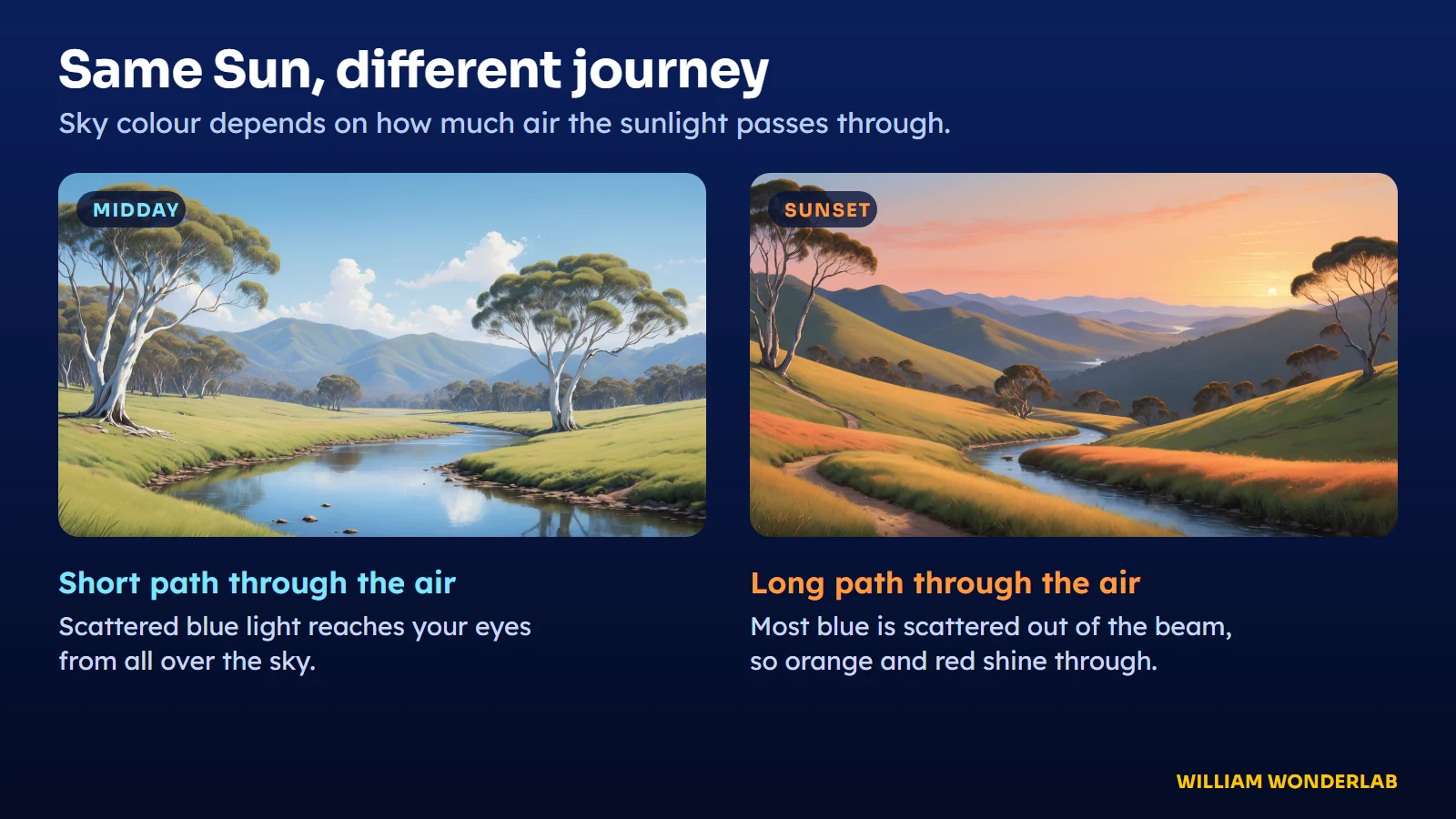
Same Sun, different journey. By day, air molecules scatter blue light across the whole sky. At sunset, sunlight takes a much longer path through the air, so more blue is scattered away and the warm colours shine through.
Related reading
More from William Wonderlab:
- Why Does the Moon Look Bigger Near the Horizon?
- Why Do Soap Bubbles Have Rainbow Colours?
- Why Does Ice Float?
Explore more from scientists:
- Why Is the Sky Blue? (NASA Space Place)
- Why are clouds white? (Met Office)
- Why is the ocean blue? (NOAA National Ocean Service)
References
[1] NASA Space Place, “Why Is the Sky Blue?” (accessed 25 October 2026)
[2] US National Weather Service (NOAA), Flagstaff office, “Why Is The Sky Blue?” (accessed 25 October 2026)
[3] HyperPhysics, Georgia State University, “Blue Sky and Rayleigh Scattering” (accessed 25 October 2026)
[4] University of Twente, ITC Living Textbook, “Rayleigh Scattering in the Earth’s Atmosphere” (accessed 25 October 2026)
[5] Met Office (UK), “Why are clouds white?” (accessed 25 October 2026)
[6] NOAA National Ocean Service, “Why is the ocean blue?” (accessed 25 October 2026)
[8] NASA Science, “Visible Light” (accessed 26 October 2026)
Keep exploring
Now try the science yourself
Reading is a great start. Experimenting is even better: these interactive models use the same science as this article.