Why Does the Moon Look Bigger Near the Horizon?
The Moon looks enormous when it rises, yet photos show it is the same width overhead. Here is what is real, what is an illusion, and what scientists still debate.
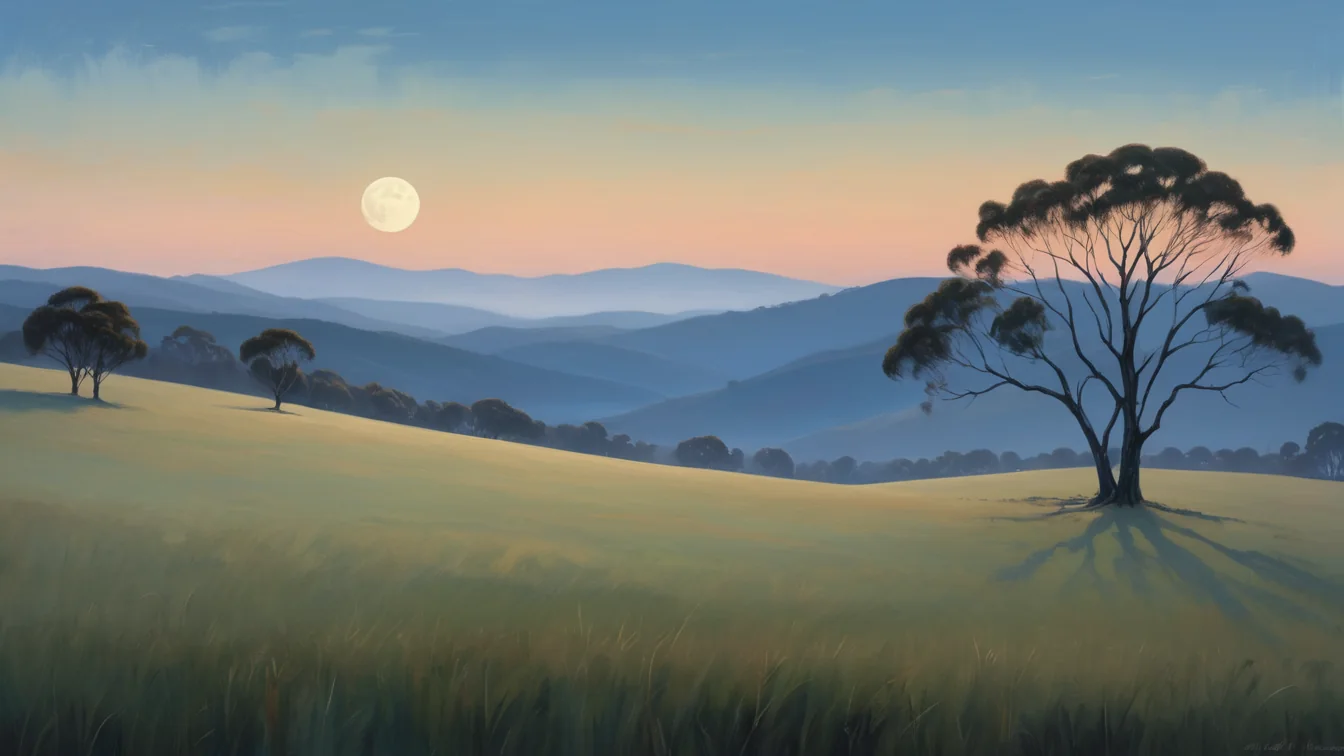
Have you ever seen a full Moon rise over the hills and thought it looked enormous? A few hours later, high in the sky, the same Moon seems to have shrunk. Your eyes are not lying to you exactly, but something surprising is happening inside your head.
The short answer: The Moon does not really get bigger as it rises. Photographs taken at the horizon and high in the sky show it is the same width. The effect is a perceptual illusion, created by the way your brain judges size and distance in the sky. Scientists still debate the full explanation.[1][2]
What is really happening
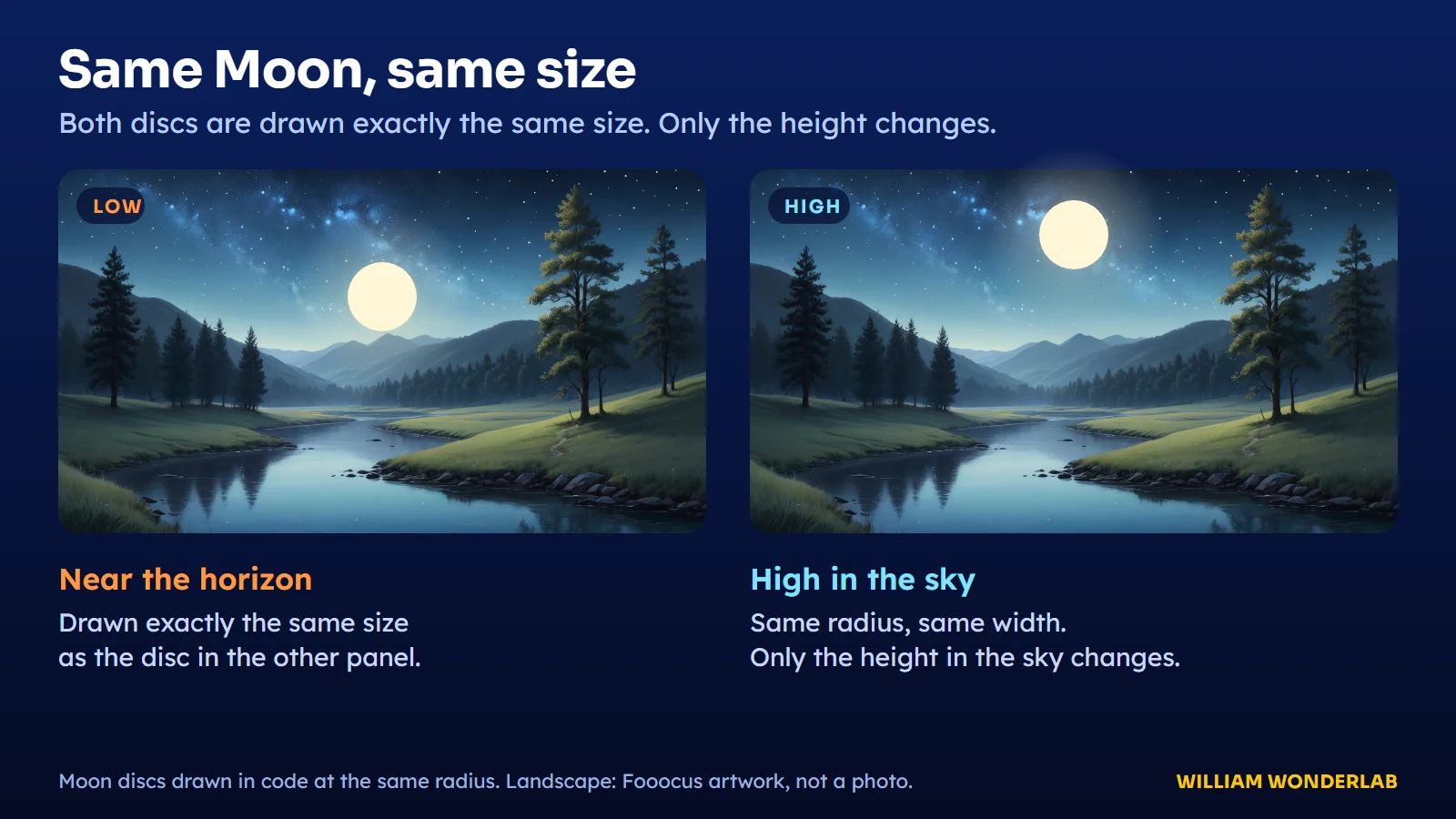
NASA describes the effect as “an illusion rooted in the way our brains process visual information.” Photographs of the Moon at different heights show that it is the same width whether it is low or high.[1]
Measurements agree. Phil Plait, writing for Scientific American, says that “simple measurements of the moon show it’s essentially the same size on the horizon as when it’s overhead.”[2] National Geographic puts it bluntly: “obviously the moon isn’t actually changing size,” and the Moon “always occupies roughly 0.52 angular degrees on the sky.”[3]
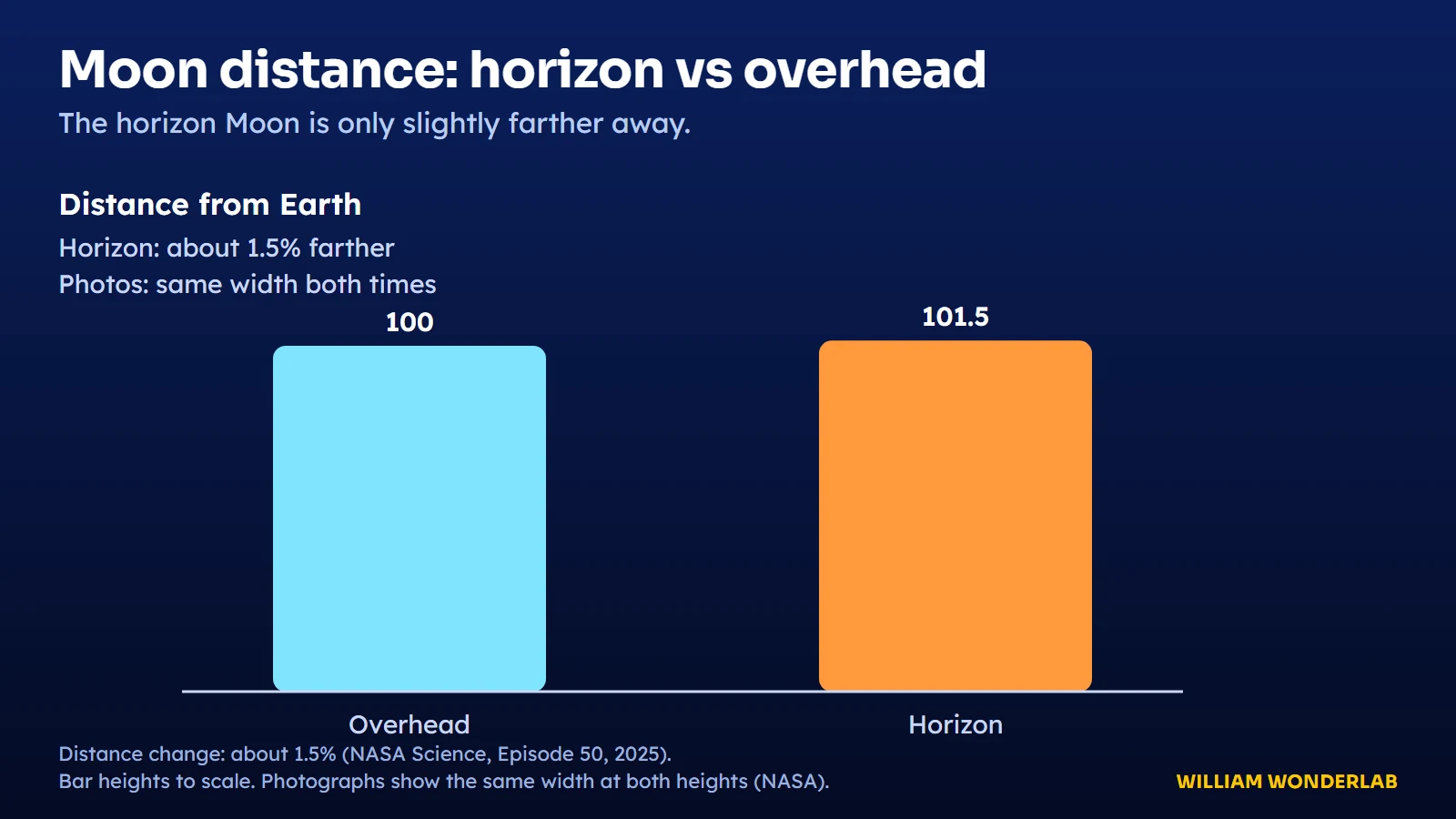
The Moon is not quite the same distance away, though. It is about 1.5% farther away at the horizon than overhead, which makes its angular size slightly smaller.[4] That change is far too small for your eyes to notice.
Why does the brain make it look bigger?
Nobody has settled this question. NASA says there is “still not a satisfying scientific explanation for exactly why we see it.”[1] Science News opened its report on the topic by saying that “scientists have yet to unravel the so-called moon illusion.”[5] A 2013 arXiv paper agrees that “no single theory has been accepted by the scientific community at large.”[6]
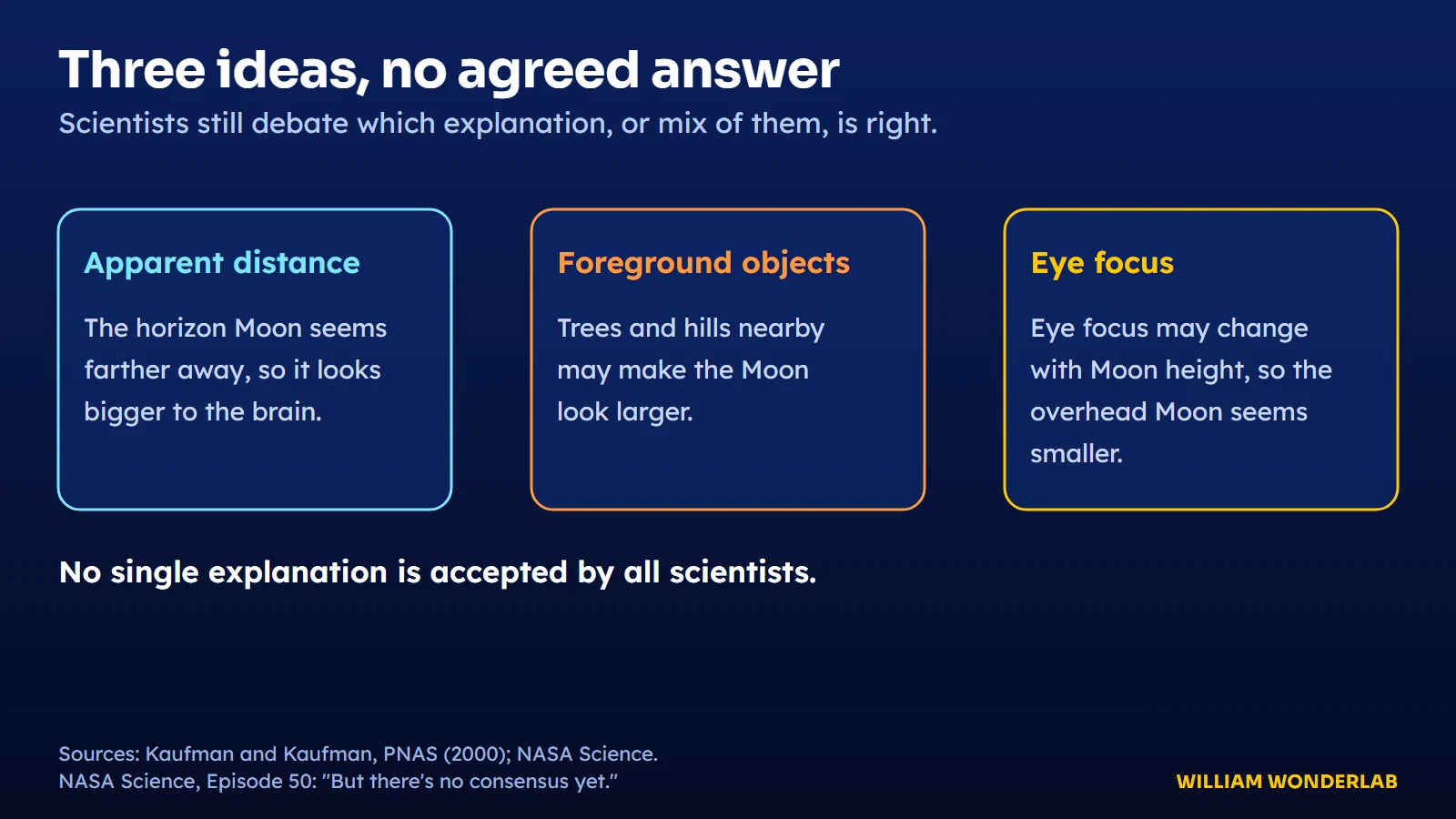
Three ideas come up most often:
- Apparent distance. Kaufman and Kaufman describe one leading idea: “the perceived distance to the moon at the horizon is greater than that to the zenith moon.”[7] Science News reports that horizon cues “make it look much farther away than a higher moon.”[5] A Moon that seems farther away may be judged as bigger. This version was popularised in 1962 by Kaufman and Rock.[6]
- Foreground objects. NASA notes that “objects in the foreground of your lunar view” may also play a role.[1] Trees, hills and buildings near the horizon may make the Moon look larger by comparison.
- Eye focus. More recent explanations suggest that “differences in accommodation or other factors cause the elevated moon to appear smaller.”[7] Accommodation is the way your eye changes its focus.
The experts do not agree on how strongly to state the answer. Phil Plait argues that “we do know the right explanation,” and that it involves an apparent-distance effect, the Ponzo illusion, where “the brain sees that, but it also perceives the top line as farther away.”[2] NASA and National Geographic say the question is still open: National Geographic reports that “no one yet agrees about what’s going on.”[3] Kaufman and Kaufman write that “today most attention is paid to two diametrically opposed general explanations.”[7]
Try it: the finger and tube test
NASA suggests a simple way to compare the Moon with something you can hold.[1] You will need a paper tube (a rolled-up sheet of paper or a kitchen-roll tube) and a clear night.
- When the Moon is low over the horizon, hold your arm out straight and hold up your index finger next to it. Notice how the Moon’s width compares with your fingertip.
- Wait until the Moon is higher in the sky, keep your arm at the same length, and repeat the comparison. Did it change?
- Look at the Moon through the paper tube, both low and high. Does the tube change how big it seems?
- Write down what you notice, then compare it with the photograph result above.
Safety first: never look at the Sun. This activity is about the Moon only. Do not point a tube, a camera, binoculars or a telescope at the Sun, and do not use your finger to search for it. Choose a time well after sunset, or a time of night when the Sun is not in view, and do the activity with an adult if you are younger.
Go deeper: the angles and the evidence
Why a 1.5% change is too small to see
Angular size depends on the Moon’s distance. If the Moon is about 1.5% farther away, its angle is about 1 ÷ 1.015 ≈ 0.985 of the overhead value. That is about 1.5% smaller in angle, which is well below what most people can judge by eye.[4]
Why the question is still open
Kaufman and Kaufman describe the apparent-distance idea and the eye-focus idea as the two main competing explanations.[7] A 2013 arXiv paper proposes a different account based on binocular disparity, the small difference between what your two eyes see.[6] Phil Plait’s view that the answer is known and NASA’s view that it is not fully settled both appear in good sources, which is itself a sign that the question is still active.[1][2]
Frequently asked questions
Is the Moon really bigger at the horizon?
No. Photographs taken at different heights show the same width, so the change is a perceptual illusion.[1]
Does the Moon shrink when it rises?
No. National Geographic says “obviously the moon isn’t actually changing size.”[3]
Is the Moon much closer to Earth when it is near the horizon?
No. It is about 1.5% farther away at the horizon than overhead, which is too small a change to explain the effect.[4]
Why can’t scientists agree on the answer?
Several explanations fit parts of the evidence, and no single theory is accepted across the scientific community.[5][6]
Can a camera show the illusion?
Not in the way your eyes do. Photographs at different heights, taken with the same zoom setting, show the same width.[1]
The big idea
The Moon’s size stays the same; the sky around it changes how big it looks. One leading idea is that your brain judges the horizon Moon to be farther away, and so bigger. Scientists are still working out the full story.
Related reading
More from William Wonderlab:
Explore more from scientists:
- The Moon Illusion: Why Does the Moon Look So Big Sometimes? (NASA Science)
- Why Does the Moon Look Bigger Near the Horizon? (Scientific American)
References
[1] NASA Science, “The Moon Illusion: Why does the Moon look so big sometimes?” (accessed 25 October 2026)
[2] Phil Plait, “Why Does the Moon Look Bigger Near the Horizon?”, Scientific American (accessed 25 October 2026)
[3] Nadia Drake, “The Moon Illusion, Explained”, National Geographic (accessed 25 October 2026)
[4] NASA Science, “Why Does the Moon Look Larger at the Horizon? We Asked a NASA Scientist: Episode 50” (12 February 2025) (accessed 25 October 2026)
[5] Bruce Bower, “The moon also rises, and assumes new sizes”, Science News, 8 January 2000 (accessed 25 October 2026)
[6] “Binocular disparity as an explanation for the moon illusion”, arXiv:1301.2715 (accessed 25 October 2026)
[7] Kaufman, L. and Kaufman, J. H., “Explaining the moon illusion”, Proceedings of the National Academy of Sciences, 97(1), 500-505 (2000) (accessed 25 October 2026)
Keep exploring
Now try the science yourself
Reading is a great start. Experimenting is even better: these interactive models use the same science as this article.