How Does Sound Travel?
Sound is made by vibrations that pass from particle to particle. Here is how that happens, why sound needs a material, and how fast it moves.
Someone claps on the other side of a room, and you hear it before you have time to look. A bell rings across a park, and the sound reaches you a moment later. Sound is so common that most of us never stop to ask how it gets from one place to another.
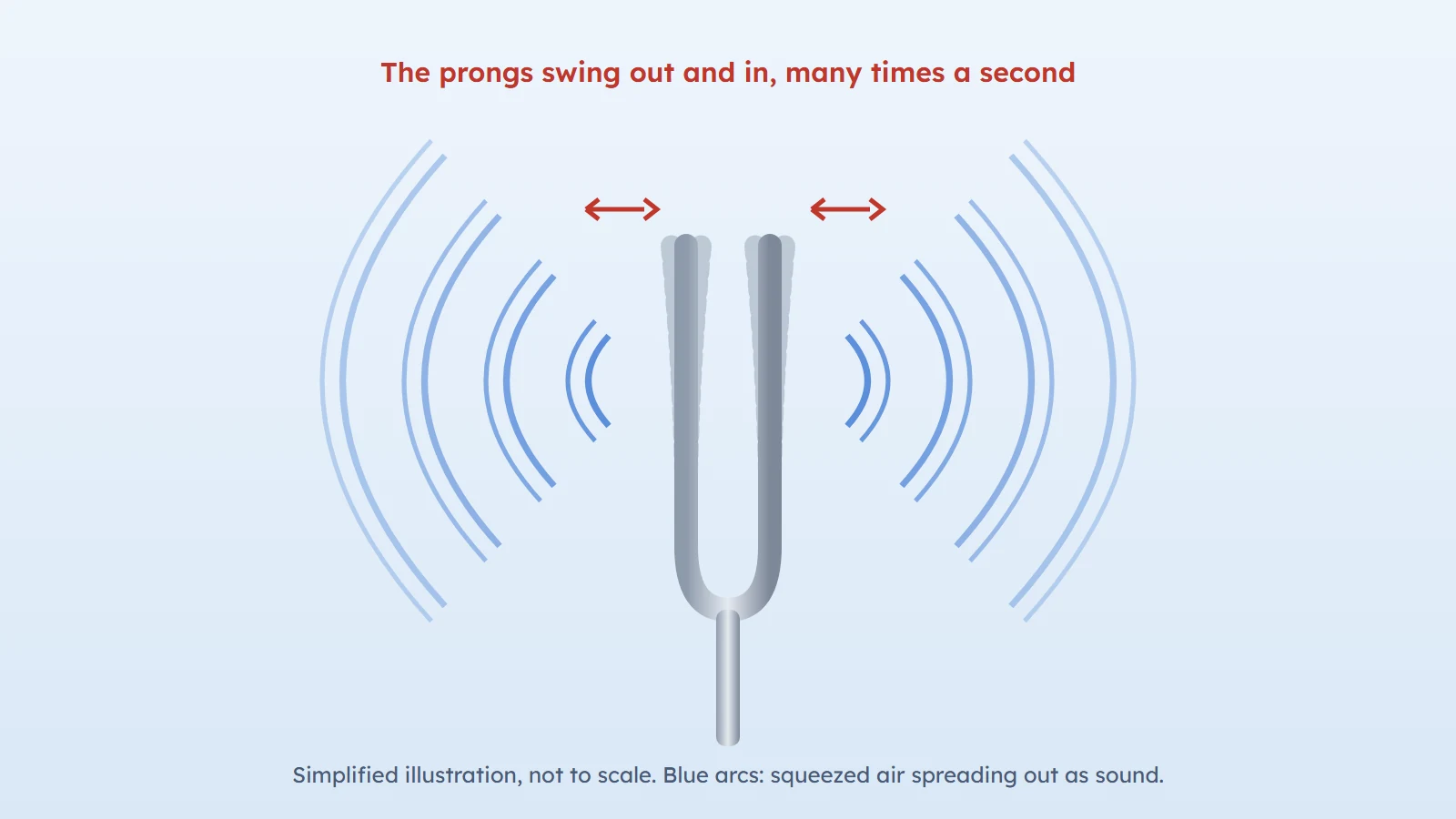
The answer is that sound is a wave. It does not fly through the air as a separate thing. A vibrating object pushes on the material next to it, that material pushes on the material beyond it, and the pushing keeps going until it reaches your ear.
The short answer: Sound is made when something vibrates. The vibration is passed along from particle to particle through a material such as air, water or steel, so sound needs a material to travel through. In air at 20 °C, sound travels at about 344 metres per second.[1][2]
Sound begins with a vibration
Almost everything that makes a sound is shaking. A guitar string, a drum skin and the cords inside your throat all move back and forth very quickly. Science Learning Hub, a New Zealand science education site, puts it simply: “Sound is a form of energy that is caused by the vibration of matter.”[1]
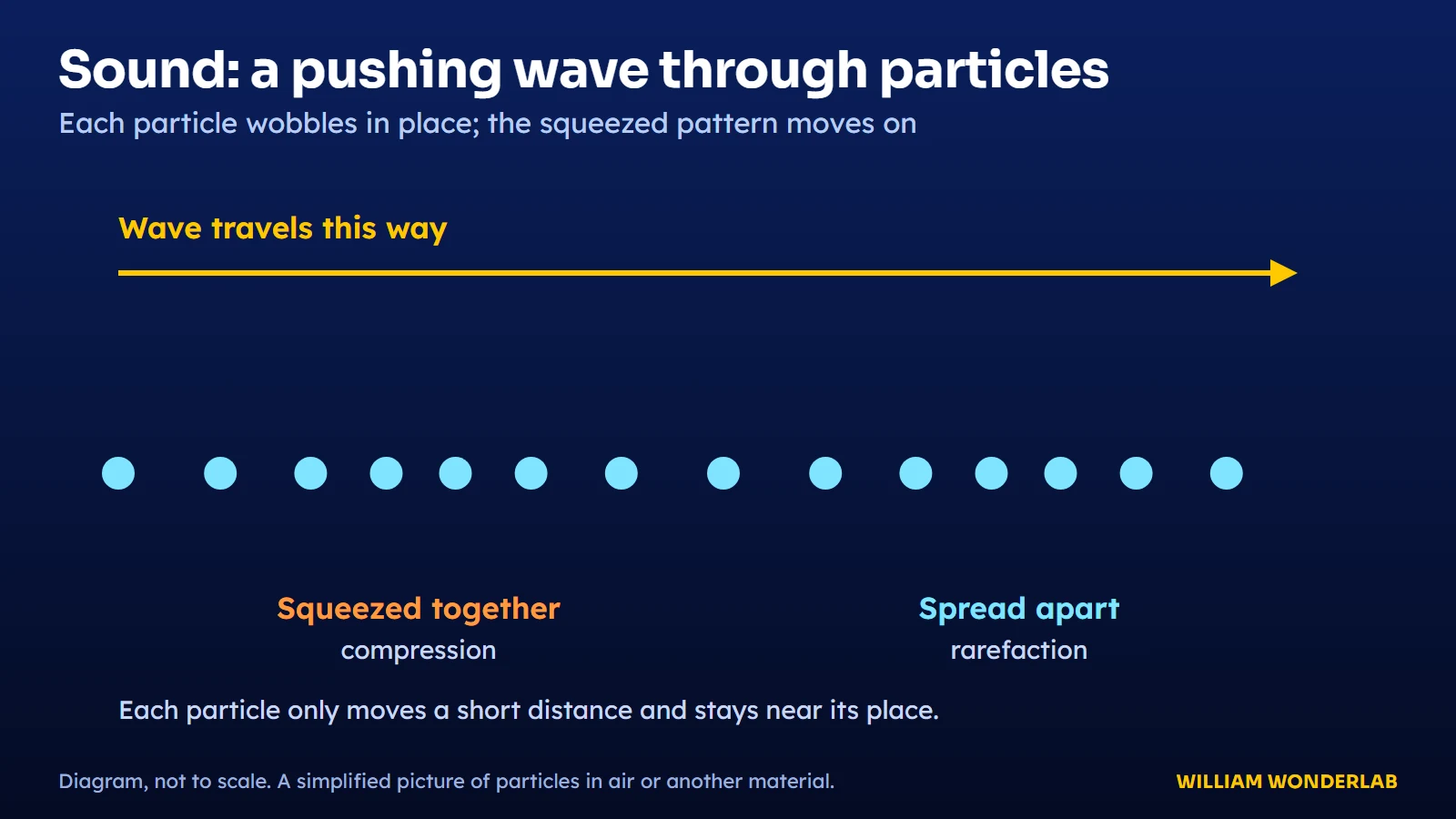
A sound wave is the way that shaking spreads out. NASA’s eClips glossary describes it as “a series of compressions and rarefactions traveling through a substance.”[4] A compression is a place where particles are squeezed together. A rarefaction is a place where they are spread further apart. Each compression pushes on the next part of the material, and the pattern moves onward.
Sound needs something to travel through
Sound cannot travel through nothing. A vibration has to be handed from one particle to the next, a bit like a relay race in which each runner passes the baton on. Science Learning Hub describes it this way: “Sound travels by particles bumping into each other as they vibrate.”[1]
The particles themselves do not race along with the sound. Each one only wobbles back and forth near its own place, and it is the wobble that gets passed on. When you hear a voice, the air molecules next to your ear are moving back and forth by a tiny amount, not travelling from the speaker’s mouth to your ear.[5]
This is also why sound cannot cross a vacuum, which is a space with almost no particles in it. The same site says: “Sound won’t travel in a vacuum because there are no particles to bump together to transmit the vibration.”[1] With no particles, there is nothing to pass the vibration along.
Air is the material we meet most often, but sound moves through liquids and solids too. Science Learning Hub notes: “We are most used to the sound travelling through air, but sound is able to travel faster and further in solids and liquids.”[5] That is why you can hear a voice on the other side of a wall, and why a knock on a table can be heard across a room.
How fast does sound travel?
Sound is fast, but it is not instant. In air at 20 °C it travels at about 344 metres per second.[2] That means sound covers roughly one kilometre in about three seconds (1,000 ÷ 344 ≈ 2.9 seconds).
The speed depends on the material. In water at 20 °C, sound travels at about 1,482 metres per second. In 347 stainless steel, a longitudinal wave (the kind that pushes and pulls along its direction of travel) moves at about 5,790 metres per second.[3] The chart below puts the three side by side.
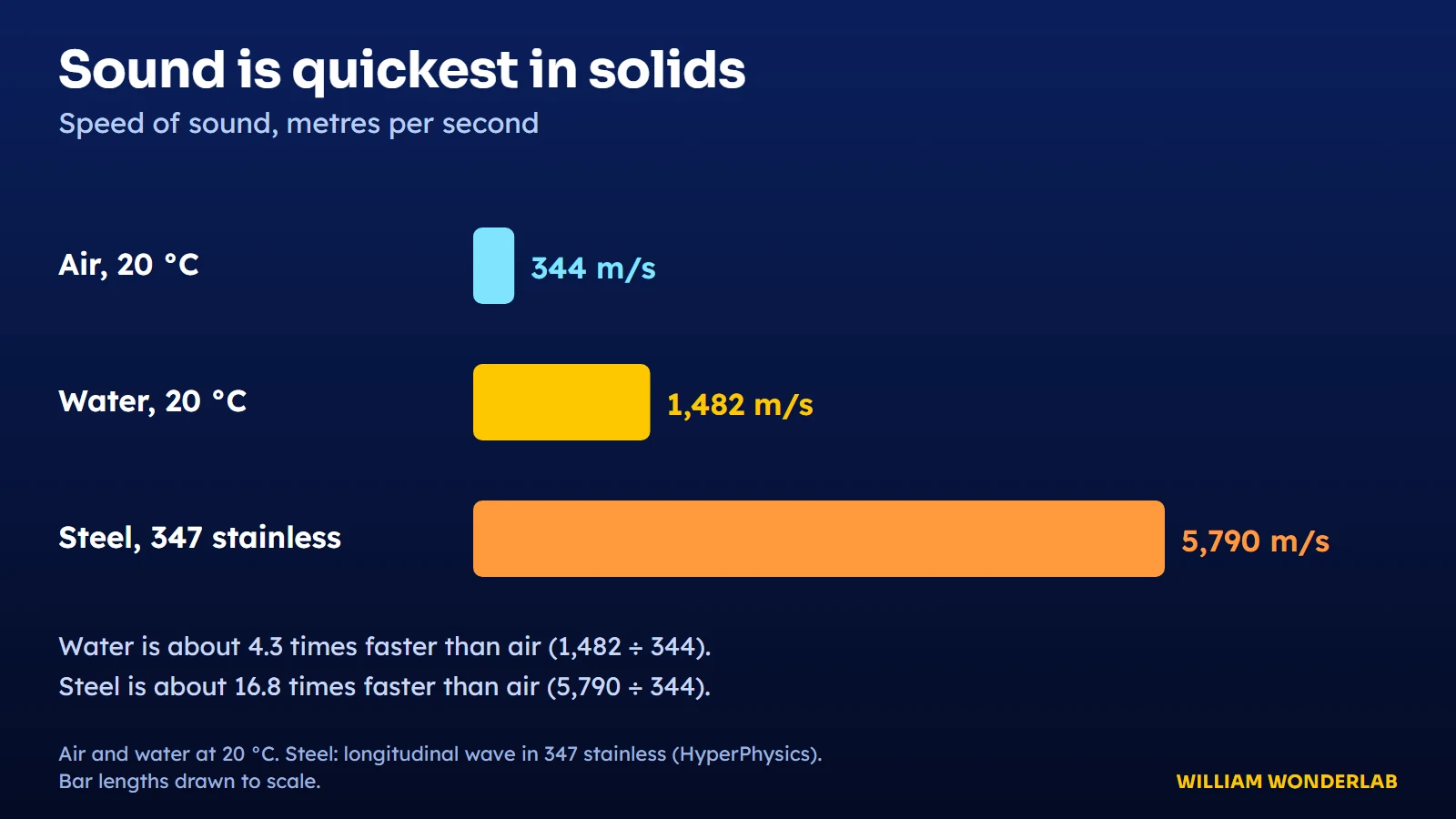
The numbers come from HyperPhysics, a physics reference from Georgia State University. Exact values change a little with temperature and with the type of material, so treat them as typical figures rather than fixed rules.[2][3]
Why sound is different in different materials
The table shows a clear pattern. Sound moves fastest through the solid, slower through the liquid and slowest through the gas. Science Learning Hub says that in solids the wave “travels even faster than it does in either liquid or air.”[1]
Scientists explain this using how closely particles sit together and how strongly they are linked. You do not need the full detail to use the pattern: the material matters as much as the sound itself. Sound in water is more than four times faster than sound in air, and sound in steel is far faster again.
Everyday examples
- Thunder after lightning. Sound takes time to cover the distance from a lightning strike to your ears, so the thunder arrives later. The timing is explained in Why Does Lightning Come Before Thunder?
- Voices through a wall. A wall is a solid, and sound travels through solids as well as air.[5] Some sound still gets through, which is why you can hear a conversation next door.
- A tap travelling through a table. A knock on a wooden table sends vibrations through the wood as well as through the air, so the sound can be heard a little differently when your ear rests on the table.
Did you know? Sound moves through water more than four times faster than through air at 20 °C. The exact figures are 1,482 ÷ 344 ≈ 4.3.[2][3]
Try it: hear sound through a solid
This is a proposed at-home activity. Nothing here has been tested by William.
You need: a sturdy wooden table, a metal spoon and a quiet room.
- Before you start, predict whether the tap will sound clearer when your ear rests on the table or when your ear is in the air above it.
- Tap the table gently with the spoon while your ear is a short distance away. Listen carefully.
- Rest your ear lightly on the table and tap it in the same spot. Compare the sound with step 2.
- Write down what you noticed, and whether it matched your prediction.
Safety first: Tap gently with the spoon, so no one gets hurt or the table is not damaged. Keep fingers clear of the spoon’s edge, and do not tap anyone with it. Never put any object into your ears. An adult should supervise, especially with younger scientists.
Go deeper: the arithmetic of sound
How long does sound take to arrive?
The travel time is the distance divided by the speed. Using the speed in air at 20 °C:
- Time for a sound 1,000 metres away = 1,000 ÷ 344 ≈ 2.9 seconds.
- If you hear a bell 2 seconds after it rings, it is about 2 × 344 = 688 metres away, when the air is at 20 °C.
These are estimates. They assume the air is at 20 °C, because the speed changes with temperature.
Temperature changes the speed in air
HyperPhysics gives the speed of sound in air as 331.5 metres per second at 0 °C and 344 metres per second at 20 °C.[2] Warmer air carries sound slightly faster, so the same clap would reach you a fraction of a second sooner on a warm day than on a cold one.
Frequently asked questions
Can sound travel through a vacuum?
No. Sound needs particles to pass each vibration along, and a vacuum contains almost none.[1]
Why can you hear through a wall?
Sound travels through solids as well as air, so some of it passes through the wall.[5]
How fast does sound travel in air?
About 344 metres per second at 20 °C. The speed changes a little with temperature.[2]
Does sound travel at the same speed in every material?
No. Sound moves fastest through solids, slower through liquids and slowest through gases, as the speeds in the chart show.[1][3]
What makes a sound?
A vibrating object. Its shaking pushes on the material around it, and that push is passed along as a wave.[1][4]
The big idea
Sound is a vibration passed along. Something shakes, the shaking is handed from particle to particle through a material, and the pattern reaches your ear. No material, no sound.
Related reading
More from William Wonderlab:
Explore more from scientists:
- Sound on the move (Science Learning Hub)
- Wave Speeds (HyperPhysics, Georgia State University)
- Speed of sound in air (HyperPhysics, Georgia State University)
References
[1] Science Learning Hub, “Sound on the move” (accessed 25 October 2026)
[2] HyperPhysics, Georgia State University, “Speed of sound in air” (accessed 25 October 2026)
[3] HyperPhysics, Georgia State University, “Wave Speeds” (accessed 25 October 2026)
[4] NASA eClips, “Glossary” (accessed 25 October 2026)
[5] Science Learning Hub, “Sound” (accessed 25 October 2026)