Why Are Diamonds and Pencil Lead Both Made of Carbon?
Diamond and graphite, the soft material in pencils, are both carbon. The difference is how the carbon atoms are arranged, which makes one very hard and the other flaky.
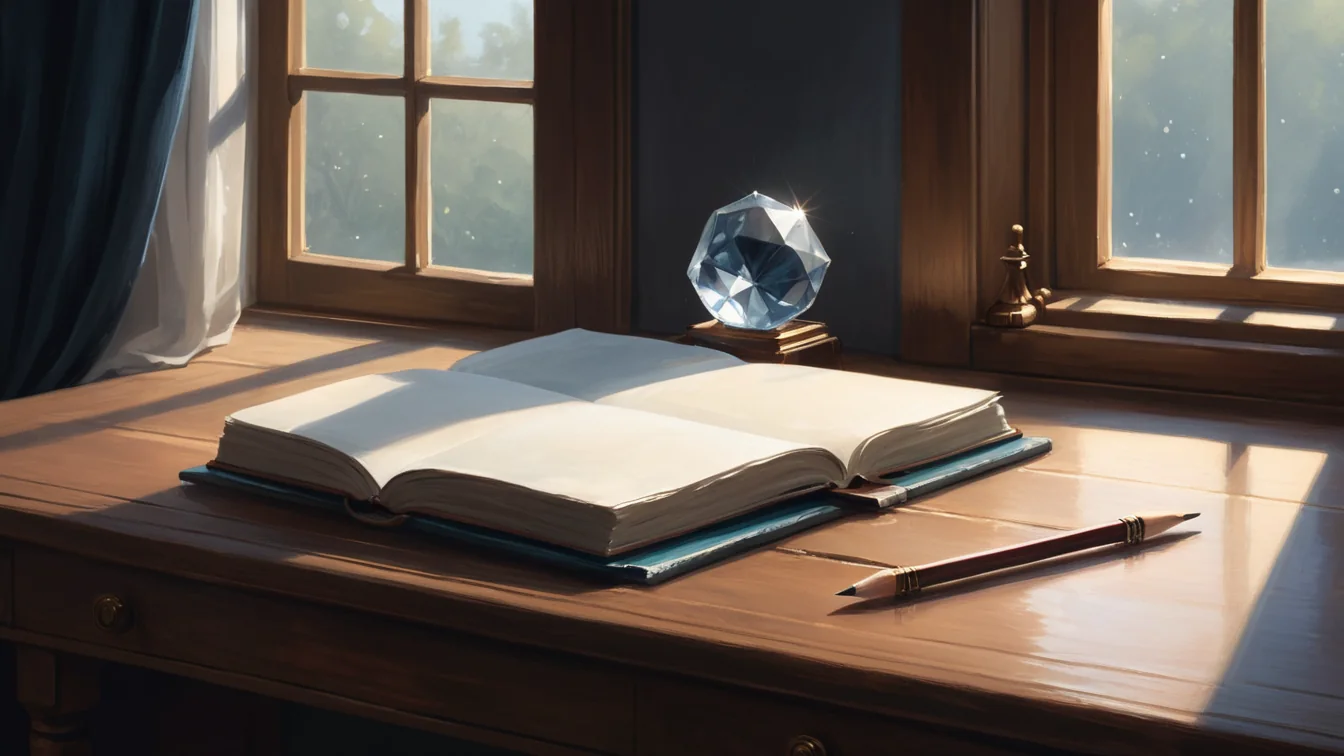
A sparkling diamond and a pencil look nothing alike. One is glassy and cool to touch. The other is grey and leaves a mark on paper. Yet both are made from the same element, carbon. How can one element make two such different everyday materials?
The short answer: Diamond and graphite, the soft material that leaves marks from a pencil, are both pure carbon. The difference is arrangement. In diamond, each carbon atom is linked to four others in a strong, three-dimensional web, which makes the material very hard. In graphite, the carbon atoms form flat sheets, and the sheets are only weakly held together, so they slide and rub off onto paper.[1][2]
One element, two arrangements
Chemists call different forms of the same element “allotropes.” The Royal Society of Chemistry’s education page on carbon says that “Until 1985 it was thought there were only two allotropes of carbon: diamond and graphite.”[2] Both are forms of one element, so the difference is in the arrangement. What changes is not the atoms themselves but how they are joined together.
Think of building with the same bricks. A wall and a stack of flat tiles use the same bricks, yet they behave very differently when you push on them. Carbon atoms work in a similar way.
Diamond: a strong three-dimensional web
In diamond, the carbon atoms form a rigid framework. A chemistry textbook on the subject says that each carbon atom is “linked to each other by covalent bonds in a giant three-dimensional network.”[1] A covalent bond is a strong link between two atoms. The same textbook describes the geometry: “Note how each carbon atom is surrounded tetrahedrally by four bonds.”[1] Tetrahedral means the four bonds point towards the corners of a pyramid with a triangular base.
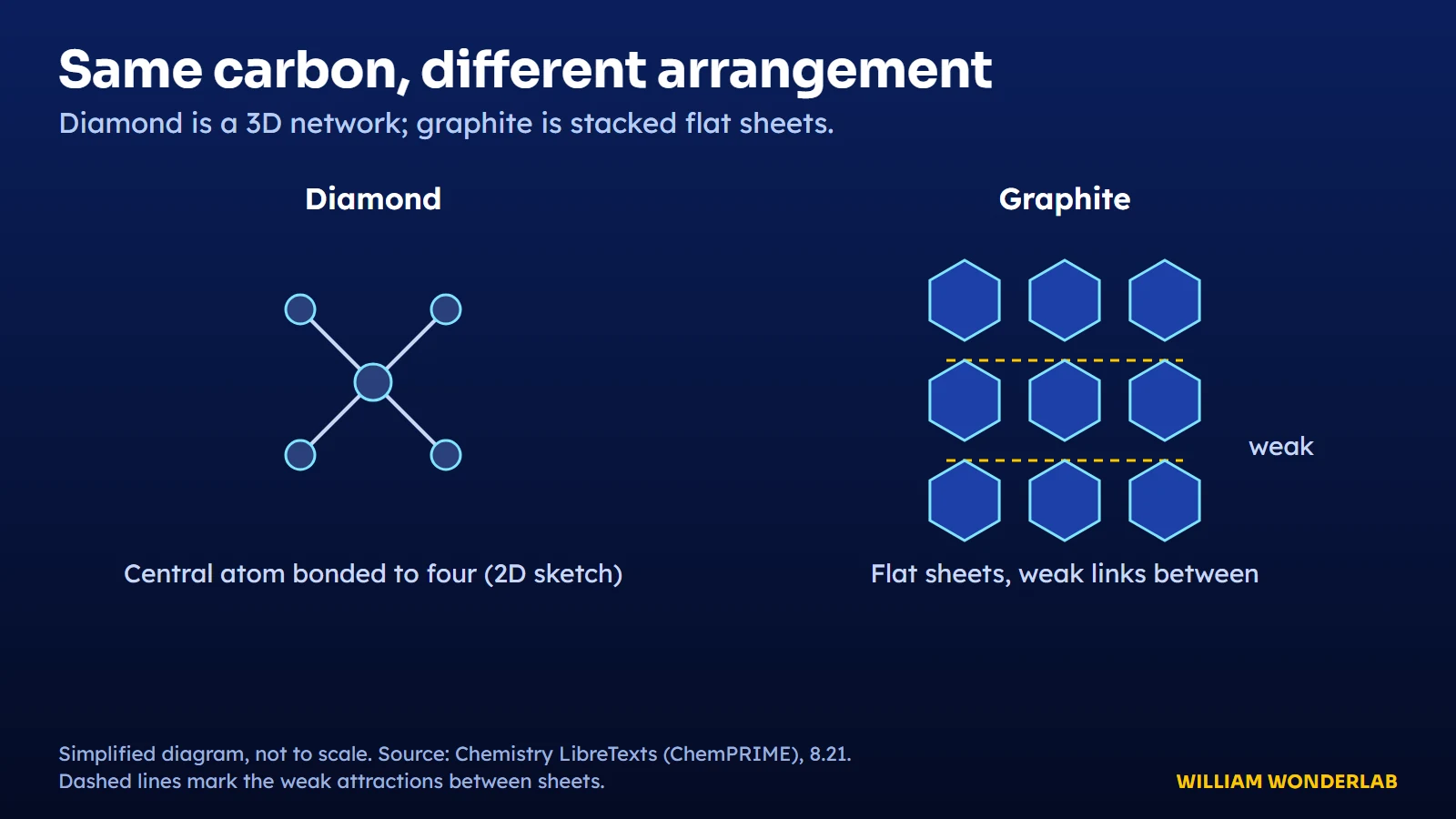
The diagram above is a simplified picture. Real diamond extends in all directions, not just across the page.
This web is the reason for diamond’s hardness. The textbook explains that “Each carbon atom is held firmly in its place from all sides and is thus very difficult to displace or remove.”[1] The Royal Society of Chemistry agrees, noting that “diamond is one of the hardest known materials.”[2] To scratch it, you would have to pull on many strong bonds at once.
Graphite: flat sheets that slide
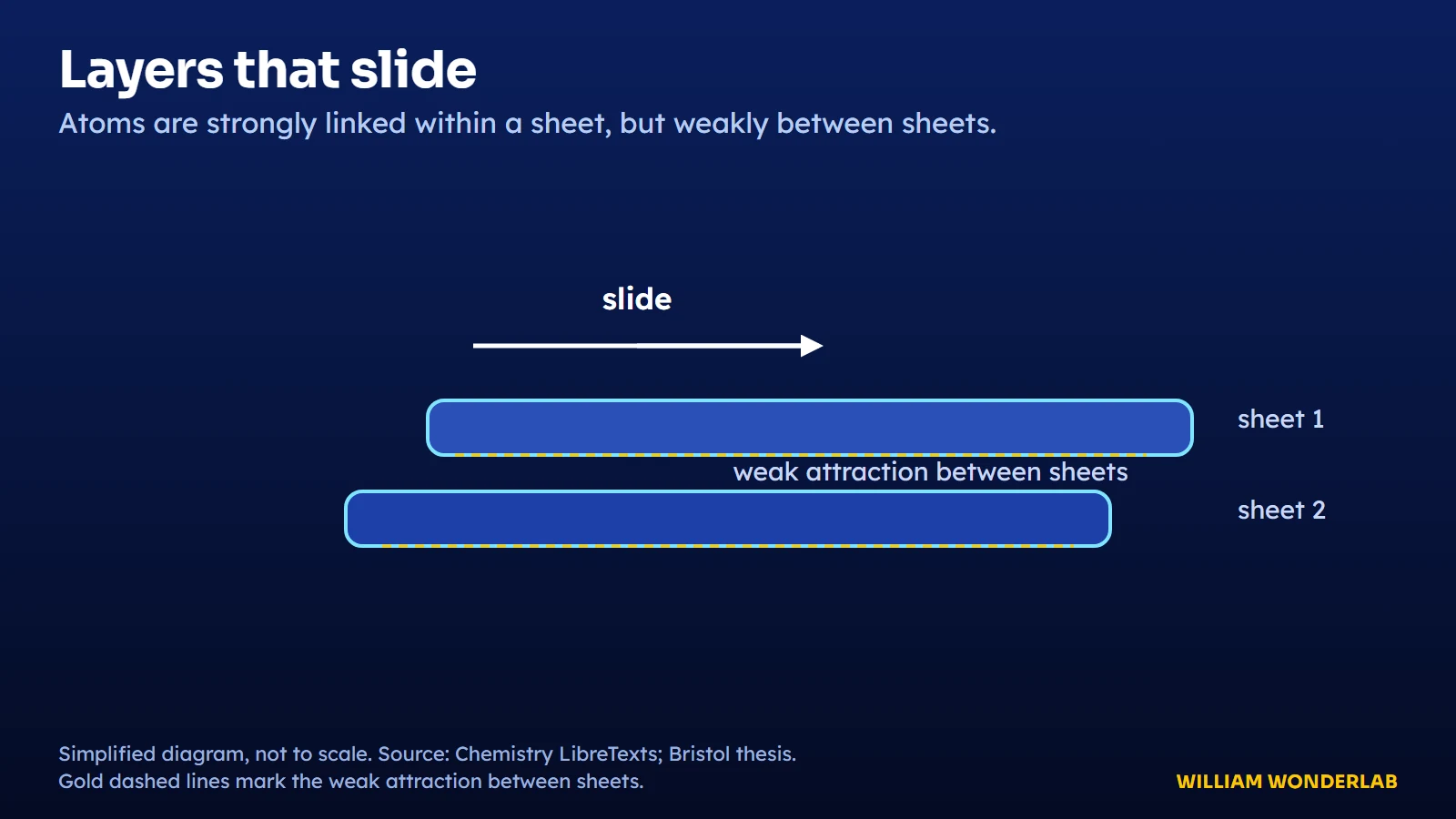
Graphite has a different plan. Its carbon atoms link into flat hexagonal sheets, and the textbook notes that “The structure of graphite consists of flat layers.”[1] Each sheet is held together by strong bonds, but the sheets sit on top of one another with only weak attraction between them. A university thesis on diamond and graphite describes this as “where each sheet is weakly bonded to its neighbour.”[3]
The weak attraction is what lets graphite slide. According to the textbook, “only weak London forces attract the planes together,” and so “The various layers can therefore slide past each other quite easily.”[1] London forces are very weak attractions between molecules or sheets that are close together. They are not strong enough to lock the sheets in place.
Why a pencil leaves marks
The Royal Society of Chemistry describes graphite’s layers as making it “soft and flaky,” and says that, “as a pencil it leaves marks on your paper.”[2] A simplified picture is this: when you write, the pencil tip rubs thin flakes of graphite loose, and they stick to the rough surface of the paper. Each flake is a stack of sheets that slid apart as you moved the pencil.
This is the same weak link that makes graphite a useful writing material. The strong bonds inside each sheet stay intact, so the marks are made of flakes, not single atoms.
Making diamonds: pressure and heat underground
Diamonds form far below the surface. Geoscience Australia says that “Diamond is thought to form 150 km to 200 km below the Earth’s surface,” where “high temperatures (1050°C – 1200°C) and pressures (45 kilobars – 55 kilobars) allow it to crystallise.”[4] The Western Australian Museum describes diamond as “the high-pressure form of carbon,” which “generally crystallises at depths greater than 150km below the Earth’s surface.”[5]
Estimates of the temperature differ. Geoscience Australia gives 1050 to 1200 °C,[4] while the Western Australian Museum says that “At these depths, the temperature increases substantially and diamonds form at about 900 to 1400 degrees Celsius.”[5] Because the estimates differ, both ranges are shown rather than one number.
Once formed, diamonds have to get to the surface. Geoscience Australia explains that “The diamonds may then be picked up by hot molten rock (magma)” and are “transported upwards as the magma intrudes up into the Earth’s crust.”[4]
The picture above is a conceptual illustration of a rock layer, not a photograph of a real mine or a real formation.
Same atoms, different outcomes
Put these pieces together. The carbon atoms are the same in both materials. Diamond forms when carbon is squeezed by very high pressure and heat deep underground, and it keeps a tight three-dimensional web. Graphite has flat sheets with weak links between them, so the layers can slide apart. Within each sheet the bonds are strong, but the sheets come apart easily between layers.[1][3]
So the question “why are they both carbon?” has a simple answer: they are both carbon, but carbon can be arranged in more than one way. Arrangement changes what a material is like to touch, to cut and to write with.
Try it: the flake test
This is a proposed at-home activity. Predict first: when you rub a pencil mark with a finger or a cotton bud, will it smear, flake, or stay put?
You need: a pencil, a sheet of plain paper, a cotton bud, a clean tissue and a pen for comparison.
- Predict what the pencil mark will do when you rub it.
- Scribble a patch of grey with the pencil, about the size of a coin.
- Make a similar patch with the pen, and do not rub it yet.
- Rub both patches gently with the same cotton bud, or a fingertip, and watch the results.
- Wipe the pencil dust with the tissue and compare. Does the pencil mark spread or flake? Does the pen behave the same way?
Safety first: Use only the pencil, pen, paper and cotton bud. Do not put any pencil, bud or tissue in your mouth, and keep pencils away from very young children who may chew them. Wash your hands after the activity, and do not blow pencil dust towards anyone’s face or eyes.
Go deeper: why the two materials feel so different
The same element, two shapes
The gap between the two materials is a matter of geometry and bonding. Because diamond’s web is built in every direction, the atoms are “held firmly in its place from all sides.”[1] In graphite, the flat sheets are strongly bonded within each layer and weakly bonded between layers, which is why the layers can slide.[1][3]
Why the numbers vary
Geoscience Australia gives 1050 to 1200 °C and the Western Australian Museum gives 900 to 1400 °C, so the text above attributes each range to its source.[4][5]
Frequently asked questions
Are diamond and pencil lead really the same element?
Yes. Both are forms of carbon. The difference lies in how the carbon atoms are arranged.[1][2]
Why is diamond so hard?
Each carbon atom is linked to four neighbours in a strong three-dimensional web, so it is very difficult to displace an atom.[1]
Why does graphite leave marks?
Its carbon atoms form flat sheets that are weakly bonded to each other. Writing rubs thin flakes loose, and the flakes stick to the paper.[2][3]
Where do diamonds form?
Geoscience Australia says diamonds are thought to form 150 to 200 kilometres below the surface, under very high pressure and heat.[4]
Could a pencil ever turn into a diamond?
Natural diamonds form deep underground under very high pressure and temperature.[4][5]
The big idea
Same carbon, different arrangement. Diamond is a strong three-dimensional web, so it is very hard. Graphite is flat sheets that slide apart, so it is soft and leaves marks on paper.
Related reading
More from William Wonderlab:
Explore more from scientists:
- 8.21: Diamond and Graphite (Chemistry LibreTexts, ChemPRIME)
- Diamond (Geoscience Australia, Australian Mineral Facts)
References
[1] Chemistry LibreTexts, ChemPRIME (Moore et al.), “8.21: Diamond and Graphite” (accessed 26 October 2026)
[2] Royal Society of Chemistry, Education, “Allotropes of carbon” (accessed 26 October 2026)
[3] University of Bristol, Chemistry Department, “Chapter 1: Introduction” (diamond and graphite thesis) (accessed 26 October 2026)
[4] Geoscience Australia, “Diamond”, Australian Mineral Facts (accessed 26 October 2026)
[5] Western Australian Museum, “The story of diamonds in Western Australia” (accessed 26 October 2026)