How Does Tap Water Get to Your House?
A glass of tap water has had a long trip. Here is how it is collected, treated, stored on higher ground and pushed through pipes to your kitchen.
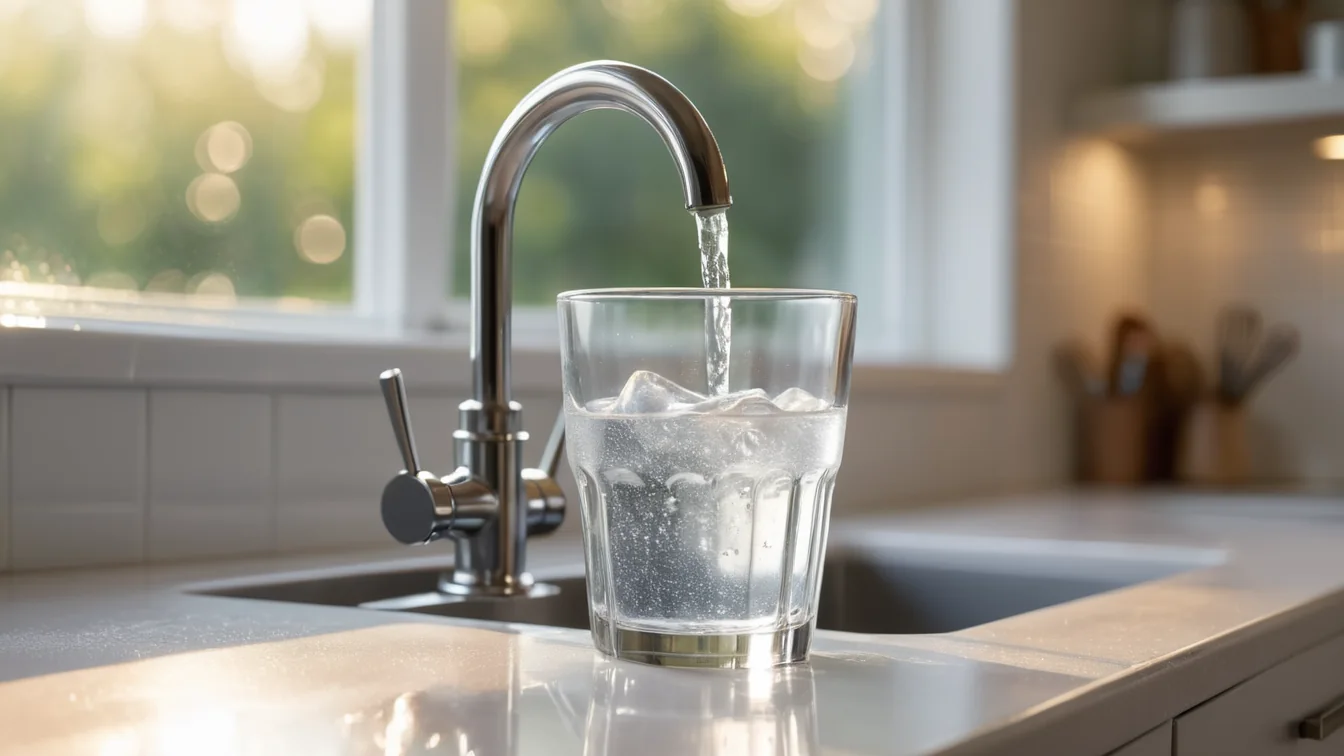
Turn on a tap and clean water comes out, sometimes within seconds of opening it. That water may have started as rain that fell on a mountain or flowed into a river a long way from your house. Its trip is a chain of steps, and each one matters for keeping the water safe and the pressure strong enough to reach your kitchen.
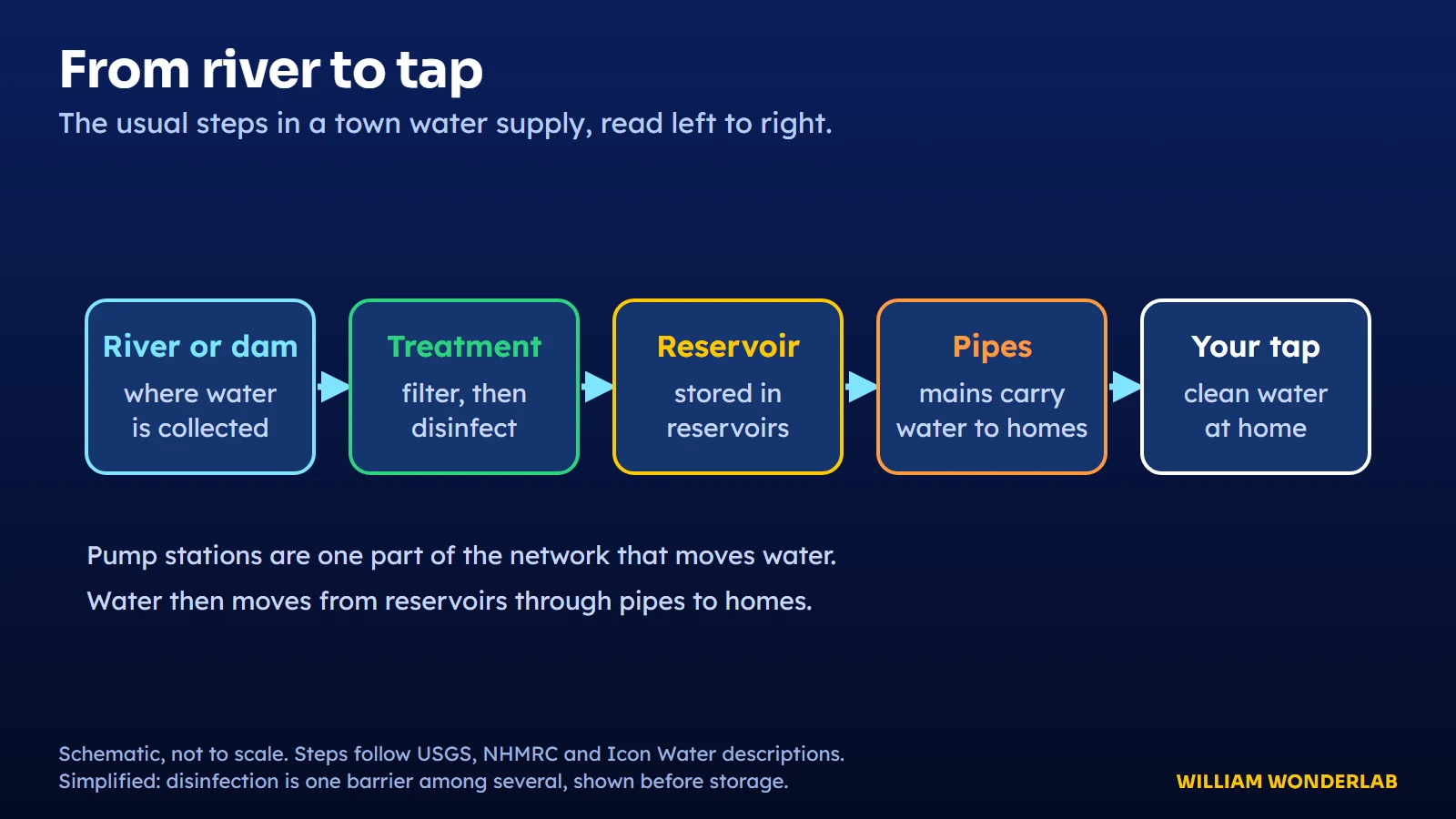
The short answer: Water is collected, cleaned at a treatment plant, and stored in reservoirs.[1][5] Then a network of pipes and pump stations carries it to your home.[5] The height of the water above a pipe also adds push.[4] Treatment and disinfection make it safe to drink.[2]
Step 1: collecting the water
Water that is simply collected is not ready to drink. The USGS notes that “Often water is withdrawn and pumped into holding ponds or containers, where solids and particles can settle to the bottom.”[1] Letting particles settle is one of the first physical steps in treatment.
Step 2: cleaning and disinfecting
Treatment plants do more than let particles settle. The USGS says that filters screen out large particles, and that “at a minimum, chlorine is added to kill dangerous bacteria and microorganisms.”[1] Disinfection is the step that kills germs.
Public health guidance takes the same view. The National Health and Medical Research Council says that “In most cases disinfection will be used as part of a multiple barrier approach to the production of safe drinking water.”[2] A barrier is any step that stops germs or dirt, and a multiple barrier system uses several steps in a row. The NHMRC notes that “Identifying and implementing preventive measures should always be undertaken within the context of a multiple barrier approach, so that failure of one barrier will be compensated by effective operation of the remaining barriers.”[3]

Step 3: storing water on higher ground
After treatment, water is held in reservoirs, which are large tanks or ponds.[5] Water held on higher ground can reach homes below it, because a taller column of water creates more pressure.[4]
Storing water also gives particles time to settle, as the USGS describes for holding ponds.[1] In the NHMRC’s list of traditional preventive measures, “detention in protected reservoirs or storages” is one of the barriers.[3]
Step 4: the pipes and the push
Pipes carry water from the network to each home, and pump stations are one part of the network that moves it along.[5] The height of the water above a pipe also adds push. HyperPhysics explains that “The pressure exerted by a static fluid depends only upon the depth of the fluid, the density of the fluid, and the acceleration of gravity.”[4] A taller column of water above a pipe creates more pressure, which can help a reservoir on a hill supply homes below it.
The same page adds that “The fluid pressure at a given depth does not depend upon the total mass or total volume of the liquid.”[4] So the pressure depends on how high the water stands above the tap, not on how big the reservoir is. A tap on a higher floor has less water above it, so the pressure there is lower.
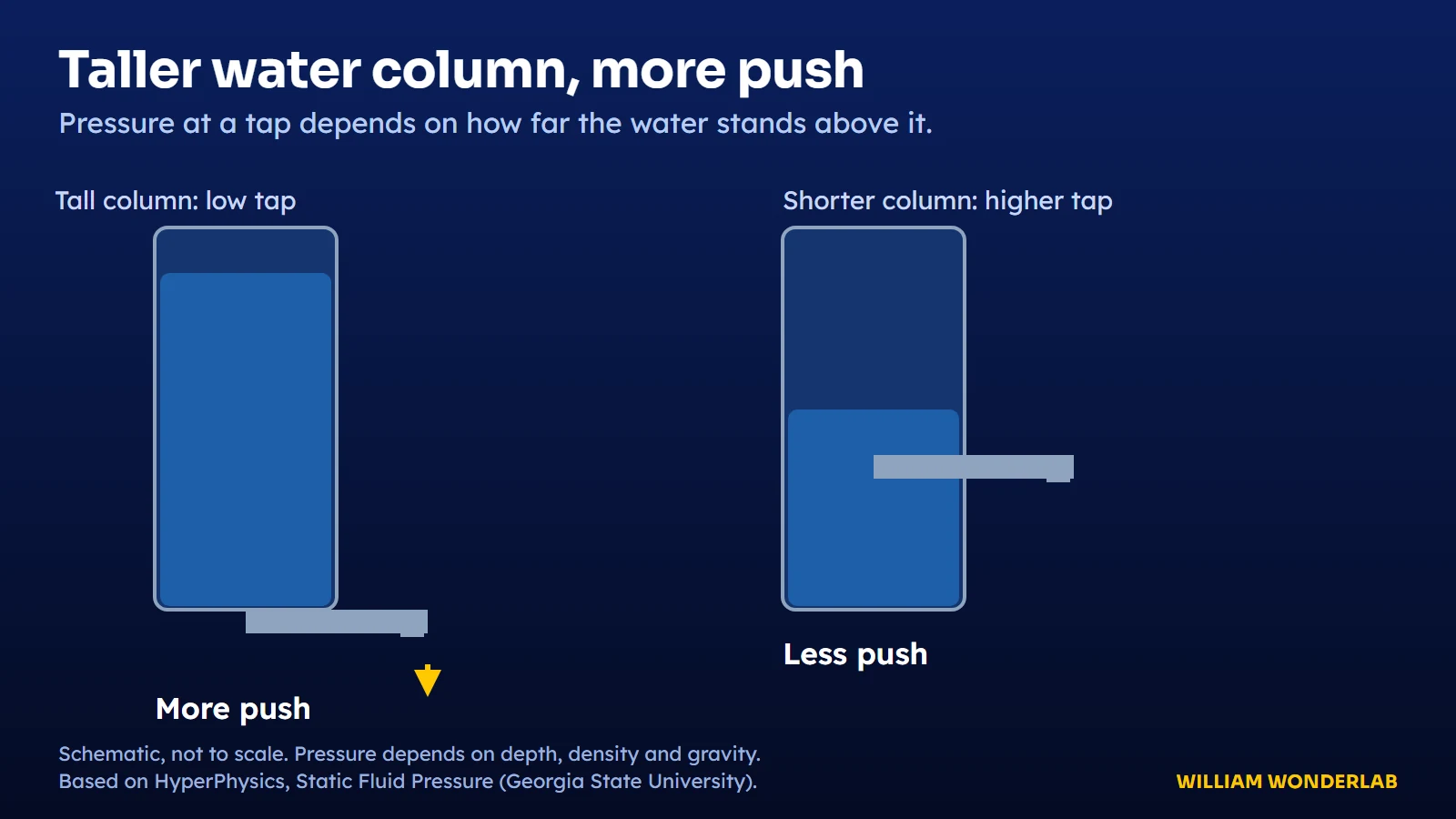
Did you know? The same height effect that HyperPhysics describes for liquids in general is one reason a tap on a higher floor can have less push than a tap lower down.[4]
Try it: the bottle at different heights
This is a proposed at-home activity that shows how the height of water changes the push it can give. It is a simple model, not a test of your home’s pipes.
You need an empty plastic drink bottle with its cap off, a tray or sink, a pencil, and cold water.
- Ask an adult to help you poke a few small holes near the bottom of the bottle, one above the other, using a pencil tip.
- Place the bottle in the sink or on a tray and fill it with water.
- Watch which hole squirts the furthest. Then fill the bottle again and compare the spray as the water level drops.
Look for the link between the height of the water and the push it gives. Lower holes have more water standing above them, which follows the depth principle described above.
Safety first: Do this over a sink or tray, and keep electrical items and power points well away from the water. Use a pencil tip, not a sharp knife, and ask an adult to help make the holes. Mop up spills straight away because wet floors are slippery. Never drink water from a bottle you have used for this activity.
Go deeper: the whole system
Why treatment comes before storage
Clean water is only useful if it stays clean on the way to your tap. The NHMRC describes preventive measures from the catchment all the way to the consumer, including disinfection and the protection and maintenance of the distribution system.[3] Each barrier helps, so no single step has to do all of the work.
Frequently asked questions
Why does tap water need to be treated?
Because water from rivers and dams can contain particles and germs. Filters and chlorine are used to remove or kill them.[1][2]
Why does water come out of the tap at all?
Water in a reservoir on higher ground stands above the tap, and the pressure in a still fluid depends on depth. The pipes carry the water to your home.[5]
Why might the top floor get less water pressure?
Because there is less water standing above the tap, and pressure in a still fluid depends on depth.[4]
The big idea
Tap water is a planned journey. It is collected, cleaned, stored up high and pushed through pipes. The barriers along the way keep it safe, and the height of the water helps keep it flowing to your kitchen.[2][3][4]
Related reading
More from William Wonderlab:
- How Does a Desalination Plant Make Seawater Drinkable?
- How Do Hydro Dams Make Electricity?
- Why Is the Ocean Salty?
Explore more from scientists:
- Australian Drinking Water Guidelines, Disinfection (NHMRC)
- Static Fluid Pressure (HyperPhysics, Georgia State University)
- Discover the journey of your water, from dam to tap (Icon Water)
References
[1] US Geological Survey, “Water Use Questions and Answers”, Water Science School (accessed 26 October 2026)
[2] National Health and Medical Research Council, “1.2: Overview of disinfection”, Australian Drinking Water Guidelines (accessed 26 October 2026)
[3] National Health and Medical Research Council, “3.3.1 Preventive measures and multiple barriers”, Australian Drinking Water Guidelines (accessed 26 October 2026)
[4] Nave, C. R., HyperPhysics, Georgia State University, “Static Fluid Pressure” (accessed 26 October 2026)
[5] Icon Water, “Discover the journey of your water, from dam to tap!”, Water education, Canberra (accessed 26 October 2026)