What Is Friction and Why Does Ice Feel Slippery?
Friction is the resistance between surfaces that slide past each other. Ice is extra slippery, but scientists still debate exactly why.
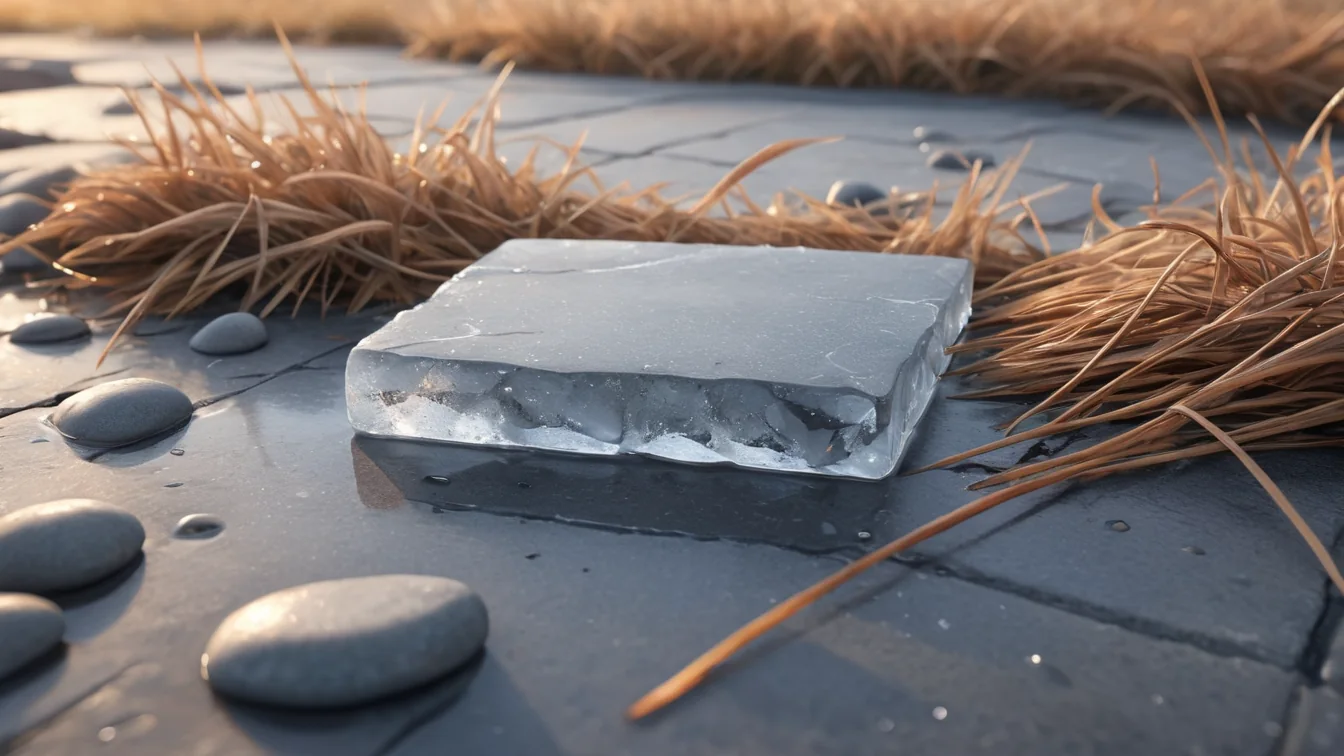
Walk across a kitchen floor in socks and you may slide. Step onto a frozen footpath and your feet can shoot out from under you, even though the ice looks solid and still. Why is ice so much slipperier than most other surfaces? The honest answer has two parts. Friction explains why sliding slows down, but scientists still disagree about the exact reason ice is so slick.
The short answer: Friction is the resistance between two surfaces that rub or slide past each other. Ice is unusually slippery, and a thin, liquid-like layer on its surface may be part of the reason, but scientists still debate how that layer forms and how much each explanation contributes.[1][2][3]
What is friction?
Friction is the resistance to relative motion between two surfaces in contact.[1] In plain words, it is the grip that stops things sliding past each other. Science Learning Hub describes it as “the contact force that slows or stops moving objects.”[2]
Your rubber shoes grip the footpath because friction between the rubber and the ground resists your feet sliding forward. Take that grip away, as with a patch of ice, and the same push sends you sliding.
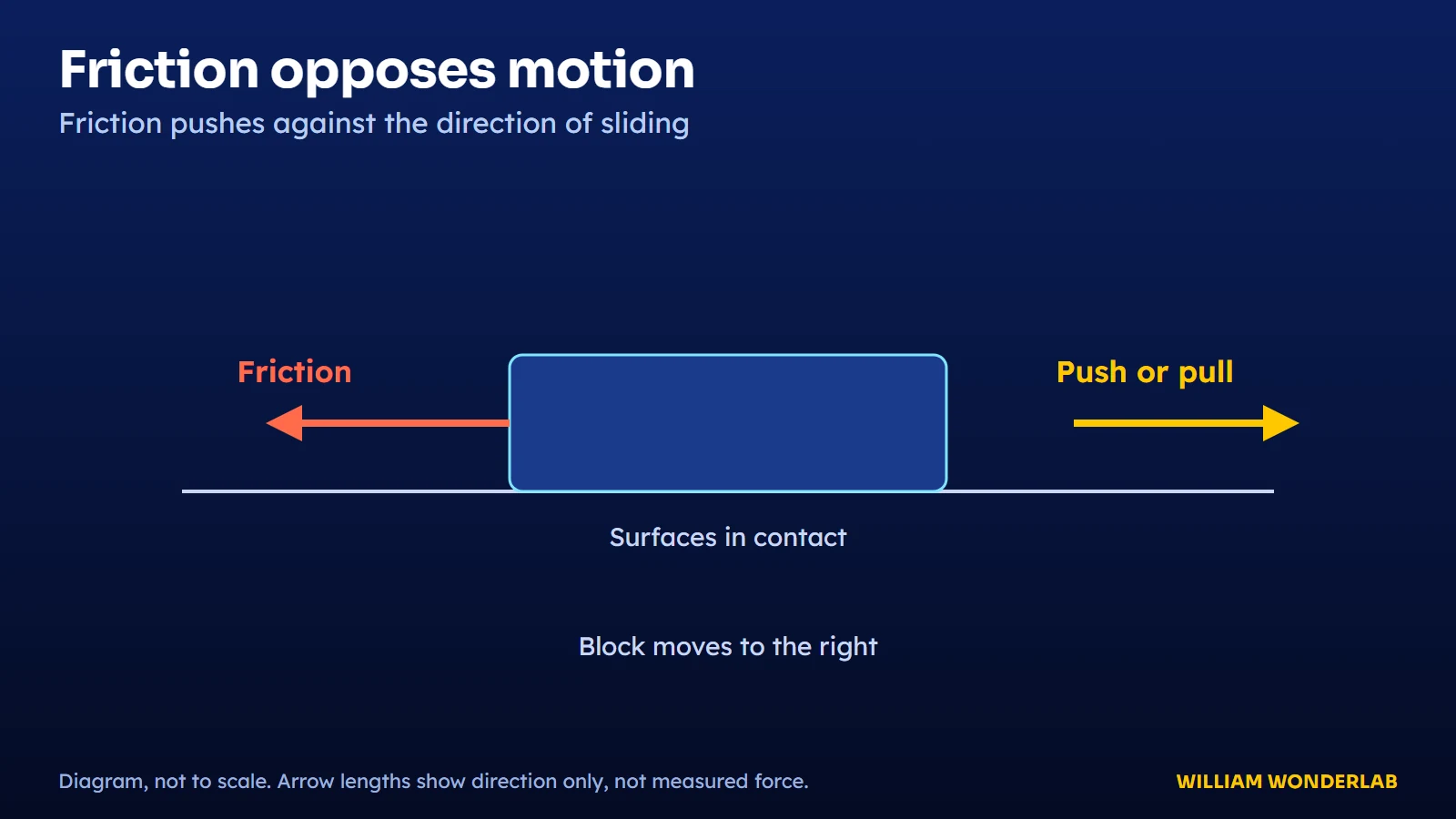
Friction always pushes against the direction of motion. In the diagram, the block is being pushed to the right, so friction acts to the left. Friction does not decide where something goes; it only resists the sliding.
Why ice is different
Many solid surfaces grip reasonably well. Ice does not, and scientists have been trying to explain why for a long time. Before going further, a quick note: whether ice floats is a separate question, explained in Why Does Ice Float?
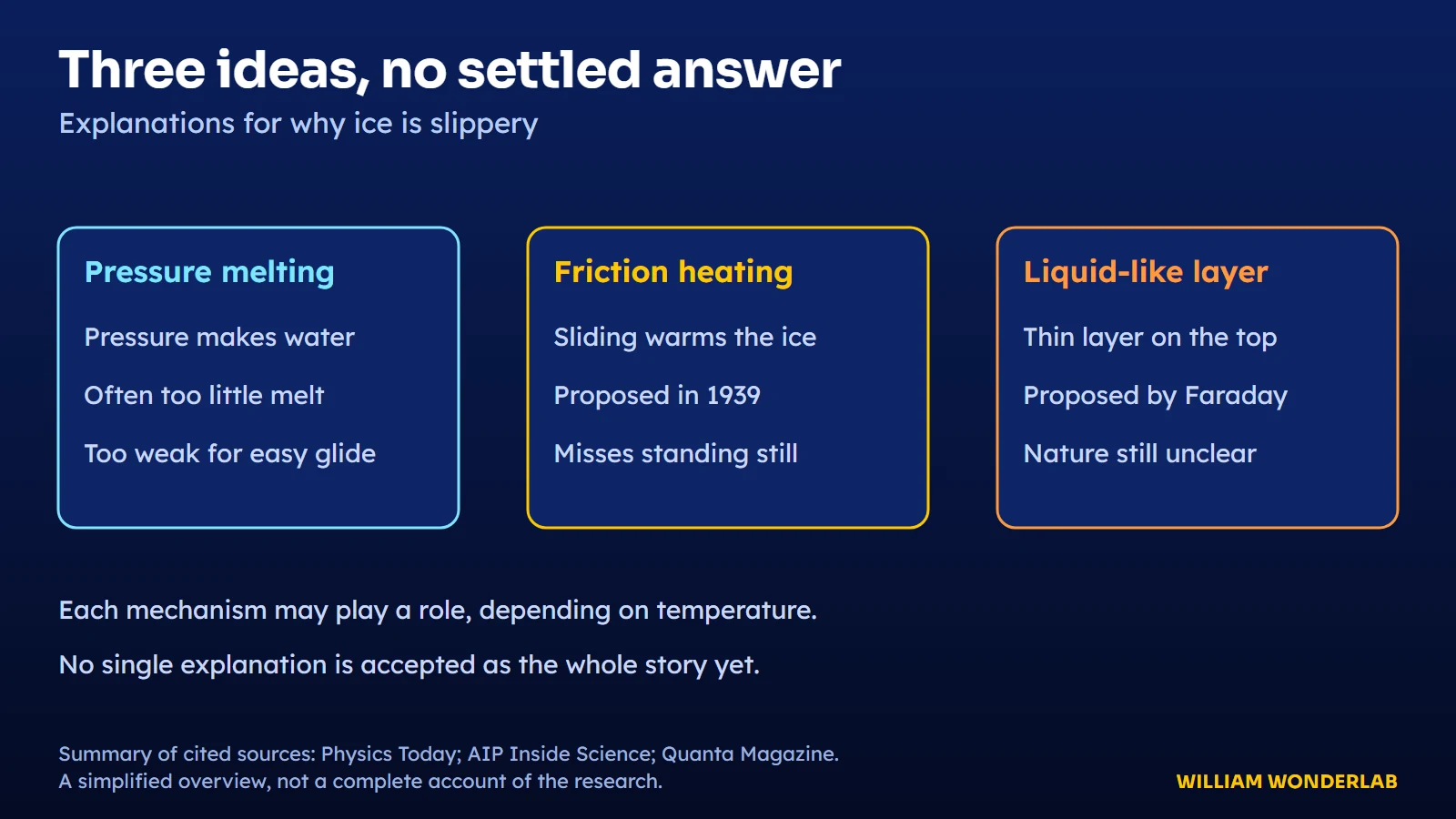
The oldest idea is pressure melting. The common picture is that a skate’s weight melts the ice under it, forming a thin film of water. Physics Today, in an article by Robert Rosenberg, describes this common perception as “ice melts under their skates’ pressure to produce a film of water.”[3]
The picture has a problem. AIP Inside Science explains that “in most cases pressure, such as from a ski or sled, does not cause nearly enough melting to allow for easy sliding on an icy surface.”[4]
The second idea is frictional heating. In 1939, Frank P. Bowden and T. P. Hughes suggested that sliding friction heats the surface and melts a film of water.[3] Friction can melt some ice, but it struggles to explain everything. The researcher Daniel Bonn, quoted by Quanta Magazine, puts the objection this way: “you only melt the ice behind you, not the ice you are actually skating on.”[5]
The third idea is a thin liquid-like layer that exists on ice even when it is not melting. Quanta describes Faraday’s proposal as “a thin, premelted layer that sits on ice’s exposed surface.”[5] This layer is the most popular candidate, but its exact nature is hard to pin down.
The hard part: standing still
Here is the puzzle that makes the story difficult. Friction heating needs sliding to melt the surface. Yet ice is slippery even when you stand still on it. AIP Inside Science makes this point: the friction explanation “still did not account for why ice is slick even when you stand still on it.”[4]
That is why the thin surface layer keeps coming back into the discussion. Physics Today describes premelting as “the development of a liquid layer that forms on solids at temperatures below the bulk melting point.”[3] In other words, the layer is a possible explanation even before anything slides.
Where the debate stands
The three ideas are not simply right or wrong. Physics Today notes that “each mechanism plays a role that depends on the temperature.”[3] The same article points out that “the nature of the liquid-like layer is not clear from experimental measurements.”[3]
A 2022 study in the Proceedings of the National Academy of Sciences used a computer simulation of ice at the nanoscale. Its authors conclude that the mechanisms are “a combination of spontaneous premelting, pressure melting, and frictional heating,” and that “equilibrium premelting, pressure melting, and frictional heating operate simultaneously.”[6] A simulation is one line of evidence, not the final answer, but it shows why researchers are looking at several explanations at once.
Quanta reports that researchers “disagree, though, about why the layer forms,” and Bonn says “ice researchers do have different and contradictory opinions.”[5] So the honest summary is that a surface layer, pressure and friction may each contribute, with the balance depending on the temperature. No single explanation has been accepted as the whole story.
Everyday examples
- Grit on an icy path. Sand or salt is spread on frozen paths because the grit gives shoes more grip. Friction between the grit and the shoe resists sliding.
- Ice skating. The skate glides, but the debate about why it glides is the same one described above.
- Standing on a frosty patch. Your feet can slip even when you are not moving, which is one of the puzzles scientists still have to explain.[4]
Did you know? The idea of a thin surface layer on ice goes back to Michael Faraday. Quanta describes his proposal as a thin, premelted layer on ice’s exposed surface, and scientists are still working out its role today.[5]
Try it: which surface holds an ice cube?
This is a proposed at-home activity. It is an informal comparison, not a measured experiment.
You need: an ice cube, a clean plastic tray, a tea towel, a sheet of baking paper and a paper towel.
- Predict which surface will let the ice cube slide the furthest when you give it the same gentle nudge: the plastic tray, the tea towel, or the baking paper.
- Place the ice cube on each surface in turn. Give it the same gentle push with one finger.
- Note how far each cube slides, and which surface seemed to grip the most.
- Compare your results with your prediction. Friction is the grip that resists sliding, so think about what you saw.
Safety first: Do this on a table, not on a wet floor. Wipe up melted water straight away, because a wet floor is slippery. Do not put ice in your mouth or near your eyes. Use cold tap water only. An adult should supervise, and everyone should wash their hands afterwards.
Go deeper: friction, forces and evidence
Friction is a force
A force is a push or a pull. Friction is a force too, so it can change how fast something moves. When the ice cube slides and slows, friction is one of the forces acting on it.[2]
Why the evidence matters
Physics Today says the difficulty is that the liquid-like layer “is not clear from experimental measurements.”[3] A good explanation has to match what scientists can measure about the surface, and what happens to ice at different temperatures. That is why an idea can be attractive and still be unproven.
Frequently asked questions
What is friction in simple words?
Friction is the grip between two surfaces that touch and slide past each other. It resists the motion.[1]
Why does ice feel slippery when I stand still?
That is one of the puzzles. Friction heating does not explain it on its own, and the question is part of the open debate.[4]
Is there one agreed reason ice is slippery?
No. Scientists still disagree about the exact mechanism.[3][5]
Does a skate’s pressure melt the ice?
Pressure can contribute, but in most cases pressure from a ski or sled does not cause nearly enough melting to allow easy sliding.[4]
Does the same explanation work at every temperature?
Not necessarily. Physics Today says each mechanism plays a role that depends on the temperature.[3]
The big idea
Friction is the grip that resists sliding. Ice is slippery because of a surface that may be liquid-like, but no one explanation has been settled. That is what makes ice one of the more interesting puzzles in everyday physics.
Related reading
More from William Wonderlab:
Explore more from scientists:
- Why is ice slippery? (Physics Today, American Institute of Physics)
- The physics of sliding on ice (AIP Inside Science)
- Friction definition (NASA Glenn Research Center, FoilSim)
References
[1] NASA Glenn Research Center, “Friction Definition” (accessed 25 October 2026)
[2] Science Learning Hub, “Friction” (accessed 25 October 2026)
[3] Robert Rosenberg, “Why Is Ice Slippery?”, Physics Today, American Institute of Physics (accessed 25 October 2026)
[4] AIP Inside Science, “The physics of sliding on ice” (accessed 25 October 2026)
[5] Paulina Rowińska, “Why Is Ice Slippery? A New Hypothesis Slides Into the Chat”, Quanta Magazine, 8 December 2025 (accessed 25 October 2026)
[6] Ł. Baran, P. Llombart, W. Rżysko and L. G. MacDowell, “Ice friction at the nanoscale”, Proceedings of the National Academy of Sciences 119(49) (2022), via PubMed Central (accessed 25 October 2026)