Why Does Saturn Have Rings?
Saturn's rings are billions of pieces of mostly water ice, with some rock and dust. Where they came from, and how old they are, is still being studied.
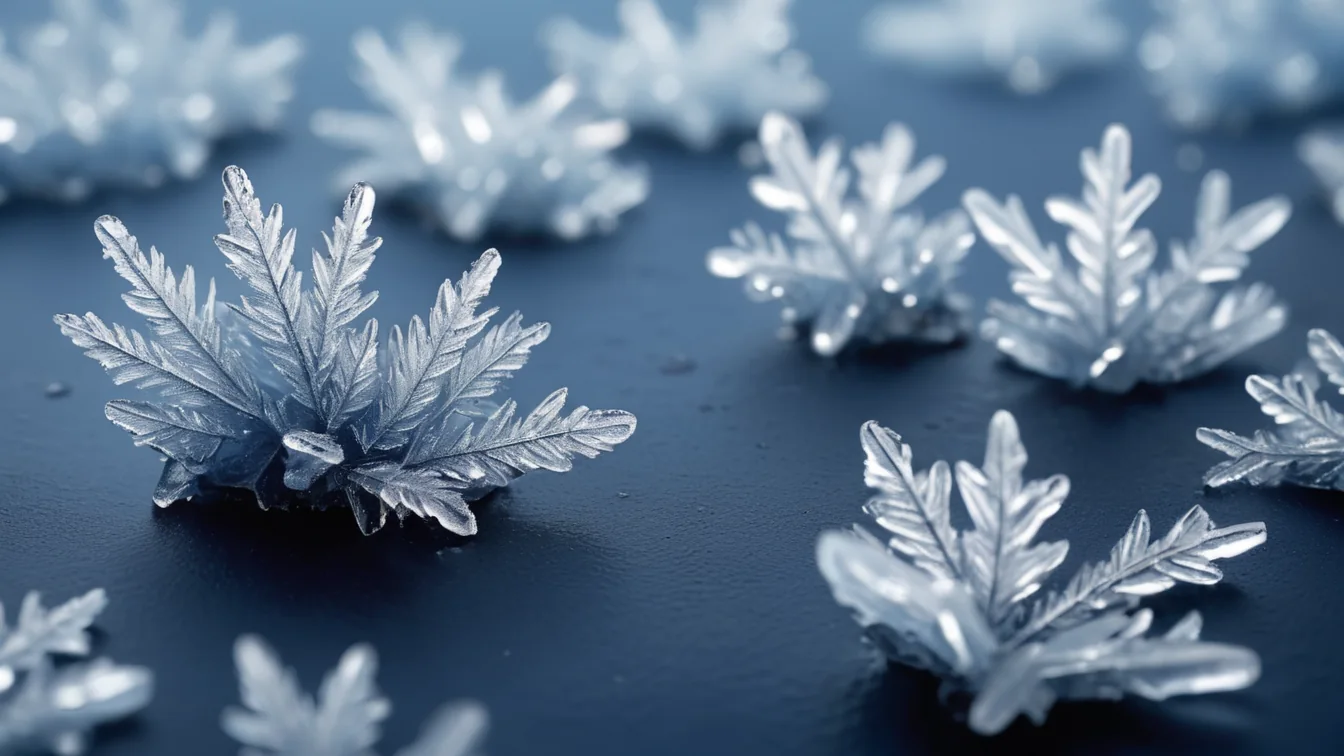
Saturn is famous for its rings. From far away they look like a smooth, flat disc around the planet. Look closer, and they are not solid at all. They are made of an enormous number of separate pieces.
The short answer: Saturn’s rings are made of billions of small chunks of mostly water ice, with some rock and dust. NASA says they are thought to be pieces of comets, asteroids or moons that broke up before they reached the planet.[1][2] How old the rings are, and how they formed, is still debated.
What the rings are made of
NASA describes the rings in one sentence: “They are made of billions of small chunks of ice and rock coated with other materials such as dust.”[1] The main ingredient is ice. NASA’s Cassini pages say the rings are “almost completely composed of billions (if not trillions) of chunks of water ice.”[3]
NASA’s ring resource puts it the same way: the ring particles are “composed primarily of water ice.”[2] Rock and dust are present too, but ice is the main material.
How big are the pieces?
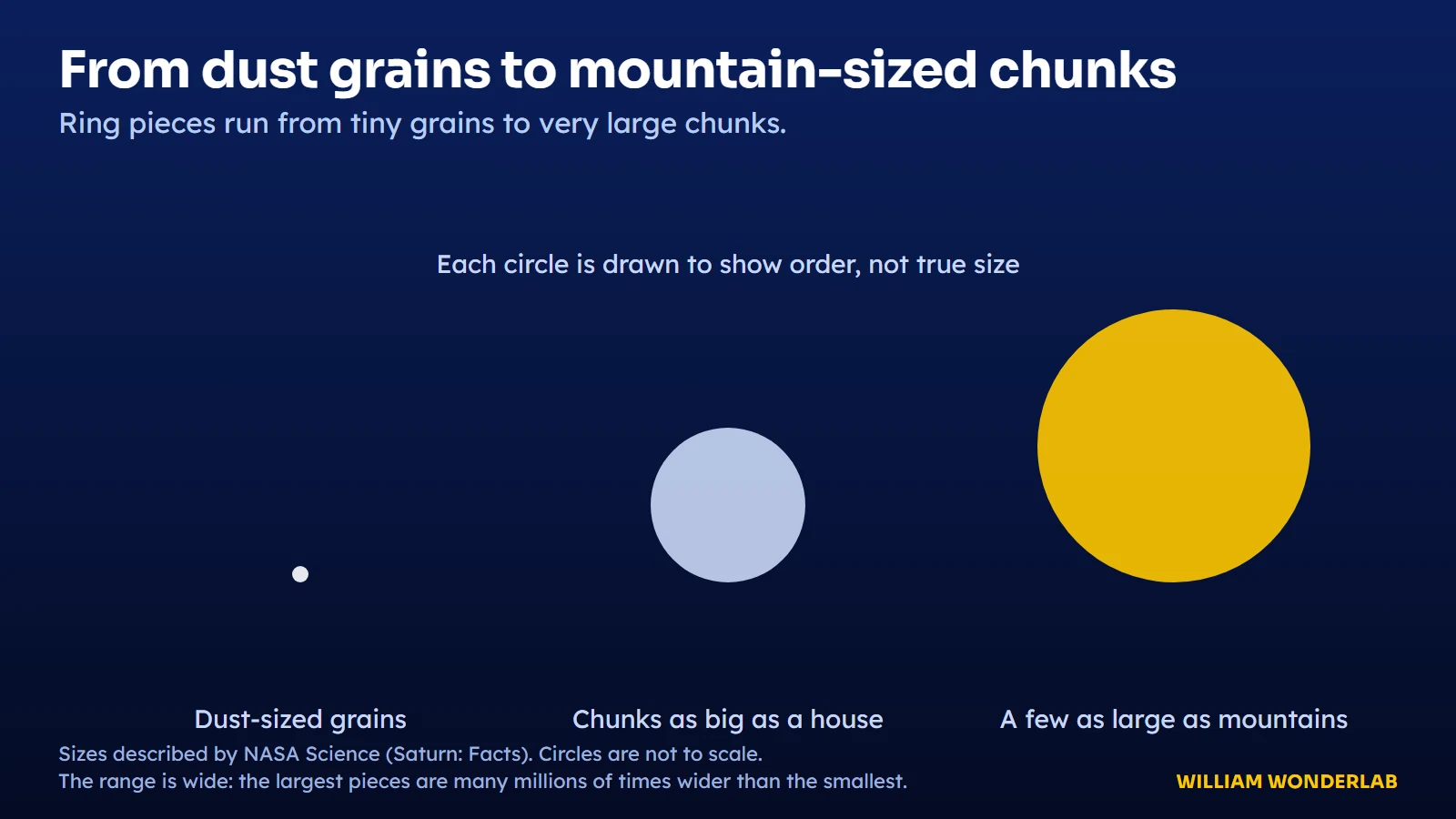
The pieces are not all the same size. NASA says the ring particles “mostly range from tiny, dust-sized icy grains to chunks as big as a house.” It adds that “a few particles are as large as mountains.”[1]
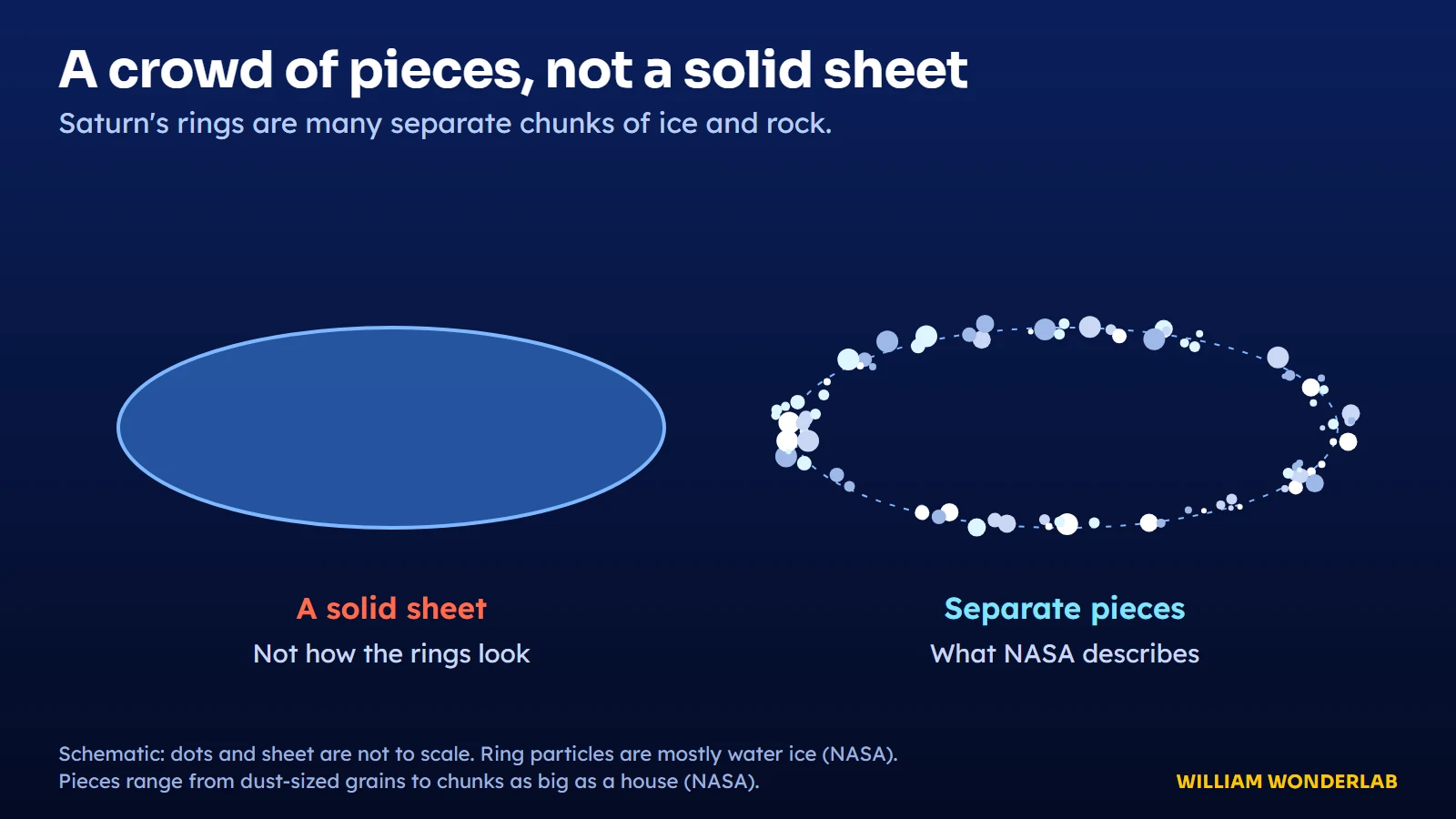
So the rings are a huge collection of very different objects. The picture of a ring as one solid sheet is wrong. It is closer to a vast crowd of separate pieces that all travel around the planet.
Where did the rings come from?
NASA says the rings are “thought to be pieces of comets, asteroids, or shattered moons that broke up before they reached the planet.”[1]
Some of the ice comes from a moon, too. NASA’s Cassini pages say that “water jets from the moon Enceladus provide much of the material in Saturn’s E-ring.”[3] NASA also describes Enceladus as “venting icy particles and gas into space as it orbits Saturn.”[3] The main rings are a different story, and their origin is still under study.
Scientists disagree about how old the rings are. A 2023 NASA article describes the view that the main rings are young. It says the rings “could have reached their current mass in just a few hundred million years.”[4] The same article quotes scientist Jeff Cuzzi, who says that “the idea that the iconic main rings of Saturn might be a recent feature of our solar system has been controversial.”[4] So this article does not give a final age or a final origin story.
A common idea: the rings are a solid disc
It is easy to picture Saturn’s rings like a flat, solid disc, such as a plate. That picture is a misconception. NASA’s description is of “billions of small chunks” of ice and rock, so the rings are a huge collection of separate pieces rather than one object.[1][3]
Everyday example: a swarm of bees looks like one dark cloud from a distance, but up close each bee is separate. The rings work in a similar way, with the pieces too small or too far to see one by one from Earth. This is an analogy, not a measurement.
Try it: the crowd of pieces
This is a proposed at-home activity. It is a model, not a real ring, but it shows how a crowd of separate pieces can look like a single shape from a distance.
You need: a dark tray or baking sheet, a small handful of dry rice grains, three or four dry pasta shells or beads, and a torch.
- Predict what will happen if you scatter the rice and the larger pieces over the tray and gently tap it. Will the pieces stay in one clump, or spread out?
- Scatter the rice first, then add the pasta pieces on top. Tap the tray gently a few times.
- Shine the torch across the tray at a low angle and look at the pattern.
- Write down what you saw. How is the tray like a crowd of pieces of different sizes?
What to expect: The pieces of different sizes stay separate and spread across the tray. The tray does not behave like one solid sheet.
Safety first: Choking hazard: keep the rice and small pieces away from young children and pets, and do not put them in your mouth. Wash your hands afterwards. Keep the torch away from anyone’s eyes, and do not shine it straight up. Use a stable, flat table and clear up any dropped pieces straight away so no one slips. An adult should supervise.
Go deeper: the size range in numbers
Comparing the smallest and largest pieces
NASA’s ring resource gives the size range as “from microns to tens of meters.”[2] A micron is one millionth of a metre. Taking the smallest piece as 1 micron (0.000001 m) and the largest as 10 metres:
- 10 m ÷ 0.000001 m = 10,000,000
So the largest piece in that range is about ten million times wider than the smallest. If the largest were 100 metres, the ratio would be about one hundred million.
Frequently asked questions
Are Saturn’s rings solid?
No. NASA describes them as billions of separate chunks of ice and rock.[1]
What are the rings made of?
Mostly water ice, with some rock and dust. NASA says the particles are composed primarily of water ice.[2]
How big are the pieces?
They range from dust-sized grains to chunks as big as a house, and a few are as large as mountains.[1]
Where did the rings come from?
NASA says they are thought to be pieces of comets, asteroids or moons that broke up before reaching the planet.[1]
Are the rings old or young?
Scientists still disagree. A 2023 NASA article argues that the main rings may be young, and quotes a scientist who says that idea has been controversial.[4]
The big idea
A crowd, not a sheet. Saturn’s rings are billions of separate pieces, mostly water ice. Where they came from, and how old they are, is still being studied.
Related reading
More from William Wonderlab:
Explore more from scientists:
References
[1] NASA Science, “Saturn: Facts” (accessed 25 October 2026)
[2] NASA Science, “Saturn’s Rings” (accessed 25 October 2026)
[3] NASA Science, “Cassini: Saturn Rings” (accessed 25 October 2026)
[4] NASA Science, “Saturn’s Rings: Young and Ephemeral, Three NASA Ames Studies Say” (22 May 2023) (accessed 25 October 2026)