How Do Mirrors Work?
A mirror sends light back in one direction because its surface is smooth. The angle in equals the angle out, and that is why your image seems to sit behind the glass.
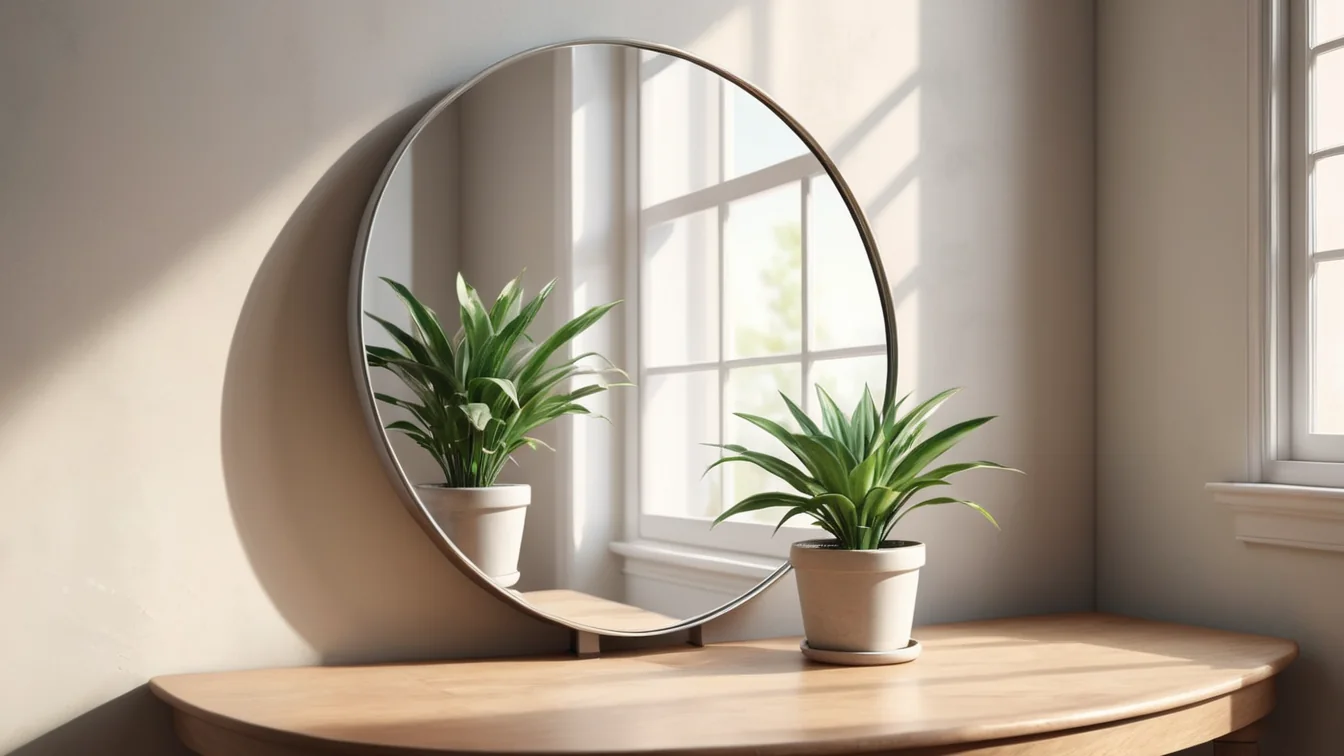
Stand in front of a mirror and you see yourself looking back, the right way up, apparently standing on the other side of the glass. How can a flat sheet send your face back to you so neatly? The answer is in the angles of light, and it is simpler than it looks.
The short answer: A mirror reflects light. The light that arrives at the surface leaves at the same angle, measured from the line perpendicular to the surface. Because the light is sent back in one direction, your eyes see an image that appears to sit as far behind the mirror as you stand in front of it.[1][2]
The law of reflection
Every reflection follows one rule. Lumen Learning’s physics text gives it in a single line: “The angle of reflection equals the angle of incidence.”[1] The angle of incidence is the angle the incoming ray makes with the perpendicular, which is the imaginary line standing straight out from the surface. The angle of reflection is the angle the outgoing ray makes with the same perpendicular.[3]
HyperPhysics states the rule for a reflective surface: “A light ray incident upon a reflective surface will be reflected at an angle equal to the incident angle.”[2] The diagram shows the rule with a 30-degree angle on each side.
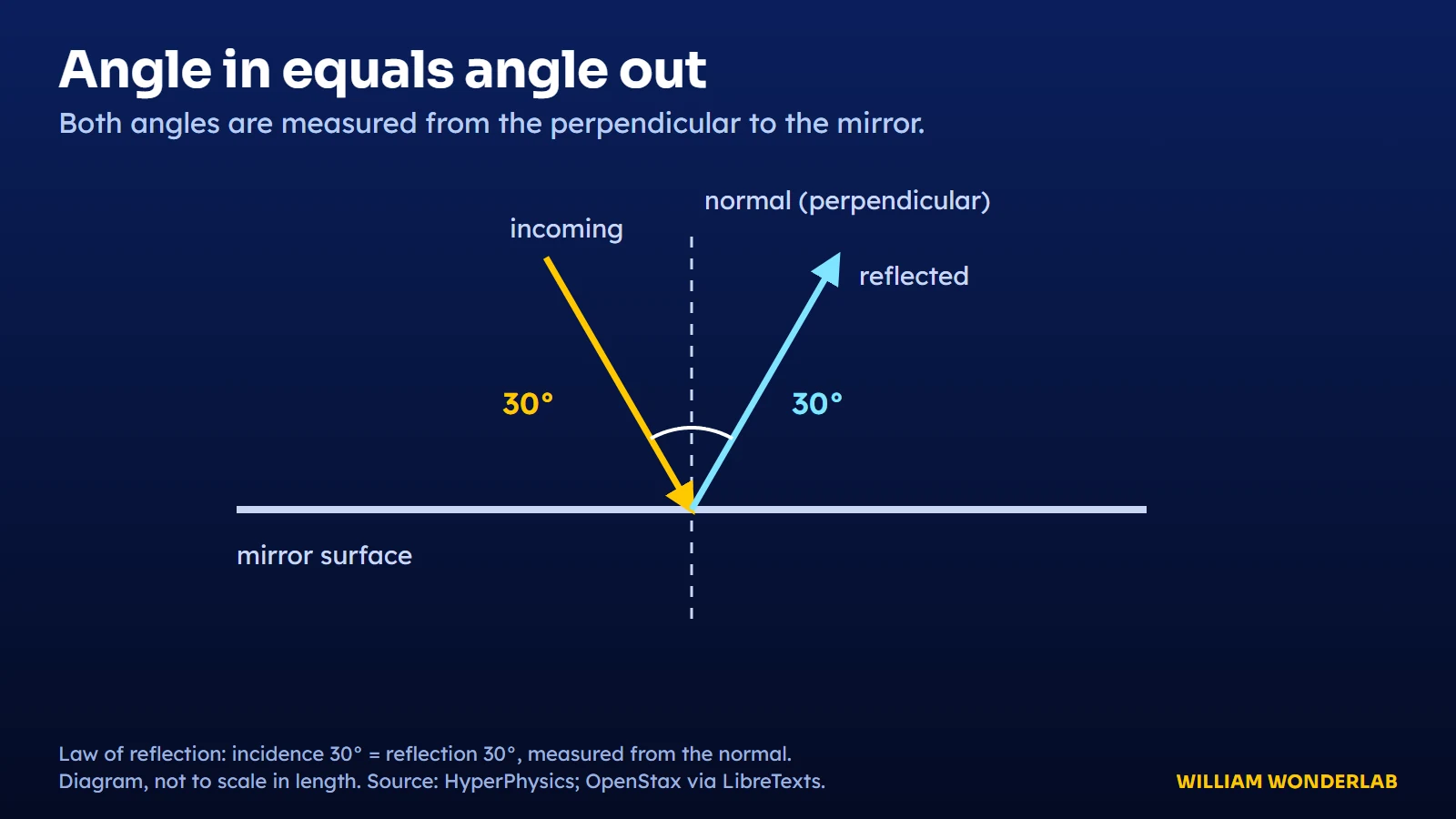
Notice that the incoming and outgoing rays lie in the same plane, and that the two angles are measured from the perpendicular, not from the surface itself. Measuring from the surface would give the wrong answer, so always start from the perpendicular.
Why a mirror is smooth
A mirror works because its surface is smooth. Lumen Learning’s text describes a smooth surface, such as a mirror, as one that “reflects them in only one direction, since its surface is very smooth.”[1] A rough surface behaves differently: OpenStax says light “is reflected in many different directions, or diffused.”[3] Science Learning Hub says that “For a rough surface, reflected light rays scatter in all directions.”[4]
The difference is about where each ray lands. On a smooth surface, every ray that comes in at a given angle leaves at the matching angle, so the rays stay together and make a clear image. On a rough surface the same rule still applies to each tiny bump, but the bumps point in many directions, so the light scatters and no sharp picture forms. That is why a wall shows you a fuzzy glow but a mirror shows you a clear reflection.
Why the image seems behind the mirror
The light that reaches your eyes travels in straight lines from the mirror. Your brain does not know the light has bounced. It assumes the light came straight from a point behind the glass. Lumen Learning’s text makes the geometry clear: “The angles are such that our image is exactly the same distance behind the mirror as we stand away from the mirror.”[1]
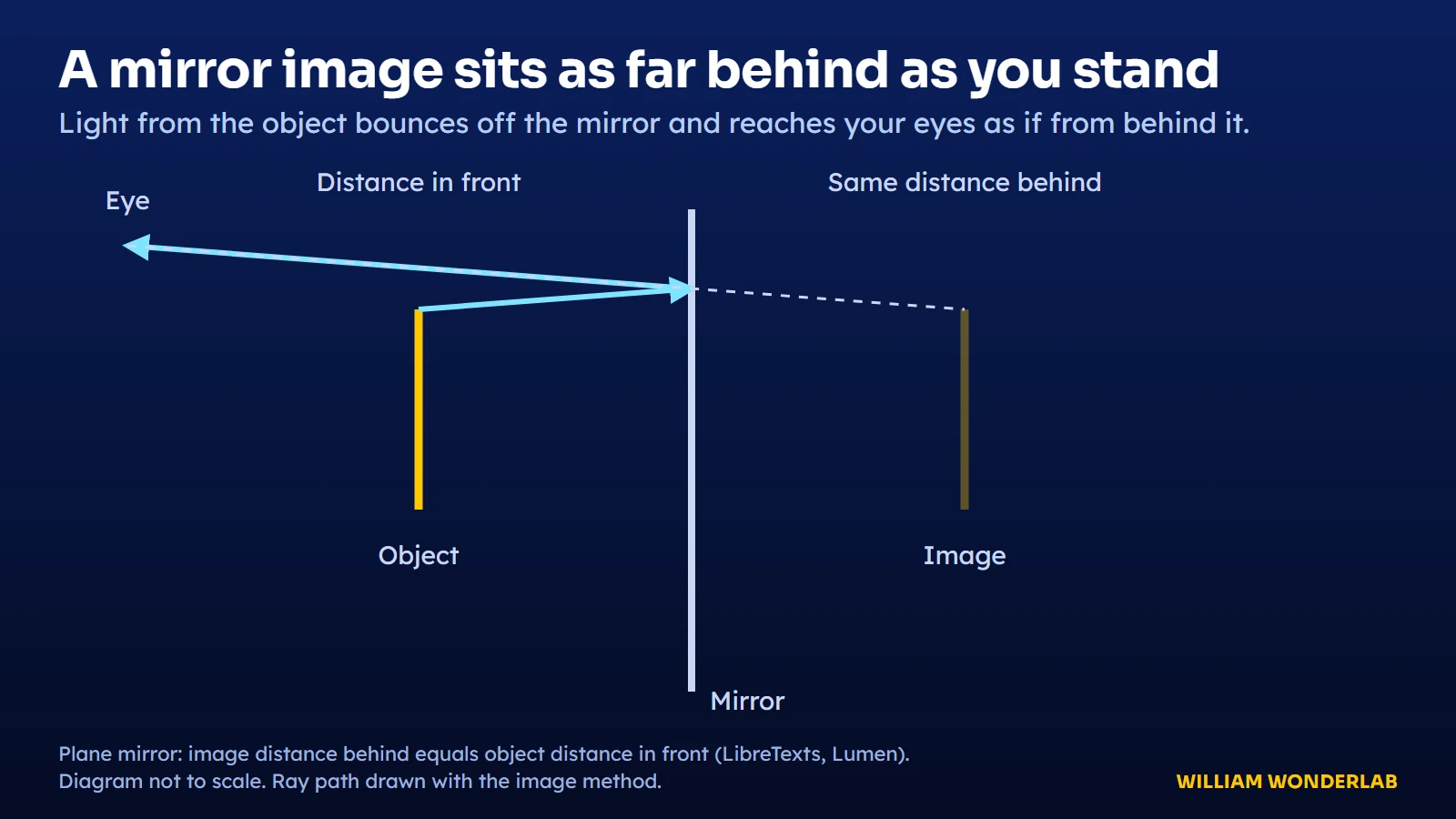
The diagram shows one ray from the top of an object. It reflects off the mirror at the angle that brings it to your eye. Trace the dashed line back behind the mirror and it meets the position of the image, the same distance behind as the object is in front.
Did you know? The image is not really behind the mirror. There is nothing there to touch. It is the place your brain places the light, because the reflected rays look as if they came from that spot.[1]
Try it: a torch and a small mirror
This is a proposed at-home activity. It is not something that was done for this article.
You need: a small plastic or shatterproof mirror, a torch (not a laser), a dark room or a shaded spot, and a piece of paper to mark the angles.
- Draw a straight line on the paper for the mirror, and a dotted line straight up from it, the perpendicular.
- Place the mirror flat on the line. Aim the torch so its beam hits the mirror at about 30 degrees from the dotted line.
- Mark where the reflected beam lands on the paper. Measure the angle on the other side of the dotted line.
- Change the torch angle to about 45 degrees and check that the reflected angle still matches.
What to expect: the reflected beam leaves on the other side of the perpendicular at the same angle as it arrived.
Safety first: Use a plastic or taped mirror so there are no glass shards if it drops. Never point a torch, a mirror or any reflected beam into anyone’s eyes. Never use a mirror to reflect sunlight, because the reflected beam can cause eye damage. Do not use a laser pointer for this activity.
Go deeper: the angle arithmetic
Measuring from the perpendicular
Suppose light arrives at 30° from the perpendicular. By the law of reflection, it leaves at 30° from the perpendicular on the other side. Measured from the point where the light hits the mirror, the angle between the ray back to the light source and the reflected ray is therefore 2 × 30° = 60°, which is what a protractor would show. The direction the light travels turns through 180° − 60° = 120°.[3]
The arithmetic works for any angle. If the incoming ray is at 45° from the perpendicular, the reflected ray is at 45°, and the rays make 90° with each other. The rule does not depend on the material, only on the surface being smooth enough to give a clear reflection.[1]
Why the distance matches
If you are 1 metre in front of a mirror, the image is 1 metre behind it. You see yourself as if you were standing 2 metres away from your real position. The geometry comes straight from the equal angles: the ray that reaches your eye is the same as the ray from the image, and the mirror is the line of symmetry between them.[1]
Frequently asked questions
Why does a wall not show a clear reflection?
The wall is rough at a small scale, so light is scattered in many directions instead of one. A smooth mirror sends it back together.[3]
Does a mirror keep the light’s angle the same?
Yes. The angle of reflection equals the angle of incidence, both measured from the perpendicular.[1][2]
Is the image really behind the glass?
No. The light only appears to come from behind the mirror. There is no real image there that you could touch.[1]
Why does the image move when you move?
Your eye receives the reflected rays from a different direction, so the image you see changes. Its distance behind the mirror still matches your distance in front.[1]
The big idea
Angle in, angle out. A smooth mirror sends each ray back at the same angle it arrived, measured from the perpendicular. Your eyes follow the rays back and place your image behind the glass.
Related reading
More from William Wonderlab:
Explore more from scientists:
- The Law of Reflection (Physics LibreTexts, OpenStax)
- The Law of Reflection (Lumen Learning, SUNY Physics)
- Reflection of light (HyperPhysics, Georgia State University)
- Reflection of light (Science Learning Hub, University of Waikato)
References
[1] Lumen Learning, SUNY Physics, “25.2: The Law of Reflection” (accessed 25 October 2026)
[2] HyperPhysics, Georgia State University, “Reflection of Light” (accessed 25 October 2026)
[3] OpenStax via Physics LibreTexts, “25.2: The Law of Reflection” (accessed 25 October 2026)
[4] Science Learning Hub, University of Waikato, “Reflection of light” (accessed 25 October 2026)