How Do Batteries Store Energy?
A battery keeps energy locked in chemicals. When it is connected to a circuit, chemical reactions release electrons that flow around the loop and deliver electrical energy.
A torch, a remote control or a clock can work without being plugged into a power point. Nothing is connected to a wall, yet the energy is there, ready to be used. Where is it kept, and how does it get out?
The short answer: A battery stores energy in chemicals, which is a form of chemical potential energy. When the battery is connected to a circuit, chemical reactions inside release electrons. The electrons flow around the circuit and deliver the energy as electricity.[1][2]
Energy stored in chemicals
Energy can be stored in many ways. A battery uses chemistry. The US Department of Energy (DOE) explains that “Batteries use chemistry, in the form of chemical potential, to store energy, just like many other everyday energy sources.”[1]
Chemical energy is held inside the substances themselves. Science Learning Hub, a New Zealand science education site, describes it as “stored in the bonds that hold atoms together, and when the bonds are broken, energy is released.”[3] Think of it like the energy stored in a piece of food: it is there until something lets it out.
The three parts: anode, cathode and electrolyte
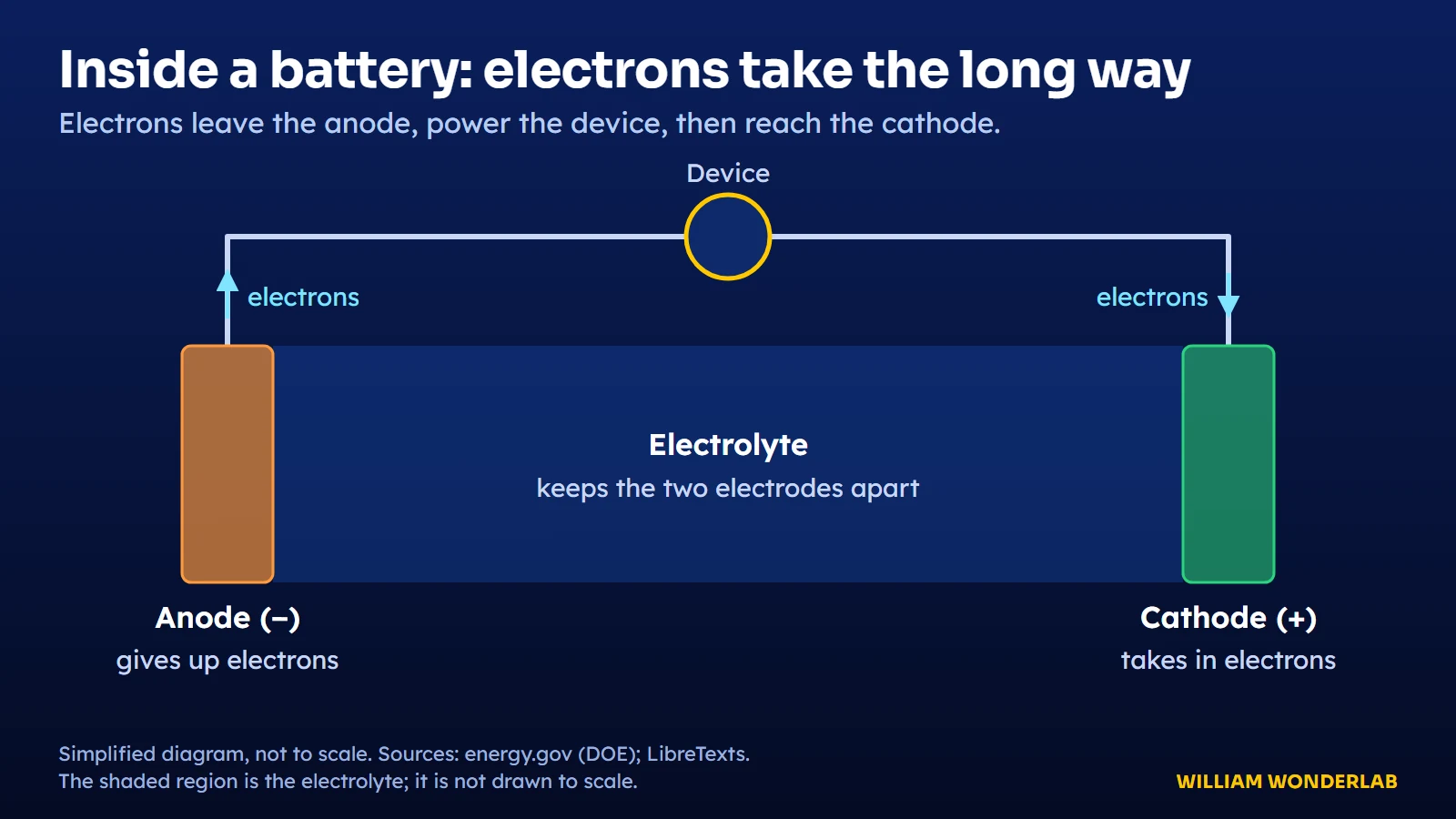
Every battery has two electrical terminals. The DOE calls them “the cathode and the anode,” and says they are “separated by a chemical material called an electrolyte.”[1] The electrolyte keeps the two terminals apart, so they cannot simply touch and cancel out.
The two ends do different jobs in the chemical reaction:
- The anode is the electrode where oxidation happens. Oxidation is the loss of electrons. Chemistry LibreTexts says that “The electrons leave the chemical reaction at the anode.”[2]
- The cathode is the electrode where reduction happens. Reduction is the gain of electrons. Chemistry LibreTexts describes it as “the electrode at which reduction (the gain of electrons) occurs.”[2]
Plain words: the anode gives electrons away, and the cathode takes them in.
Electrons flow around the circuit
A battery makes electricity only when there is a path for electrons to follow. LibreTexts explains that “current is produced when electrons flow externally through the circuit.”[2] In the battery, the electrons leave the anode and travel “through wires into the device (light bulb, phone, etc.).”[2]
Science Learning Hub compares this to water in a pipe. It says that an electrical current flows when a battery’s ends are joined by a conductor, “with the electrons flowing from the negative side of the battery to the positive side much like water flows in a pipe.”[4]
The electrons carry energy along the wire, and the device uses that energy.
Chemical energy becomes electricity
The DOE says batteries “convert this chemical potential energy to electricity in the circuit.”[1] The energy changes form. It starts as chemical energy in the battery, becomes electrical energy as the electrons move, and then becomes light, sound or motion in the device.
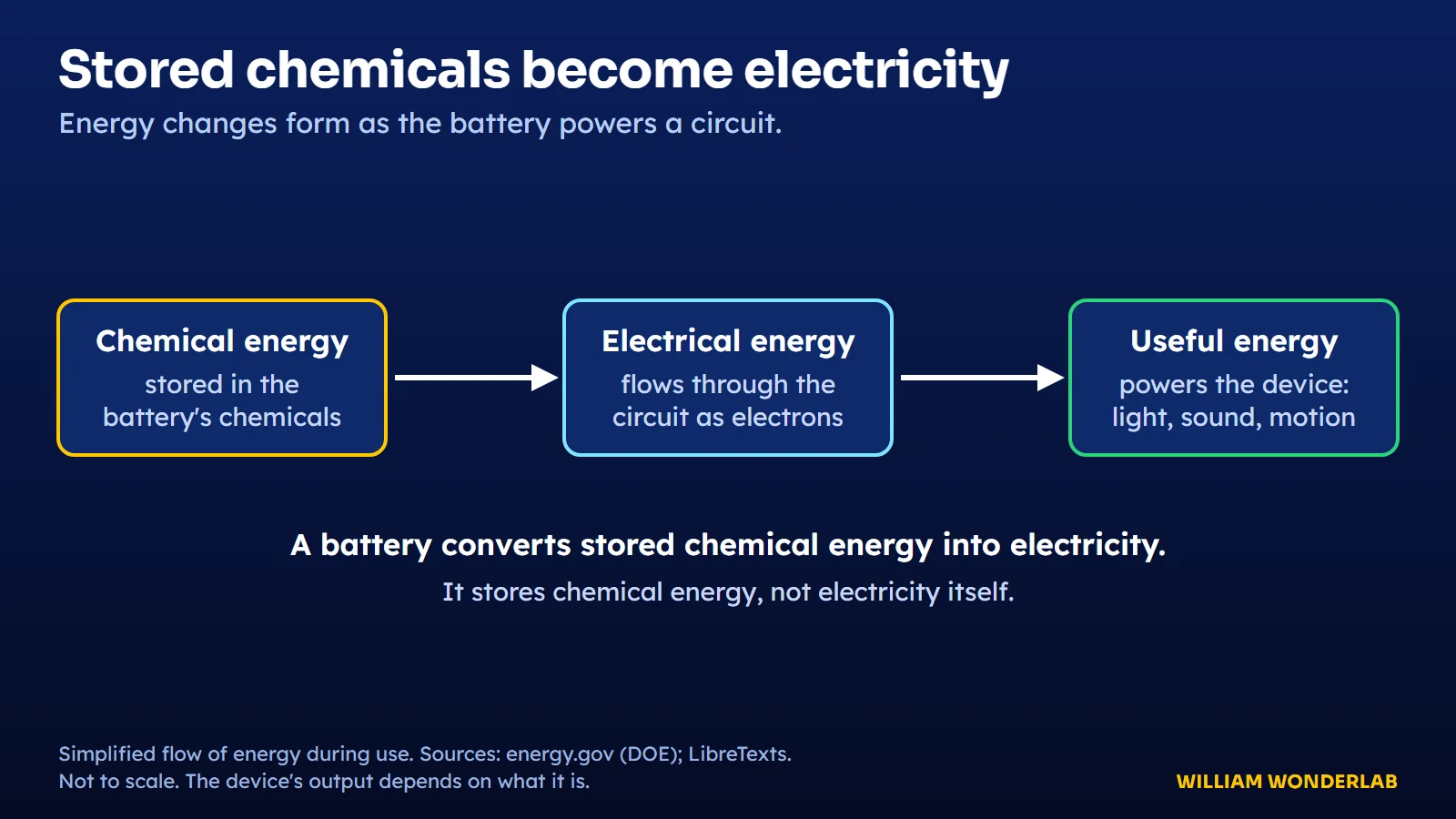
Did you know? A battery does not store electricity in the way a bucket stores water. It stores chemical energy, and the electricity only appears when a circuit lets the electrons flow.[1]
Myth: batteries are full of electricity
It is easy to think a battery holds electricity the way a jar holds sweets. That is not quite right. The DOE’s wording points to chemistry as the store.[1] Electricity is what you get when the stored chemical energy is released through a circuit.
Everyday examples
- A torch. The batteries hold chemical energy, and the bulb turns the electrical energy into light when the switch closes the circuit.
- A TV remote. Small batteries power a circuit that sends signals to the television. The batteries stay quiet until a button closes the circuit.
- A phone. The battery’s chemical energy is turned into electricity that powers the screen and the processor.
These are hypothetical examples to help you picture how a circuit uses a battery.
Button batteries: a serious safety warning
Button batteries are small, flat, round batteries. They can be a serious hazard if swallowed. The NSW Sydney Children’s Hospitals Network states that “Button batteries cause severe injury in under 2 hours.”[5]
The same fact sheet advises “keeping spare and used batteries in a locked cupboard, out of reach of children” and “keeping items without a screw out of reach.”[5] If you think your child has swallowed a button battery, act immediately: call the NSW Poisons Information Centre on 13 11 26 for first-aid information and advice on where to go for help.[5] Button battery injuries need hospital treatment.[5] The fact sheet also says “DO NOT try to make your child vomit” and “DO NOT let your child eat or drink until you’ve spoken to the NSW Poisons Information Centre.”[5] If your child is unconscious or not breathing, call Triple Zero (000) and ask for an ambulance.[6]
Safety first: This is not an activity, and no battery experiments are suggested in this article. Keep spare and used batteries in a locked cupboard, out of reach of children. If you think a button battery has been swallowed, act immediately: call the NSW Poisons Information Centre on 13 11 26. Do not make the child vomit, and do not let them eat or drink until you have spoken to the Poisons Information Centre.[5] If the child is unconscious or not breathing, call Triple Zero (000).[6]
Go deeper: oxidation and reduction
Two halves of one reaction
In a battery, the reaction happens in two halves that have to occur together. One half is oxidation at the anode, where electrons are released. The other half is reduction at the cathode, where electrons are taken up. LibreTexts describes the anode as “the electrode at which oxidation (the loss of electrons) occurs.”[2]
Because the electrons must pass through the external circuit to reach the cathode, the battery can power a device. If the two halves could simply touch, the energy would be released without doing any useful work.
Why the materials matter
The chemicals inside a battery decide how it behaves. This article does not compare specific battery types or give figures for how much energy each one holds, because the sources checked here do not provide verified figures for each type.
Frequently asked questions
Does a battery store electricity?
Not directly. The DOE says batteries use chemistry to store energy, and they convert that stored chemical energy into electricity in a circuit.[1]
Where do the electrons come from?
They are released by the chemical reaction at the anode, which is the electrode where oxidation takes place.[2]
Why must a battery be connected to a circuit?
Electricity only flows when electrons have a path to follow. LibreTexts says current is produced when electrons flow externally through the circuit.[2]
Why are button batteries dangerous?
They can cause severe injury in under 2 hours if swallowed, according to the NSW Sydney Children’s Hospitals Network.[5]
What does the electrolyte do?
It is the chemical material between the anode and the cathode. It keeps the two terminals separate.[1]
The big idea
Chemical energy, released as electricity. A battery keeps energy locked in chemicals. When a circuit connects its two ends, reactions release electrons, and those electrons carry the energy to the device.
Related reading
More from William Wonderlab:
- How Do Plants Turn Sunlight Into Food?
- How Do Solar Panels Make Electricity?
- How Do Noise-Cancelling Headphones Work?
Explore more from scientists:
- DOE Explains… Batteries (US Department of Energy)
- 10.2 Batteries and Electrolytic Cells (Chemistry LibreTexts)
References
[1] US Department of Energy, “DOE Explains…Batteries” (accessed 25 October 2026)
[2] Chemistry LibreTexts, “10.2 Batteries and Electrolytic Cells” (accessed 25 October 2026)
[3] Science Learning Hub (New Zealand), “What is energy?” (accessed 25 October 2026)
[4] Science Learning Hub (New Zealand), “Electricity: electrons, insulators and conductors” (accessed 25 October 2026)
[5] NSW Sydney Children’s Hospitals Network, “Button battery safety” fact sheet (accessed 26 October 2026)