Why Does Popcorn Pop?
A popcorn kernel bursts into a fluffy flake in a flash. The secret is steam, pressure and a hull that finally gives way.
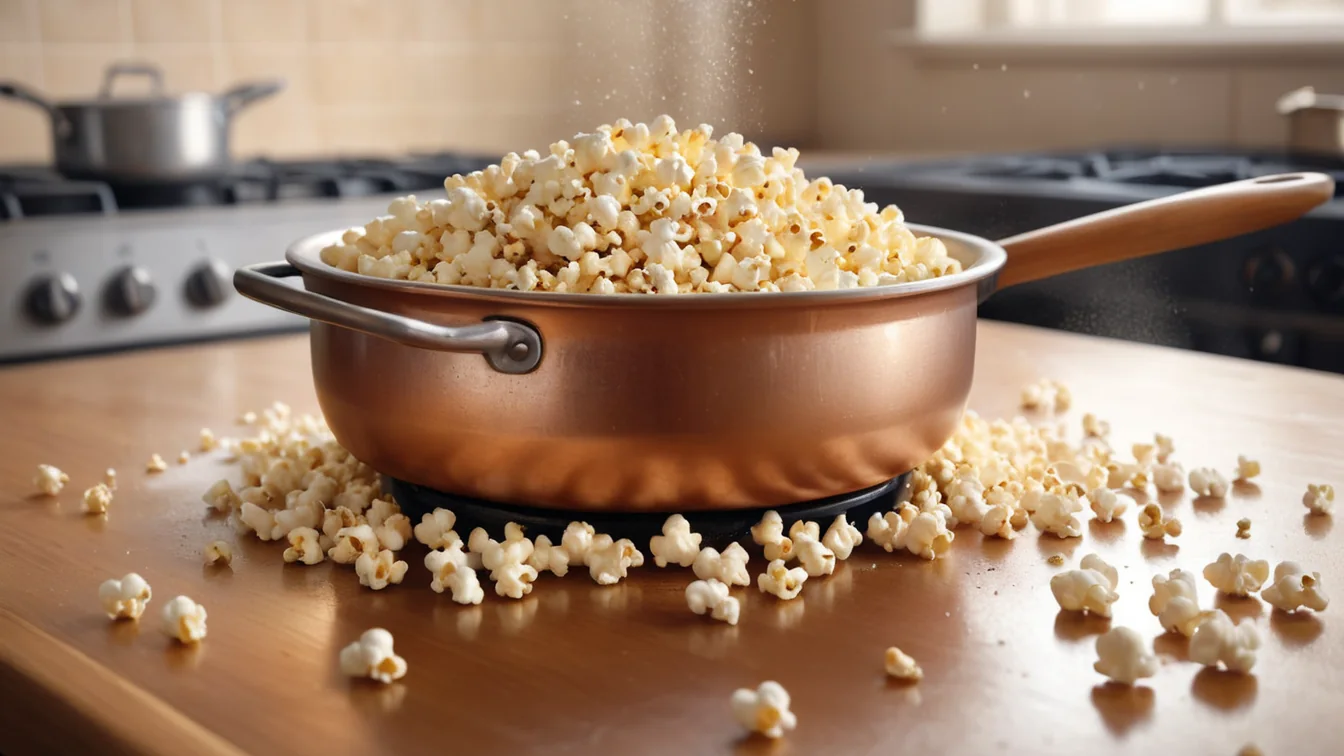
Heat a pot of kernels and, after a while, they start to bang. Some kernels jump clear of the lid while others burst open into soft white flakes. Nothing is added to make this happen. So what is going on inside a single kernel?
The short answer: Each kernel holds a little water inside a tough shell, and a starchy centre. As the kernel heats, the water turns into steam and the pressure inside builds. When the pressure is high enough, the shell (the hull) splits, and the starch bursts outwards and puffs into a flake.[1][2][3]
What is inside a popcorn kernel
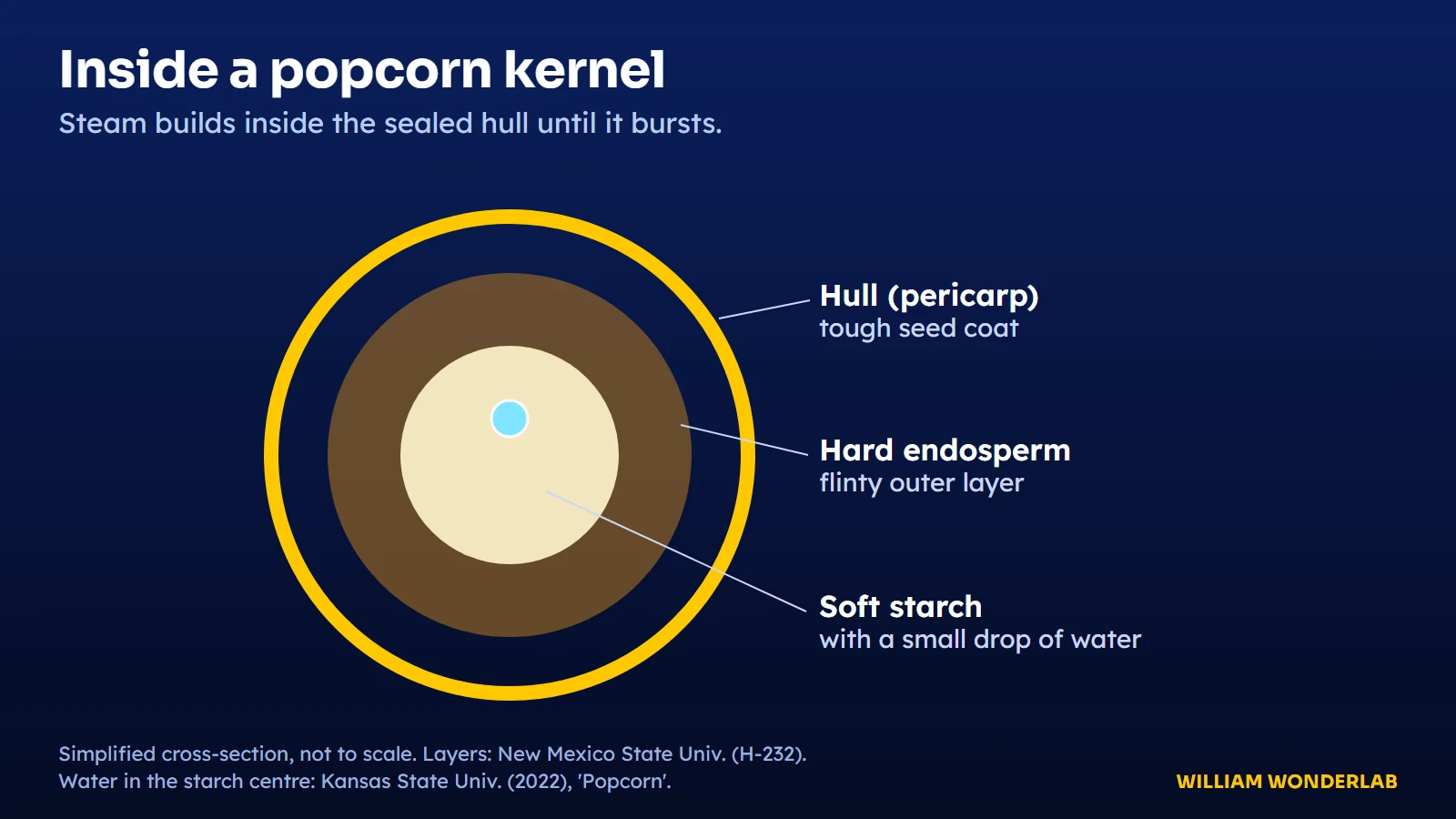
A popcorn kernel has three main parts. On the outside is the pericarp, the tough seed coat, which is often called the hull. Inside is a hard, flinty layer called the endosperm. At the centre is a small amount of soft, moist starch.[3]
Water is the key ingredient. Kansas State University’s extension article says that each kernel contains a small drop of water stored inside a circle of soft starch.[4]
Heat turns water into steam
When a kernel heats up, the water inside it begins to boil. The Virot and Ponomarenko study on popcorn, published in the Journal of the Royal Society Interface in 2015, describes this step: the moisture in the popcorn boils once the kernel is hotter than 100 °C, and it reaches a balance with the steam pressure around it.[1]
The important part is the shell. Steam cannot easily escape through the hull, so the pressure inside keeps rising as more water turns to steam. The kernel is, in effect, a small sealed pressure cooker.[3][5]
Pressure splits the hull
The 2015 study says that once the pressure inside the hull passes a critical level, the hull breaks.[1] The paper gives that critical level as about 10 bar, which is roughly ten times the pressure of the air around us.[1]
Kansas State University gives a figure you can compare with this. It says that the kernel continues to heat to 347 degrees, with the pressure inside reaching 135 pounds per square inch, before the hull bursts.[4] Converting those figures gives about 175 °C and about 9.3 bar. The two sources agree closely. The same Kansas State article says popcorn’s hull has just the right thickness to allow it to burst open.[4]
Did you know? The Royal Society notes that all popcorn, no matter what shape and size, pops at the same temperature.[2]
The starch puffs out
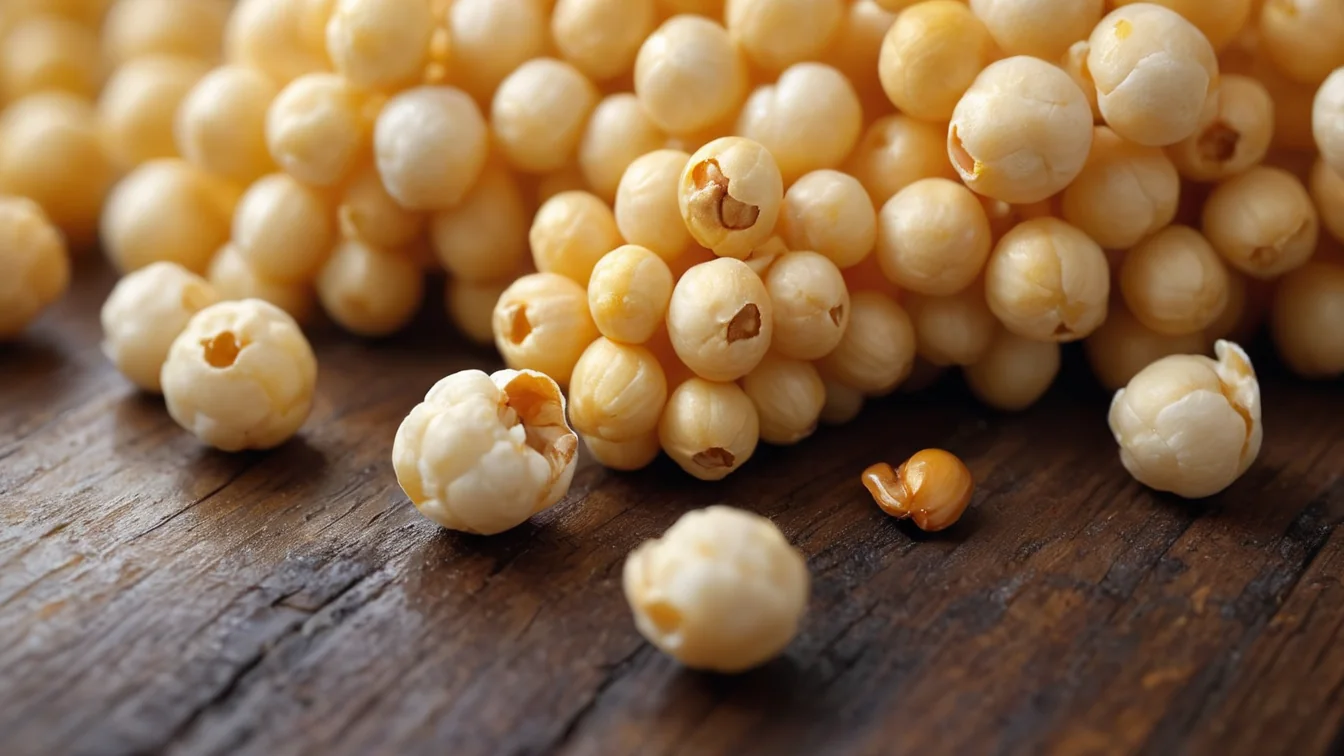
Once the hull splits, the pressure drops suddenly. The hot, soft starch inside then expands very quickly. The study describes this as the starch granules expanding to form a spongy flake of various shapes.[1] New Mexico State University’s extension guide says that the steam splits the pericarp and causes the endosperm to explode, turning the kernel inside out.[3]
That is why a popped kernel looks like a fluffy white flake, far larger than the original kernel and very different in texture.
Why do some popcorn pieces jump?
Popcorn does not just burst; it can also jump. The Virot and Ponomarenko study reports that popcorn jumps with a “leg” of starch which is compressed on the ground.[1] In other words, the starch that bursts out pushes against the surface beneath the kernel, and the kernel leaps.
The pop itself makes a sound. The Royal Society describes the popping noise as due to the release of water vapour.[2]
Why 180 °C?
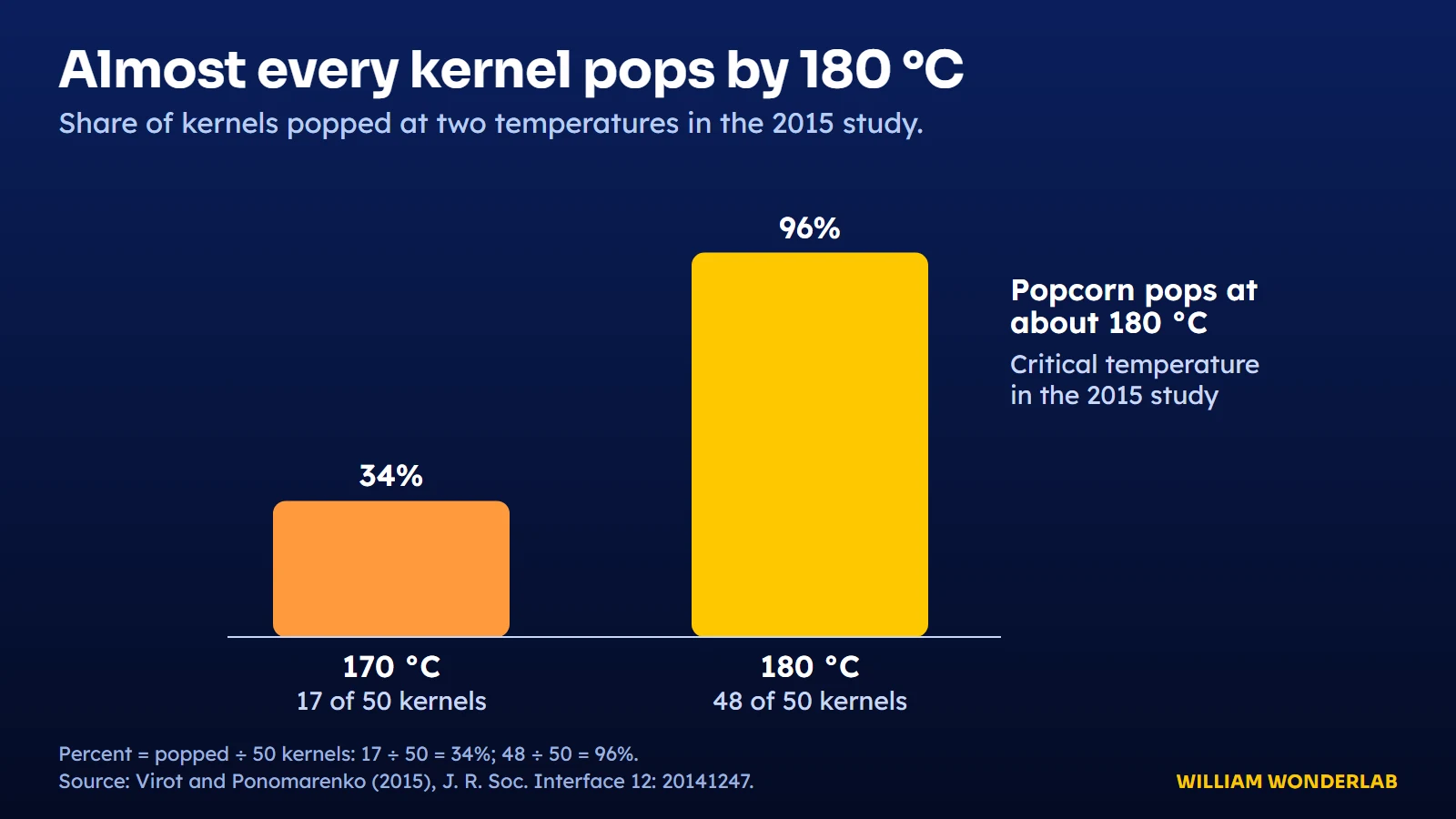
Popcorn pops at a fairly sharp temperature. In the 2015 study, only 34 per cent of kernels had popped at 170 °C (17 out of 50). At 180 °C, 96 per cent had popped (48 out of 50). The study calls 180 °C the critical temperature at which almost all popcorn pops.[1]
The Royal Society’s blog repeats the point, and says the oven was set at a fixed 180 °C in its demonstration.[2] The study also discusses why this critical temperature hardly depends on kernel characteristics.[1]
Popcorn and safety
Popping corn in a pot uses hot oil and makes hot steam. Both can cause serious burns, so popcorn should only be made with adult supervision. Keep the lid on, keep hands and faces away from the steam, and never leave a hot pan unattended.
Go deeper: the hull and the numbers
Stress and strength
The 2015 study looks at the hull as a container under stress. The authors compare the stress that the steam pressure produces in the hull with the hull’s ultimate strength. The paper states that the hull has an ultimate strength of about 10 MPa at the rupture point, and that the critical pressure is about 10 bar.[1]
The core idea is simple: the hull fails when the stress from the pressure inside is greater than the material can take. The hull can hold a lot of steam, but only up to that limit.
Converting the units
The numbers come in different units, so it helps to convert them:
- 347 °F = (347 − 32) × 5 ÷ 9 = 175 °C
- 135 psi × 0.0689 bar per psi = 9.3 bar
- 10 bar is about ten times normal air pressure (about 1 bar), so the hull holds roughly ten times the outside pressure before it fails.[1]
Frequently asked questions
Why does popcorn pop?
Water inside the kernel turns into steam when heated. The hull keeps the steam in, the pressure rises, and the hull splits. The starch then bursts outwards into a flake.[1][3]
Why is popcorn so fluffy?
The starch inside the kernel expands very quickly when the pressure is released, forming a spongy flake.[1]
Why does popcorn pop at about 180 °C?
In the 2015 study, almost all kernels popped at about 180 °C. The pressure inside the hull reaches the level needed to break it at about that temperature.[1][2]
What makes the popping sound?
The Royal Society describes the sound as due to the release of water vapour.[2]
The big idea
Water, pressure and a hull that gives way. Popcorn is a tiny pressure cooker. Steam builds up inside a tough shell until the shell breaks, and the starch inside puffs out in the instant the pressure is released.
Related reading
More from William Wonderlab:
- Why Does Metal Feel Colder Than Wood?
- Why Do Soap Bubbles Have Rainbow Colours?
- Why Is the Sky Blue?
Explore more from scientists:
- Popcorn: critical temperature, jump and sound (Virot and Ponomarenko, 2015)
- The science of popcorn (Royal Society)
- Specialty Corns (New Mexico State University extension)
References
[1] Virot E, Ponomarenko A, “Popcorn: critical temperature, jump and sound”, Journal of the Royal Society Interface 12(104), 2015 (accessed 25 October 2026)
[2] Royal Society, “The science of popcorn” (accessed 25 October 2026)
[3] Dickerson GW, “Specialty Corns”, Guide H-232, New Mexico State University (accessed 25 October 2026)
[4] Kansas State University Wild West District, “Popcorn” (June 2022) (accessed 25 October 2026)
[5] Schnable J, “Why popcorn pops”, Biofortified blog (accessed 25 October 2026)