Why Does Earth Have Seasons?
Earth is closest to the Sun in early January, yet it is summer in Australia. The real cause of the seasons is the tilt of Earth's axis.

Many people think the seasons happen because Earth moves closer to the Sun in summer and farther away in winter. It is a natural guess, but it is wrong. In fact, Earth is closest to the Sun in early January, in the middle of the Australian summer.
The short answer: Earth has seasons because its axis is tilted, by about 23.4 degrees. When your part of the planet leans towards the Sun, sunlight arrives more directly and the days are longer, so it is summer. When it leans away, it is winter. Distance from the Sun is not the cause.[1][2][3]
Tilt, not distance, makes the seasons
NASA’s Space Place puts it simply: “Earth’s tilted axis causes the seasons.”[1] It also says that “Earth’s distance from the Sun is not the cause of the seasons.”[1]
HyperPhysics at Georgia State University explains that Earth’s spin axis is tilted with respect to the plane of its orbit around the Sun. It adds that a common idea, that seasons happen because Earth is farther from the Sun in winter, is a misconception.[2] NASA’s Earth Fact Sheet gives the axial tilt as 23.44 degrees, which this article rounds to 23.4 degrees.[3]
Earth is actually closest to the Sun in early January. NASA’s StarChild notes that on 4 January 2003, Earth made its closest approach of that year, about 147.5 million kilometres from the Sun.[4] Australia is in summer during that same period, so distance cannot be the explanation.
NASA’s Helio and You page sums up the link between tilt and season: “When a hemisphere is tilted toward the Sun, it experiences summer; when it’s tilted away, it experiences winter.”[5]
Why the angle of sunlight matters
When the Sun is high in the sky, its light arrives at a steep angle and is spread over less ground. When it is low, the same light is spread over more ground and the days are shorter. Your position on Earth decides how high the Sun gets at noon. The arithmetic is simple: the noon height of the Sun is 90 degrees minus the difference between your latitude and the Sun’s declination (the latitude where the Sun is directly overhead at that time of year).
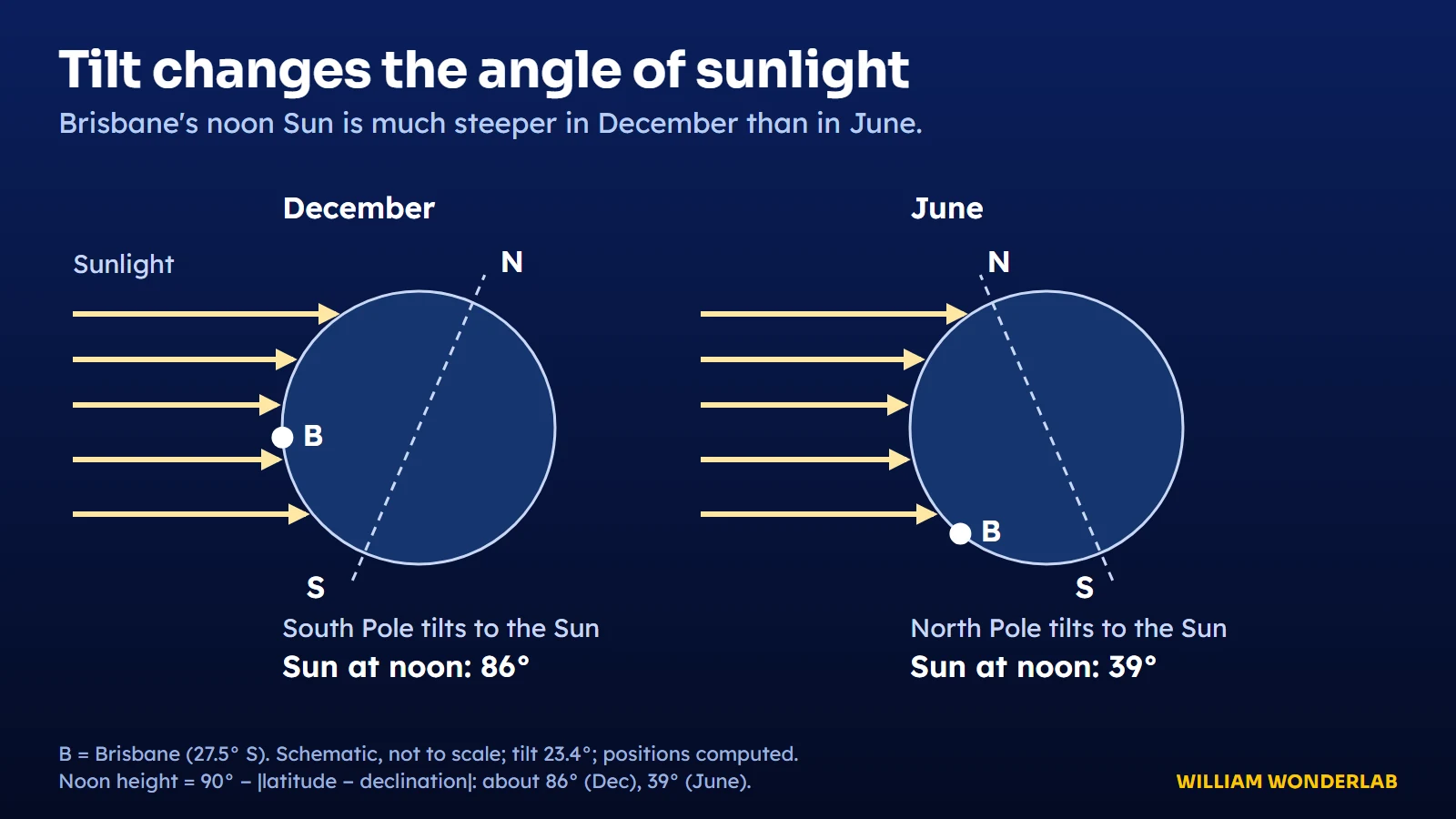
For Brisbane, at latitude 27.5 degrees south, the calculation gives about 86 degrees at the December solstice, when the Sun is almost overhead, and about 39 degrees at the June solstice. Those values are our calculation, based on the cited latitude and tilt.[6][7]
Australia’s seasons and the solstice dates
Geoscience Australia explains that “the summer solstice occurs once a year in December when the Sun’s track across the Australian sky reaches its highest point.”[6] It usually falls on 22 December, but can occur between 21 and 23 December. The winter solstice is the opposite: it “usually occurs on 22 June but can occur between 21 and 23 June.”[6]
So Australian summer begins with the December solstice, and winter with the June solstice, while the northern hemisphere has the reverse. Winter in the south is the time when the south pole leans away from the Sun.[5]

Try it: the shadow test
You need a straight stick or rod about one metre long, a flat patch of ground in the sun, a pencil and a tape measure. Pick a clear day, ideally in December and again in June.
- Stand the stick upright in the ground around solar noon, the time when shadows are shortest.
- Mark the tip of the shadow on the ground and measure its length.
- Repeat on a clear day in the other season, and compare the two lengths.
What to expect: The arithmetic predicts a very short shadow in December (about 7 cm for a 1 m stick) and a much longer one in June (about 1.2 m). Your measurements may differ, because solar noon depends on your exact location and the clock time.
Safety first: never look at the Sun. Do not stare at the Sun to judge its height, and never sight along the stick or use a mirror, binoculars or a camera to look at it. Measure the shadow only, and keep your eyes on the ground or the stick.
Go deeper: the maths and the hemispheres
Why the hemispheres have opposite seasons
NASA’s Space Place says that “when the North Pole tilts toward the Sun, it’s summer in the Northern Hemisphere.”[1] Because the axis keeps the same tilt as Earth orbits, the two hemispheres take turns leaning towards the Sun, half a year apart. That is why Australian summer falls in December, while the northern summer falls around June.[1][6]
The noon height formula
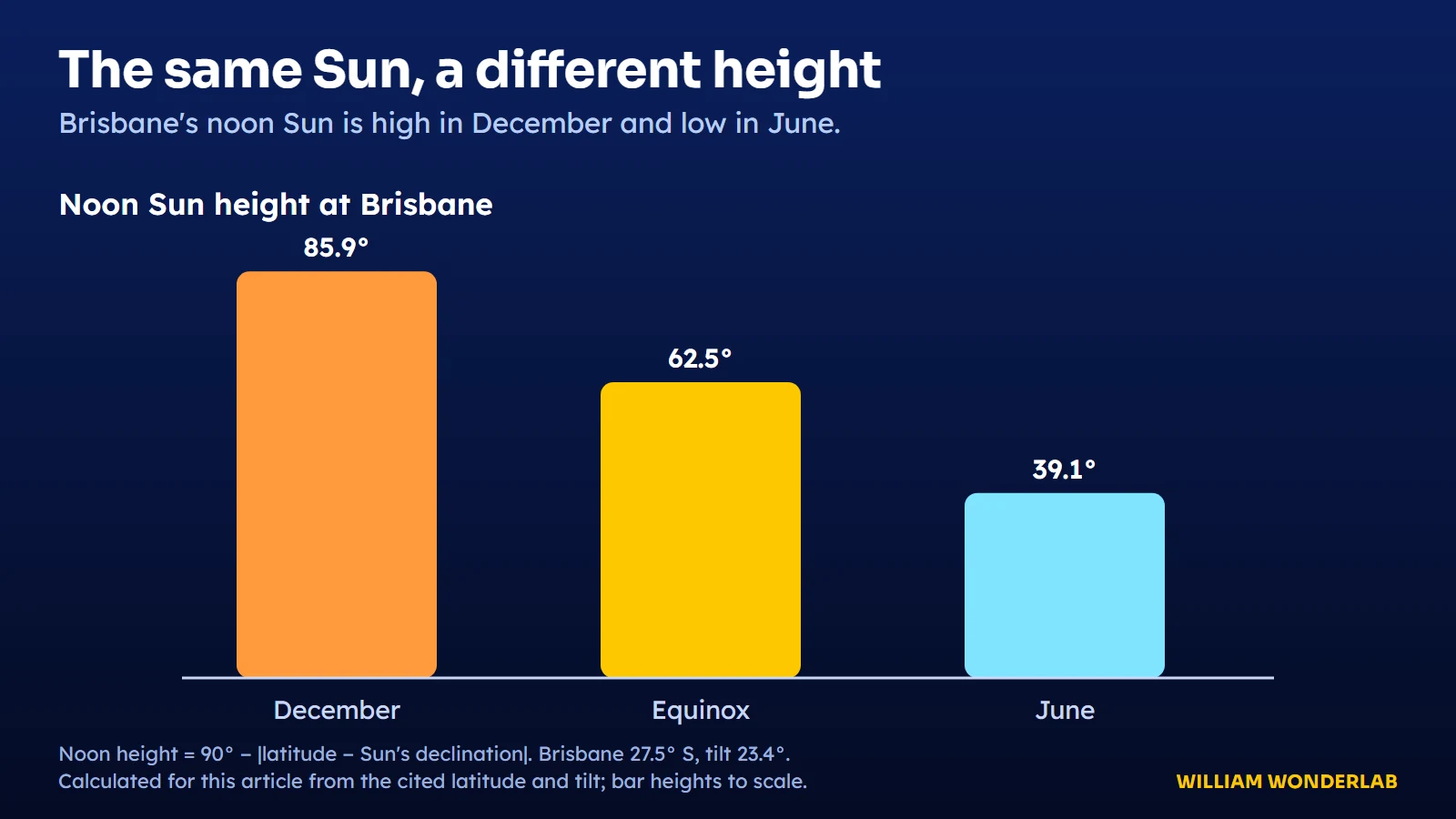
The Sun’s declination is the angle of the Sun north or south of the equator. At the December solstice it is about 23.4 degrees south, and at the June solstice about 23.4 degrees north. For Brisbane at 27.5 degrees south:
- December: 90 − |−27.5 − (−23.4)| = 90 − 4.1 = 85.9 degrees
- Equinox: 90 − |−27.5 − 0| = 90 − 27.5 = 62.5 degrees
- June: 90 − |−27.5 − 23.4| = 90 − 50.9 = 39.1 degrees
Brisbane’s latitude is taken from the Geoscience Australia station record at the University of Queensland.[7]
Some sources round the tilt to 23.5 degrees. That difference changes the noon heights by only about 0.1 degree and does not change any statement in this article.
Frequently asked questions
Is Earth closer to the Sun in summer?
No. Earth is closest to the Sun in early January, during the Australian summer.[4]
What causes the seasons?
The tilt of Earth’s axis. Earth’s tilted axis causes the seasons.[1]
Why is it summer in December in Australia but winter in June?
Because the southern hemisphere leans towards the Sun in December and away from it in June.[5][6]
Is the solstice always on the same date?
Not quite. The usual date is 22 December, but it can fall between 21 and 23 December. The June solstice is usually 22 June, with the same one-day range.[6]
Does the Sun’s height really change that much?
Yes. For Brisbane the calculated noon height falls from about 86 degrees in December to about 39 degrees in June.[6][7]
The big idea
Seasons come from the tilt, not the distance. Earth’s axis leans about 23.4 degrees. When your half of the planet tips towards the Sun, sunlight is steeper and days are longer. In Australia that means summer in December, while Earth is almost at its closest to the Sun.
Related reading
More from William Wonderlab:
Explore more from scientists:
References
[1] NASA Space Place, “Seasons” (accessed 25 October 2026)
[2] HyperPhysics, Georgia State University, “Seasons” (accessed 25 October 2026)
[3] NASA Earth Fact Sheet, “Earth Fact Sheet” (last updated 15 November 2024), NSSDC, NASA (accessed 25 October 2026)
[4] NASA StarChild, “Question of the Month for January 2003” (accessed 25 October 2026)
[5] NASA Science, “Helio and You: Seasons on Earth, Mars, and Beyond” (accessed 25 October 2026)
[6] Geoscience Australia, “Summer and winter solstice” (accessed 25 October 2026)
[7] Geoscience Australia, gravity station record, University of Queensland, Brisbane (latitude -27.500066, GDA94) (accessed 25 October 2026)
Keep exploring
Now try the science yourself
Reading is a great start. Experimenting is even better: these interactive models use the same science as this article.