How Does Soap Clean Your Hands?
Water alone cannot lift oily dirt. Soap molecules have two different ends, and together they wrap grease into tiny balls that rinse away. Here is how it works.
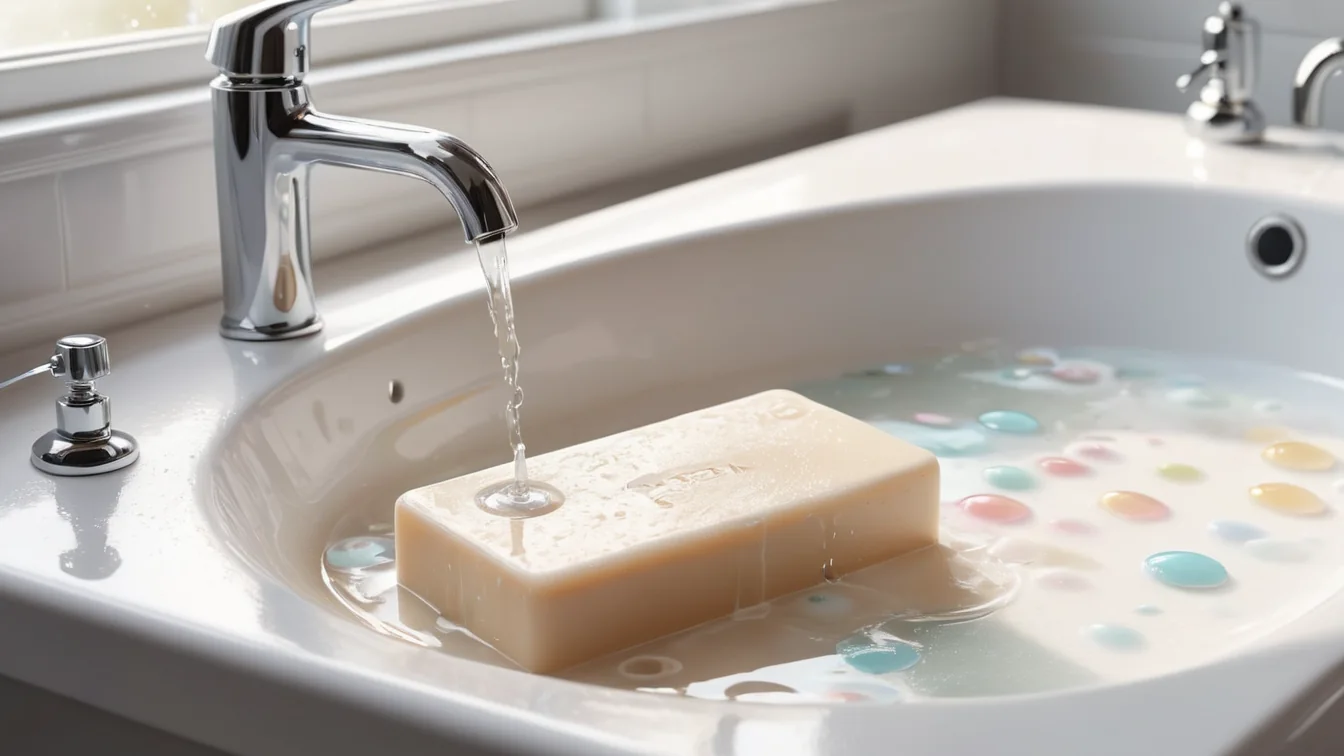
Rinse your hands under a tap and they still feel greasy after cooking. Water is very good at washing away sugar and salt, but oily dirt does not mix with water. So how does soap manage to get that grease off your skin? The answer lies in the shape of the soap molecule.
The short answer: A soap molecule has two different ends. One end likes water and the other end likes oil. Soap molecules gather round grease, trapping it in tiny balls called micelles, and the balls rinse away with the water.[1]
Oil and water do not mix
Grease and water separate, like oil floating on top of a salad dressing. That is why a splash of water alone rarely lifts oily dirt off a plate or your hands. The water and the grease do not want to be together.
Soap solves this problem with its shape. A soap molecule is long, with one end that is attracted to water and one end that is not.
Two ends with two jobs
The LibreTexts chemistry page on soap describes the two parts. The first end is “ionic and therefore hydrophilic, or attracted to water.”[1] Hydrophilic is the word chemists use for water-loving. The long tail is different: “The long hydrocarbon portion of the molecule, however, is nonpolar and hydrophobic.”[1] Hydrophobic means water-repelling, and the tail prefers oil.
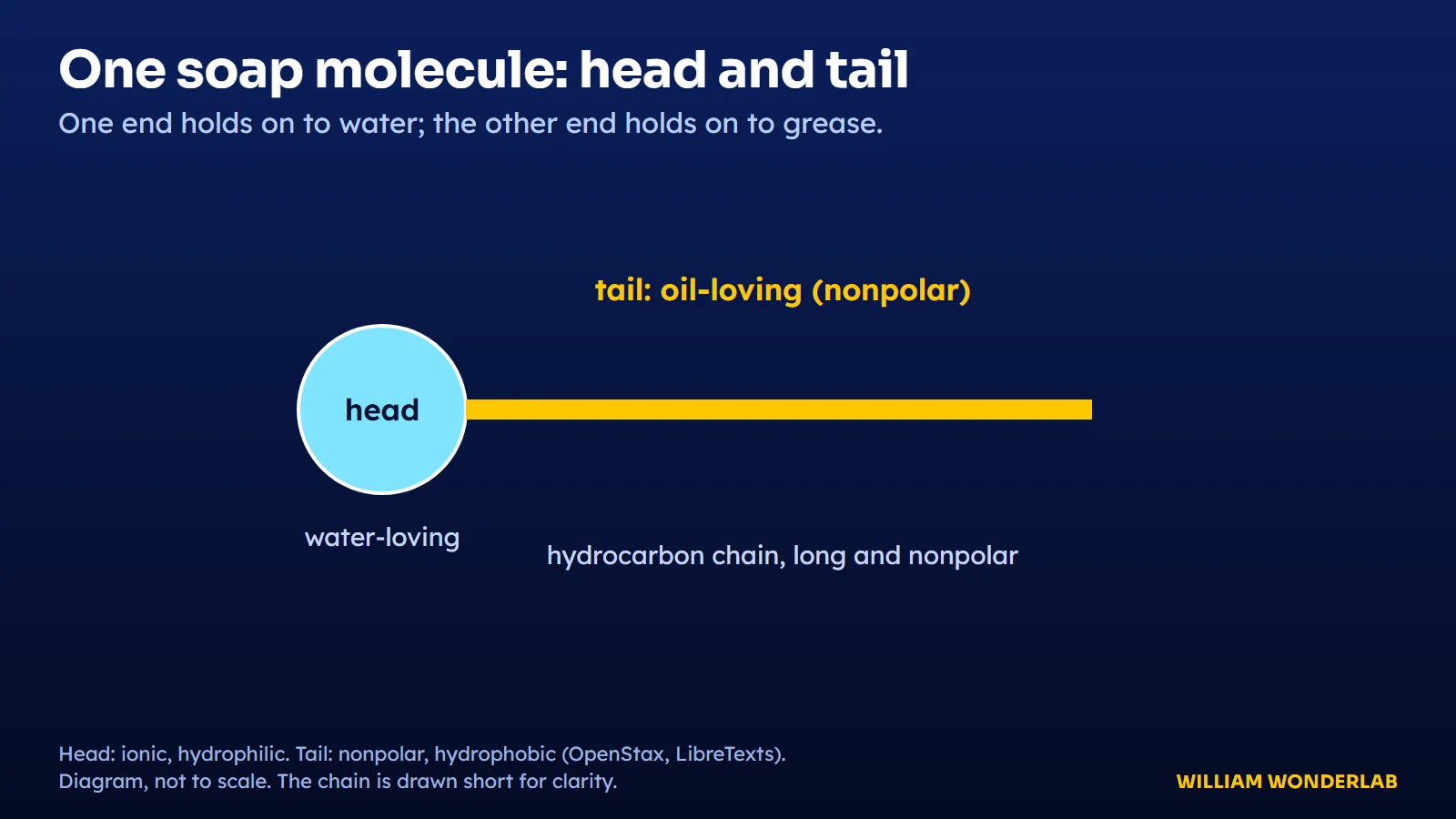
In everyday terms, the head is like a friend who holds on to water, and the tail is like a friend who holds on to grease. One soap molecule can therefore link a drop of oil to the water around it.[1]
Did you know? A soap molecule is long, with a charged head at one end and a long chain of carbon and hydrogen atoms at the other.[1]
Micelles trap the grease
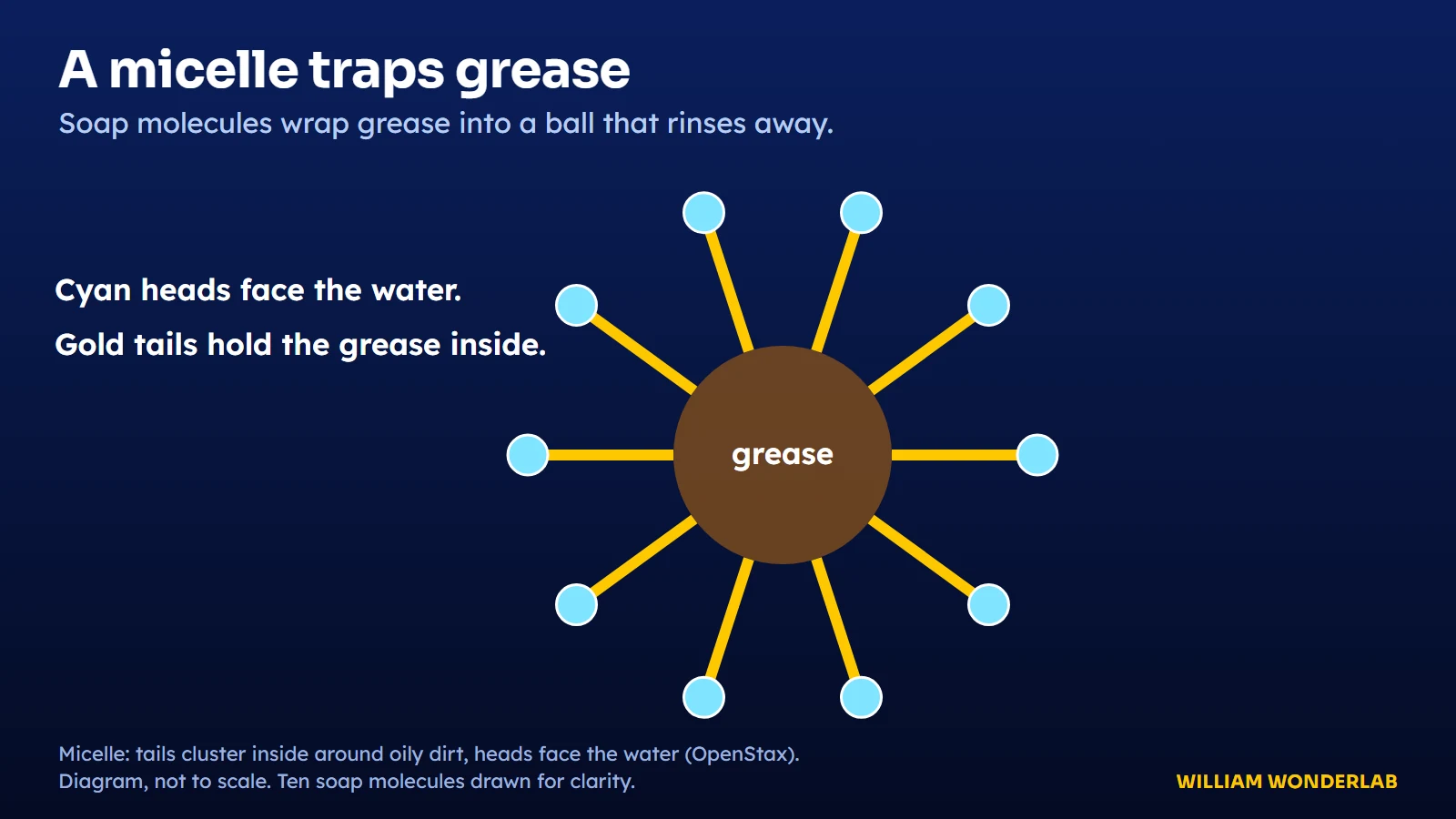
When there are many soap molecules in water, they gather into balls. The LibreTexts page says the “long hydrocarbon tails cluster together on the inside of a tangled, hydrophobic ball,” and calls the result “These spherical clusters, called micelles.”[1]
The water-loving heads face outwards, into the water. The oil-loving tails face inwards, where they can hold the grease. This arrangement is called a micelle, and it works like a tiny bubble that wraps around oily dirt.[1]
Rinsing carries the grease away
Once the grease is wrapped in the micelles, it can be carried away with the water. LibreTexts explains: “Grease and oil droplets are solubilized in water when they are coated by the nonpolar, hydrophobic tails of soap molecules.”[1] Solubilised means the grease is held in the water. The page adds: “Once solubilized, the grease and dirt can be rinsed away.”[1]
This is the reason rinsing matters. The soap holds the grease, and the water carries the dirt away.
Handwashing: time and germs
Hand hygiene also depends on how long you wash. This article uses the advice of the Victorian Department of Health for timing, because it comes from an Australian state health authority. The department says to “Continue thoroughly rubbing your hands for about as long as it takes to sing the Happy Birthday song twice.”[2] The same page says you should “always wash your hands with soap and water if your hands are visibly dirty.”[2]
Soap also affects some germs. A 2021 review in PeerJ says soap and other detergents “are capable of disrupting the continuity of the viral envelope,” which is the fatty outer layer of some viruses, including SARS-CoV-2.[3] The same review says hand washing with soap and water “accomplishes the physical removal of pathogens.”[3] Yale Medicine explains that some soap molecules wedge into the lipid envelopes of certain microbes and viruses, prying them apart.[4] In other words, washing lifts germs off your skin and carries them away with the water.
Try it: the dish test
This is a proposed at-home activity. It compares plain water with soapy water on a greasy surface.
You need: two clean plates or saucers, a small amount of cooking oil, a small cup of plain tap water, a cup of tap water with a few drops of washing-up liquid, a paper towel, and an adult to help.
- Predict which plate will be cleaner after a rinse: the one washed with plain water or the one washed with soapy water.
- Put a thin smear of cooking oil on each plate, and let them sit for a few minutes.
- Rinse one plate with plain water. Rinse the other plate with the soapy water, gently wiping it with a paper towel.
- Look at both plates closely. Which one is cleaner? Write down what you see.
What to expect: This is a prediction, not a result. The soapy plate should look cleaner than the plain-water plate. The oil on the plain plate may still form a film, because water alone does not lift oil well.[1]
Safety first: Use washing-up liquid only as a drop or two in the water, and do not mix it with bleach or any other cleaning product. Keep the cup away from the edge of the bench. Do not put soapy water in your eyes or mouth, and do not drink it. Rinse your hands and the plates afterwards, and wash your hands well at the end. An adult should supervise the test and handle any hot water.
Go deeper: the chemistry of the head and tail
Why the head likes water
The head of the soap molecule is ionic. LibreTexts says that “the carboxylate end of the long-chain molecule is ionic and therefore hydrophilic, or attracted to water.”[1] Because the head is ionic, it is attracted to water and stays in it.
Why the tail avoids water
The tail is a long chain of carbon and hydrogen atoms. LibreTexts describes it as “nonpolar and hydrophobic.”[1] Nonpolar means the tail does not carry a charge, and so it does not mix with water.
Why the micelle works
The micelle is a shape that lets the water-loving heads face the water while the oil-loving tails shelter the grease. The grease is trapped in the middle and carried away.[1]
Frequently asked questions
Why does water alone not clean greasy hands well?
Grease does not mix with water, so the water cannot easily lift it away. Soap molecules help by linking the grease to the water.[1]
What is a micelle?
A micelle is a small ball formed by soap molecules in water. The tails cluster inside, holding grease, while the heads face outwards into the water.[1]
How long should I wash my hands?
In Victoria, the Department of Health advises rubbing your hands thoroughly for about as long as it takes to sing “Happy Birthday” twice.[2] Other health authorities may give different guidance, so check the advice for where you live.
Is hand sanitiser the same as soap?
This article does not compare them in detail. The Victorian advice is to wash with soap and water whenever your hands are visibly dirty.[2]
The big idea
Soap has two ends, so it can carry grease away. One end holds on to water and the other holds on to oil. Soap wraps grease in micelles, and rinsing takes the dirt away with the water.
Related reading
More from William Wonderlab:
Explore more from scientists:
- Soap (OpenStax, via LibreTexts Chemistry)
- Handwashing with soap and water (Victorian Department of Health)
- Soap, water, and SARS-CoV-2: an ancient handwashing strategy (PeerJ, 2021)
Related on this site: Why Do Soap Bubbles Have Rainbow Colours? is about the same soap films, with a different explanation.
References
[1] OpenStax, “27.2: Soap,” via LibreTexts Chemistry (accessed 25 October 2026)
[2] Department of Health, Victoria, “Handwashing with soap and water” (accessed 25 October 2026)
[3] Ijaz MK, Nims RW, de Szalay S and Rubino JR, “Soap, water, and severe acute respiratory syndrome coronavirus 2 (SARS-CoV-2): an ancient handwashing strategy for preventing dissemination of a novel virus,” PeerJ (2021) (accessed 25 October 2026)
[4] Yale Medicine, Ferris Jabr, “Why soap works” (13 March 2020) (accessed 25 October 2026)