What Makes Fireworks Different Colours?
Each colour in a firework comes from a metal salt that glows when it is heated. Here is how electrons release light, and which metals make which colours.

On a summer night, a firework bursts into red, then gold, then a shower of green. Where does the colour come from? The bright light is not paint, and it is not a dye. It is chemistry, and it starts with a few metals and a lot of heat.
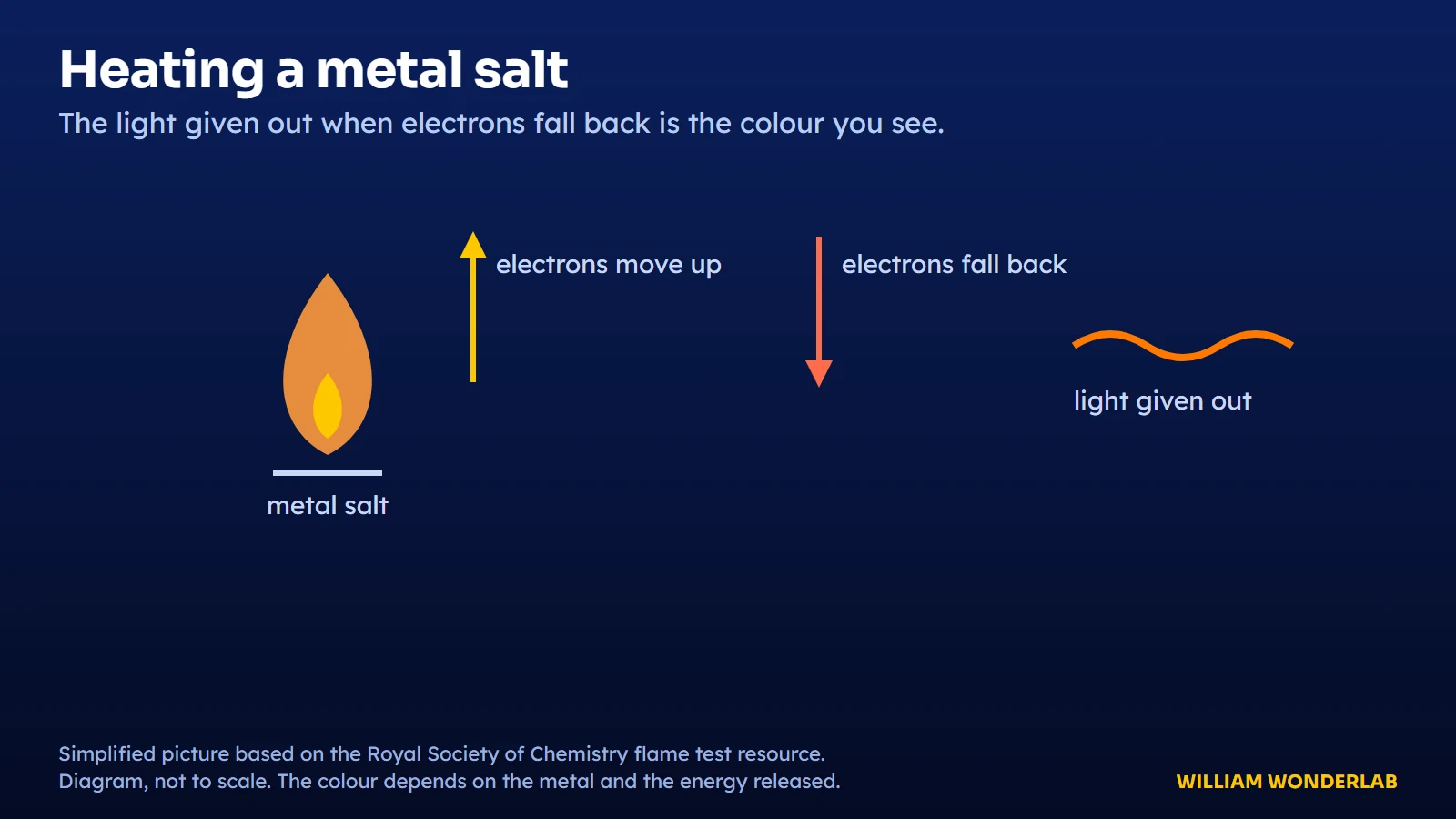
The short answer: Fireworks contain various metal salts that make different, specific colours as they are heated.[1] The heat lifts electrons in the metal atoms to higher energy levels. As the electrons fall back, they release light, and each metal gives its own colour. Strontium gives red, barium green, copper blue or blue-green, and sodium yellow.[2]
The heat makes electrons jump
A salt is a compound made of a metal and another element, such as chlorine. Inside each metal atom, electrons move around the centre of the atom, which is called the nucleus. The electrons have set amounts of energy, called energy levels.[1]
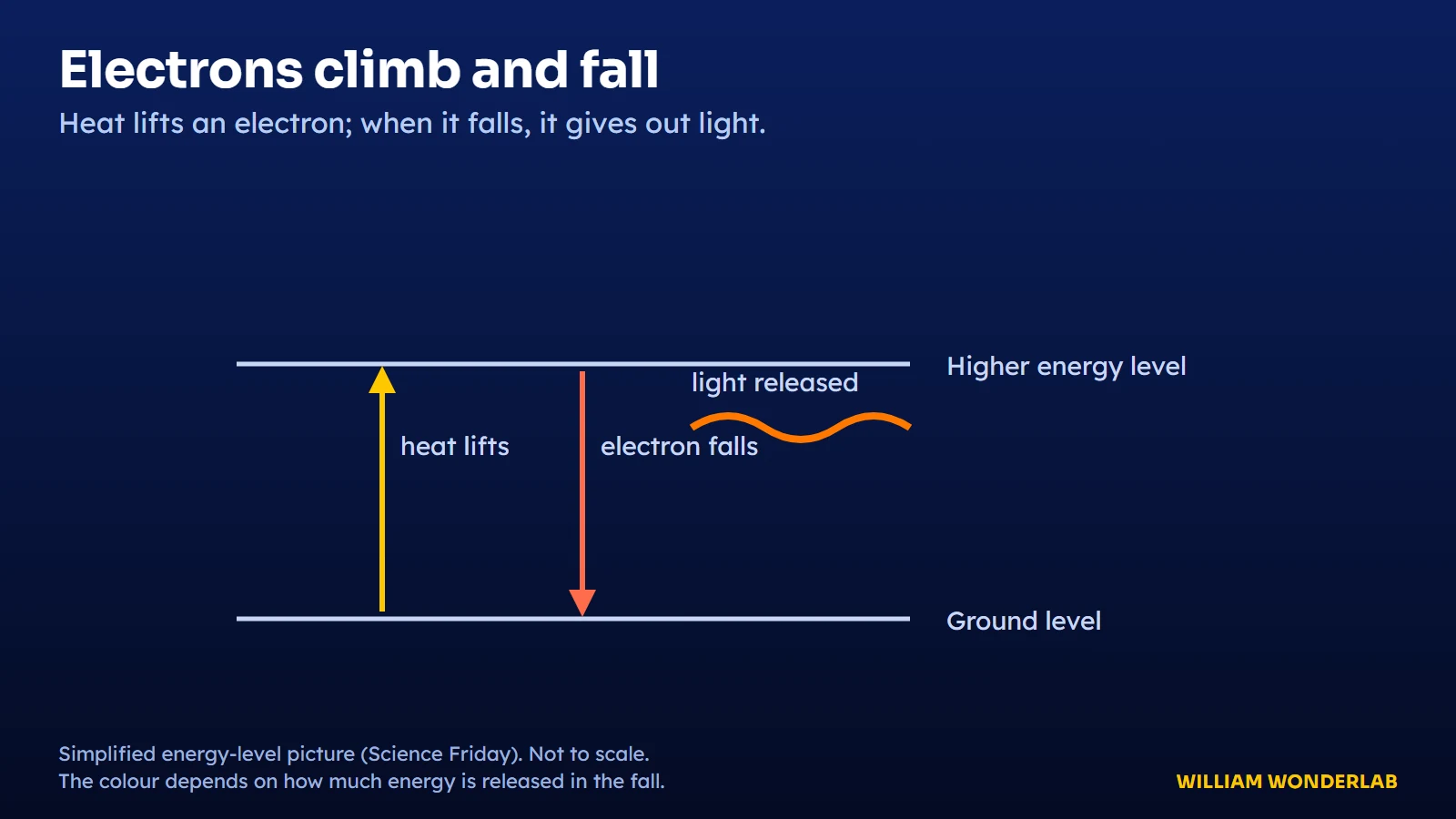
Electrons sit at particular energy levels, like rungs on a ladder. Science Friday explains that “If electrons gain energy, they move from one energy level up to a higher level through distinct steps.”[1] The heat of a firework gives the electrons energy, so they climb up the ladder.
Did you know? The Alaska Science Forum notes that sodium is such a powerful source of yellow-orange light that fireworks makers have to use it carefully.[2]
The light comes out as the electrons fall
Electrons do not stay high on the ladder. The Royal Society of Chemistry describes how the excited electrons return to their original energy level, and the energy they gained is given out as light.[3]
Science Friday says: “The lost energy can be carried away in the form of heat or in the form of light (as a photon).”[1] A photon is a tiny packet of light. How much energy is lost in the fall affects the kind of light that is made.[1]
Which metals make which colours
The diagram below sums up the colours named in the sources. These are common firework colours, not a complete list.
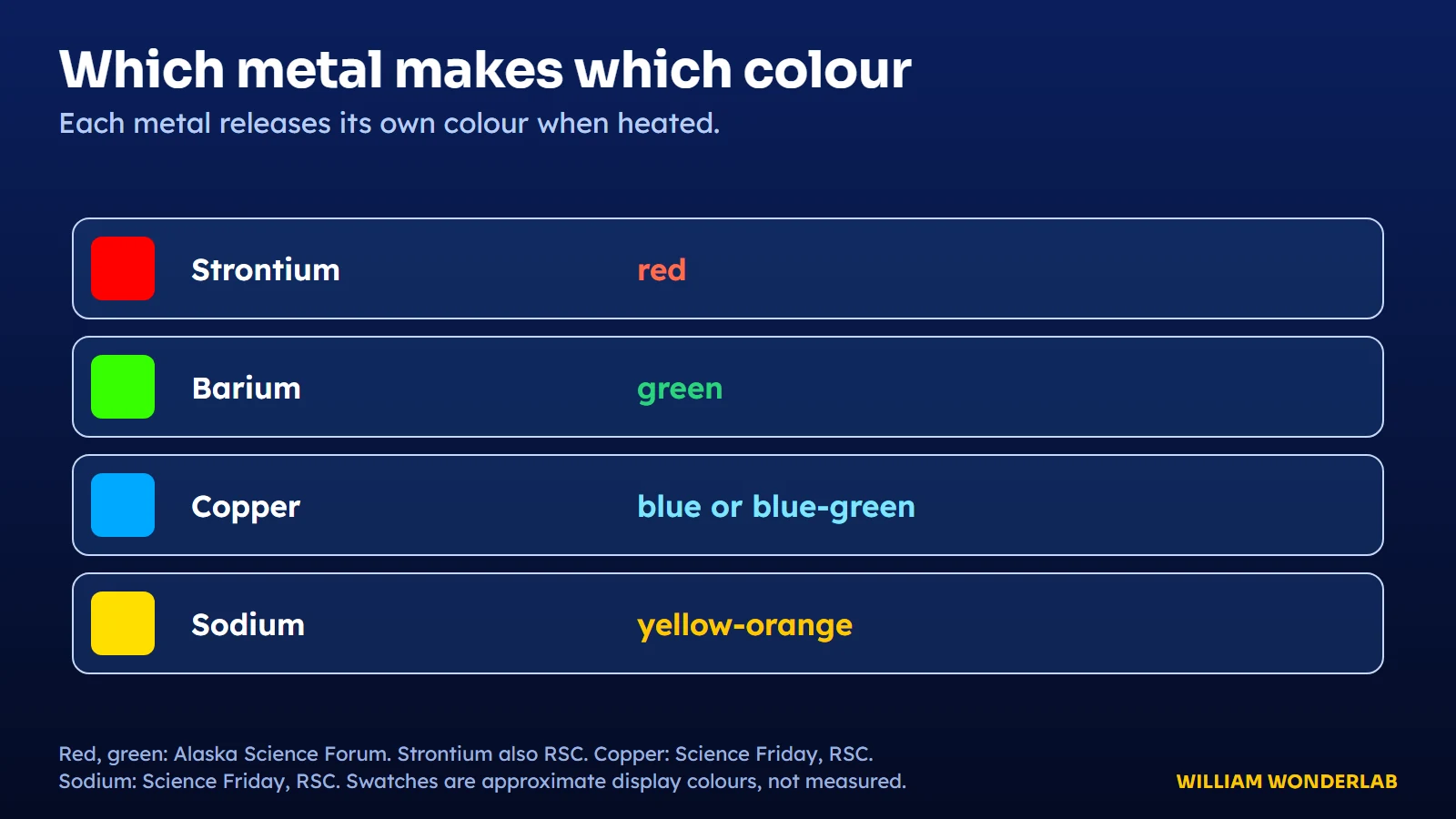
- Red comes from strontium. The Alaska Science Forum, a publication of the University of Alaska Fairbanks Geophysical Institute, states: “Most reds in fireworks come from strontium compounds.”[2] The Royal Society of Chemistry’s flame test resource also lists strontium as giving a crimson red flame.[3]
- Green comes from barium. The same article says: “Barium compounds are the source for the different greens in fireworks.”[2]
- Blue comes from copper. The Alaska article calls copper chloride “the best source yet identified for a rich blue color.”[2] Science Friday describes heated copper as giving “bluish-green light”,[1] and the Royal Society of Chemistry says copper(II) gives a blue or green flame.[3] Copper’s colour is therefore described as blue or blue-green.
- Yellow comes from sodium. Science Friday says that when sodium is heated, it “makes intense yellow/orange light.”[1] The Royal Society of Chemistry lists sodium as giving a yellow flame.[3]
White light is different
Not every firework colour comes from a salt.
The Alaska article describes a white-light device that is “fueled by a reactive metal, such as magnesium.”[2] Instead of a sharp colour, the heated metal particles “develop a white-hot incandescent glow.”[2]
What decides the final colour
A firework is not made from one metal alone. Science Friday says that “The color, or colors, that a firework makes depends on what color-producing chemicals are in the firework.”[1] The energy released when electrons fall also matters, because “Exactly how much energy is lost affects what kind of light is made.”[1] So both the chemicals in the mix and the energy they release shape the colour you see.
Safety: fireworks are not for home experiments
Fireworks and sparklers can cause serious harm. WorkSafe Victoria states that fireworks “can and do cause serious injuries and deaths in untrained hands.”[4] Its page also reports that burns were the most common injury, at 42 per cent, in the figures it cites.[4]
The Queensland Government says that “Authorised displays are conducted by professional, licenced operators using approved firework products.”[5] Authorised displays have met legislative requirements that include safety planning and community notification obligations.[5]
A study of children treated at a burns unit in Sydney found 96 patients with burns from fireworks or sparklers between 2004 and 2019. Sparklers caused 69 (72%) of the burns, and there was a lack of parental supervision in almost all (90%) of cases.[6]
Safety first: do not try this at home. Never make, mix, light or handle fireworks or sparklers to test colours. This article does not include any activity with fireworks, sparklers or their chemicals.
Go deeper: energy levels and light
Energy levels in atoms
An atom’s electrons sit at set energy levels. Science Friday says electrons moving around the nucleus “have certain amounts of energy, called energy levels.”[1] When a firework heats them, the electrons move to a higher level, then drop back down.[1]
Why each metal gives its own colour
The Royal Society of Chemistry describes the electrons being excited, jumping to the next highest shell, then returning to their original shell and giving out energy as light.[3] Each metal gives a different flame colour, so the colour acts like a fingerprint of the metal rather than a mix of paint.
Frequently asked questions
Why does a firework have a colour at all?
The heat excites electrons in metal atoms. As they fall back, they release light, and the colour depends on the metal and the energy released.[1][3]
Which metal makes red fireworks?
Strontium. The Alaska Science Forum says most reds come from strontium compounds.[2]
Which metal makes blue fireworks?
Copper. The Alaska Science Forum calls copper chloride the best source yet identified for a rich blue, and Science Friday describes heated copper as bluish-green.[2][1]
Can I make fireworks at home?
No. WorkSafe Victoria warns that fireworks can cause serious injuries in untrained hands, and this article does not include any home activity.[4]
The big idea
Each metal has its own colour. The heat of a firework lifts electrons in metal atoms. When they drop back, the metal releases light of its own colour. Strontium is red, barium green, copper blue or blue-green, and sodium yellow.
Related reading
More from William Wonderlab:
Explore more from scientists:
- Whoosh…Bang! Happy New Year (Alaska Science Forum, University of Alaska Fairbanks)
- Flame tests using metal salts (Royal Society of Chemistry Education)
- Don’t get burnt playing with fireworks (WorkSafe Victoria)
Related on this site: Why Do Soap Bubbles Have Rainbow Colours? is another colour story, with a different cause.
References
[1] Teisha Rowland, PhD, “The Chemistry Behind How Fireworks Get Their Colors,” Science Friday (Science Buddies content) (accessed 25 October 2026)
[2] Carla Helfferich, “Whoosh…Bang! Happy New Year,” Alaska Science Forum, Geophysical Institute, University of Alaska Fairbanks, 19 December 1990 (accessed 25 October 2026)
[3] “Flame tests using metal salts,” Royal Society of Chemistry Education (accessed 25 October 2026)
[4] “Don’t get burnt playing with fireworks,” WorkSafe Victoria, published 27 December 2019 (accessed 25 October 2026)
[5] “Fireworks in the community,” Queensland Government (accessed 25 October 2026)
[6] Daniel Ricciardello, Nam Kyu Yang, Kira Chamberlain and Andrew Holland, “Firework and sparkler burns in paediatric patients,” Australasian Journal of Plastic Surgery, vol. 4, issue 1, 2021, pp. 29-33 (accessed 25 October 2026)