Why Does Metal Feel Colder Than Wood?
Touch a metal spoon and a wooden spoon from the same drawer and the metal feels colder, even though both are the same temperature. Here is why.
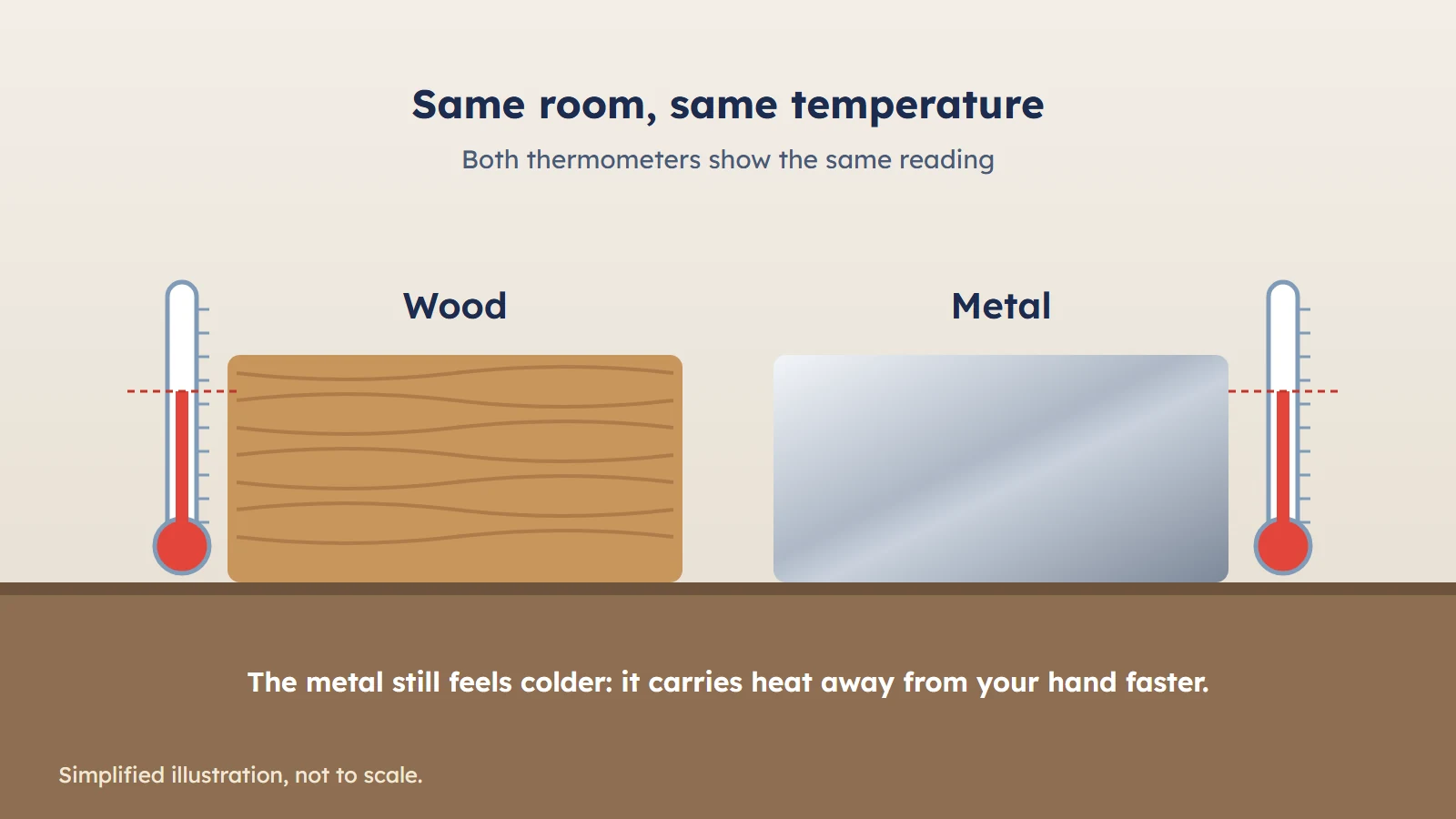
Pick up a metal spoon and then a wooden spoon from the same bench. The metal feels colder, even though both have been sitting in the same room. If the spoons are the same temperature, why does one feel colder than the other?
The short answer: The metal is not colder. Metals conduct heat much better than wood, so a metal object pulls heat out of your skin faster. Your nerves sense that faster heat loss as cold.[1][2]
Same room, same temperature
Both spoons are at room temperature, so no heat is moving between them. Your hand is warm, though, and it is always giving off heat. Your skin does not sense the temperature of the object directly. It senses how fast heat is leaving your hand.
HyperPhysics answers the question for steel and wood at 0 °C. With both objects at that temperature, steel feels colder than wood because its thermal conductivity is much higher, so it conducts energy away from your finger faster.[2] The University of Illinois Physics Van gives the same explanation at room temperature. Your hand is warmer than the room, both materials draw heat from it, and because metal conducts better it cools your hand faster. That faster cooling is what you feel.[3]

Heat leaves your hand
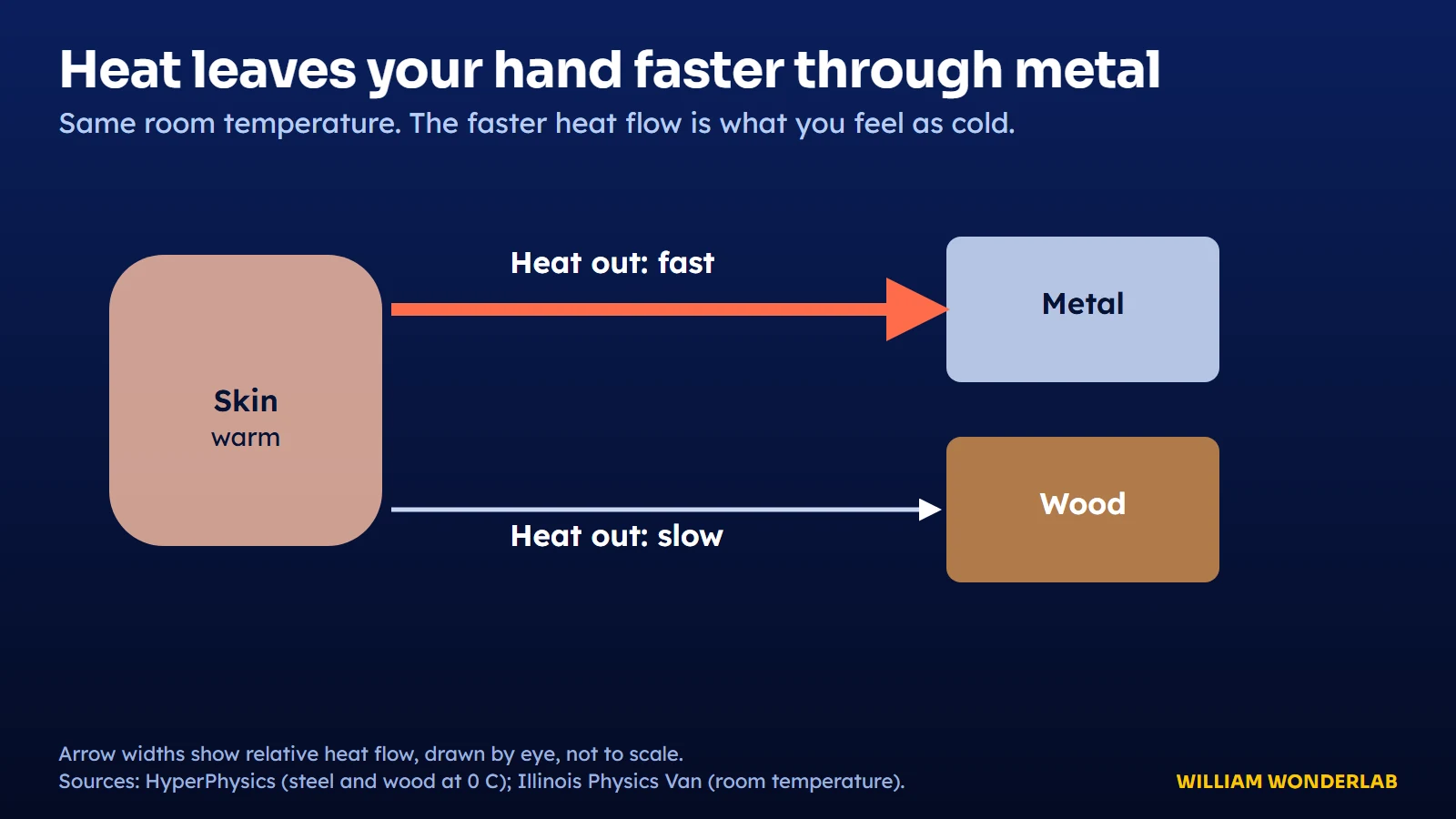
Heat always moves from the warmer thing to the cooler thing. When your fingers touch an object, heat starts to flow out of your skin into the object. How fast it flows depends on the material.
The skin loses heat most quickly where it touches the material that conducts heat best. Because metal carries heat away from the contact point faster than wood does, the spot your fingers touch cools faster, and the nerves report that as cold.[3]
Conductivity: how fast a material moves heat
The property that matters most is thermal conductivity. HyperPhysics lists the thermal conductivity of several materials in watts per metre per kelvin (W/m·K).[1] Here are the values from that table:
- Copper: 385.0 W/(m·K)
- Aluminium: 205.0 W/(m·K)
- Iron: 79.5 W/(m·K)
- Wood: 0.12 to 0.04 W/(m·K), given as a range in the table
The table gives wood as a range rather than a single number. The USDA Forest Products Laboratory’s Wood Handbook explains that wood’s conductivity depends on its density, moisture content, grain direction and temperature, so the values vary.[4]
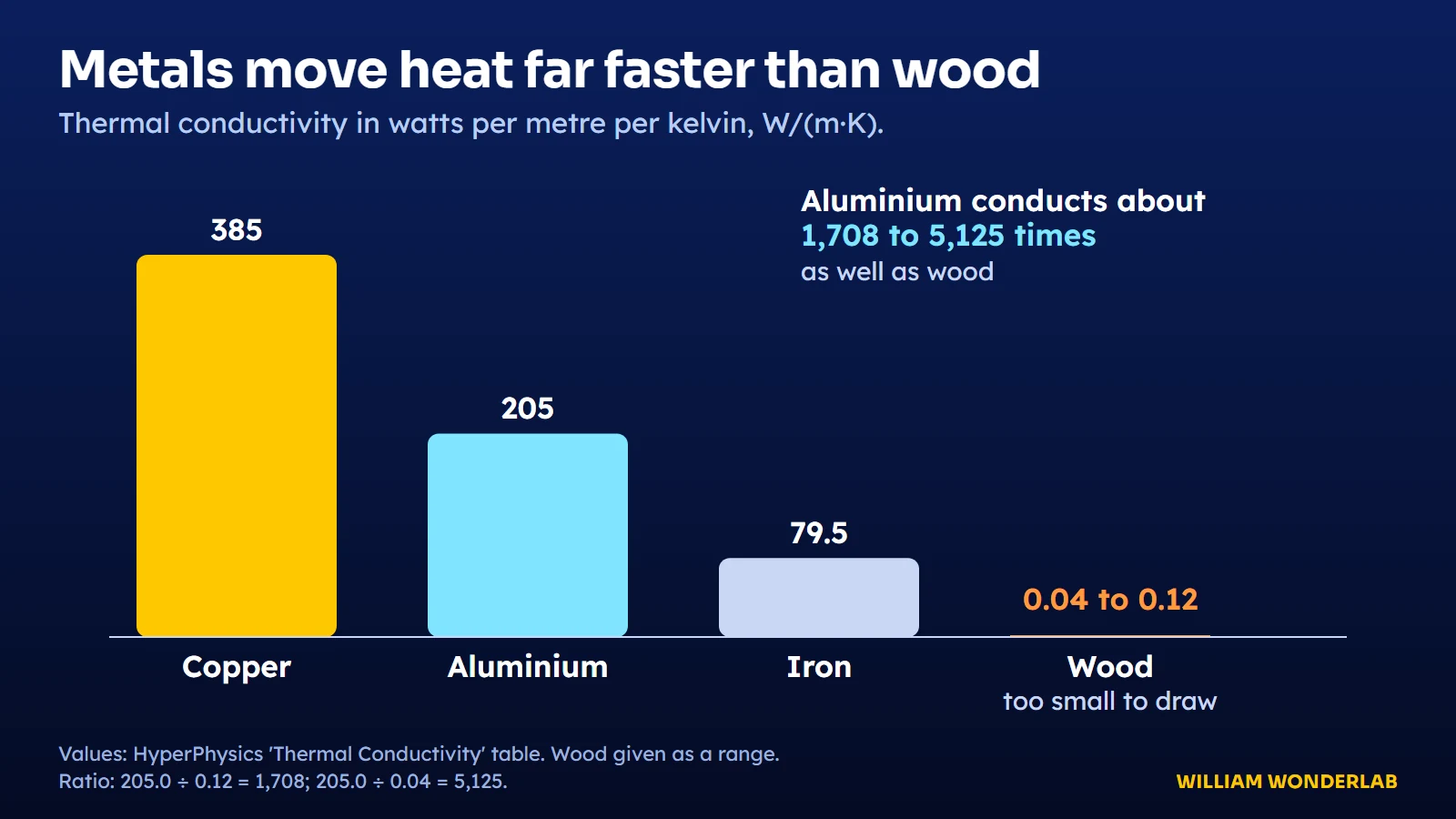
The table values show a huge difference. Aluminium conducts heat about 1,700 to 5,100 times better than wood, depending on which wood value is used. Copper conducts almost twice as well as aluminium (385 ÷ 205, about 1.9). The working is in the reference notes.
HyperPhysics explains the general relation this way. The rate of heat loss through a barrier of constant thickness depends on the thermal conductivity of the material, among other things.[5]
Why metals conduct heat so well
Metals are good at moving heat because of their electrons. HyperPhysics explains that the same mobile electrons which take part in electrical conduction also take part in the transfer of heat.[6]
Wood is at the other end of the scale. The Wood Handbook states that the conductivity of common structural woods “is much less than the conductivity of metals with which wood often is mated in construction.”[4]
The feeling flips when things are hot
Heat flows from warm to cool. If an object is warmer than your skin, heat flows into your hand instead of out of it. A good conductor such as metal then delivers heat to your skin faster than wood does, so metal feels hotter than wood at the same temperature.[2]
Did you know? The conductivity values from HyperPhysics differ by more than a thousand times between aluminium and wood, even though both are everyday materials you touch.[1]
Try it: the spoon test
You need: one metal spoon, one wooden spoon of similar size, and a thermometer (optional).
- Leave both spoons in the same room for a while so they match the room temperature. Use a thermometer to check both read the same, if you have one.
- Touch the bowl of the metal spoon briefly with a fingertip. Count a few seconds, then feel how cold it seems.
- Repeat with the wooden spoon.
- Note which spoon felt colder and whether the difference was clear.
What to expect: Both spoons measure the same temperature, but the metal spoon should feel colder. This is because it draws heat out of your fingertip faster.
Safety first: Use spoons only at room temperature. Do not use anything hot, anything from the fridge or freezer, or anything close to a stove. Do not put the spoons in your mouth. Wash your hands afterwards. Younger children should do this activity with an adult.
Go deeper: the numbers
Ratios from the table
Each ratio is a division of two values from the table:
| Comparison | Calculation | Result |
|---|---|---|
| Copper to aluminium | 385.0 ÷ 205.0 | about 1.9 |
| Aluminium to wood | 205.0 ÷ 0.12 and 205.0 ÷ 0.04 | about 1,700 to 5,100 |
| Iron to wood | 79.5 ÷ 0.12 and 79.5 ÷ 0.04 | about 660 to 2,000 |
Why the sensation is about heat flow
The feeling comes from the rate of heat flow, not from the object’s temperature. The sensation depends on how fast the skin loses heat at the point of contact. Both materials are at the same temperature, so the difference lies in how quickly each one conducts heat away from the skin.[2][3]
Frequently asked questions
Is metal actually colder than wood?
No. Both materials are at the same temperature. Metal removes heat from your skin faster, and your nerves read that as cold.[3]
Does the metal feel colder even when it is the same temperature?
Yes. This is the main point of the spoon test. Both are at room temperature, but they feel different.[3]
Does the feeling ever reverse?
Yes. If the object is warmer than your skin, the metal delivers heat faster and feels hotter than wood.
The big idea
Feel the flow, not the temperature. Your skin senses how fast heat is leaving it. Metals conduct heat quickly, so they pull heat from your hand and feel cold. Wood conducts slowly, so it feels warmer.
Related reading
More from William Wonderlab:
Explore more from scientists:
- Thermal Conductivity table (HyperPhysics, Georgia State University)
- Heat Conduction (HyperPhysics, Georgia State University)
- Thermal Conductivity and the Wiedemann-Franz Law (HyperPhysics, Georgia State University)
References
[1] HyperPhysics, Georgia State University, “Thermal Conductivity” table (accessed 25 October 2026)
[2] HyperPhysics, Georgia State University, “Steel and Wood at Zero Celsius” (Heat Questions) (accessed 25 October 2026)
[3] University of Illinois Urbana-Champaign, Physics Van, “Cold Metal” (answer dated 22 October 2007) (accessed 25 October 2026)
[4] Glass, S. V. and Zelinka, S. L., “Chapter 4: Moisture relations and physical properties of wood”, Wood Handbook: Wood as an Engineering Material, General Technical Report FPL-GTR-282, USDA Forest Service, Forest Products Laboratory (2021), section “Thermal Conductivity”, p. 4-13 (accessed 25 October 2026)
[5] HyperPhysics, Georgia State University, “Heat Conduction” (accessed 25 October 2026)
[6] HyperPhysics, Georgia State University, “Thermal Conductivity and the Wiedemann-Franz Law” (accessed 25 October 2026)