Why Do We Have Tides?
Tides are the rise and fall of the ocean, pulled mainly by the Moon's gravity and partly by the Sun's. Here is why there are two bulges of water.
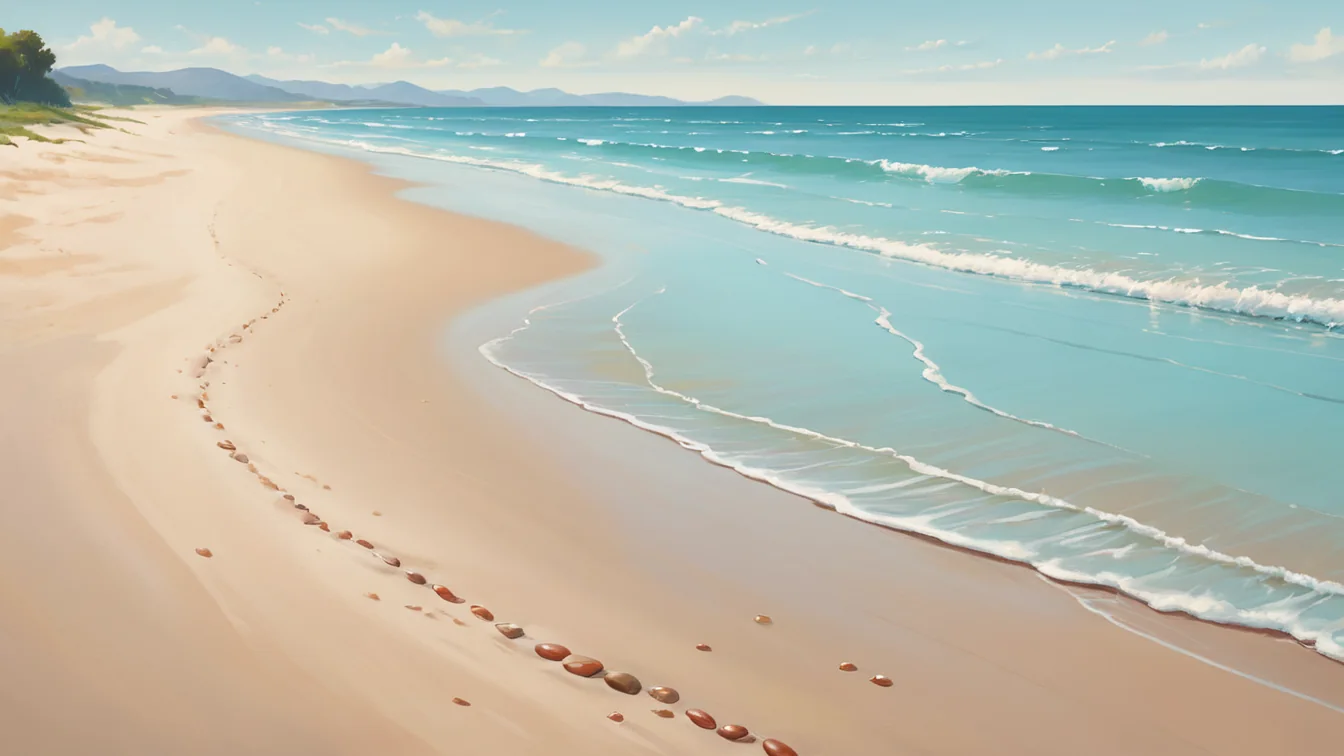
Stand on a beach for a while and the water creeps up the sand, then slips back out to sea. Come back a few hours later and the shoreline may be in a completely different place. What is pulling the ocean around like that?
The short answer: Tides are the regular rising and falling of the ocean, caused by the gravity of the Moon and the Sun. The Moon does most of the work because it is much closer to Earth. Its pull creates a bulge of water on the side of Earth facing it, and a second bulge on the far side.[1][2]
Gravity pulls on the sea
Gravity is the pull that every object with mass exerts on every other object. You feel it every time something falls. The bigger an object is and the closer it is, the stronger its pull.
NOAA describes tides as “the periodic rising and falling of ocean waters caused by the gravitational forces of the sun and moon.”[1] The Sun is far larger than the Moon, but it is also far more distant. The Moon is close enough that its pull on Earth’s oceans is stronger. NOAA says the Moon’s effect is “about twice that of the sun, since the moon is closer to the Earth.”[1]
NOAA’s general tide page puts it simply: “Tides are caused by gravitational pull of the moon and the sun.”[3] Earth’s oceans are liquid, so they can move. The Moon pulls the water nearest to it a little harder than it pulls the middle of the planet. That difference is what shapes the tides.
Two bulges, not one
You might expect the Moon to pile the water up on the side facing it, and nowhere else. In fact, the ocean bulges on two sides at once. NASA explains that the Moon’s gravity causes “the oceans to bulge out on both the side closest to the Moon and the side farthest from the Moon,” and that “these bulges create high tides.”[2]
NOAA gives the same picture: at any moment, one side of Earth is closer to the Moon than the opposite side. The water on the near side is pulled into a bulge, which makes a high tide. On the far side, a similar bulge forms, creating another high tide.[1]
Here is a simple way to picture the far-side bulge. Inertia is the tendency of something to keep doing what it is already doing. As Earth is pulled toward the Moon, the water on the far side is, in effect, left behind, so it bulges outwards.
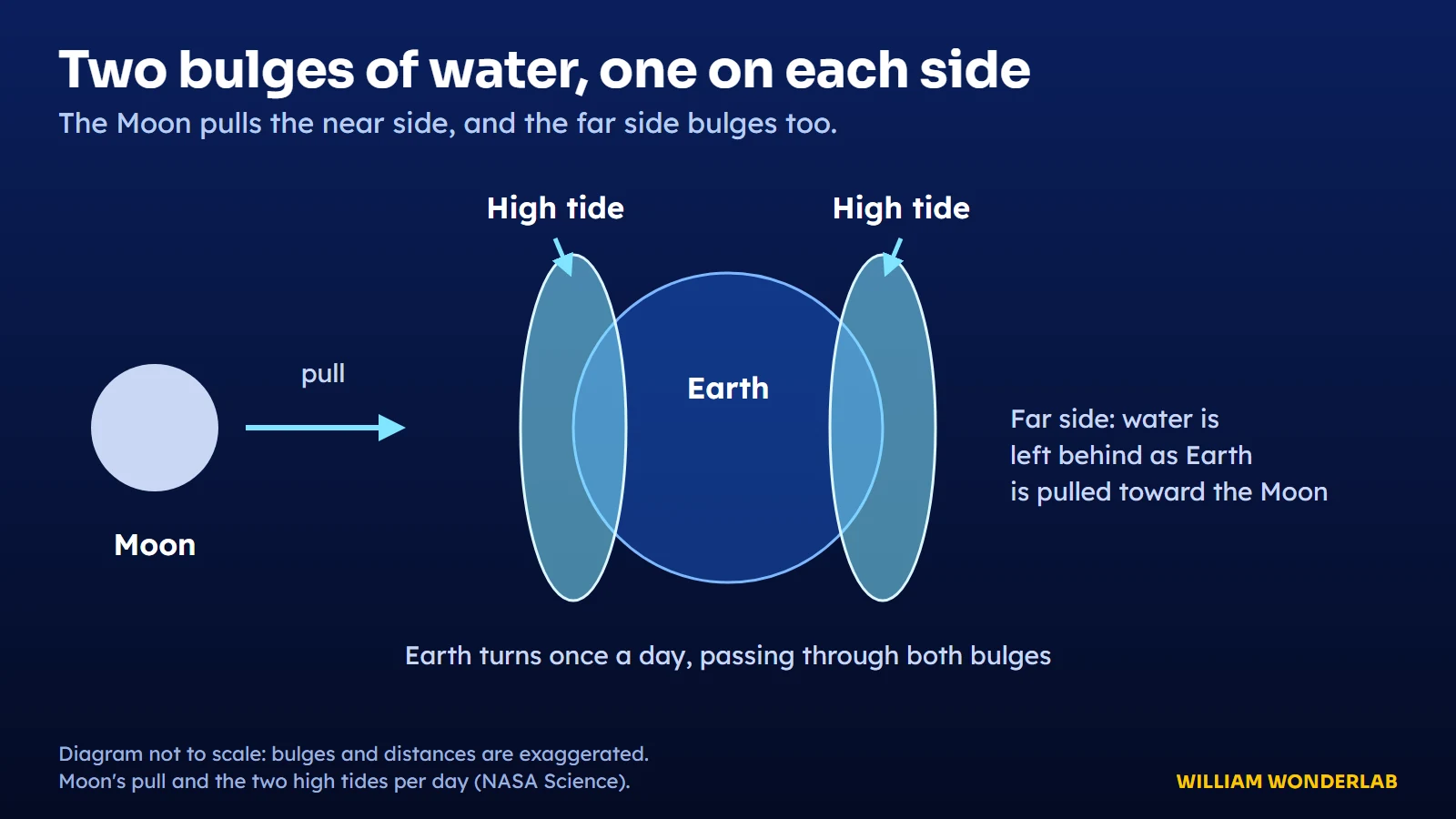
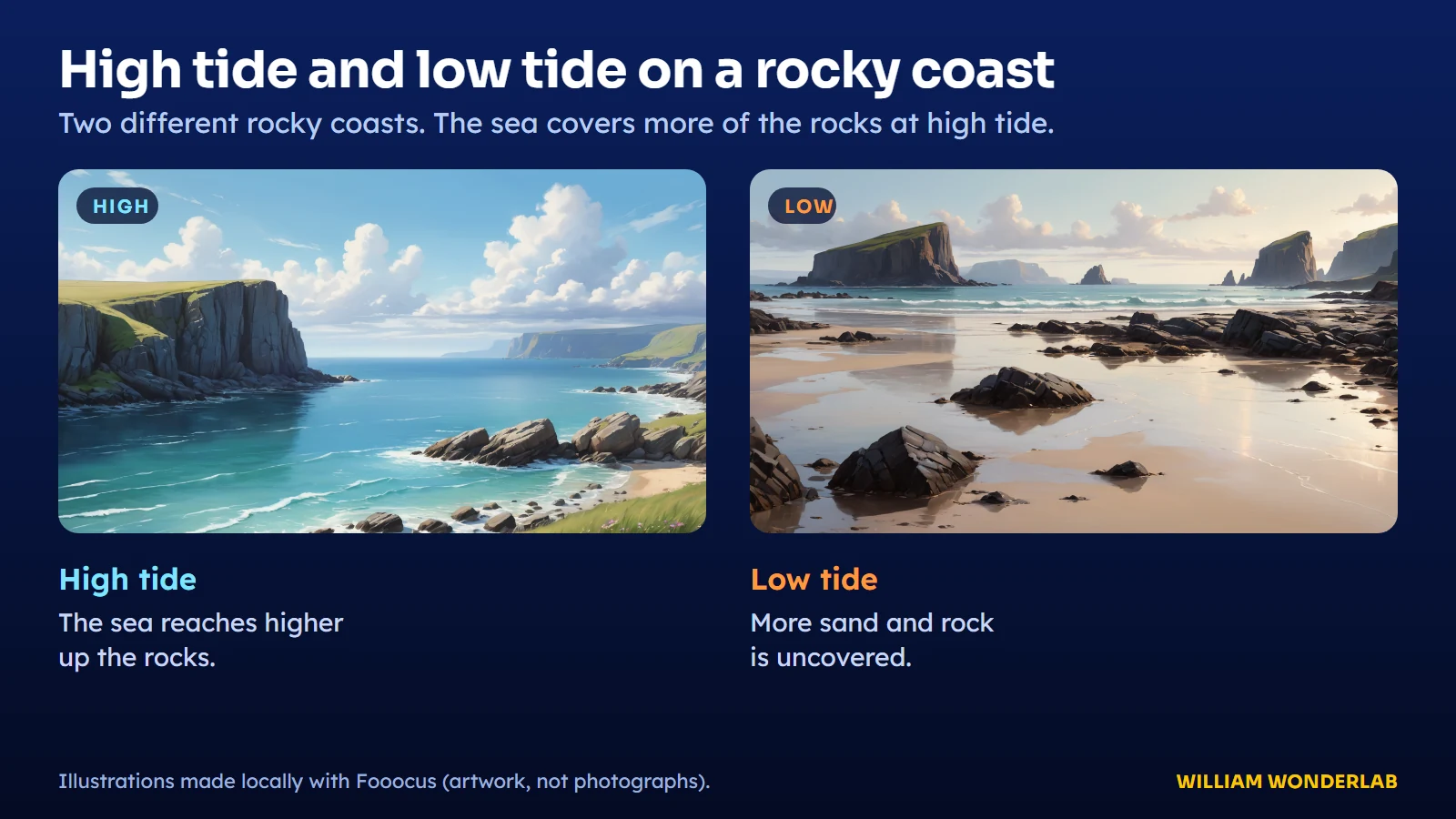
Earth spins underneath these two bulges. Because of that, most shorelines pass through a high tide and a low tide twice a day. NASA states that “Most shorelines experience two high and low tides per day.”[2]
Spring tides and neap tides
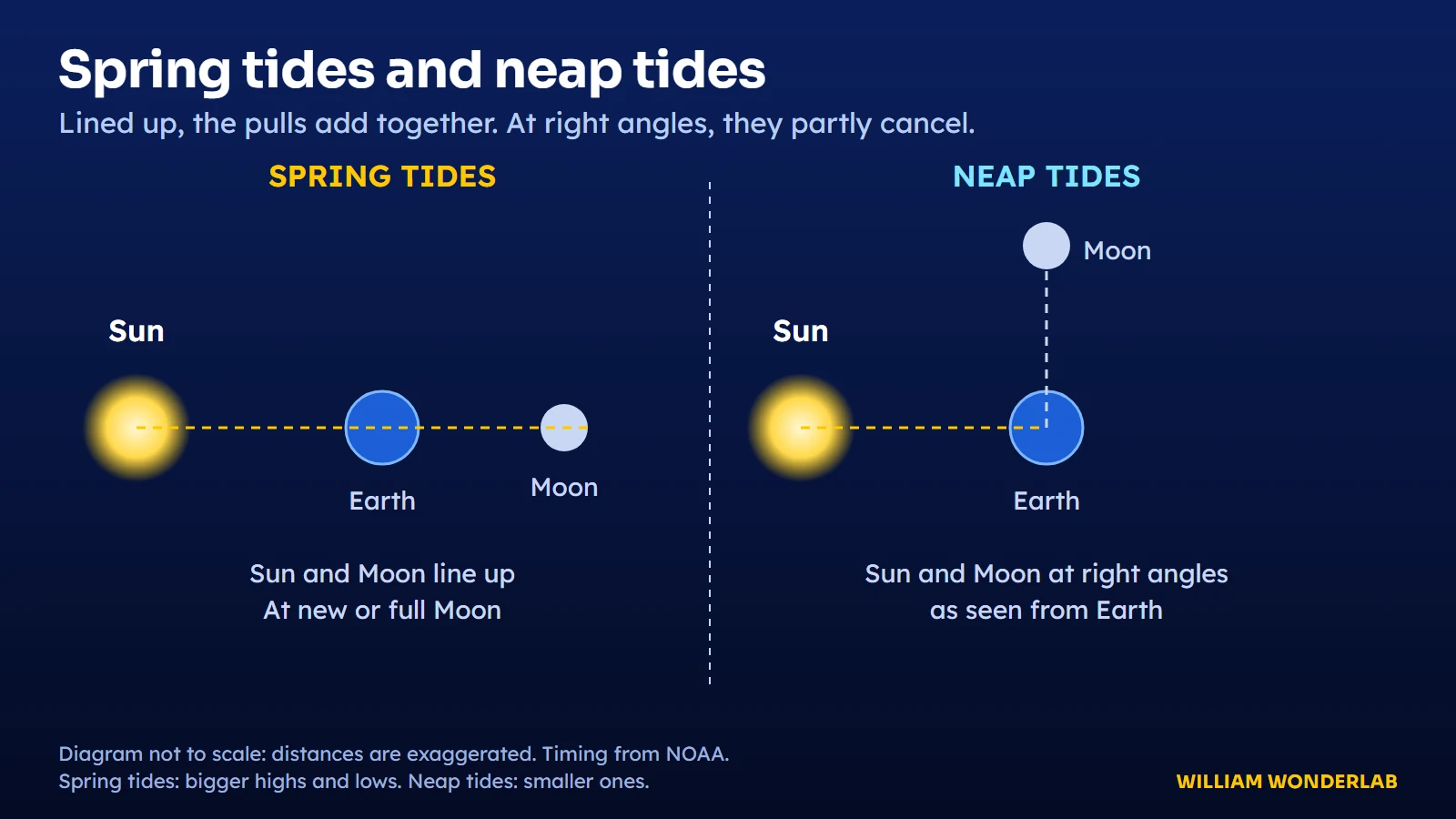
The Sun also pulls on the ocean. Its pull is weaker than the Moon’s, but it can add to the Moon’s pull or work against it, depending on where the three bodies are.
NOAA describes two cases. When “the sun and moon are aligned (at the time of full moon or new moon),” the pulls work together and “produce more pronounced high and low tides that are called spring tides.” When “the sun and moon are at right angles relative to the earth,” the Sun partly cancels the Moon’s pull, and the result is “less pronounced high and low tides that are called neap tides.”[1]
The word “spring” here means the water rises and falls more, not that it happens in spring. Spring tides and neap tides both follow the Moon’s monthly cycle, so their pattern repeats as the Moon moves round Earth.
Did you know? The Moon’s effect on the tides is about twice the Sun’s, even though the Sun is much larger. Distance matters as much as size when it comes to gravity.[1]
Try it: track the tide
Proposed at-home activity. This is an observation, not an experiment.
You need: a notebook, a pencil, a watch or phone clock, and an adult to take you to a beach, jetty or harbour.
- Before you go, look up the tide times for your area in a local tide table or tide chart.
- At the water’s edge, pick a fixed object, such as a rock or a post, and note how far the water reaches from it.
- Check again every hour or two and write down the time and the water level compared with the object.
- Compare your notes with the tide chart. Did the water rise when the chart said it would?
What to expect: the water level changes slowly and steadily over several hours, rising towards a high tide and falling towards a low tide.
Safety first: Watch only from dry, stable ground well back from the waves. Do not walk on wet sand, slippery rocks or jetties near the water, and never go into the sea to measure anything. Tides and waves can change quickly, so keep an eye on the time and leave early if the water comes closer. Go with an adult.
Go deeper: why the diagrams are not to scale
Gravity, distance and the bulges
Gravity weakens quickly as distance increases. That is why the Moon, which is much closer to Earth than the Sun, has a larger effect on the tides even though the Sun is far more massive. The diagrams in this article exaggerate the bulges so you can see them. In real life the bulges are much smaller compared with the size of the planet.
Why the pattern is not perfectly regular
Tides follow the Moon and the Sun, and those bodies move in their own orbits. Local factors matter too. Land Information New Zealand says that, besides the pull of the Moon and Sun, “the rotation of the Earth, the size and shape of the ocean, as well as local factors all affect the size and frequency of the tide at a particular place.”[4] That is why a local tide table is needed to know when the water will be high at your beach.
Frequently asked questions
Why are there two high tides a day?
Water bulges on the side of Earth facing the Moon and on the far side. As Earth turns, most coastlines pass through both bulges, so they have two high tides a day.[1][2]
Is the Moon or the Sun more important for tides?
The Moon. NOAA says the Moon’s effect is about twice the Sun’s because it is closer to Earth.[1]
What is a spring tide?
A spring tide happens when the Sun and Moon line up, at new or full Moon. Their pulls combine and produce bigger highs and lower lows.[1]
What is a neap tide?
A neap tide happens when the Sun and Moon are at right angles to each other as seen from Earth. Their pulls partly cancel, so the highs and lows are less extreme.[1]
The big idea
The Moon pulls the ocean into bulges. Two bulges of water form on opposite sides of Earth, and as the planet turns, most coasts rise and fall twice a day. The Sun’s pull adds to or cancels the Moon’s, which makes the tides bigger or smaller.
Related reading
More from William Wonderlab:
- Why Does Earth Have Seasons?
- Why Does the Moon Look Bigger Near the Horizon?
- Why Does the Moon Change Shape?
Explore more from scientists:
References
[1] NOAA Ocean Service, “What causes tides and tidal currents?” (accessed 25 October 2026)
[2] NASA Science, “Moon tides” (accessed 25 October 2026)
[3] NOAA Ocean Service, “Tides” (facts page, last updated 23 September 2026) (accessed 25 October 2026)
[4] Land Information New Zealand (LINZ), “Tides” (accessed 25 October 2026)