Why Does Chocolate Melt in Your Hand?
Chocolate is solid in the shop and soft in your palm because its fat, cocoa butter, melts close to body temperature. The shape of its crystals decides how sharply it melts.
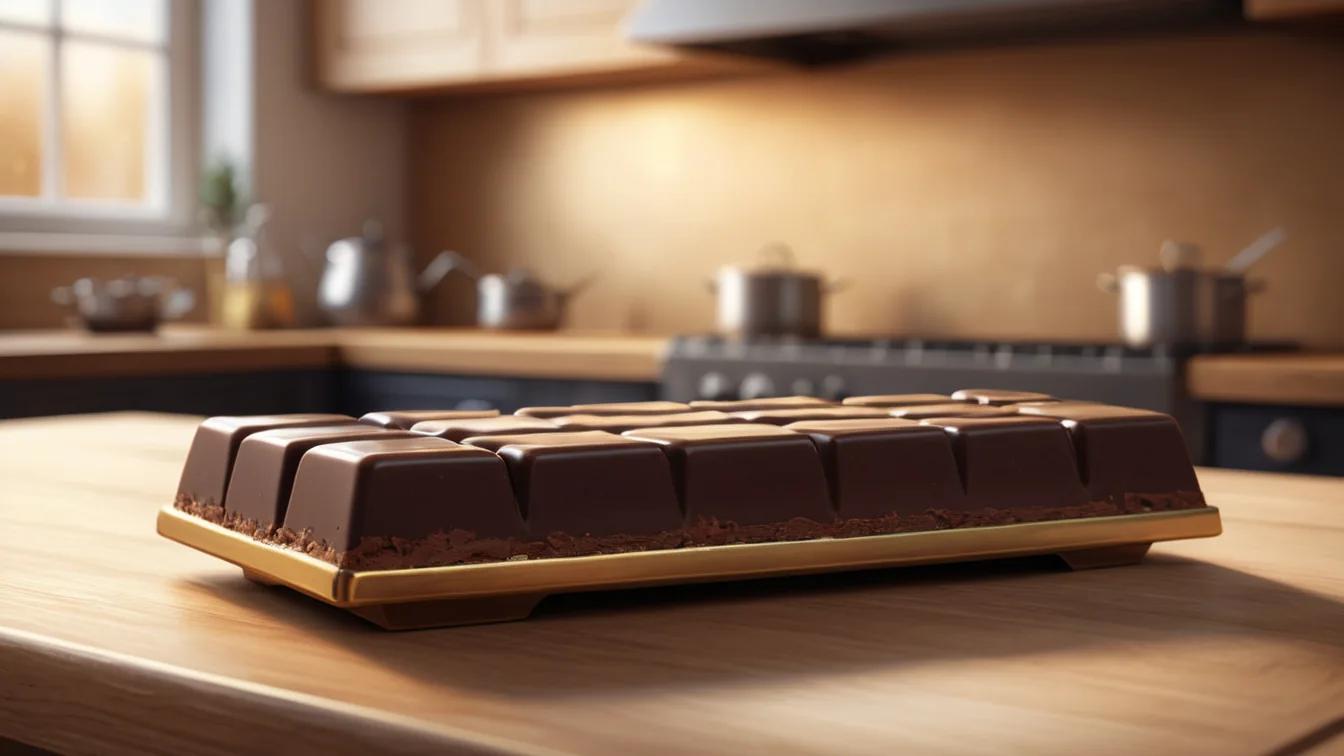
Hold a chocolate square for a minute and it goes soft and shiny, and a little sticky on your fingers. Leave the same square on the bench and it stays firm. Your hand has not changed the chocolate’s ingredients. So what is it about your warm skin that makes the chocolate give way?
The short answer: Most of the fat in chocolate is cocoa butter, and its melting range sits close to normal body temperature. Warmth from your hand is enough to soften the fat, while a cool room keeps it solid. The way the fat crystals are arranged decides how sharply the chocolate melts.[1][2]
What is chocolate made of?
Chocolate is a mixture. It holds solid particles, such as cocoa solids and sugar, spread through a fat. That fat is cocoa butter, which comes from the cocoa bean. The solid particles give chocolate its bite and colour, while the cocoa butter gives it the smooth flow and the way it melts.
Scientists describe the cocoa butter as a mixture of fats called triglycerides.[3] A triglyceride is a molecule made of three fatty acid chains joined to a glycerol backbone. The chains and their arrangement set the temperature at which the fat turns from a solid into a liquid.
Melting: a solid becomes a liquid
Melting happens when a solid absorbs enough heat for its particles to slide past one another. In a solid, particles stay in fixed positions in an orderly pattern. In a liquid, they move more freely.
Most fats melt over a wide range of temperatures, because they contain many different molecules that each melt at a slightly different temperature. Cocoa butter is different. A review in Crystal Growth & Design by Jarvis Stobbs, from the Department of Food Science at the University of Guelph, reports that cocoa butter has “a sharp melting profile” and that most of it is made of a few triglycerides, with “1,3-distearoyl-2-oleoyl-sn-glycerol (SOS)” among the main ones. Together, these main triglycerides “account for over 80% of its TAG content.”[1]
Because the melting is sharp, cocoa butter goes from firm to fluid over a narrow band of temperatures.
Crystals decide where the melt happens
Cocoa butter does not have just one solid form. Its molecules can pack together in several different crystal shapes, called polymorphs. Polymorph is a word meaning “many forms”. A review by Barišić and colleagues says cocoa butter “can exist in six polymorphs.”[3] The same fat can be rigid and glossy in one form and dull and crumbly in another, depending on how the molecules lock together.
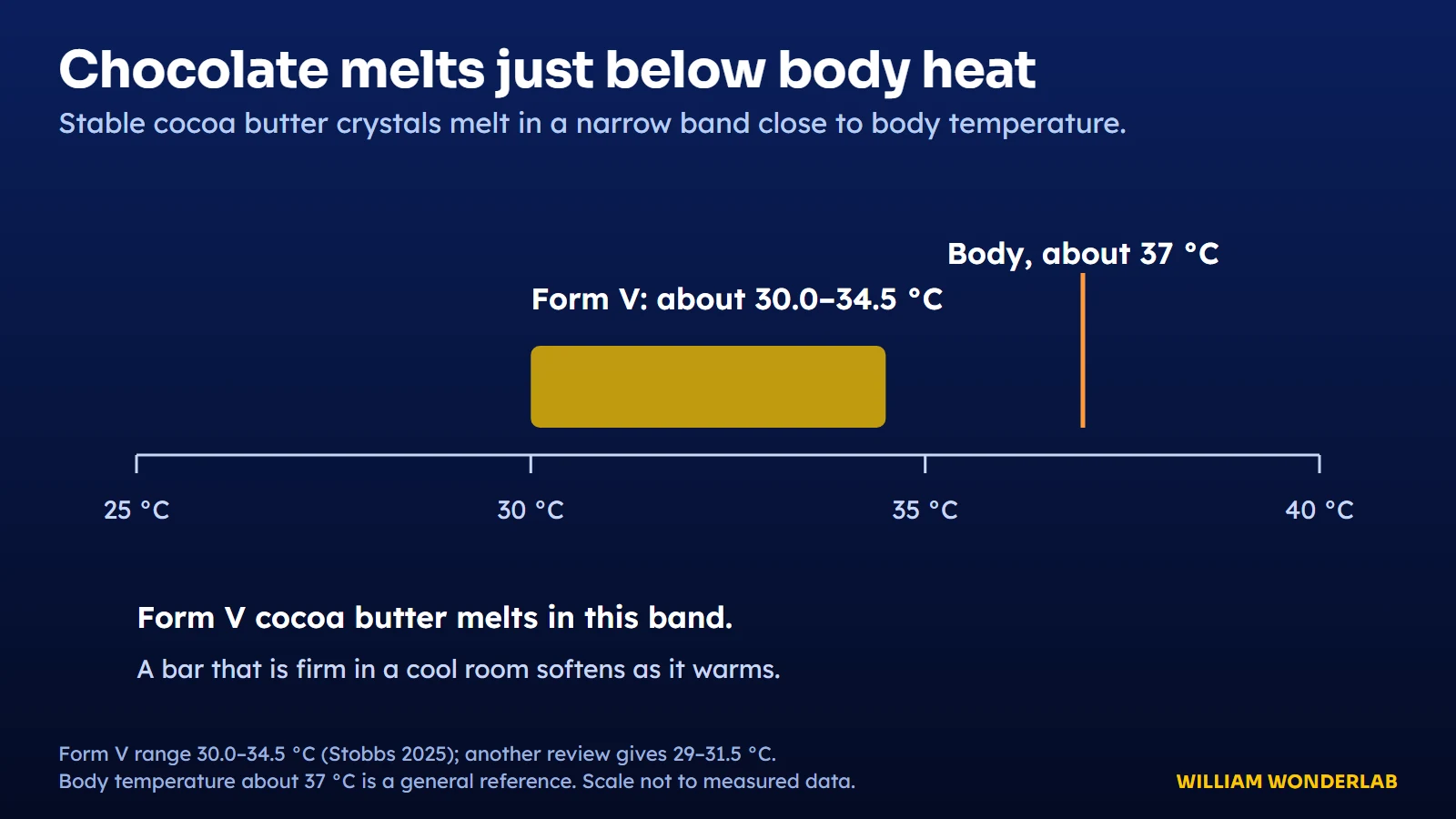
Stobbs describes the form that chocolate makers aim for: “optimal melting behavior near body temperature (∼30.0–34.5 °C).”[1] This form is called Form V. Its ordered arrangement lets the fat stay firm at room temperature, then melt when it reaches the warm range near your body. Another review gives a slightly lower range for the same desirable form, “melts at 29–31.5 °C”,[3] so the exact band depends on which study you read.
Chocolate makers are not guessing about this. A study from the University of Guelph’s Department of Food Science, published in Nature Communications, states: “Chocolate structured by Form V CB has the proper texture, gloss, snap, and melting profile.”[2]
The diagram below shows the melting window. It is drawn to show the idea, and the body-temperature mark is a general reference rather than a measurement.
Tempering: teaching the fat to crystallise well
Chocolate makers use a process called tempering to encourage Form V. Stobbs describes tempering as “the controlled crystallization of its structuring component, cocoa butter.”[1] In plain language, it is a careful cycle of heating and cooling that helps the fat build the right crystals. The Barišić review says tempering “results in stable and consistently sized crystals of cocoa butter.”[3]
Another study from the same university says that getting Form V “can be challenging or tedious, often demanding very specific tempering processes.”[2] This is why good chocolate is harder to make than it looks.
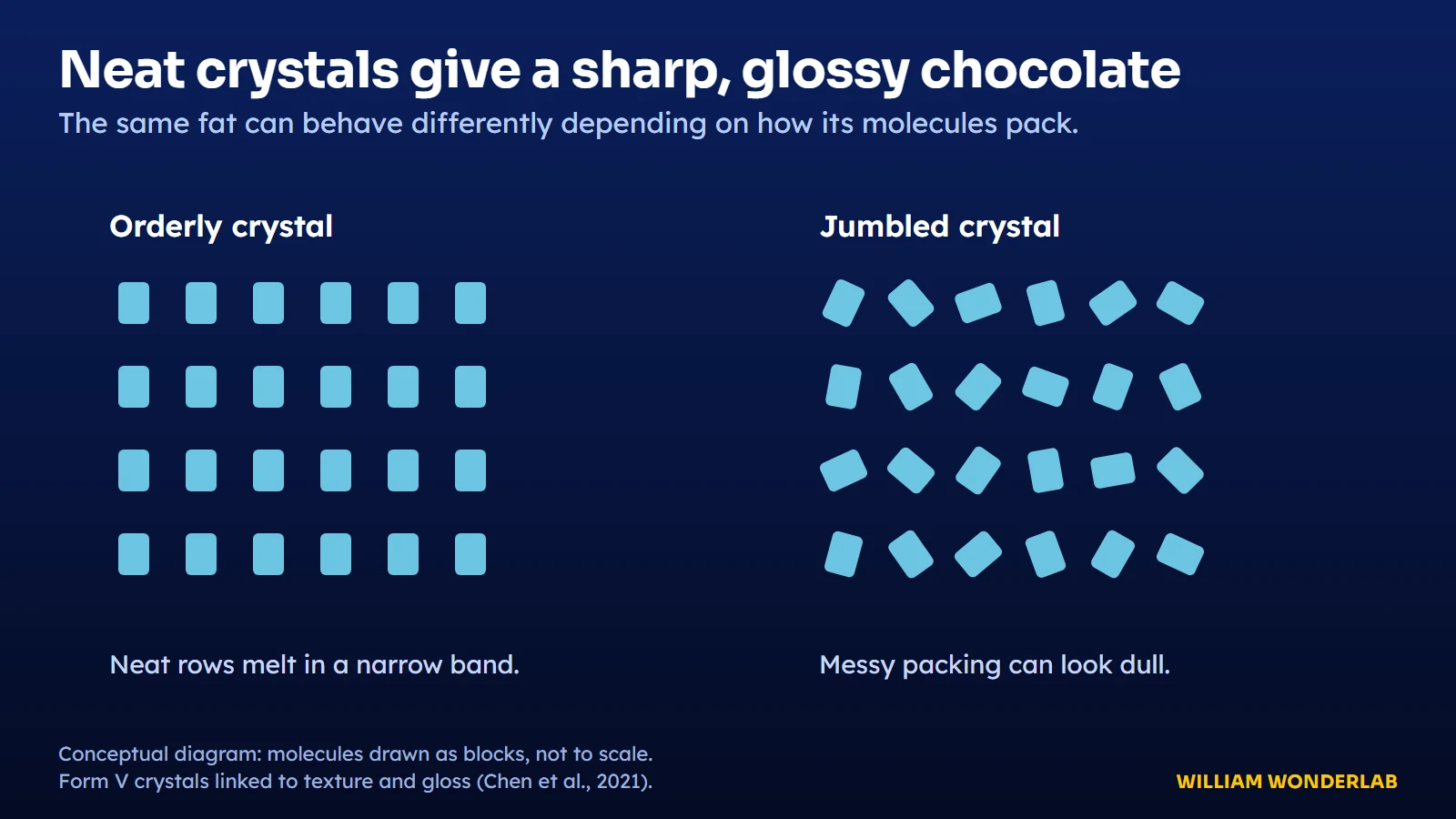
Tempering matters for your hands and your mouth. If the crystals are wrong, the chocolate can look dull, feel soft, or melt in the wrong place. The diagram below contrasts orderly crystals with jumbled ones.
Why your hand is warm enough
Your skin is warmer than a cool kitchen. A study from the University of Guelph notes that “Proper tempering is often judged by the resulting melting temperature, a function of the CB polymorphic form.”[2] For a well-tempered bar, that melting temperature falls close to body temperature.
One commercial chocolate in the same study had a melting temperature of about 33.3 °C.[2] Normal body temperature is about 37 °C, so the chocolate is already close to that warmth. Holding it lets heat flow from your skin into the bar, and the fat begins to melt at its surface. The Royal Society of Chemistry’s teaching resource on melting chocolate makes the same point: chocolate “begins to melt at a temperature lower than the temperature of the human body. That’s why when you put some in your mouth it begins to melt.”[4]
Chocolate in a cool box does not get that heat, so it stays firm. Warm rooms, warm hands and the heat of a car on a summer day can all soften a bar more quickly.
Did you know? The stable Form V crystals melt across a range of about 30.0 to 34.5 °C. That is a little below normal body temperature, which is about 37 °C.[1]
Why chocolate can go dull
When the crystals in chocolate change form, the surface can become dull and streaked with pale patches. This is often called bloom. Stobbs notes that a stable form can still have problems: “Form V alone does not guarantee long-term structural integrity.”[1] Bloom is a reminder that the way crystals form matters as much as the ingredients.
Try it: which piece melts first?
This is a proposed at-home activity that needs no heat. You will compare two pieces of the same chocolate.
You need: two squares of the same plain chocolate (ask a grown-up to check there are no nuts or other allergens you need to avoid), a plate, a clock or timer, and a notepad.
- Put one square on a plate and leave it on the bench for five minutes. Do not touch it.
- Hold the second square in your palm and close your hand around it gently. Time how long it takes to feel soft or to look shiny.
- Next, press a fingertip against the first square and compare how easily it dents.
- Write down the times and what you noticed. Which piece changed faster? Why do you think that happened?
What to expect: the square held in a warm palm should soften sooner than the one left on the plate. Results depend on the chocolate and the room, so treat your notes as an observation, not a measurement.
Safety first: Do not heat the chocolate in a microwave, saucepan or hot water, and do not melt it near any flame. Check the label for nuts and allergens before anyone handles it, and do not share the chocolate with anyone who has an allergy. Wash your hands before and after, and keep the chocolate off the keyboard, books and pets. If anyone has a sore stomach, stop. An adult should check the chocolate and the plate.
Go deeper: fats, crystals and the melting window
Why a narrow melt matters
A fat that melts over a wide range becomes soft across a large temperature band. A fat with a sharp melt goes from firm to liquid over a narrow band. Stobbs calls the melt of cocoa butter “sharp” and ties it to the chocolate’s “macroscopic physical properties.”[1] For a chocolate maker, this means a bar can stay firm in the packet and then melt cleanly in the mouth.
Why crystal form changes the melt
The triglyceride molecules are the same, but their arrangement changes the melting temperature. Stobbs writes that “the melting temperatures are highly dependent on the specific composition of TAGs within the CB,”[1] which also depends on how the molecules pack together. The same fat can melt at different temperatures depending on its crystal form.
Frequently asked questions
Why does chocolate stay solid in a cool room?
Its cocoa butter is in a solid crystal form at room temperature. It melts only when it warms into its melting range, which is close to body temperature.[1][2]
Why does chocolate melt in your mouth?
The melting range of well-tempered cocoa butter is close to body temperature, so the fat softens and liquefies in your mouth.[1][2]
Does every chocolate melt at the same temperature?
No. The crystal form and the mix of triglycerides change the melting range. A study found a commercial chocolate melted at about 33.3 °C.[2]
What is tempering?
Tempering is a controlled heating and cooling process that helps cocoa butter form the stable Form V crystals.[1][2]
Why does chocolate sometimes look dull?
Changes in crystal form can cause bloom, a dull pale look on the surface. Stable crystals help, but the form alone does not guarantee good results.[1]
The big idea
Close to body temperature. The cocoa butter in chocolate melts within the warm range of a hand or mouth. The shape of its crystals controls how sharply it melts.
Related reading
More from William Wonderlab:
Explore more from scientists:
- Chocolate Tempering: A Perspective (Crystal Growth & Design, via PubMed Central)
- Tempering of cocoa butter and chocolate using minor lipidic components (Nature Communications, via PubMed Central)
References
[1] Jarvis A. Stobbs, University of Guelph Department of Food Science, “Chocolate Tempering: A Perspective”, Crystal Growth & Design (2025), via PubMed Central (accessed 25 October 2026)
[2] Jay Chen and colleagues, University of Guelph Department of Food Science, “Tempering of cocoa butter and chocolate using minor lipidic components”, Nature Communications (2021), via PubMed Central (accessed 25 October 2026)
[3] V. Barišić, M. Kopjar, A. Jozinović, I. Flanjak, Đ. Ačkar, B. Miličević, D. Šubarić, S. Jokić and J. Babić, “The Chemistry behind Chocolate Production”, Molecules (2019), via PubMed Central (accessed 25 October 2026)
[4] Royal Society of Chemistry Education, “The science of melting chocolate” (teaching poster) (accessed 25 October 2026)