How Do Roots Know Which Way to Grow?
Plant roots sense gravity with starch-filled particles that settle in the root tip. That signal moves the growth hormone auxin, which makes the root bend downward.

Plant a bean seed in a pot and it will send its root down into the soil and its shoot up towards the light, even if you plant it upside down. How does a root that has no eyes and no brain know which way is down?
The short answer: Root tips sense gravity using tiny, starch-filled particles called statoliths. They settle to the bottom of special cells, and that settling starts a signal. The signal moves the plant chemical auxin to the lower side of the root. Auxin slows growth on that side, so the root bends downward.[1][2]
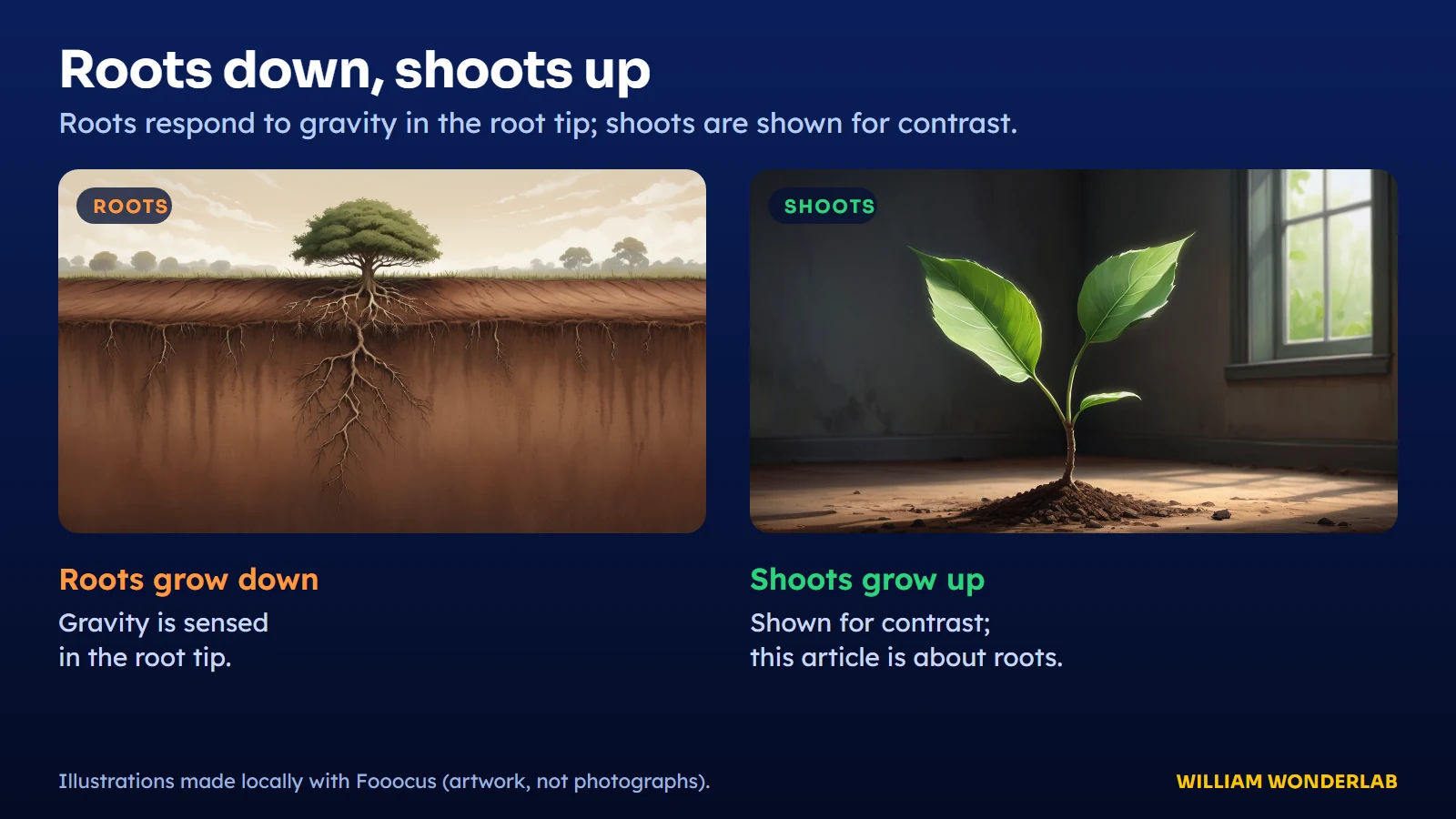
Gravity sensors in the root tip
Inside the tip of a root is a cap of cells that act as gravity sensors. A 2012 study of a small flowering plant, Arabidopsis thaliana, describes them: “In the primary root meristem of A. thaliana, cells in the central root cap (columella) act as statocytes.”[3] A statocyte is a cell that senses gravity.
Inside those cells are tiny packets of starch. Scientists call them amyloplasts when they are inside the cell, and statoliths when they act as the sensor. The 2015 Journal of Experimental Botany review describes them as “dense starch-filled amyloplasts or statoliths within columella cells sediment in the direction of gravity.”[2] In plain words, the starch grains are heavier than the rest of the cell, so they drop to the bottom.
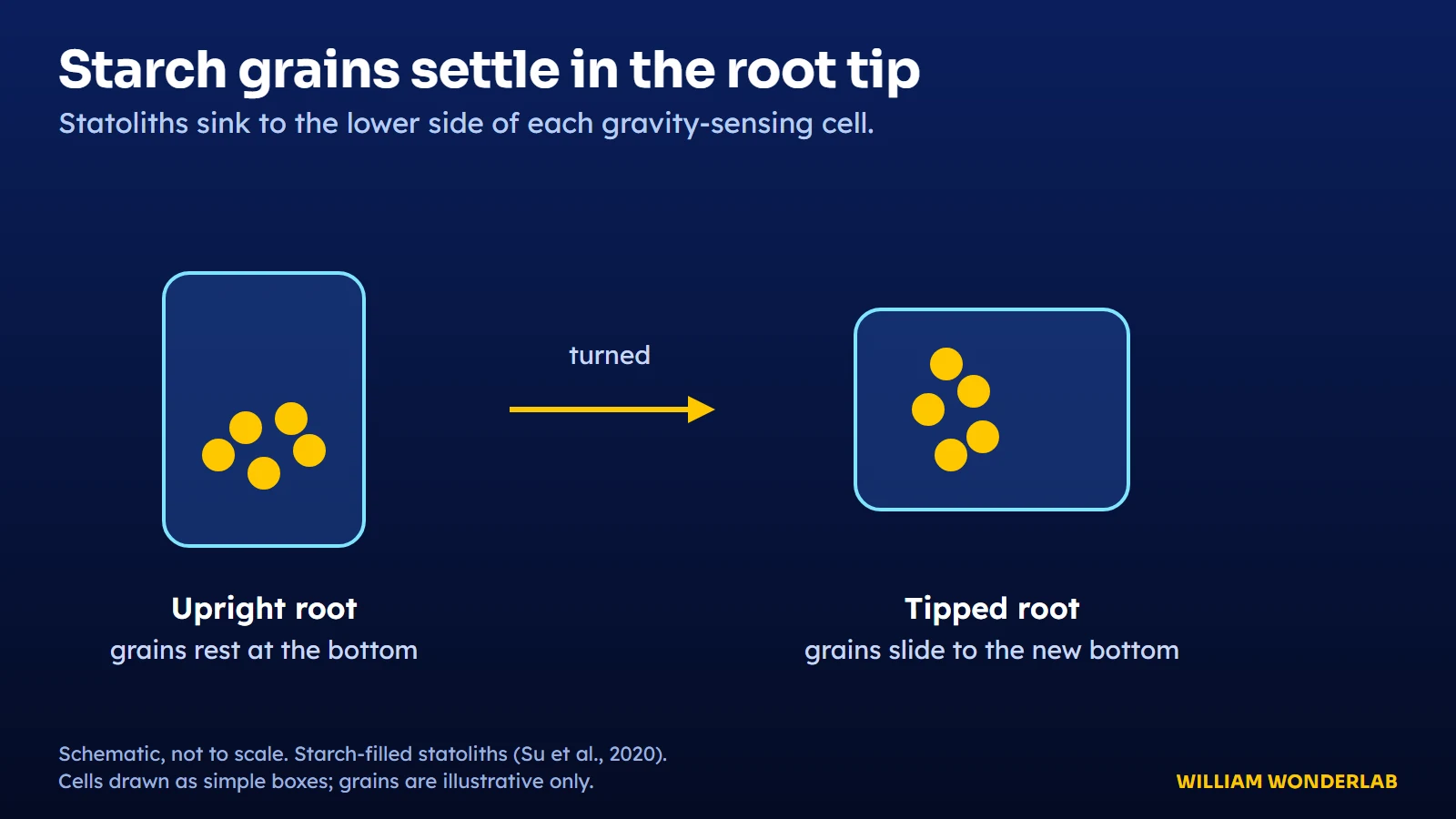
Sediment is material that settles downward. Here, the starch grains settle to the lower part of each cell, a little like sand sinking to the bottom of a jar of water.
From settling to a signal
Settling alone is not enough. The cell must turn the position of the grains into a message. The 2015 review says that “sedimentation of amyloplasts triggers a signal transduction cascade.”[2] A cascade means a chain of molecular steps, where each one passes the message on.
One key step involves PIN proteins, which act as auxin transporters. The 2020 review Gravity Signaling in Flowering Plant Roots explains that “PIN relocalization leads to the formation of a lateral gradient of auxin across the root cap.”[1] A gradient is a difference in amount from one side to the other. Here, more auxin ends up on one side than the other.
Scientists describe this as the Cholodny-Went theory. The 2005 review Gravity Signal Transduction in Primary Roots puts it simply: gravity “promotes the lateral transport of auxin across gravistimulated organs, with accumulation at the bottom.”[4]
Auxin makes the bend
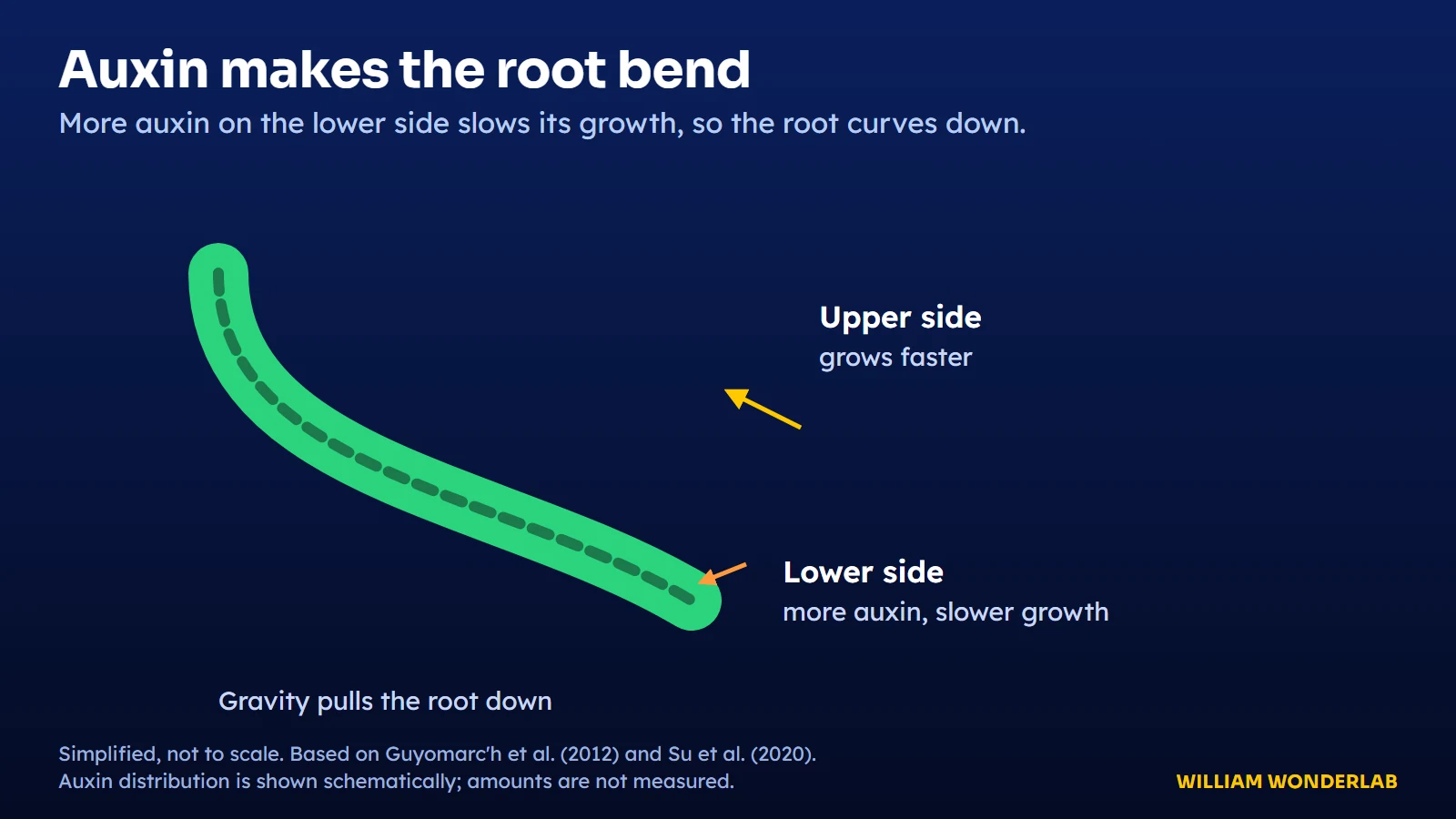
Auxin is a signal that controls how cells grow. The 2012 study describes the effect in roots: “More auxin is transported to the bottom side of the root.” It then adds that “Asymmetric auxin distribution in the epidermis leads to differential cell elongation and eventually to root bending.”[3]
Put simply, when one side of the root has more auxin, the cells on that side grow more slowly. The other side keeps growing, so the root curves towards the lower side.[3] The 2020 review describes the lower side in cell terms: auxin there causes “an increase in cell-wall rigidity and decreased rate of cellular elongation.”[1]
Did you know? A root can turn back towards the ground if it is knocked sideways. The starch grains slide to the new bottom of the cells, which tells the root to bend again.[1]
Try it: a bean in a jar
This is a proposed at-home activity, a simple way to watch roots respond to gravity. You do not need to do it to understand the article.
You need: a clean clear jar, a paper towel, a dry bean seed (such as a kidney or broad bean from the supermarket), tape, water and a sunny window.
- Dampen the paper towel. Slide it between the inside of the jar and the glass, then place the bean between the towel and the glass, near the top.
- Keep the paper damp, but not soaked, and stand the jar in a bright spot.
- Each day, look at the bean and the root. Mark the jar with a piece of tape to show which way is up when you start.
- After a few days, tip the jar on its side and mark the new position. Watch how the root changes direction over the following days.
- Write down what you notice. Which way does the root grow? Which way does the shoot grow?
Safety first: Do this with an adult. Use only a clean, clear, unbroken jar, and keep it away from the edge of the bench so it cannot be knocked over. Do not eat the bean or any sprouts. Wash your hands after touching seeds, soil or damp paper. Keep the jar away from electrical sockets and hot appliances. Do not use knives or other sharp tools.
Go deeper: the starch and the statolith model
The starch-statolith idea
The starch-statolith hypothesis is a leading explanation for gravity sensing in plants. The 2005 review describes it as holding that gravity perception depends on “the sedimentation or pressure/tension exerted by starch-filled plastids (statoliths).”[4]
Is settling always needed?
The same 2005 review notes that the settling may not be strictly required. Plants with very little starch still show some gravity response.[4] This is a reminder that the mechanism is still being studied, and that scientists are careful about calling any one explanation the whole story.
Frequently asked questions
Do roots have a sense of direction?
Roots do not think, but their tip cells sense gravity. Starch grains settle to the lower side of those cells and start a signal.[2]
What is auxin?
Auxin is a signal that controls how cells grow. In roots, more auxin on the lower side slows cell growth there, so the root bends down.[3]
Do roots need the starch grains to sense gravity?
Scientists think the settling of starch grains is important, but the 2005 review notes that some plants with little starch still respond to gravity.[4]
Does this work the same way for shoots?
This article focuses on roots and does not cover shoots.
The big idea
Roots follow the pull of gravity. Starch grains settle in the root tip, the signal moves auxin to the lower side, and the lower side grows more slowly. The root bends down into the soil.[1][2]
Related reading
More from William Wonderlab:
- How Do Plants Turn Sunlight Into Food?
- Why Do Leaves Change Colour?
- How Do Bees Find Their Way Home?
Explore more from scientists:
- Gravity Signaling in Flowering Plant Roots (Plants, 2020, via PubMed Central)
- New insights into root gravitropic signalling (Journal of Experimental Botany, 2015)
- Early development and gravitropic response of lateral roots in Arabidopsis thaliana (Philosophical Transactions B, 2012, via PubMed Central)
References
[1] Su, Keith and Masson, “Gravity Signaling in Flowering Plant Roots”, Plants 9(10):1290 (2020), via PubMed Central (accessed 25 October 2026)
[2] Sato, Hijazi, Bennett, Vissenberg and Swarup, “New insights into root gravitropic signalling”, Journal of Experimental Botany 66(8):2155-2165 (2015) (accessed 25 October 2026)
[3] Guyomarc’h, Léran, Auzon-Cape, Perrine-Walker, Lucas and Laplaze, “Early development and gravitropic response of lateral roots in Arabidopsis thaliana”, Philosophical Transactions of the Royal Society B 367(1595):1509-1516 (2012), via PubMed Central (accessed 25 October 2026)
[4] Perrin, Young, Narayana Murthy, Harrison, Wang, Will and Masson, “Gravity Signal Transduction in Primary Roots”, Annals of Botany 96(5):737-743 (2005), via PubMed Central (accessed 25 October 2026)