Why Does Cornflour Slime Act Like a Solid and a Liquid?
Cornflour slime pours gently, but it hardens when hit or squeezed hard. This is shear thickening, a behaviour called non-Newtonian.
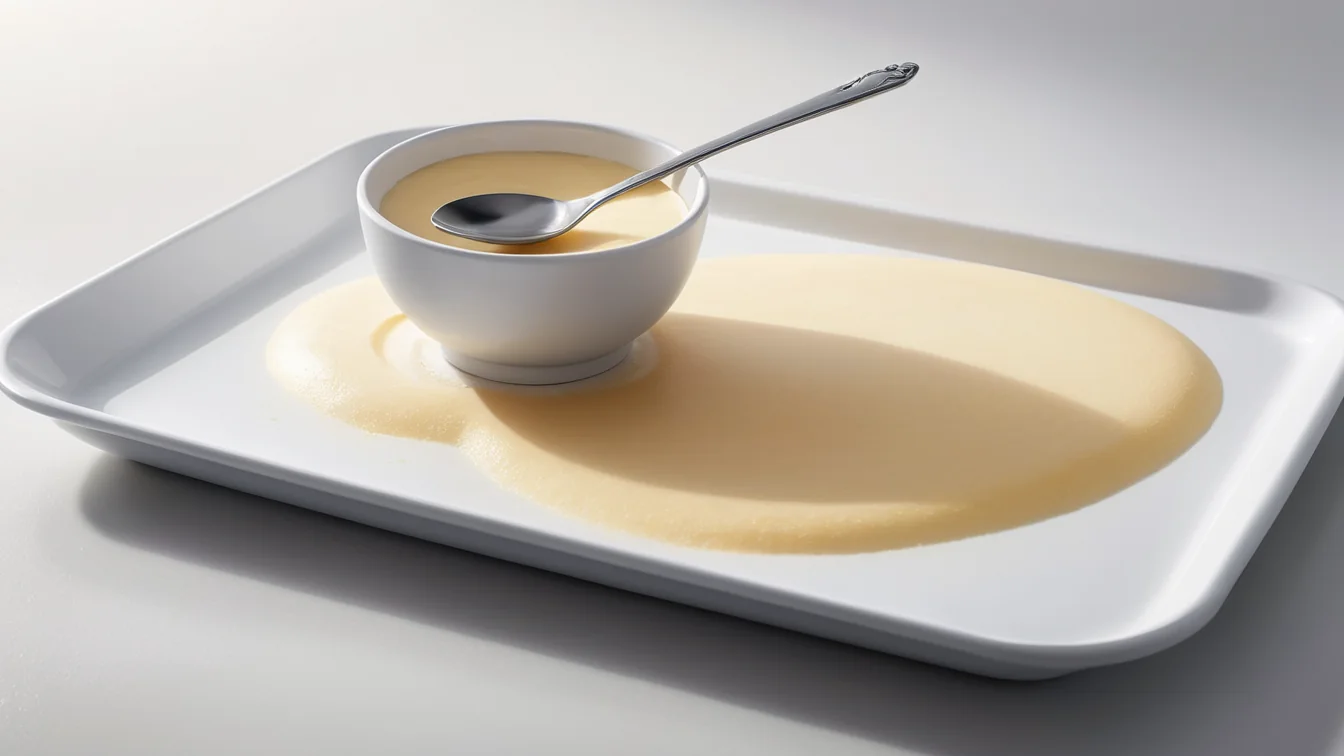
Dip your finger into a bowl of cornflour mixed with water and it feels runny. Press your finger in quickly and it feels firm. Hit the surface with a spoon and it can seem almost solid. Most liquids do not behave like this, so what is going on?
The short answer: Cornflour slime is a non-Newtonian mixture. It is shear thickening, which means that the harder you push or stir it, the thicker it gets. Under a gentle push it flows, but under a sudden force the tiny particles jam together, and it acts more like a solid.[1][2]
What “non-Newtonian” means
Most everyday liquids, such as water or milk, keep the same thickness whether you stir them gently or quickly. Scientists call these “Newtonian” liquids. A non-Newtonian fluid does not behave in that simple way. Its thickness, or resistance to flow, changes with how it is pushed.
Cornell University researchers describe cornstarch and water as “a ‘non-Newtonian’ fluid that doesn’t respond to outside forces the way you’d expect.”[1] The Cornell news story also explains the mixture in plain words: “The harder you stir it, the thicker it gets and the more it resists your stirring.”[1]
Physicists call this behaviour shear thickening. The force needed to make the mixture flow rises faster than the rate at which it is being pushed along.[3]
Gentle push, sudden push
The key is how fast the mixture is pushed. Pushed slowly, the mixture flows. Pushed quickly, it resists, and the research below explains the cause.[1]
A science museum describes this as “when a sudden large force is applied, the starch particles tangle, and the mixture hardens.”[2] Cornell researchers report one cause. They say that “the contact force dominates, so friction between particles is the primary mechanism for shear thickening.”[1]

Everyday examples
- Running on a pool of the mixture. Cornell notes that “on YouTube you can find videos of people running across pools filled with Oobleck.”[1]
- A thick mix that flows slowly. Stirring slowly, the mixture pours. This is the everyday feel of a liquid.
- Stirring hard. A spoon moved fast meets more resistance, which is why the mixture seems to fight back.[1]

Did you know? Cornell researchers describe friction between the particles as the primary mechanism for shear thickening.[1]
Try it: find the solid and liquid
You need: a clean bowl, dry cornflour (a small amount to start), a little water, a spoon, a flat tray or plate to work on, and an apron or old clothes.
- Predict whether the mixture will behave like a liquid or a solid when you stir it slowly, and when you hit it.
- Put a small amount of cornflour in the bowl. Add water a little at a time, stirring as you go, until the mixture is thick but still runs off a spoon when lifted slowly.
- Stir it slowly with your spoon, then lift the spoon quickly and see what happens.
- Press a finger into the surface gently, then press quickly. Write down the difference.
- Tip the mixture into a bin bag once you have finished. Wipe the tray with a damp cloth.
What to expect: the mixture should flow when stirred slowly and feel firm under a quick push, which matches the research described above.
Safety first: Pour the cornflour slowly to avoid a cloud of dust, and do not breathe it in or put it near your face. Keep all cornflour and mixture out of your mouth, and do not taste it. Work on a tray and wipe up any spills at once so no one slips. Do not pour the mixture down a sink, drain or toilet, because it can block pipes. Once it has dried out, scrape it into the bin or sweep it up. Wash your hands afterwards. Younger scientists should do this with an adult, and an apron or old clothes will help keep the mess under control.
Go deeper: particles, friction and jamming
A simple model
A mixture like this is made of particles suspended in a liquid. When the particles are pushed quickly, they press against each other and rub together. Cornell’s researchers report that this contact friction is the main reason the mixture thickens.[1]
Two explanations
The Science Museum Group describes the particles “tangling” under a sudden force.[2] Cornell describes friction between the particles as the primary mechanism.[1] Scientists still discuss the details, though. A NIST and Georgetown team describes an ongoing debate between two models. In one, liquid is squeezed out from between the particles, leaving a thinner lubricating layer as the stress increases. In the other, particle collisions and friction are the main driver.[4] Both models describe the same overall result: a mixture that flows gently and resists sudden force.
Frequently asked questions
Why does cornflour slime feel like a solid when I hit it?
A sudden force makes the particles jam together, and the mixture resists flowing. Cornell’s research points to friction between the particles as the main cause, although researchers still debate the details.[1][4]
Is cornflour slime a liquid or a solid?
It behaves like both. It flows when pushed slowly and resists when pushed quickly, which is why it is called non-Newtonian.[1]
Why does the mixture get thicker when I stir it harder?
Cornell describes it simply: “the harder you stir it, the thicker it gets and the more it resists your stirring.”[1]
Can you run on cornflour slime?
Videos show people running across pools of the mixture.[1]
The big idea
Shear thickening. Cornflour slime flows when pushed gently. A sudden push makes its particles jam, so it acts like a solid for a moment.
Related reading
More from William Wonderlab:
Explore more from scientists:
- Cornell University, “The secret of Oobleck revealed at last”
- Science Museum Group, “Oozing oobleck” (learning resource)
- Georgetown University, “A Crack in the Mystery of ‘Oobleck'” (NIST and Georgetown research)
References
[1] Cornell University, College of Arts and Sciences, “The secret of Oobleck revealed at last” (accessed 25 October 2026)
[2] Science Museum Group, “Oozing oobleck” (learning resource) (accessed 25 October 2026)
[3] Eric Brown and Heinrich M. Jaeger, “Shear thickening in concentrated suspensions: phenomenology, mechanisms, and relations to jamming”, arXiv:1307.0269 (accessed 25 October 2026)
[4] Georgetown University news, “A Crack in the Mystery of ‘Oobleck'” (research by NIST and Georgetown University) (accessed 25 October 2026)