How Do Rockets Work in Space?
Rockets do not push against air. They throw gas out of their back, and the reaction pushes the rocket forward, even in a vacuum.

Imagine standing on a skateboard and throwing a heavy bag backwards. You roll forwards. A rocket works in a similar way, except it throws out a stream of gas instead of a bag. Out in space there is no air, so there is nothing for that gas to push against. Yet rockets fly, and they fly very well. The reason comes from one famous rule that Isaac Newton described more than 300 years ago.
The short answer: A rocket moves forward by throwing gas out of its back. Newton’s third law says every action has an equal and opposite reaction, so the gas pushing backwards pushes the rocket forwards. The rocket does not need air to push against, because it pushes against its own exhaust.[1][3][4]
The big misunderstanding
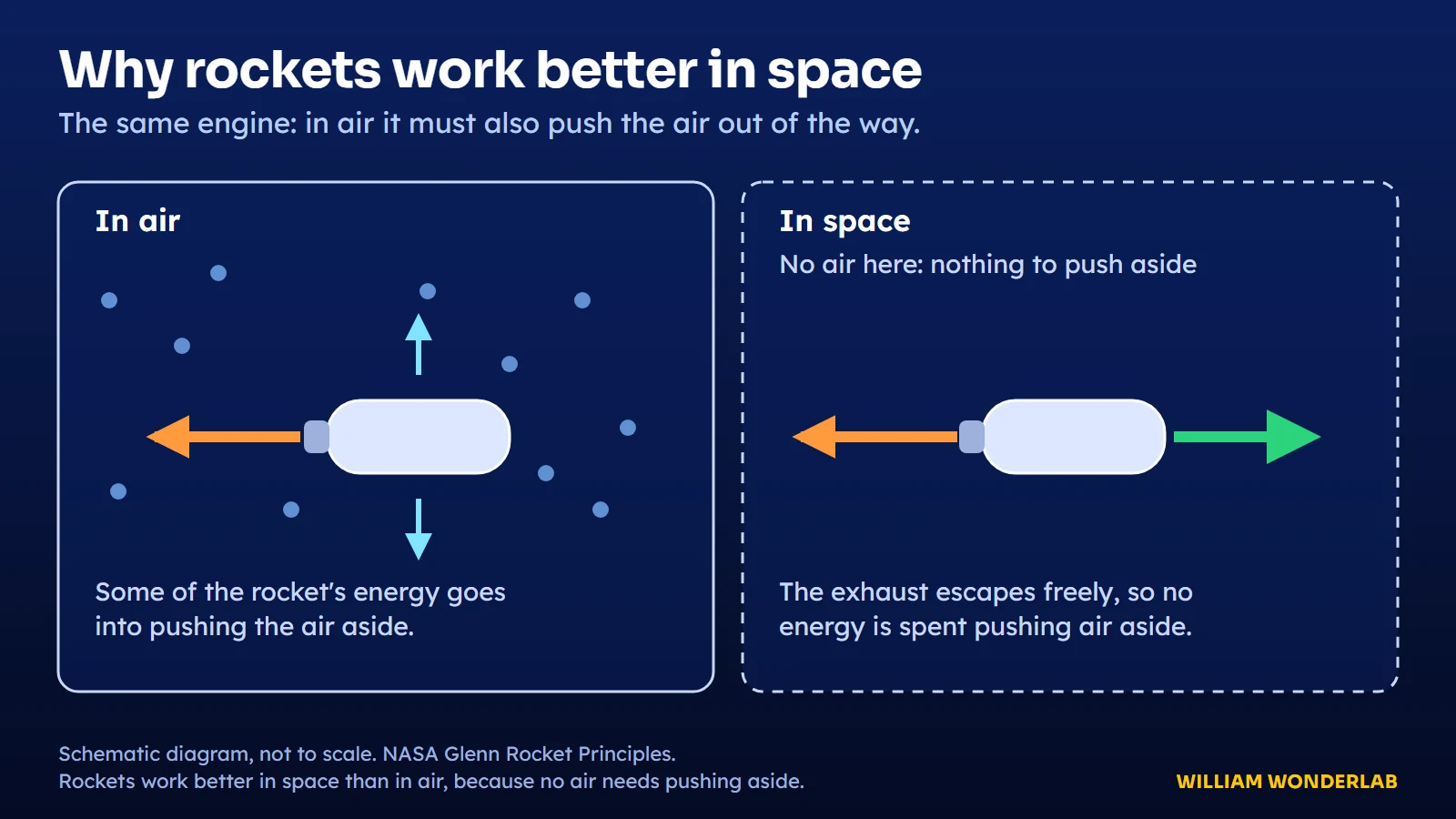
Many people think a rocket pushes against the air behind it. The idea sounds sensible, but it is wrong. NASA’s Rocket Principles page asks how rockets “can work in space where there is no air for them to push against.”[1]
NASA’s answer is that rockets “actually work better in space than they do in air.”[1] In the air, a rocket “must push away the surrounding air”, and that “uses up some of the energy of the rocket.”[1] Out in space the exhaust gases can escape freely, so none of the rocket’s energy is spent on pushing air aside.
Action and reaction
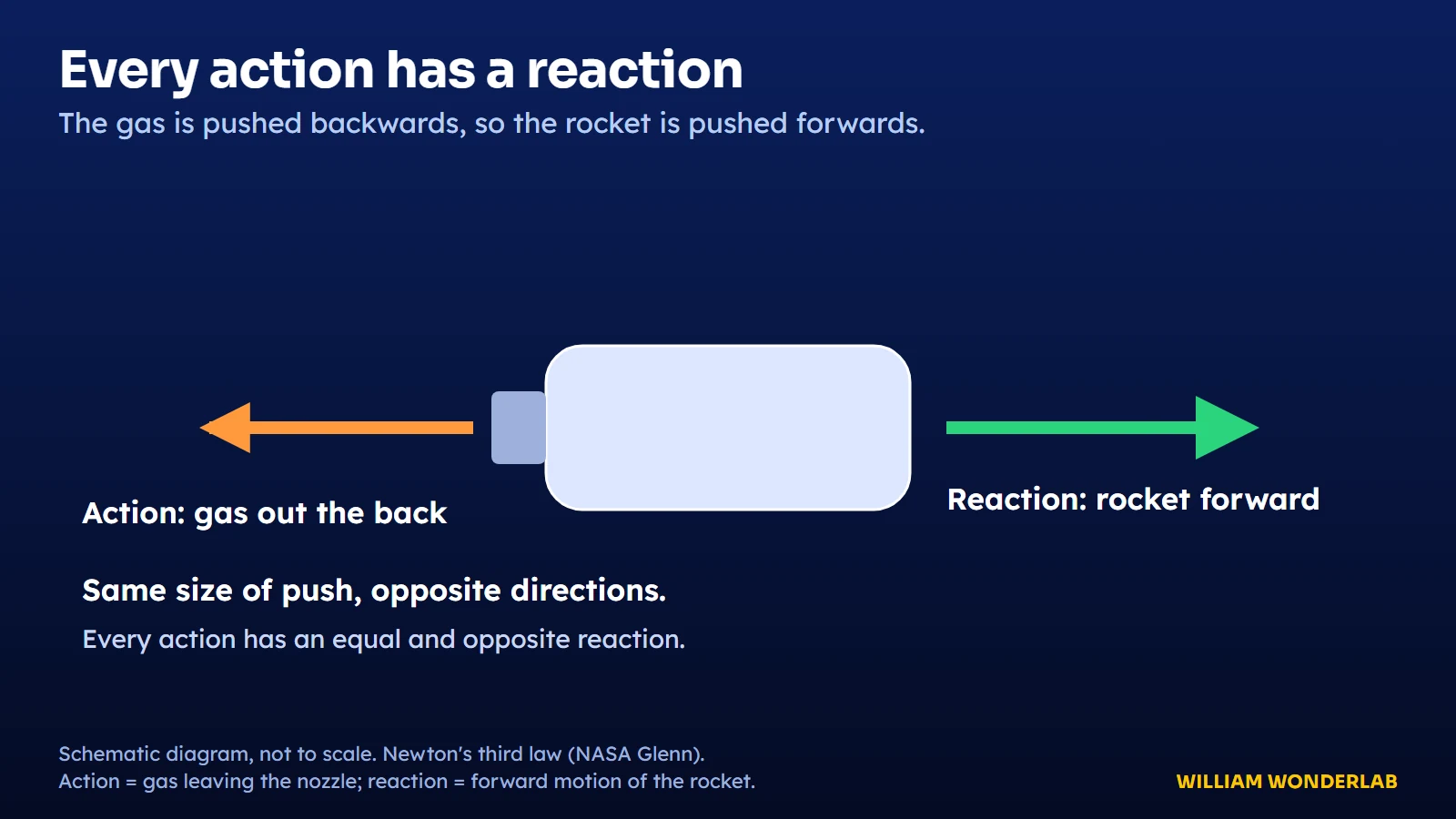
Isaac Newton’s third law is often written as “for every action there is an equal and opposite reaction.”[1] NASA Science puts it in rocket terms: “a rocket creates thrust by expelling mass to take advantage of Sir Isaac Newton’s third law.”[3]
Thrust is the forward push that the engine gives the rocket. The action is the gas leaving the engine through the nozzle, which is the narrow opening at the back. The reaction is the rocket moving the other way.
NASA Glenn’s water-rocket lesson describes the same pairing. It says the “action” is “the movement of air out of the nozzle,” and the “reaction” is “the forward motion of the bottle.”[2] The same lesson calls this law “the essence of jet and rocket propulsion.”[2]
The rocket carries its own oxygen
Fuel needs something to burn with. On Earth, that is the oxygen in the air. A rocket cannot count on finding air in space, so it carries its own oxidiser, a substance that supplies the oxygen for burning. NASA Science says a rocket “carries its own oxidizer and can operate outside the atmosphere.”[3]
This is the main reason rockets can keep working where aeroplanes and jet engines cannot. A jet engine takes in air from outside. A rocket brings everything it needs with it.
Momentum: the rule behind the push
Momentum is the amount of motion something has. You find it by multiplying an object’s mass by its velocity, which is how fast it moves and in which direction. Momentum is shared out in a collision or a throw, and the total stays the same unless something from outside acts on the system.
HyperPhysics, a physics resource from Georgia State University, applies this to rockets. Rocket thrust “results from the high speed ejection of material and does not require any medium to ‘push against’.”[4] When material is thrown backwards, the rest of the rocket gains forward momentum, because an isolated system cannot change its total momentum.[4]
Try it: the balloon rocket on a string
NASA Glenn’s balloon pinwheel activity explains the same idea. Squeezing the air inside a balloon makes it rush out through a straw, and that escaping air produces the reaction that spins the pinwheel.[5] The activity below is a proposed at-home version using a straw and string. It is an idea to try, not a record of an experiment that has been done.
You need: a balloon, a drinking straw, about 3 metres of thin string, sticky tape, and two fixed points such as chair backs about 3 metres apart.
- Thread the string through the straw and tie each end to a fixed point, so the string is pulled tight.
- An adult inflates the balloon, pinches the neck closed, and tapes the balloon to the straw with the neck pointing towards one end.
- Predict which way the straw will move when the neck is released.
- Let go of the neck and watch carefully. Repeat once and compare.
What to expect: The straw should slide along the string in the direction away from the open neck. The escaping air is the action, and the straw’s movement is the reaction. Your results may differ depending on the balloon and the tightness of the string.
Safety first: An adult should inflate and tie the balloon. Balloons can be a choking hazard for young children, so keep balloons and any broken pieces away from small children, and never put a balloon or a piece of balloon in your mouth. Never burst a balloon near anyone’s face. Keep string away from necks, and do not pull the string hard or let it snap back. Clear the area of other people before you let go.
Go deeper: the momentum sum
A hypothetical example
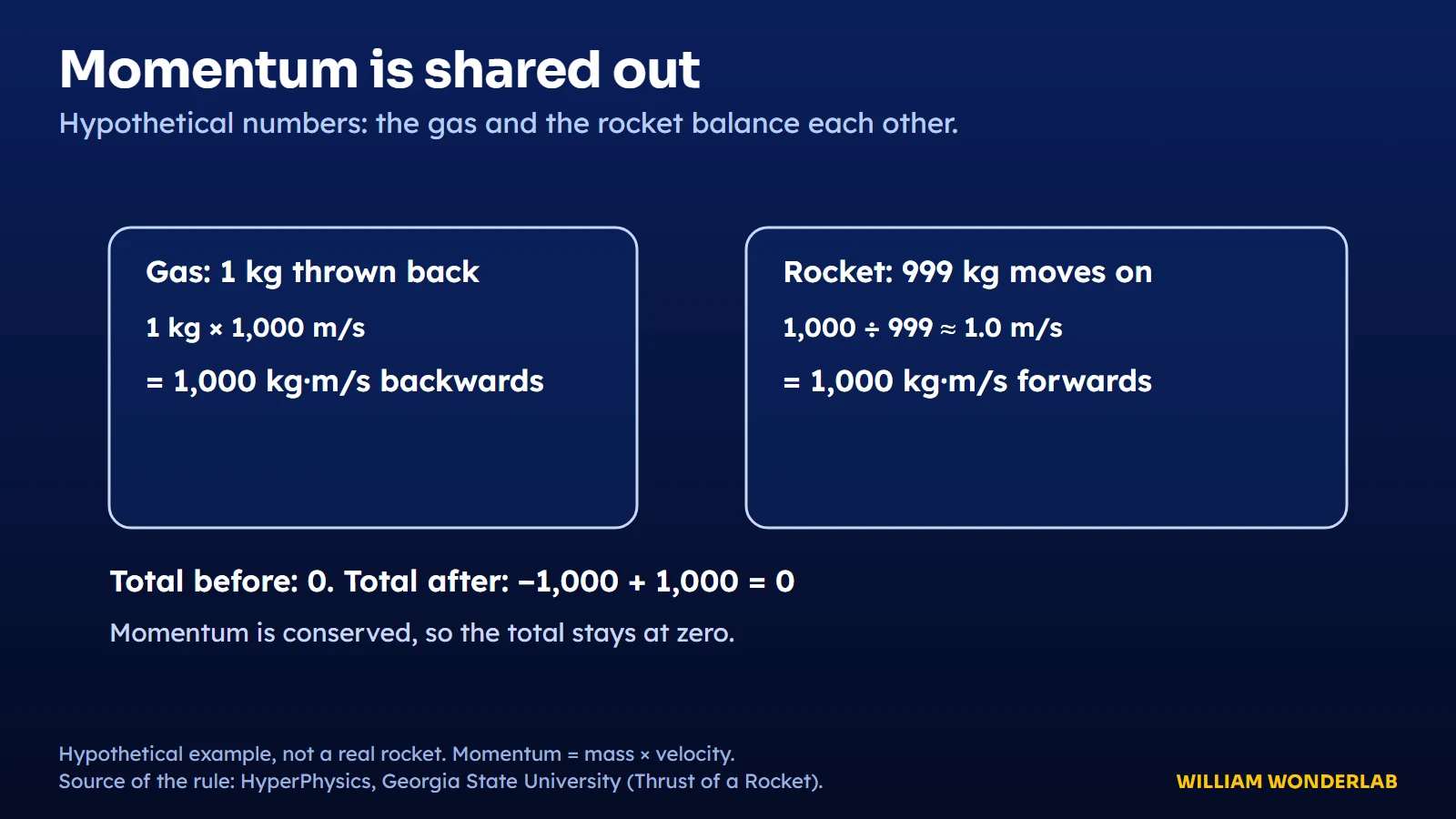
This example uses made-up numbers to show the arithmetic. It does not describe a real rocket. Imagine a rocket and fuel with a total mass of 1,000 kg, which throws 1 kg of gas backwards at 1,000 m/s.
- Before the throw, the total momentum is zero.
- The gas has momentum of 1 kg × 1,000 m/s = 1,000 kg·m/s, backwards.
- The remaining 999 kg must therefore gain 1,000 kg·m/s forwards. Its speed is 1,000 ÷ 999, or about 1.0 m/s, forwards.
- Check: the forward momentum is 999 kg × 1.0 m/s, which is about 1,000 kg·m/s. The total is +1,000 − 1,000 = 0, so momentum is conserved.
The same arithmetic shows why engineers care about exhaust speed. In this example, the rocket gets its push from how fast the gas leaves. The faster the gas, the bigger the forward gain for the same mass thrown out.
Frequently asked questions
Can a rocket work in a vacuum?
Yes. Rocket thrust does not need any medium to push against.[4] A rocket pushes its exhaust backwards, and the reaction moves the rocket forwards.[3]
Does a rocket push on the air behind it?
No. NASA’s Rocket Principles page says rockets “actually work better in space than they do in air.”[1]
What is Newton’s third law?
It says every action has an equal and opposite reaction.[1] For a rocket, the action is the exhaust leaving the engine, and the reaction is the rocket moving forwards.[2]
Why do rockets carry their own oxidiser?
Because there is no air to supply oxygen in space. NASA Science says a rocket “carries its own oxidizer and can operate outside the atmosphere.”[3]
Is the push the same in every rocket?
No. The push depends on how much gas is thrown out and how fast it leaves. The hypothetical example above shows that a faster exhaust gives a bigger gain in forward momentum for the same mass.[4]
The big idea
Throw the exhaust backwards, and the rocket goes forwards. A rocket does not need air to push against. It throws gas out of its engine, and Newton’s third law pushes the rocket the other way.
Related reading
More from William Wonderlab:
Explore more from scientists:
References
[1] NASA Glenn Research Center, “Rocket Principles” (accessed 25 October 2026)
[2] NASA Glenn Research Center, “Water Rocketry: Start your journey, laws of motion” (accessed 25 October 2026)
[3] NASA Science, “Chapter 3: Gravity & Mechanics” (accessed 25 October 2026)
[4] HyperPhysics, Georgia State University, “Thrust of a Rocket” (accessed 25 October 2026)
[5] NASA Glenn Research Center, “Rocket Pinwheel” (accessed 25 October 2026)