Why Do We Get Static Electricity Shocks?
A static shock is extra electrons jumping from your body to something that has fewer. Here is how the charge builds up, why winter makes it worse, and what the zap really is.

You walk across a carpet, reach for a door handle and – zap! A tiny jolt makes you jump. It happens most on cold, dry days, and it can feel as if the door has bitten you. What is actually going on? The short version is that you have been collecting electrons, and they have decided to leave.
The short answer: Rubbing or touching two different materials can move electrons from one to the other. If you end up with extra electrons, and then touch something with fewer, those electrons rush across in a quick zap. Dry air makes it worse, because moisture would normally let the extra charge leak away slowly.[1][2]
Electrons are the moving part
Every atom has tiny particles called electrons, which carry negative charge. Normally an object has the same number of electrons and positive charge, so it is neutral and shows no static. When an object gains extra electrons, it becomes negatively charged. When it loses some, it becomes positively charged.
Charge changes hands when materials touch. Northwestern University’s triboelectricity research page describes this as “the transfer of charge between two rubbing or contacting materials.”[3] It also notes that charge transfers “when two objects of different materials or different shapes come into simple contact.”[3]
Rubbing gives electrons a ride
The classic example is a balloon rubbed on hair. The University of California, Santa Barbara, puts it this way: “when we rub the balloon against our hair, we transfer negative charge to the balloon in the form of electrons.”[4] The balloon ends up negative, and the hair ends up positive.
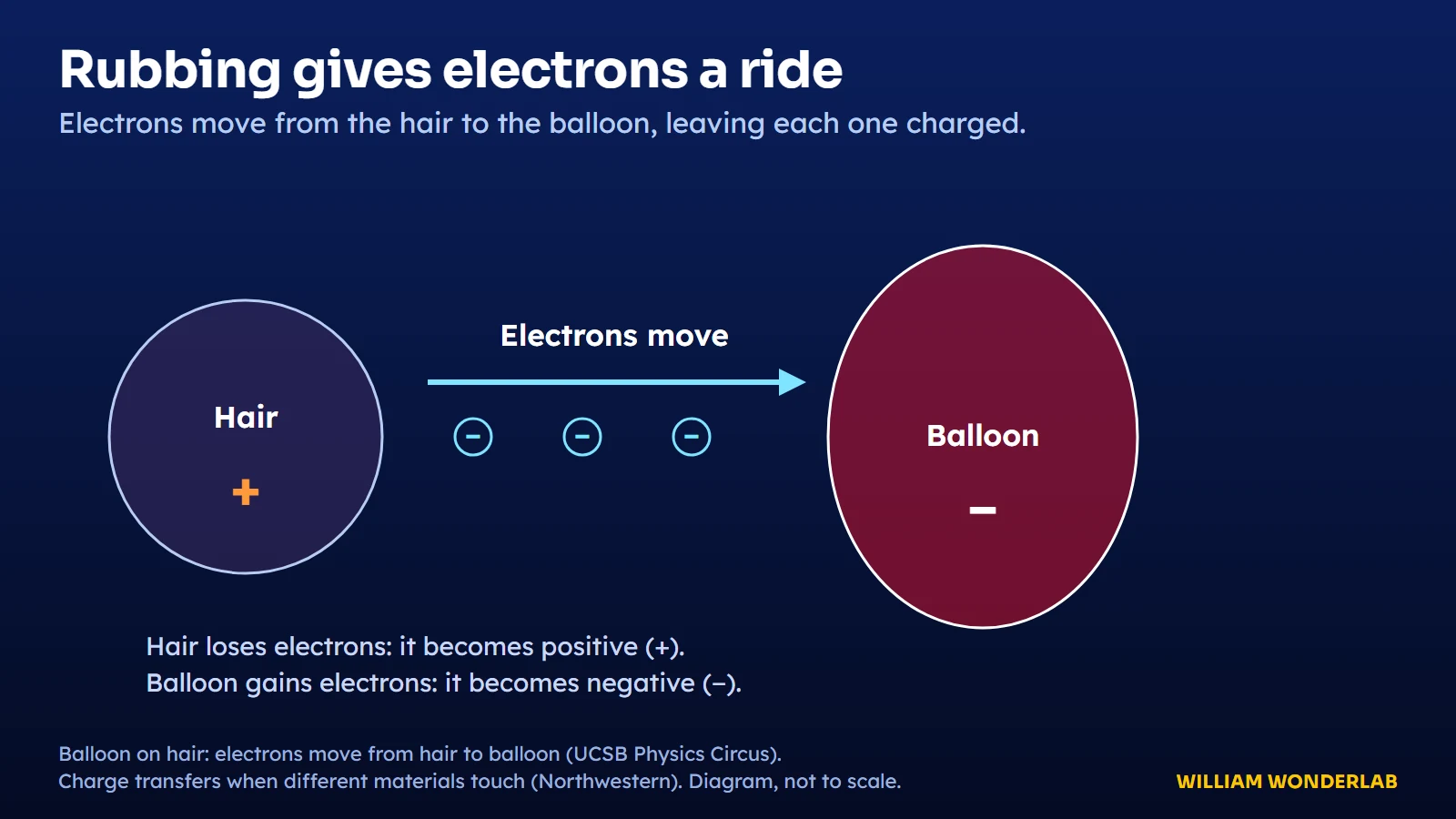
The diagram shows the direction of the movement. The hair loses electrons and is left positive, while the balloon gains them and becomes negative.
Why the charge stays on you in winter
Once you have picked up extra electrons, they would normally drain away. Moist air helps them go. UMBC’s explanation is simple: “Moisture in the air allows electrons to flow more freely and return to their original surface without shocking anyone.”[1]
In dry air, the electrons get stuck. The UMBC physicists describe electrons getting “trapped on the surface,” so they “can’t find their way to flow back to the surface where they came from.”[1] That is why static builds up most on cold, dry days.
Northeastern University’s tips article, quoting Dimitrova, gives the same reason: “In winter or dry climates, however, the air contains less moisture.”[2] With fewer water molecules to help the charge spread out, it piles up on your body.[2]
The zap
Think of your charged finger as a store of extra electrons. When it gets close to something metal and uncharged, the electrons move to it. UMBC describes the moment: “The zap we feel is the electrons moving from one surface to the other.”[1] Then “the electrons flow quickly onto the uncharged object, creating the classic static electricity zap.”[1]

The gap is very small. Electrons jump across it as a spark, which is the sudden movement you feel in your finger.
What a spark is
Air is normally a poor conductor. When the electrical push is strong enough, it can break the air down. Georgia Tech’s physics text explains that “a strong electric field ionizes molecules of a normally neutral substance such as air.”[5] The spark appears when the molecules release energy as light. The text says that “Sparks produce light because when molecules recombine, they move to a lower energy state and emit the difference in energy as a photon.”[5]
Did you know? Lightning is the same kind of event, on a far bigger scale. NOAA’s education pages describe lightning as “a giant spark of electricity in the atmosphere between clouds, the air, or the ground.”[6] The light we see is produced by the air around the spark.
You can read more about lightning in the article Why Does Lightning Come Before Thunder?. For the static shock, the principle is the same: charge builds up, then crosses a gap when the air can no longer hold it back.
Try it: a balloon that picks up paper
This is a proposed at-home activity. It is not something that was done for this article.
You need: a balloon, a dry day, a woollen jumper or your dry hair, and a few small pieces of paper torn into bits.
- Predict what will happen when you rub the balloon on your jumper, then bring it near the paper.
- Rub the balloon on the jumper or your hair for about 20 seconds.
- Hold the balloon a few centimetres above the paper pieces without touching them.
- Watch what the paper does. Does it jump toward the balloon? Try again on a humid day if you can and compare.
What to expect: the paper bits may lift toward the balloon for a moment, because the balloon now has extra electrons and the paper is neutral.
Safety first: Balloons can burst, and broken pieces are a choking hazard for children under eight, so keep them well away from small children and pets. Do the activity away from power points, cords and light fittings. Do not rub the balloon near hair you are styling with heat or near any flame. Keep the paper pieces out of mouths.
Go deeper: moisture, charge and grounding
Why humidity changes the story
Water molecules in the air let charge spread out and drain slowly. In dry air there are fewer of these molecules, so the charge stays on the surface.[2] Adding a humidifier is one way to change this at home. Northeastern’s advice is that “adding humidifiers to your environment will add water molecules to the air.”[2]
Discharging before you touch
Northeastern’s advice is to “discharge yourself often by touching metal objects to avoid a big, painful shock.”[2] Touch a metal object slowly, with a finger, before you reach for a handle.
Frequently asked questions
Does static come from the carpet?
Walking on carpet is one everyday case. Two different materials that touch can move electrons from one to the other.[3]
Why does static shock happen in winter?
Cold air holds less moisture, so the extra electrons cannot drift away as easily. Dry air lets the charge build up on your body.[1][2]
Is a static shock dangerous?
Everyday static zaps are brief and small. Lightning is a far larger spark, so stay indoors during storms.[6]
Why do I feel the zap but not see it?
The gap is very small and the movement is quick. A spark is produced when the air’s molecules give off light as they release energy.[5]
Can I stop static shocks completely?
You can reduce them. Keeping the air a bit more humid and discharging through metal before you touch a handle both help.[2]
The big idea
Static is stored electrons. Rubbing or touching moves electrons between materials. Dry air stops them leaking away, so they stay on you until they find a metal route, and then the zap is those electrons crossing a gap.
Related reading
More from William Wonderlab:
Explore more from scientists:
- Physicists explain winter’s extra helping of static electricity (UMBC)
- Triboelectricity (Northwestern University)
- Lightning, Svrwx101 (NOAA National Severe Storms Laboratory)
References
[1] University of Maryland, Baltimore County (UMBC), “Physicists Deffner and Ibrahim explain winter’s extra helping of static electricity” (accessed 25 October 2026)
[2] Northeastern University, News, “10 tips to get rid of static this winter” (accessed 25 October 2026)
[3] Northwestern University, “Triboelectricity” research page (accessed 25 October 2026)
[4] University of California, Santa Barbara, Physics Circus, “Balloons and static electricity” (accessed 25 October 2026)
[5] Georgia Institute of Technology, Physics Book, “Sparks in Air” (accessed 25 October 2026)
[6] NOAA National Severe Storms Laboratory, “Lightning” (SVRWX101 education pages) (accessed 25 October 2026)