Why Does the Moon Change Shape?
The Moon does not really change shape. The Sun always lights half of it, and the phases happen because we see different amounts of that lit half as the Moon orbits Earth.
Look up on a few nights in a row and the Moon seems to change shape. One night it is a thin curve, a week later it is a bright round disc, and then it shrinks back again. Is the Moon growing and shrinking like a balloon?
The short answer: The Moon does not change shape. The Sun always lights up half of it. The phases happen because the Moon travels around Earth, so we see different amounts of that lit half from one night to the next.[1][2]
The Moon is always half lit
Think of a ball in a dark room with a torch shining on it. Half the ball is always bright and half is always in shadow. If you walk around the ball, the bright part you can see changes, even though the ball itself has not changed at all.
NASA says the same about the Moon: “The Sun always illuminates half of the Moon while the other half remains dark,” but “how much we are able to see of that illuminated half changes as the Moon travels through its orbit.”[1]
NASA’s Space Place puts it even more simply: “The shape of the Moon isn’t changing throughout the month. However, our view of the Moon does change.”[2] The lit side is the one facing the Sun, and the dark side faces away from it. NASA’s StarChild page describes it this way: “the Moon always has a lit side (facing the Sun) and a dark side (facing away from the Sun).”[3]
The Moon’s phases are about where it is in its orbit, not about the Moon’s shape. (If the Moon looks huge when it rises above the horizon, that is a different effect. See Why Does the Moon Look Bigger Near the Horizon?)
Our view changes as the Moon orbits
The Moon orbits Earth, and Earth orbits the Sun. As the Moon moves round Earth, the angle between the Sun, Earth and the Moon keeps changing. The diagram below shows the main positions. The Sun is drawn on the left, far away, so its light comes from the left.
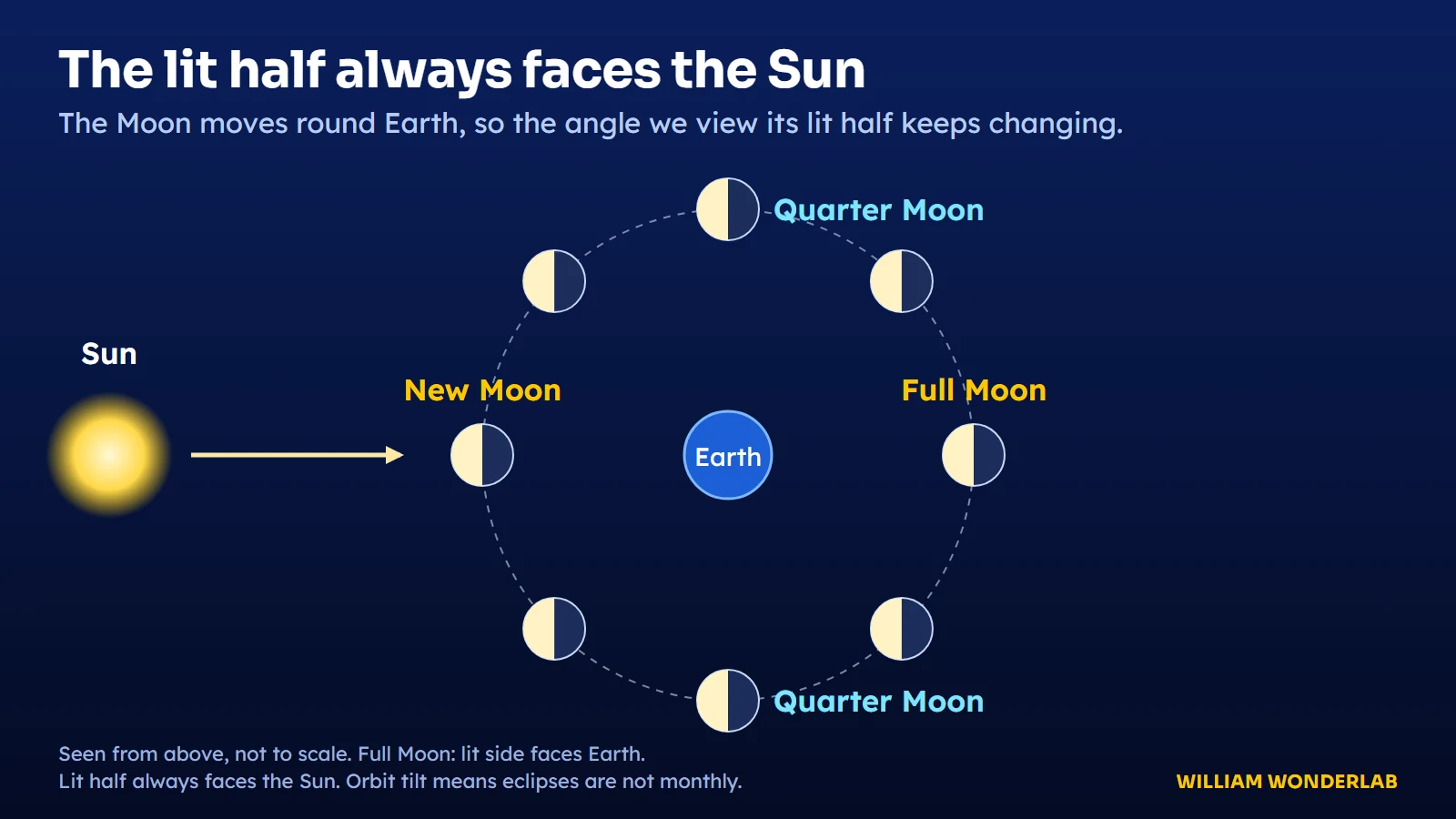
New Moon. The Moon sits between Earth and the Sun. NASA describes “the illuminated side of the Moon facing the Sun and the night side facing Earth.”[1] We see only the dark side, so the Moon is hard to spot. NASA adds that the Moon “doesn’t usually pass directly between Earth and the Sun, due to the inclination of the Moon’s orbit.”[1] Because its orbit is tilted, the Moon usually passes just above or below the Sun.
Full Moon. The Moon is on the far side of Earth from the Sun. NASA says “The Moon is opposite the Sun, as viewed from Earth, revealing the Moon’s dayside.”[1] We see the whole lit face, so the Moon looks like a full disc.
Quarter Moons. About a quarter of the way through its monthly journey, the Moon shows a half disc. NASA puts it this way: “You’re seeing just a slice of the entire Moon ― half of the illuminated half.”[1]
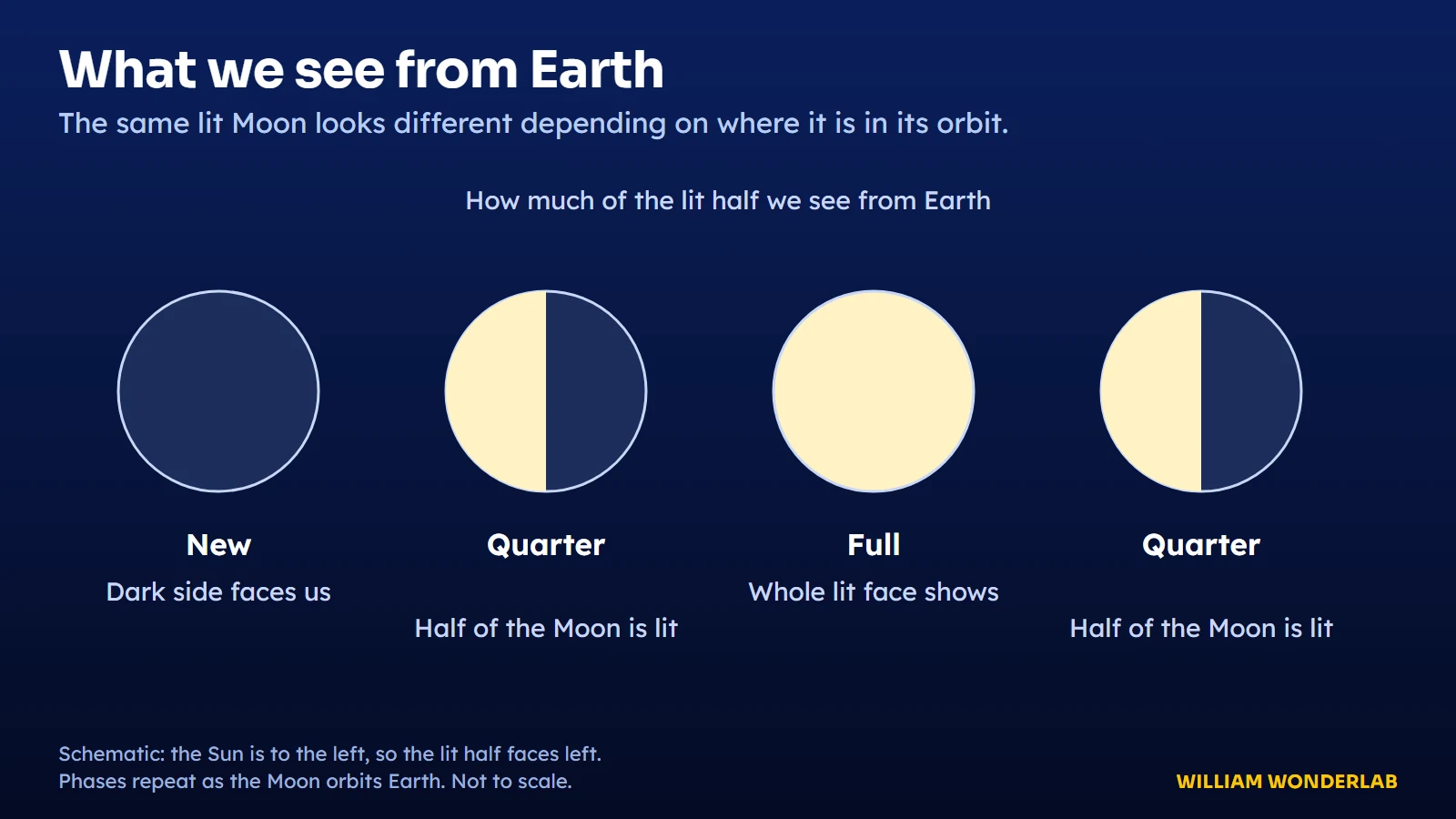
Between these main positions, the view changes a little every night. NASA’s Space Place describes this as “our view of the illuminated part of the Moon changes each night.”[2]
Why the Moon looks upside down in the Southern Hemisphere
If you have seen Moon pictures from the Northern Hemisphere, you might notice that the Moon looks different when you are in Australia. The Royal Astronomical Society of New Zealand puts it simply: “The Moon looks different in the Southern Hemisphere than it does in the Northern Hemisphere.”[4]
The reason is the viewing angle. EarthSky explains that “From Earth’s Northern Hemisphere, the moon’s north pole appears at the top,” while “From Earth’s Southern Hemisphere, the moon’s south pole appears at the top.”[5] Observers in the two hemispheres stand on opposite sides of Earth, so their view of the sky is turned round. The Moon has not flipped. Two people looking at the same map from opposite sides of a table will each see it the right way up, yet it looks upside down to the other person. The Moon’s phases are still the same in both hemispheres: “Everyone looking up at the moon from any spot on the globe sees the same moon, in more or less the same phase.”[5]
Try it: a torch and a ball
Proposed at-home activity. You are the Earth, and a small ball is the Moon.
You need: a dark room, an LED torch, a ball about the size of a tennis ball, and a helper to hold the torch.
- Ask your helper to hold the torch still on one side of the room, at about head height. This is the Sun.
- Stand in the middle of the room, facing the torch, and hold the ball at arm’s length between you and the torch. Notice that the side of the ball facing you is dark. That matches the New Moon.
- Keep your position still and turn the ball slowly so that it is on the far side of you from the torch. Now the lit side faces you. That matches the Full Moon.
- Move the ball to your left or right, so it sits at a right angle to the torch. Notice that half of the lit side faces you.
What to expect: the part of the ball you can see lit up changes as you move it, but the ball itself stays the same shape.
Safety first: Use an LED torch that stays cool. Do not shine the torch into anyone’s eyes, including your own, and never point it at the eyes of someone who is standing close by. Keep the floor clear so no one trips over a chair or cable. Switch the torch off when you finish.
Go deeper: why the Moon is not a shadow
Earth’s shadow is not the cause
It is a common idea that the phases happen when Earth’s shadow falls on the Moon. This is not the case. Earth’s shadow reaches the Moon only during a lunar eclipse, when Earth sits directly between the Sun and the Moon.[6] The phases you see every month come from the angle at which we view the lit half of the Moon.
Why we see the phases in order
As the Moon completes its orbit, it moves through the positions in the diagram, one after another. Our view of the lit half therefore changes steadily, from a thin sliver to a full disc and back again. This is why the phases repeat in the same order each time.
Frequently asked questions
Does the Moon really change shape?
No. NASA says “The shape of the Moon isn’t changing throughout the month.”[2] What changes is how much of its lit half we can see.
Is the Earth’s shadow the reason for the phases?
No. Earth’s shadow only falls on the Moon during a lunar eclipse. The phases come from the angle at which we see the lit half.[6]
Why is the Moon dark at New Moon?
At New Moon the Moon sits between Earth and the Sun. Its lit side faces the Sun, away from us, so we see the dark side.[1]
Why does the Moon look upside down in Australia?
Observers in the Southern Hemisphere are on the other side of Earth, so the sky looks turned around to them. The Moon looks different from the Southern Hemisphere, and its south pole appears at the top for southern observers.[4][5]
The big idea
The Moon’s shape never changes; our view does. Half of the Moon is always lit by the Sun. As the Moon orbits Earth, we see more or less of that lit half, which creates the phases.
Related reading
More from William Wonderlab:
Explore more from scientists:
References
[1] NASA Science, “Moon phases” (accessed 25 October 2026)
[2] NASA Space Place, “Moon phases” (accessed 25 October 2026)
[3] NASA StarChild, “Moon phases” (accessed 25 October 2026)
[4] Royal Astronomical Society of New Zealand, “Lunar Phases” (accessed 25 October 2026)
[5] EarthSky, “Do we all see the same Moon phase?” (accessed 25 October 2026)
[6] NASA Space Place, “Eclipses” (accessed 25 October 2026)
Keep exploring
Now try the science yourself
Reading is a great start. Experimenting is even better: these interactive models use the same science as this article.