Why Do Birds Sing at Dawn?
Many songbirds sing hardest just before sunrise. Scientists think the dawn chorus helps birds defend territory and find mates, and one popular idea was tested and not supported.
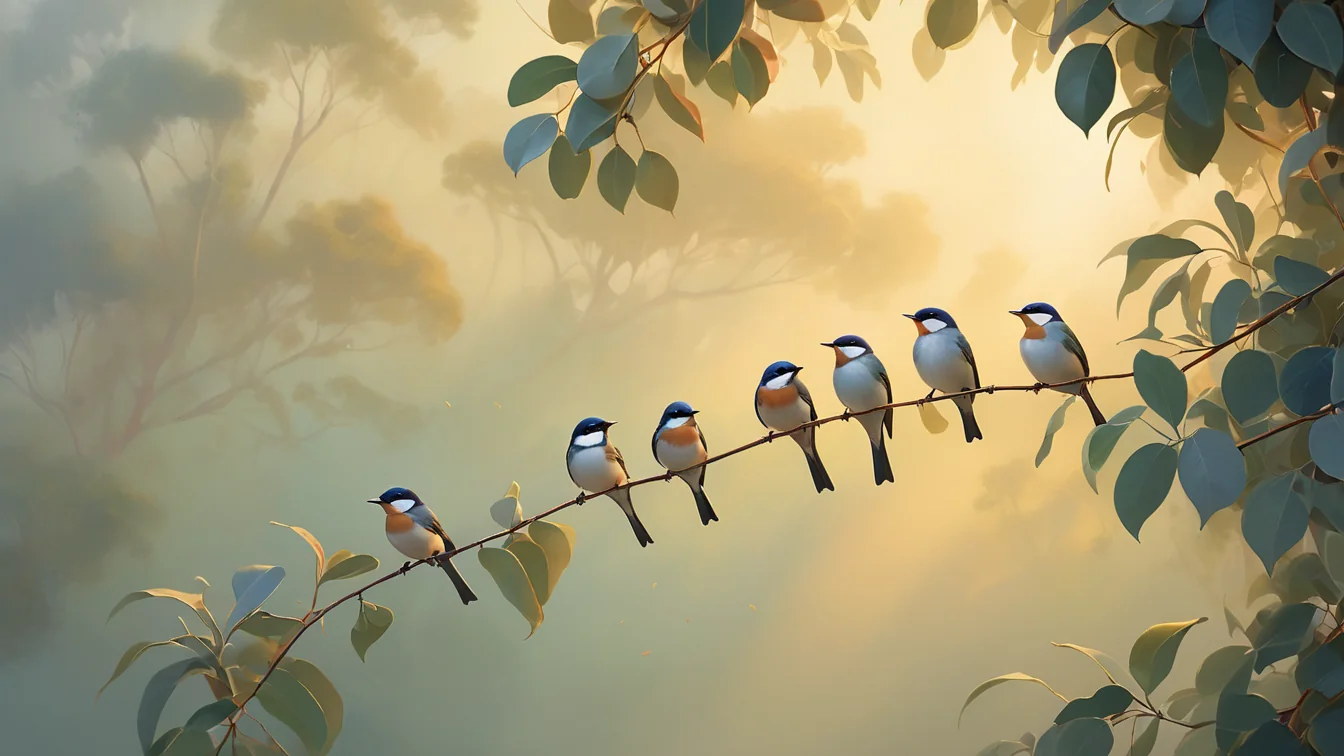
Step outside before sunrise in a leafy suburb or bush reserve and you may hear it first: one bird starts singing, then another, then dozens more, until the whole area is loud. Scientists call this the dawn chorus. It is one of the most noticeable sounds of the day, yet the reasons behind it are still being worked out.
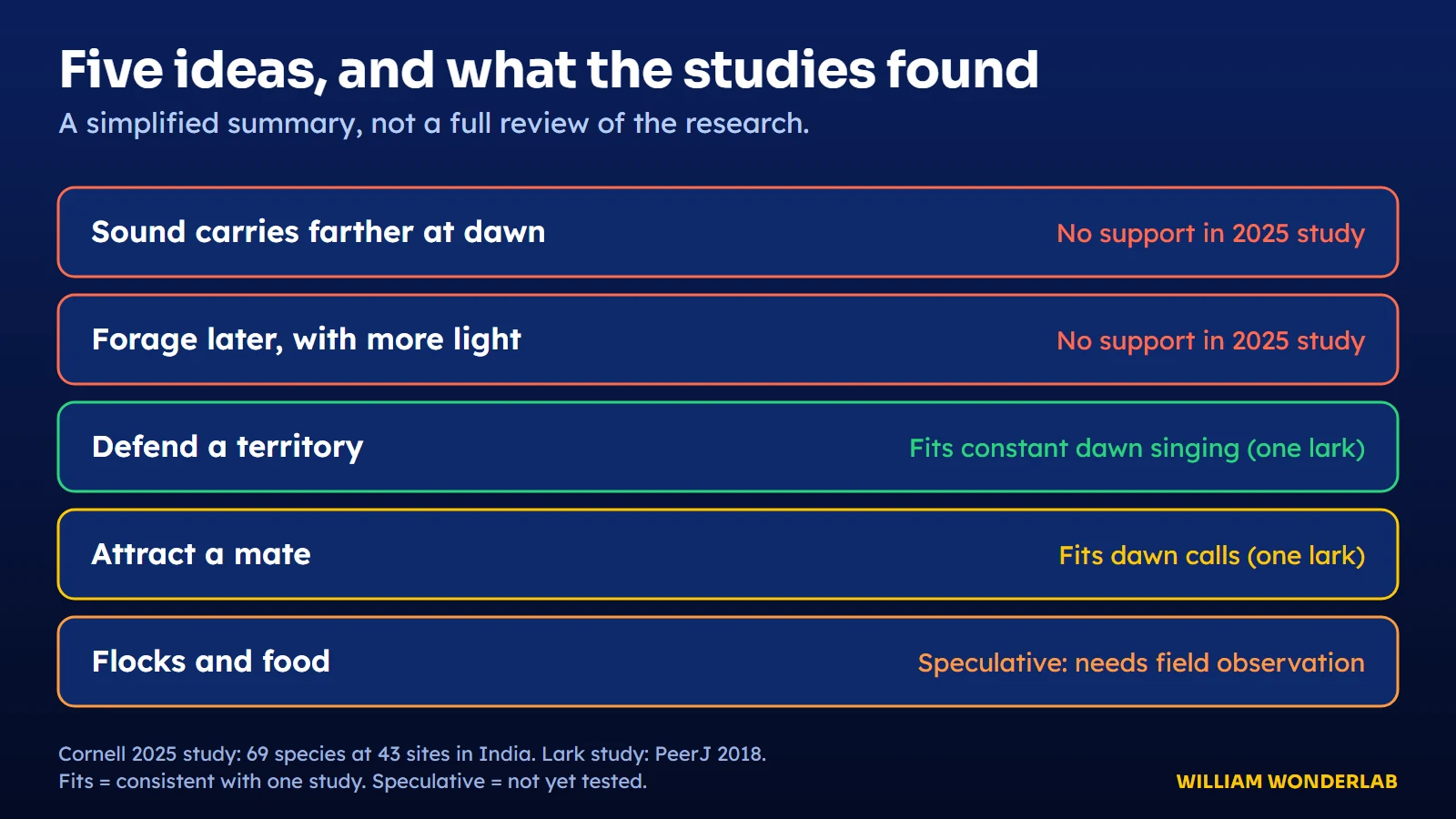
The short answer: Many songbirds sing hardest in the period just before sunrise. Scientists think this helps them defend their territory and attract mates, and the exact mix of reasons differs between species. One popular idea, that sound carries better at dawn, was tested in a 2025 study and was not supported.[1]
What is the dawn chorus?
A territory is the area a bird defends from rivals, usually for feeding and nesting. Songs are one way birds mark that space. Many territorial songbirds sing intensely before sunrise and then reduce their singing for the rest of the day.[2]

Think of the dawn chorus like a busy playground before the morning bell. Lots of voices overlap, and each one is saying something to the others.
Idea one: does sound carry farther at dawn?
One early explanation is called the acoustic transmission hypothesis. The idea is that cool, calm, damp morning air might carry sound more clearly, so a song sung at dawn could reach farther than one sung at midday.
To test it, researchers at the Cornell Lab of Ornithology and Project Dhvani in India used recordings from 43 locations in the Western Ghats, a mountain range in southern India. They covered 69 bird species. The team found no evidence that sound transmission affected when birds sang.[1]
The same study also looked at light, which is linked to the idea that birds sing early so they can forage later. It reported that light levels and sound transmission conditions “did not significantly influence when birds sang.”[1] A simple test like this is useful: a clear “no” rules an idea out and points scientists towards better explanations.
Idea two: territory and mates
Two ideas have been studied for a long time. In territory defence, a song tells rival birds that a space is already taken. In mate attraction, a song tells potential partners that a male is ready.
Research on a lark found that calls and songs at dawn may do different jobs. Dawn calling may be mainly linked to attracting mates, while dawn singing that stays constant across the breeding season would support a link to defending a territory.[2] Other species may differ, so one answer does not fit every bird.
A 2023 study proposed a different idea. Its authors argued that a dawn and dusk chorus will arise when two conditions are met, one of which is that males sing more when separated from their mates. Their blue tit data showed that males sang at a higher rate when separated from their mate, and the authors found no evidence contradicting the hypothesis.[3] This is a proposed explanation that still needs more testing, not a settled answer.
Idea three: food and flocks
The 2025 Cornell study also found that highly territorial birds and omnivores, which eat both plants and animals, were much more likely to be active singers at dawn.[1]
The lead researcher, Vijay Ramesh, suspected a link with mixed-species foraging flocks. In these groups, birds from different species move through the forest together, and calls help them find food and warn each other about predators. He noted that observations of the birds themselves are needed to test this idea.[1]
Could light set the start time?
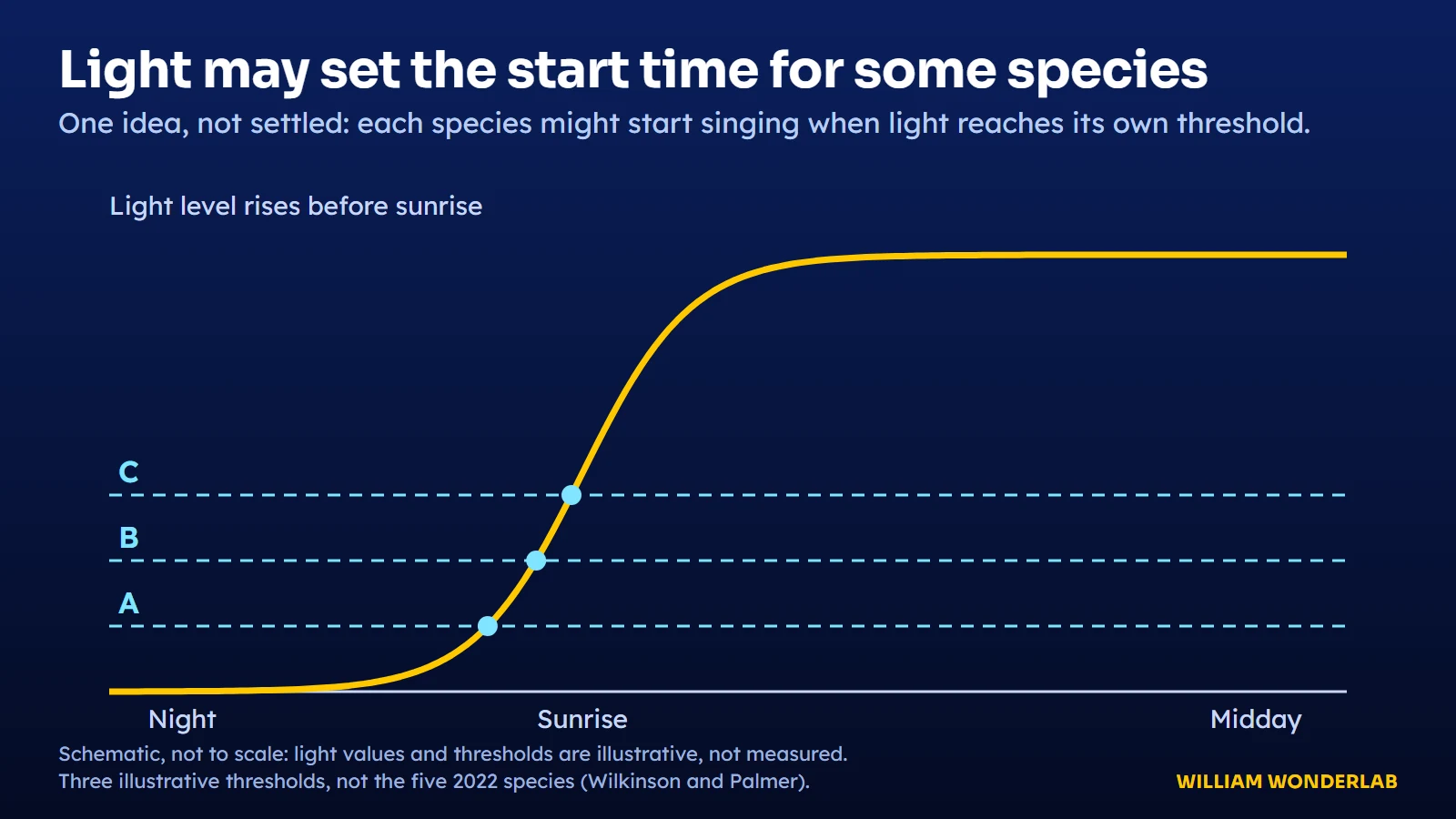
Light may be a clue. A 2022 study of five common eastern Australian bird species, including the Australian magpie, found that each species began singing once the light reached its own threshold level.[4] That study covered five species in one region of eastern Australia.
The 2025 Cornell study of 69 species pointed the other way. It found that light levels did not significantly influence when birds sang.[1] The two results do not agree, so the light idea is not settled.
A threshold is the point at which something switches on. If the idea holds, each species would act like a switch set at its own brightness, and the dimmest switch would be flipped first. This is a simplified picture, not a settled result.
A separate study of a bird community in a temperate forest in Poland found that the birds changed how they used acoustic space through the day and the season. Splitting the day into different singing times may only occur at certain times before sunrise.[5]
Did you know? Birds sing in the middle of the day too. But the same forest study found no evidence of large-scale time-sharing among species singing in daylight.[5]
Try it: a dawn bird count
This is a proposed at-home activity, to try with a grown-up on a calm morning.
- Before you go out, predict how many different kinds of birds you will hear in 10 minutes.
- Go with a grown-up to your garden, a local park or a quiet footpath you know well, a little before sunrise, once you can see the path clearly. Stand still and listen.
- Note the time you start, then count each different bird you can hear. Count a kind of bird once, even if it sings many times.
- Repeat the count 30 minutes later, once the sky is brighter. Compare the two numbers and your prediction.
Safety first: Go out with a grown-up, dress warmly, and stay on paths or footpaths in daylight or the first light of dawn. Watch where you put your feet, and never walk into dense bush or near water in the dark. Keep your distance from nests and do not try to touch or chase a bird. If you feel unwell or lost, go straight back inside. Phone the emergency number 000 in an emergency.
Go deeper: why scientists weigh several possible explanations
Why one answer is not enough
The dawn chorus is hard to explain because many things change at dawn at once. Light rises, the air temperature and humidity shift, birds wake up, and rivals and mates are close by. Scientists have several possible explanations for when birds sing. The 2025 study considered four of them, using recordings from 69 bird species at 43 sites. It found that factors such as light levels and sound transmission conditions “did not significantly influence when birds sang.”[1]
Reading a recording
Useful evidence comes from passive acoustic monitoring, where microphones record birds over long periods without a person being there. Because the recorders run all day, researchers can compare dawn and dusk recordings.[1]
Frequently asked questions
Do all birds sing at dawn?
No. Many songbirds sing intensely before sunrise, but the amount of singing differs between species. Highly territorial and omnivorous birds were more likely to be active singers at dawn in the 2025 study.[1]
Is the dawn chorus just birds being happy to see the sun?
Light may matter for some birds: one 2022 study of five Australian species reported that each started singing at its own threshold light level.[4] But the 2025 study of 69 species found that light levels did not significantly influence when birds sang.[1] The research also points to jobs such as defending territory and attracting mates, and the food idea is still being tested.[1][2]
Can the air make birds sing louder at dawn?
This was tested in a 2025 study, and the researchers found no evidence that sound transmission affected when birds sang.[1]
Does the singing change across the breeding season?
In one lark study, dawn calling declined after the first month of breeding, while dawn singing stayed constant. That pattern would support a link to defending a territory, but other species may differ.[2]
The big idea
Light may affect when some birds start, but the main ideas are territories and mates. Many songbirds sing hardest before sunrise, and scientists think this may help them claim space and attract partners. The early explanations are still being tested, and the best answer may differ between species.
Related reading
More from William Wonderlab:
Explore more from scientists:
- Study reveals why the early bird sings early (Cornell University, 2025)
- Dawn chorus interpretation differs when using songs or calls: the Dupont’s Lark case (PeerJ, 2018)
- A dawn and dusk chorus will emerge if males sing in the absence of their mate (Proceedings of the Royal Society B, 2023)
References
[1] Cornell University, “Study reveals why the early bird sings early” (accessed 26 October 2026)
[2] PeerJ (via PubMed Central), “Dawn chorus interpretation differs when using songs or calls: the Dupont’s Lark Chersophilus duponti case” (accessed 26 October 2026)
[3] Proceedings of the Royal Society B, “A dawn and dusk chorus will emerge if males sing in the absence of their mate” (accessed 26 October 2026)
[4] Wilkinson, K. E. and Palmer, G. C., “Ambient light energy intensity as a trigger for the dawn chorus: Patterns in five common eastern Australian bird species”, Australian Field Ornithology (accessed 26 October 2026)
[5] Behavioral Ecology, “Competition for acoustic space in a temperate-forest bird community” (accessed 26 October 2026)