How Do Bees Find Their Way Home?
Honey bees use the position of the Sun, polarised light, landmarks and smells to navigate. They even share directions with a waggle dance.
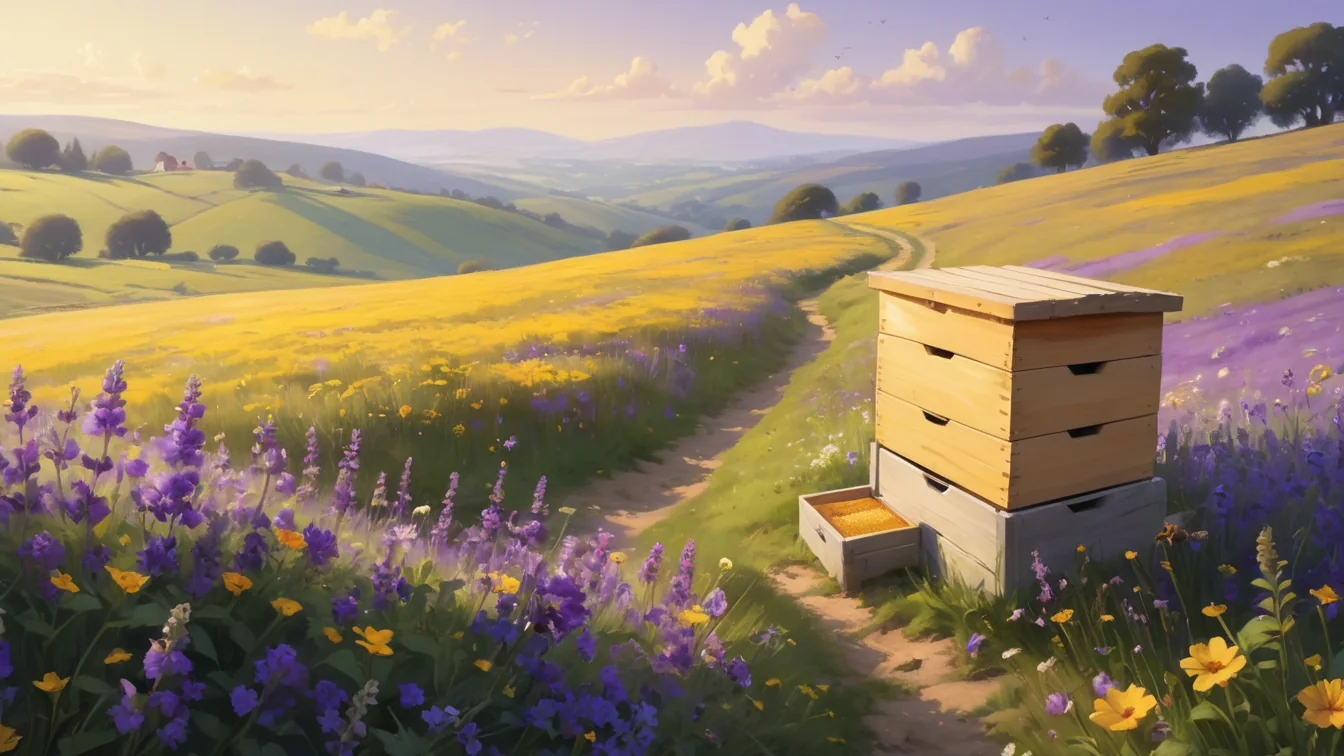
A honey bee can leave the hive, search a garden, find a patch of flowers and fly straight back. Most of us would need a map and a phone to do that. The bee manages it with a very small brain and several clever senses.
The short answer: Honey bees use the position of the Sun as a compass, which they can see directly or work out from patterns of polarised light in the sky. Near a food source, they use landmarks and smells. Returning foragers also tell their nestmates where food is with a waggle dance.[1][2][3]
The Sun is a compass
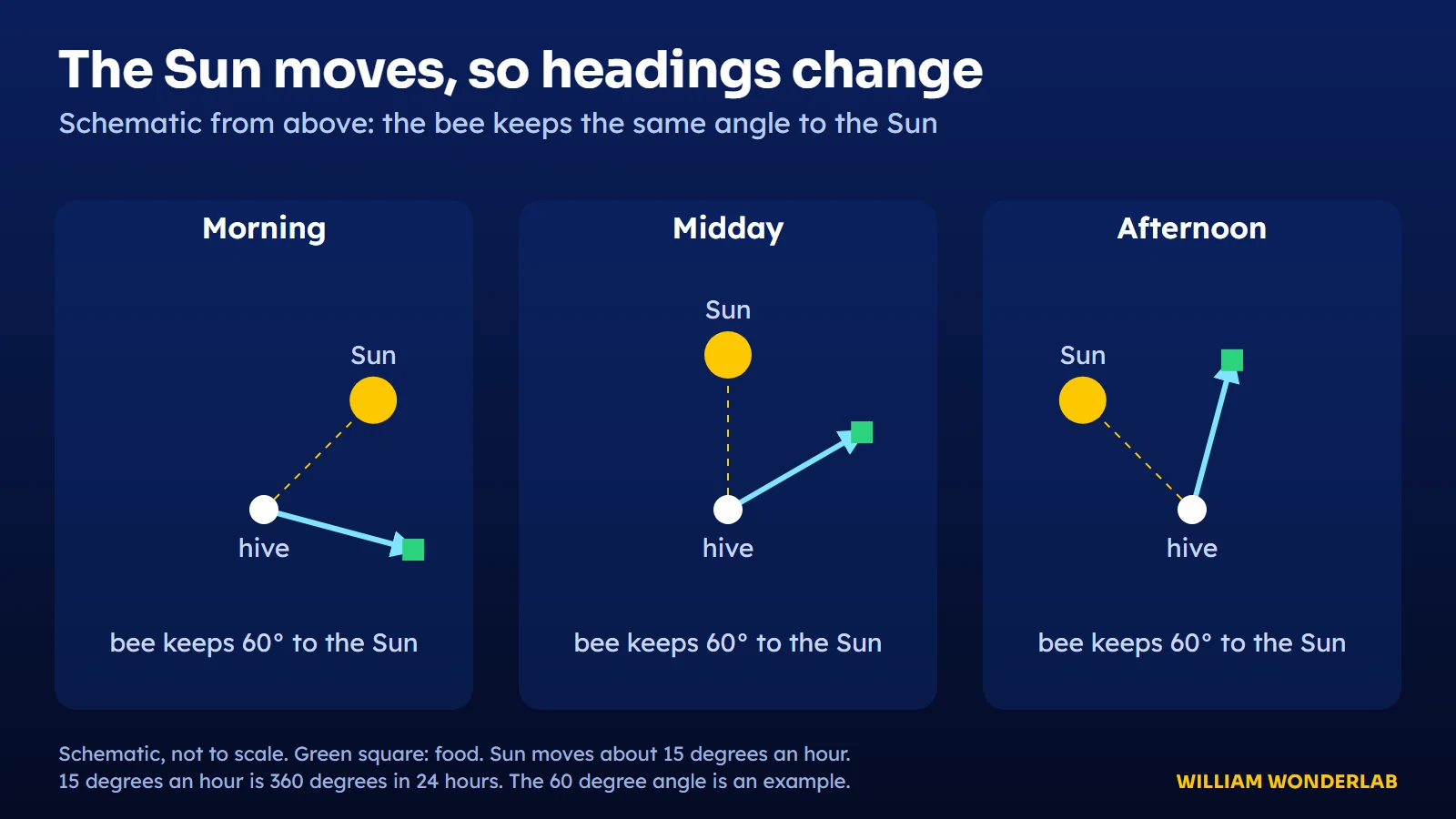
Honey bees prioritise the position of the Sun when they navigate. They can work it out from direct sighting, or from patterns of polarised light across the sky.[3]
Because the Sun moves across the sky during the day, a bee has to keep track of where it is at each time. Researchers describe this as navigation by a sun compass.[1] The bee’s internal clock helps it follow the Sun’s position through the day.[1]
Landmarks and smells
Close to a food source, bees rely on what they can see. Once near a floral destination, a bee can use short-range landmarks to pinpoint its target.[3] When a bee arrives at a target, it first aims at a landmark and matches what it sees with a stored view.[3]
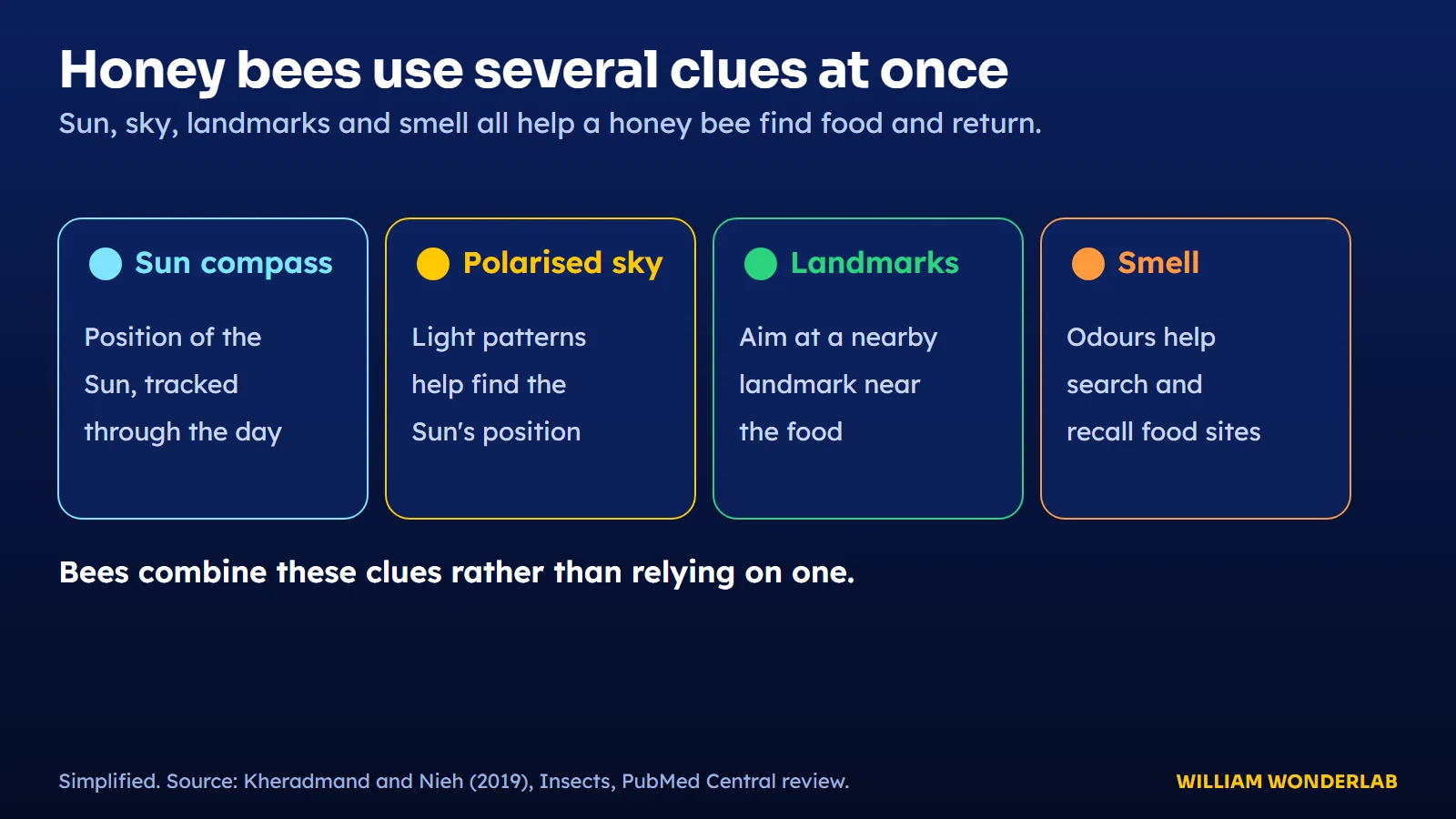
Smell matters too. Odours can help honey bees search for food and find their way back to it.[3] Smells can also bring back memories of specific food sites, through the landmark memories linked to them.[3] Honey bees also mark their nest entrance, and food sources, with Nasonov pheromone and other scented chemicals.[3]
The waggle dance
A returning forager that wants to advertise a food source performs the waggle dance.[1] The dance tells other bees both the direction and the distance of the food from the hive.[2] Karl von Frisch, a Nobel laureate, deciphered the code hidden in this dance in the 1940s.[4]
The direction is coded in the angle. The angle of the waggle run from vertical on the comb represents the angle of the food source from the Sun’s azimuth.[1] In other words, “up” on the comb stands in for the Sun’s direction, so the angle from vertical tells nestmates where the food lies relative to the Sun.
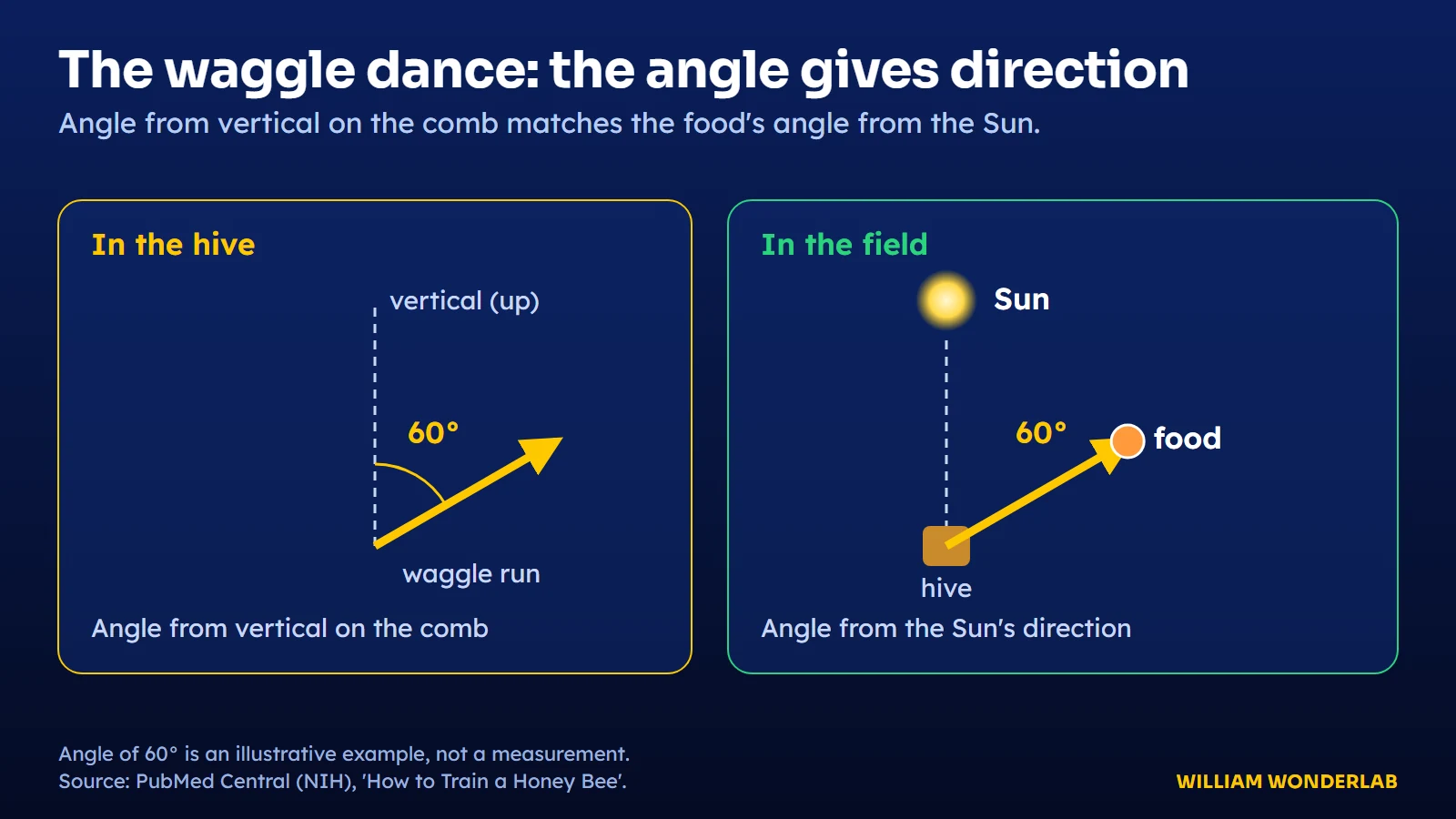
The distance is coded in time. The duration of the waggle run is proportional to the distance of the source from the hive.[1]
Did you know? A 2023 study in the Proceedings of the National Academy of Sciences looked at how honey bees use the dances of returning foragers to infer where a food source is.[2]
Try it: watch flight paths from a safe distance
You need: a notebook, a pencil and a flowering plant that bees visit in a garden or park where you have permission to sit.
- Choose a flowering plant with bees visiting. Sit a safe distance away, well clear of any hive, nest or sugary drink.
- For five minutes, count how many bees visit the flowers. Note whether they come back to the same plant.
- Look at the landmarks near the plant, such as a fence, a tree or a path. Do the bees seem to fly the same route each time?
- Write down one question you could test next time.
What to expect: Bee visits and routes vary a lot. Record what you see rather than expecting a set pattern.
Safety first: Do not open, disturb or stand near a hive or nest. If bees come near you, keep calm and move away slowly, because honeybees normally only sting in self-defence.[5] Never swat at bees. Do not drink from open cans outdoors, and wear light-coloured, covering clothing and shoes.[5] Bee stings are currently Australia’s most common cause of insect sting anaphylaxis.[5] If you have a known bee-sting allergy, do not take part. Keep any prescribed adrenaline device and ASCIA Action Plan with you. Anaphylaxis is a medical emergency that needs immediate treatment with adrenaline, injected into the outer mid-thigh muscle.[6]
Go deeper: navigation is more than one clue
Combining the compass with memory
Solar information is generally useful and reliable for navigating bees.[3] When bees arrive at a target, they first aim at a landmark and associate it with a stored view.[3]
How the dance codes direction and distance
Direction in the dance is coded in an angle, and distance in the length of the waggle run.[1] Distance is also linked to what the bee sees on the way. Bees appear to measure distance partly through optic flow, the image motion they experience on the outbound flight.[7] In experiments, knowledge of the surrounding environment could override this optic-flow effect on the distance a dance reports.[7]
Australian native bees
Not every bee is a honey bee. Australian native stingless bees, such as Tetragonula carbonaria, have been tested for homing. In a 2016 study, the share of nectar foragers that returned successfully did not differ between landscapes. The authors suggest that these bees use “other than elongated ground features for navigation.”[8] The rest of this article describes honey bees, which are the best-studied bees for navigation.
Frequently asked questions
Do bees use the Sun to find their way?
Yes. Honey bees prioritise the position of the Sun, which they can see directly or work out from patterns of polarised light.[3]
How does a bee tell its nestmates where the food is?
A returning forager performs the waggle dance. The angle of the waggle run from vertical stands for the angle of the food from the Sun, and the length of the run is proportional to distance.[1]
Do bees use smell to find their way?
Yes, as one clue among several. Odours help honey bees search for food and return to it, and honey bees mark their nest entrance with scent.[3]
Are honey bees dangerous?
Honeybees normally only sting in self-defence. Avoid provoking bees and their nests.[5]
The big idea
Many clues, one trip home. Honey bees combine the Sun’s position, polarised skylight, landmarks and smells to find flowers and return. Returning foragers then share a direction and distance with the waggle dance.
Related reading
More from William Wonderlab:
Explore more from scientists:
- The Role of Landscapes and Landmarks in Bee Navigation: A Review (PubMed Central)
- How to Train a Honey Bee (PubMed Central)
- Allergic reactions to bites and stings (ASCIA)
References
[1] PubMed Central (NIH), “How to Train a Honey Bee” (accessed 25 October 2026)
[2] PubMed Central (NIH), “Honey bees infer source location from the dances of returning foragers” (PNAS, 2023) (accessed 25 October 2026)
[3] PubMed Central (NIH), Kheradmand and Nieh, “The Role of Landscapes and Landmarks in Bee Navigation: A Review” (Insects, 2019) (accessed 25 October 2026)
[4] PubMed Central (NIH), Chittka, “Dances as Windows into Insect Perception” (PLoS Biology, 2004) (accessed 25 October 2026)
[5] ASCIA, “Allergic reactions to bites and stings” (accessed 25 October 2026)
[6] ASCIA, “Anaphylaxis” (health professionals) (accessed 25 October 2026)
[7] PubMed Central (NIH), “Landmark knowledge overrides optic flow in honeybee waggle dance distance estimation” (Journal of Experimental Biology, 2024) (accessed 25 October 2026)