Why Do Tall Buildings Sway in the Wind?
A skyscraper can move a small distance in strong wind, and that movement is part of its design. Here is how wind, flexing and dampers work together.

On a windy day, a skyscraper can look completely still from the footpath. Up on the top floors, though, it may be moving. Tall buildings are designed to flex a little, and engineers plan for that movement rather than trying to make a building perfectly rigid.
The short answer: Wind is faster higher up, so the upper parts of a tall building are pushed harder and the top bends and sways a small distance.[1][2] Engineers can limit the motion with dampers, such as a heavy mass that swings against the sway.[4][5]
Why the top is pushed harder
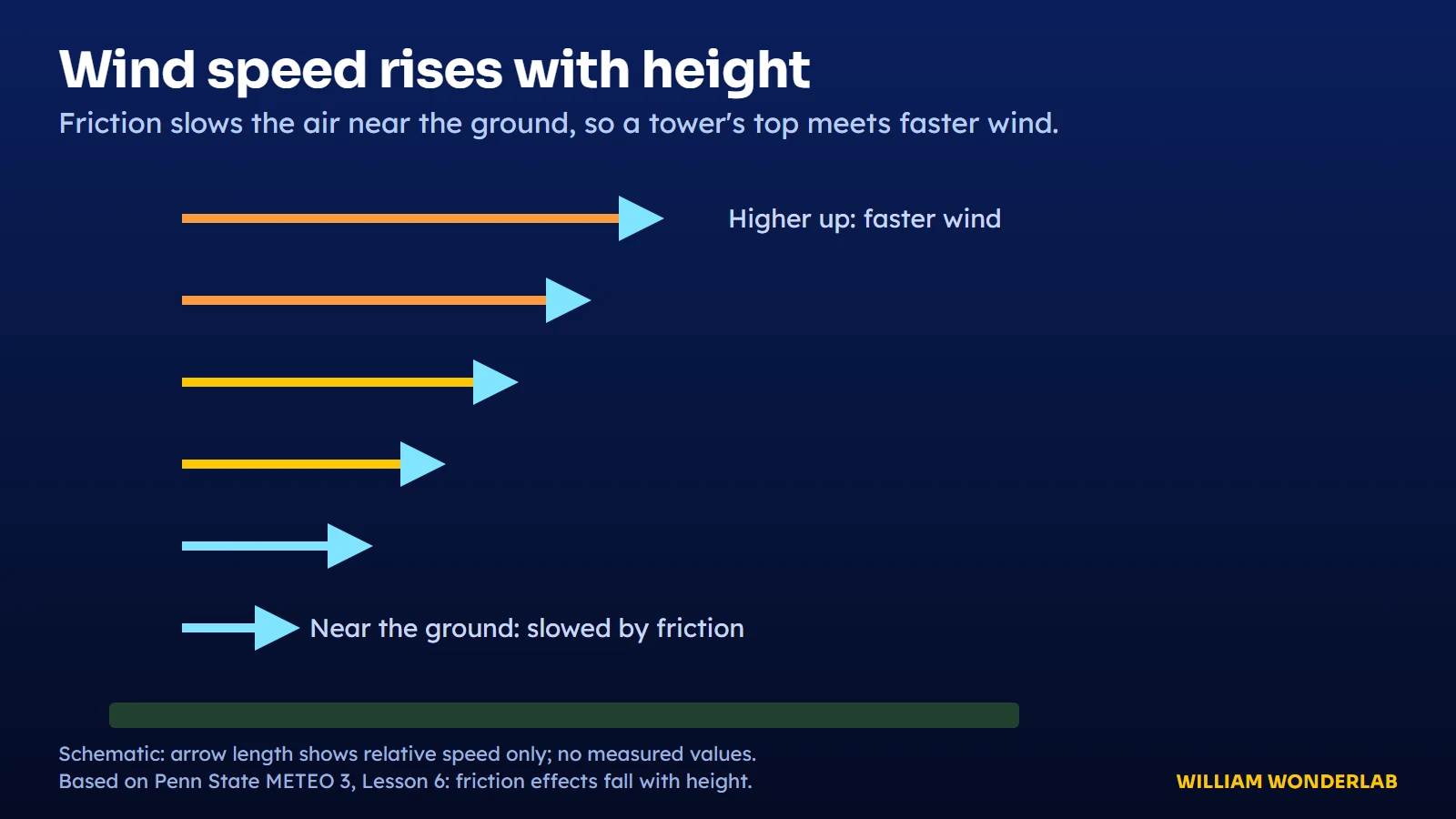
Wind near the ground is slowed down by friction with the surface. Penn State’s meteorology course explains that “friction at the earth’s surface acts to produce a wind-speed profile that increases with height because air right near the earth’s surface is slowed the most by friction.”[1] In other words, the air higher up is moving faster than the air at street level.
A tower rises through that faster air, so its top has more wind pushing on it. The same course says that “The effects of friction decrease with increasing height above the ground, leading to faster wind speeds with increasing height (all else being equal).”[1]
A tall building is a springy structure
A tall building is not a rigid block. It is more like a long, flexible rod fixed at the bottom. When the wind pushes, the upper floors move a little and then spring back. The abstract of Lamb’s doctoral thesis at Western Sydney University says that “Tall buildings vibrate at low frequencies in response to wind excitation that can be perceptible to building occupants”.[2]
Every structure has a natural frequency, the rhythm it likes to move at when nothing keeps pushing it. OpenStax physics, published through LibreTexts, defines it as “the frequency at which a system would oscillate if there were no driving and no damping force.”[3]
Think of pushing a playground swing. Small pushes at the right rhythm add up, and the swing goes higher. Physics calls this effect resonance. The same source says that “driving a system with a frequency equal to its natural frequency is called resonance.”[3] Wind is not a neat, regular push like a child’s hand on a swing, so the real picture for a building is more complicated. Could gusts build the motion up too far?
Why sway matters to people
Some people inside a tall building can feel the movement. Lamb’s thesis reports that building motion “may cause fear and alarm and can induce motion sickness”.[2] The same work found that “Motion sickness degrades work performance, therefore also affecting the efficiency of organisations located in tall buildings.”[2]
The damper: a weight that moves the other way
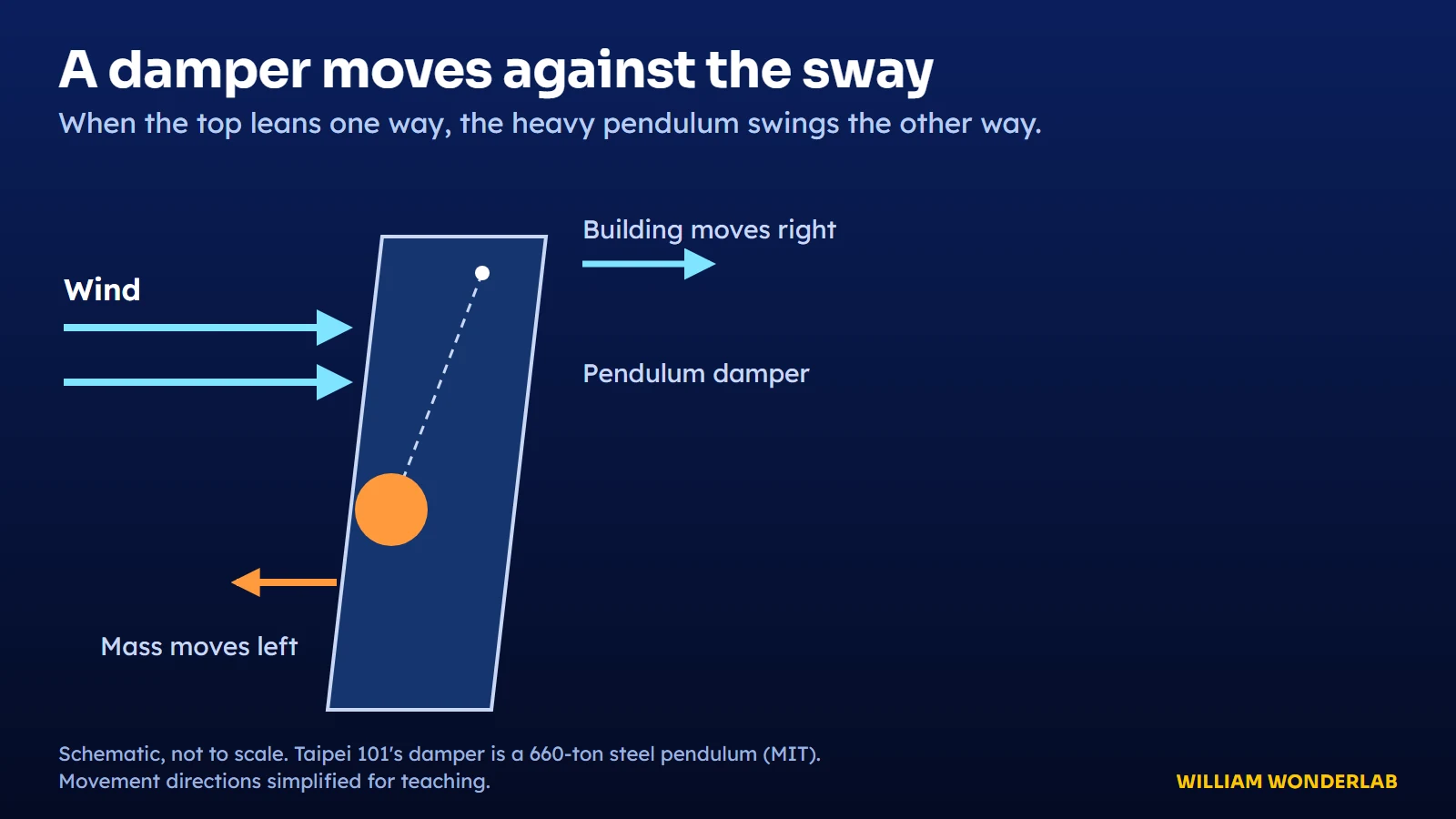
A damper removes energy from a moving structure, so the motion dies away sooner. One of the best-known examples is the damper in Taipei 101. MIT OpenCourseWare describes it as a 660-ton steel pendulum between floors 87 and 92. It “serves as a tuned mass damper; it sways to offset movement of the building by strong gusts of winds.”[4]
A pendulum damper swings out of step with the building. When the building leans one way, the heavy mass swings the other way, and the two movements partly cancel. The damper does not stop the wind. It reduces how far the top of the tower moves.
Dampers are also studied before they are built. A University of Sydney research report from 1990 says its wind tunnel model tests and theoretical analyses were conducted “to investigate the effectiveness of tuned mass dampers in suppressing wind-induced tall building motion.”[5] The model was a 1:400 scale aeroelastic model of a standard test building, the CAARC Standard Tall Building, tested in a wind tunnel with simulated atmospheric flow.[5]
Try it: the wobbling ruler
This is a proposed at-home activity that shows how a springy object vibrates. It is a simplified demonstration, not a copy of a building test.
You need a plastic or wooden ruler, a table with a clear edge, and a helper to hold the other end of the ruler flat on the table.
- Hold the ruler flat on the table with about 10 centimetres sticking out over the edge.
- Gently press the free end down, let go, and watch how it wobbles.
- Slide the ruler so that about 20 centimetres sticks out, then press and release again.
- Compare the two wobbles. Notice which one moves more slowly and which one looks more like a gentle sway.
The wobble is a simple model of how the top of a tall building flexes and springs back. Compare what you see with the natural frequency idea above.
Safety first: Use only a plastic or wooden ruler, never a metal one with sharp edges. Keep your fingers clear of the moving end, and stop if the ruler flicks off the table. Ask an adult to help if you are young, and keep glass, knives and heavy objects away from the table edge.
Go deeper: a design balance
Why engineers accept some movement
Lamb’s thesis looks at the people side of the design question: how wind-induced building motion affects occupant comfort, wellbeing and work performance.[2]
How dampers are tested
The 1990 University of Sydney report used a 1:400 scale model of a standard test building, tested in a wind tunnel.[5] The same report’s abstract describes both model tests and theoretical analyses, so the damper was checked with more than one method.[5] MIT describes Taipei 101’s damper as a pendulum that sways to offset the building’s movement.[4]
Frequently asked questions
Does a tall building really move in the wind?
Yes, a little. Tall buildings vibrate at low frequencies in response to wind, and the movement can be felt by people inside.[2]
Why does the top of a tower move more than the bottom?
Because wind speed usually increases with height above the ground, so the upper parts meet faster air.[1]
What is a damper in a building?
A damper removes energy from a moving structure. Taipei 101 uses a steel pendulum that swings to offset the building’s movement.[4]
What is resonance?
Resonance is what happens when a push is applied at the same frequency as a system’s natural frequency, so the motion builds up.[3]
The big idea
A little sway is part of the design. Wind pushes hardest near the top of a tall building, and the structure flexes and springs back. Engineers use dampers, such as a heavy pendulum that moves against the sway, to keep that movement small and comfortable.[1][4][5]
Related reading
More from William Wonderlab:
- How Do Bridges Hold So Much Weight?
- How Do Wind Turbines Make Electricity?
- How Do Hydro Dams Make Electricity?
Explore more from scientists:
- Lesson 6: Surface Patterns of Pressure and Wind (Penn State METEO 3)
- 2.04A Systems and Controls, Taipei 101 damper (MIT OpenCourseWare)
References
[1] Penn State University, “Lesson 6: Surface Patterns of Pressure and Wind”, METEO 3: Weather Revealed (accessed 26 October 2026)
[2] Lamb, S., “The effect of wind-induced tall building motion on occupant comfort, wellbeing, and work performance”, Western Sydney University doctoral thesis (accessed 26 October 2026)
[3] OpenStax, “16.8: Forced Oscillations and Resonance”, College Physics, via LibreTexts Physics (accessed 26 October 2026)
[4] MIT OpenCourseWare, “2.04A Systems and Controls, Spring 2013: Taipei 101 image” (accessed 26 October 2026)
[5] University of Sydney School of Civil and Mining Engineering, “Control of wind-induced tall building vibration by tuned mass dampers”, research report no. 617 (1990), via PolyU Scholars Hub (accessed 26 October 2026)