How Does a Desalination Plant Make Seawater Drinkable?
Can you drink the sea? Desalination removes the salt, using pressure and a membrane with tiny pores. Here is how it works and why it costs so much energy.

Seawater is everywhere, but it is not ready to drink. A desalination plant takes seawater and removes most of the salt, so the result can be used as drinking water. The hard part is taking the salt out, and that takes a great deal of energy.
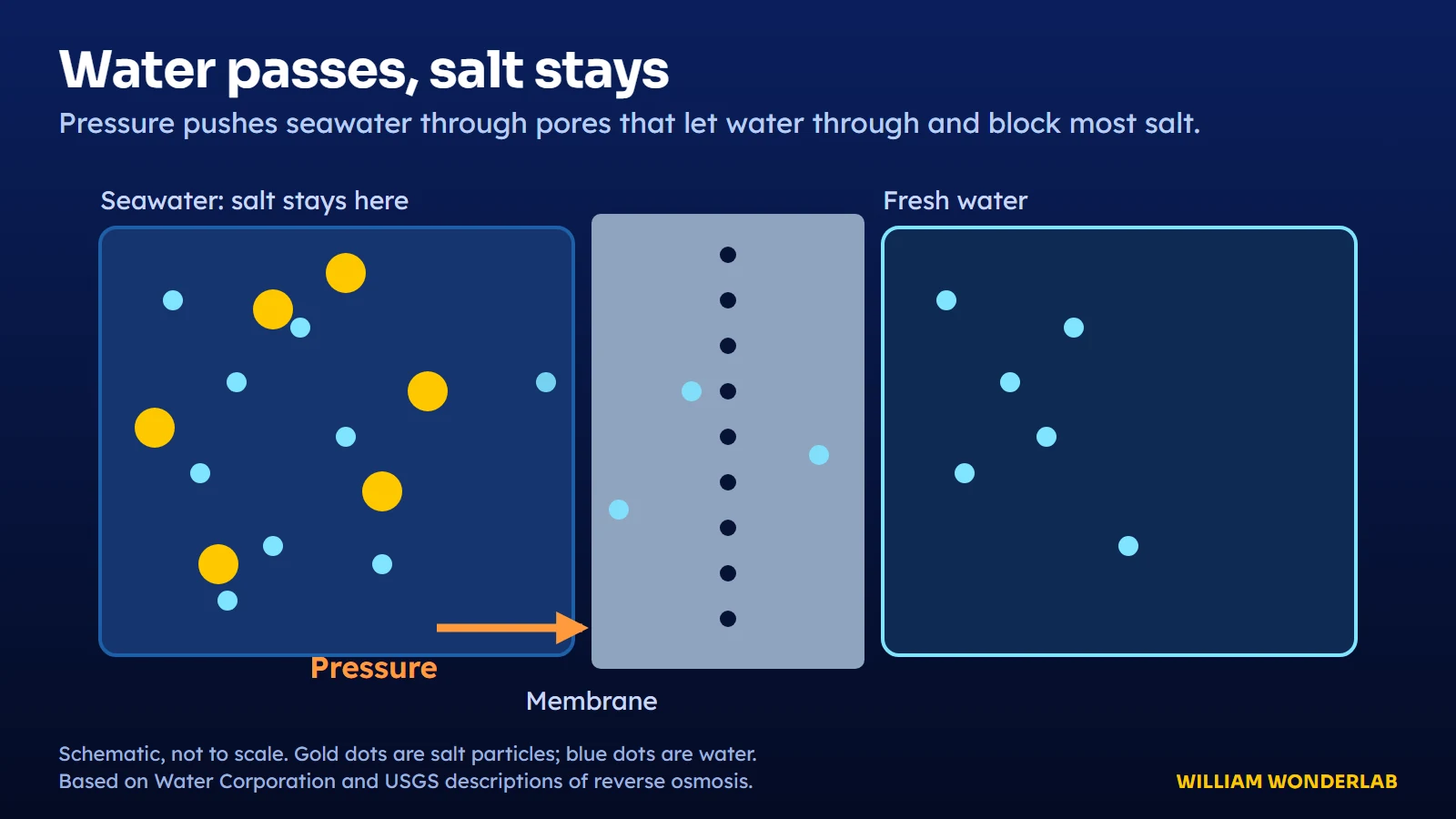
The short answer: Desalination removes salt from seawater so it can be used as drinking water. One method, reverse osmosis, pushes seawater at high pressure through a membrane with tiny pores. The pores let water through but block most of the salt.[1][2]
How salty is the sea?
The NOAA Ocean Service explains that “The average salinity is about 35 parts per thousand.”[3] Its wording is that the concentration of salt in seawater “varies with temperature, evaporation, and precipitation,” so the number changes from place to place. The average is a useful starting point. For every 1,000 parts of seawater, about 35 parts are dissolved salt.
Desalination is therefore about separating the water from the salt. Water Corporation, which runs seawater desalination plants in Western Australia, describes the goal simply: desalination “turns seawater into fresh water for drinking, using a process called reverse osmosis.”[1]
Pushing water against its natural flow
Water naturally moves through a membrane from the fresh side to the salty side. This is osmosis.[4] Reverse osmosis works the other way round. The LibreTexts chemistry text notes that “applying a hydrostatic pressure greater than this to the high-solute side of an osmotic cell will force water to flow back into the fresh-water side.”[4] The same text says that “The osmotic pressure of seawater is almost 26 atm.”[4]
In other words, the pump has to push harder than the natural pull of the salt. Water is then forced out through the membrane while the dissolved salt is left behind.[5]
The membrane with tiny pores
A membrane is a thin barrier with very small openings. Water Corporation explains that “These membranes have sub microscopic pores which act like ultra-fine strainers, removing salt, bacteria, viruses and other impurities in a process called reverse osmosis.”[1]
The USGS puts the process in simple terms: water containing dissolved salt “is forced through a semi-permeable membrane (essentially a filter), in which the larger salt molecules do not get through the membrane holes but the smaller water molecules do.”[2] The salt is held back, and the water passes through.
Water Corporation’s process description puts it in one line: “Fresh water is separated by pushing the filtered seawater through membranes using intense pressure.”[1] The seawater is filtered first, so the membranes receive water that has already been through a filtering step. The pressure does the separating, and the membrane does the sorting.
The leftover salty water: brine
Not all of the seawater becomes drinking water. The rest is called brine, and it is saltier than the sea it came from. Water Corporation says that “The remaining water, known as brine, is around twice as salty as normal seawater.”[1] Combining the NOAA average for seawater with Water Corporation’s twice-as-salty figure gives roughly 70 parts per thousand in the brine (calculated from those two figures).[3][1]
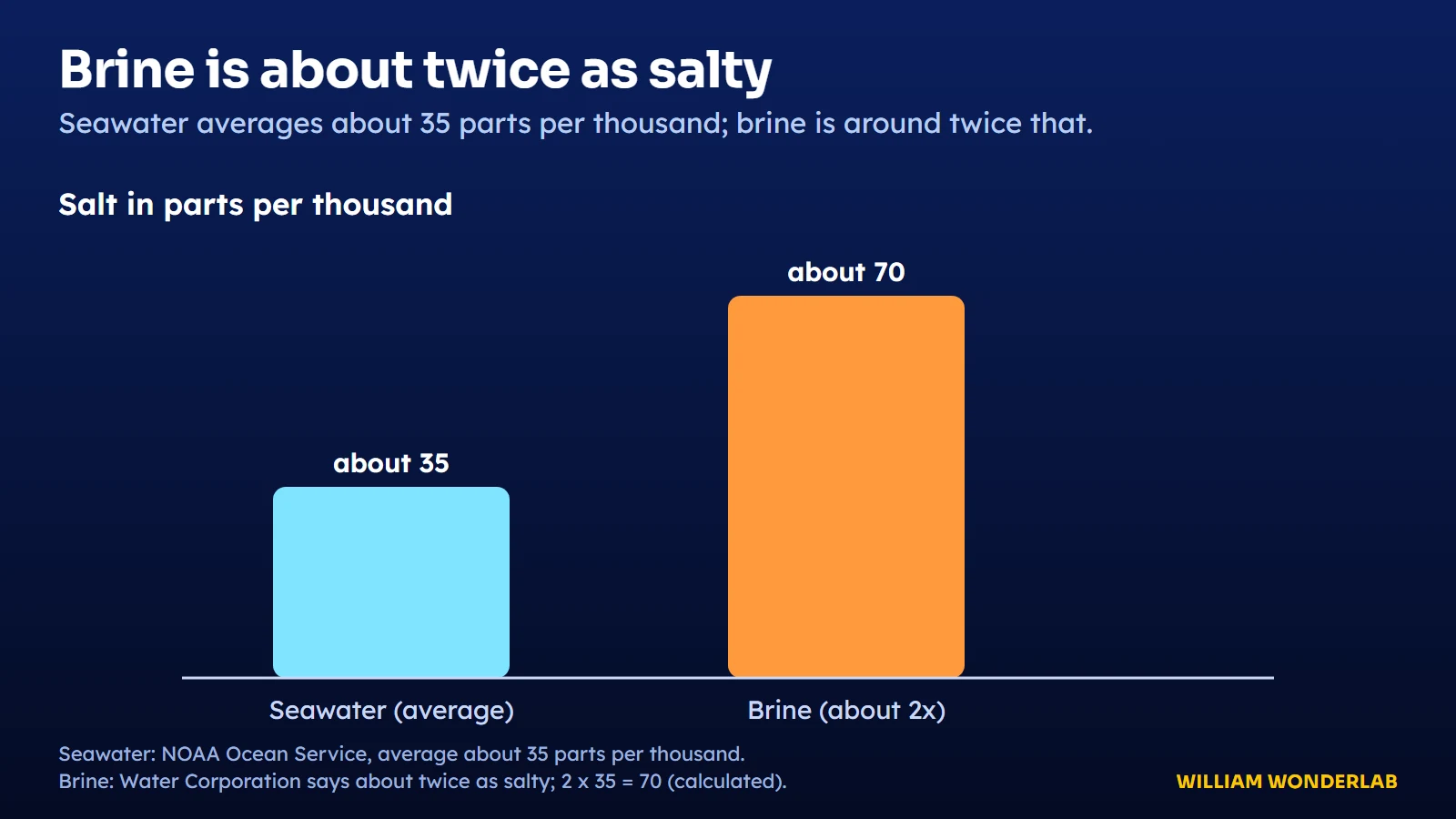
Water Corporation’s answer to the question “What is brine?” is short: “In seawater desalination plants, brine is the salty byproduct returned to the ocean.”[1] The company’s FAQ also explains why it is so salty: “It is nearly twice as salty as seawater because about 35-45% of the freshwater is removed, depending on the design of the desalination plant.”[1] When a large share of the water is taken out, the salt that remains is more concentrated.
Brine has to go somewhere. Water Corporation says its “specially designed diffusers” disperse the brine into the ocean, mixing it with the surrounding water.[1] The diffusers work with natural ocean currents and water movement near the plant, so the brine is spread out rather than left in one spot.[1]
Did you know? The membrane pores are small enough to block salt and bacteria, while water molecules still pass through.[1][2]
Why it takes so much energy
The pump has to push seawater against the natural pull of the salt, and that uses a lot of power. Water Corporation describes desalination as “an energy-intensive process,” and says it is “investing in renewable energy, including farms and solar,” to help with that.[1]
Go deeper: the chemistry and the trade-offs
Why pressure is the key
The LibreTexts chemistry text gives the osmotic pressure of seawater as almost 26 atm. It says that a greater hydrostatic pressure forces water back toward the fresh-water side.[4] So a plant must provide more pressure than the seawater’s osmotic pressure before any fresh water can flow through.
Balancing supply and trade-offs
Water Corporation says its seawater desalination plants at Kwinana and Binningup provide water security for Perth, with the capacity to supply around half of the local water needs.[1] The trade-off is between that steady supply and the energy the plants use, plus the brine they return to the ocean.
Frequently asked questions
Can you drink seawater straight from the ocean?
Not safely. Seawater averages about 35 parts of salt per 1,000 parts, so desalination is needed before it can be used as drinking water.[3][1]
What is reverse osmosis?
It is the process of pushing water through a membrane with a pressure higher than the osmotic pressure of the salty water. The membrane lets water through and holds back most of the salt.[4][5]
What is brine?
Brine is the salty water left over after fresh water has been removed. Water Corporation says it is around twice as salty as normal seawater.[1]
Why does desalination need so much energy?
Because the water has to be pushed hard through the membrane, which takes a lot of energy. Water Corporation describes desalination as an energy-intensive process.[1]
The big idea
Desalination makes seawater drinkable by pushing it through tiny pores. Reverse osmosis uses high pressure to separate fresh water from salt. The fresh water is usable, but the process needs a lot of energy and leaves behind salty brine.[1][2][4]
Related reading
More from William Wonderlab:
Explore more from scientists:
References
[1] Water Corporation (Western Australia), “How seawater desalination works” (accessed 26 October 2026)
[2] US Geological Survey, “Desalination”, Water Science School (accessed 26 October 2026)
[3] NOAA Ocean Service, “Why is the ocean salty?” (accessed 26 October 2026)
[4] LibreTexts Chemistry, “8.6: Reverse Osmosis”, General Chemistry Chem1 (Lower) (accessed 26 October 2026)
[5] LibreTexts Chemistry, “18.8: Osmotic Pressure”, Introductory Chemistry for Allied Health (Chan) (accessed 26 October 2026)