How Do Scientists Measure Earthquakes?
A shake under your feet can be measured from far away. Seismometers stay still while the ground moves, and the timing of two kinds of waves locates the quake.
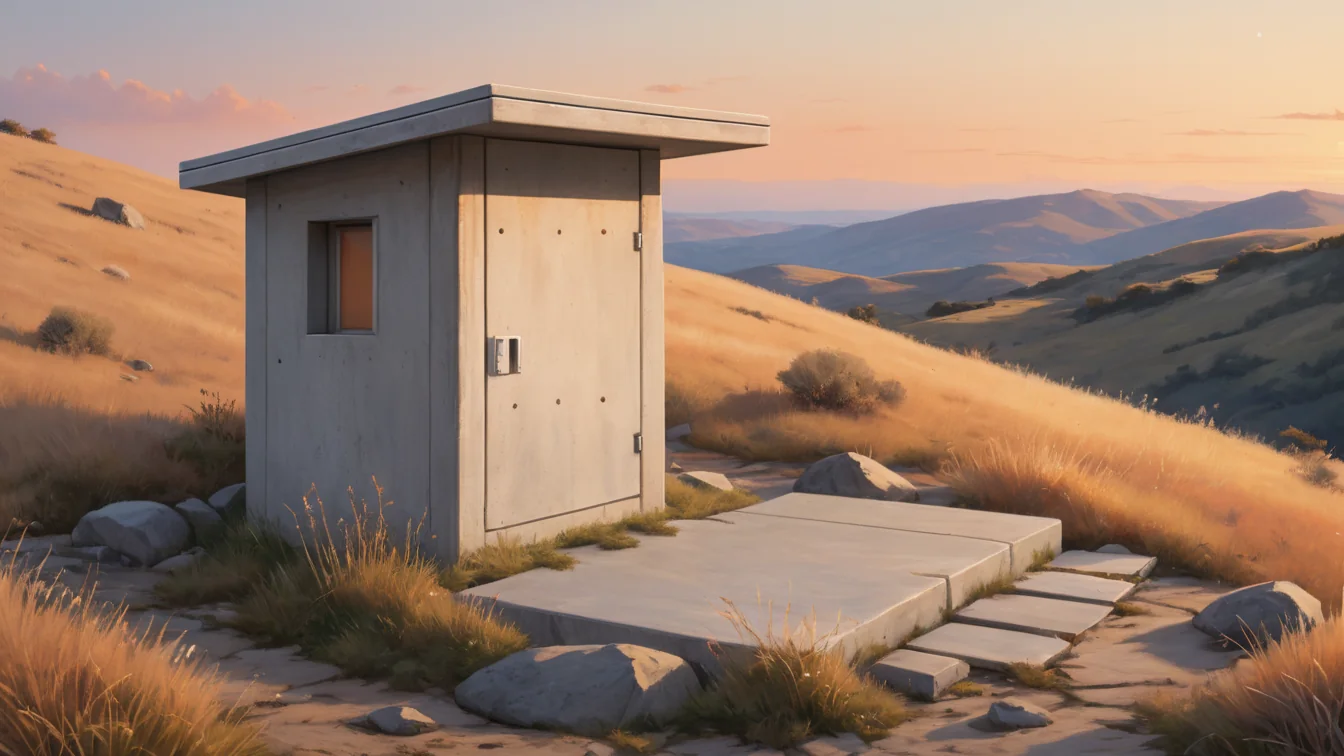
A small earthquake can be felt by no one, yet scientists can still work out where it happened and how big it was. The instruments that do this are called seismometers, and they can record waves from even the smallest earthquakes.[1]
The short answer: Seismometers detect tiny ground movements and record them as seismograms. Scientists use the time gap between two kinds of seismic wave to work out how far away the quake was. They measure the size of the waves recorded to estimate its magnitude, which is a measure of the energy released.[1][2][3]
A seismometer stays still while the ground moves
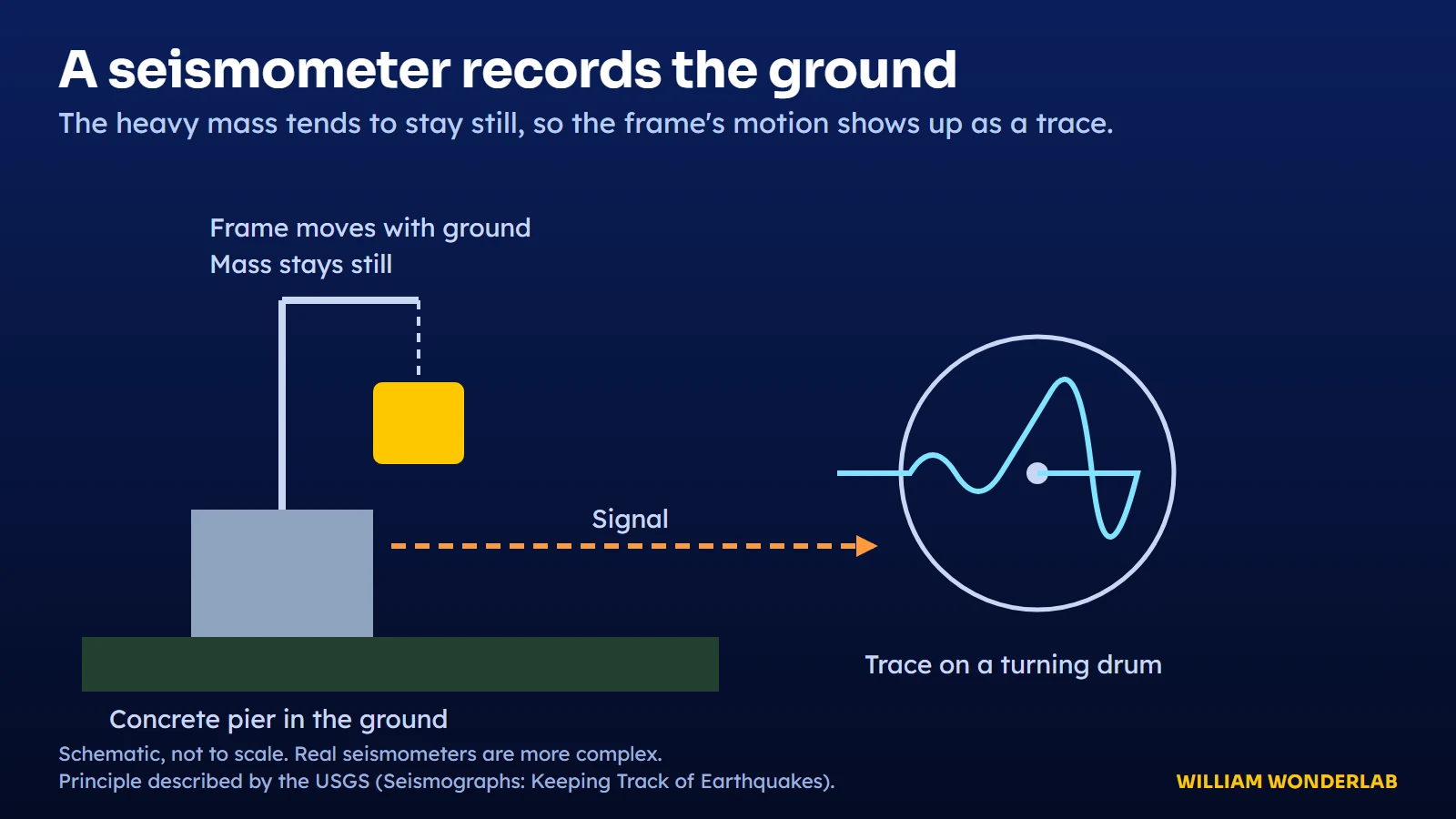
A seismometer does not measure the ground directly from a fixed spot. It has a heavy mass that tends to stay still, and a frame that moves with the ground. The USGS explains that “the differential motion between a free mass (which tends to remain at rest) and a supporting structure anchored in the ground (which moves with the vibrating Earth) can be used to record seismic waves.”[1]
The instrument turns that difference in motion into a trace, which is called a seismogram.[1] To record ground motion in all three dimensions, seismologists use three separate sensors within the same instrument. The British Geological Survey says that “Each sensor records the vibrations in a different direction”: up and down, east and west, and north and south.[2]
Two waves that arrive at different times
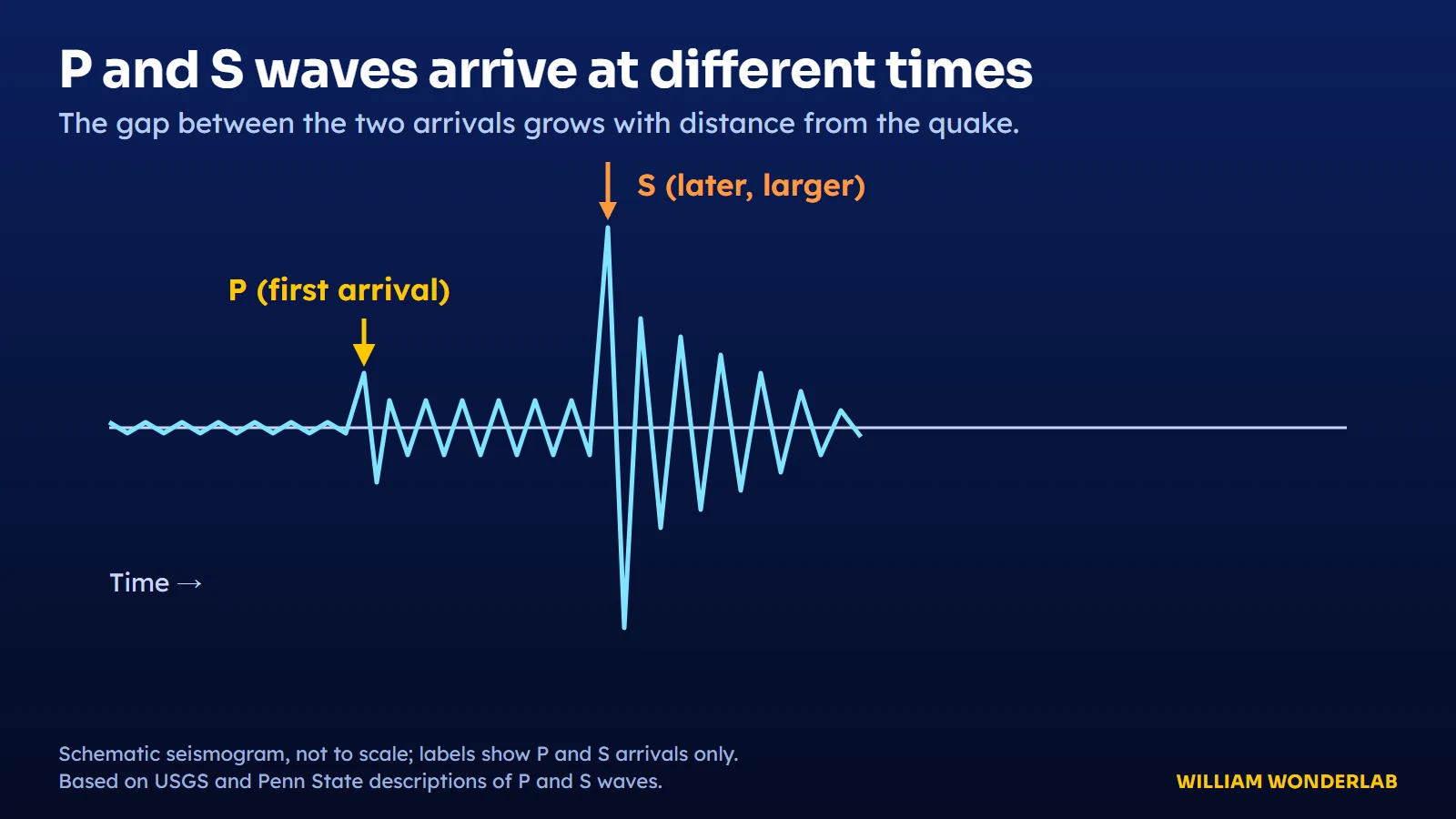
An earthquake sends out several kinds of seismic waves. The two that matter most for locating a quake are the P wave and the S wave. The USGS describes them this way: the P wave “compresses and dilates the rock as it travels forward through the Earth,” and the S wave “shakes the rock sideways as it advances at barely more than half the P-wave speed.”[1]
Penn State’s seismology notes explain why the P wave is recorded first: “P-waves are the first waves to arrive on a complete record of ground shaking because they travel the fastest.”[4] The P wave is quicker, so the gap between its arrival and the S wave’s arrival grows the farther the seismometer is from the quake.
Locating the quake from the time gap
The BGS explains that “The time difference between the P- and S-waves tells us the distance the earthquake is from the seismometer.”[2] One seismometer gives only a distance, not a place. To find the epicentre, which is the point on the surface above the quake, scientists need several stations.
The USGS describes the simplest method: “find the time interval between the P- and S-wave arrivals at several seismograph stations.”[1] Each station gives a distance, which can be drawn as a circle on a map. The BGS notes that “If we calculate the S minus P time to determine distance from the seismometer at three stations, we can work out where the epicentre of the earthquake is.”[2] The circles meet at one point, and that point is the epicentre.
Magnitude: how much energy was released
Once a quake is located, scientists estimate its size. Geoscience Australia explains that “The size or magnitude of earthquakes is a measure of the energy released by the earthquake and is determined by measuring the amplitude of the seismic waves recorded on a seismometer, together with the distance of that seismometer from the earthquake.”[3]
Each whole-number step is a big change. Geoscience Australia says that “For every one unit increase in magnitude, there is roughly a thirty-fold increase in the energy released.”[3] A magnitude 6 quake releases about 30 times more energy than a magnitude 5, and a magnitude 7 releases about 900 times more than a magnitude 5.[3]
Magnitude is not the same as shaking
Magnitude describes the quake itself, but the shaking people feel depends on where they are. The LibreTexts geology text draws the difference clearly: “Magnitude is determined from measurements on seismographs.” By contrast, “Intensity is determined from effects on people, human structures, and the natural environment.”[5]
Geoscience Australia notes that effects based on human observation are rated using the Modified Mercalli (MM) intensity scale, which “ranges from I (imperceptible) up to XII (total destruction).”[3] Geoscience Australia notes that the shaking depends on many factors, including the magnitude, the distance from the epicentre and the depth.[3]
Did you know? Seismometers can record waves from the smallest earthquakes. The USGS notes that sensitive detectors, called seismometers, can record the waves from even the smallest earthquakes.[1]
Try it: the still washer
This is a proposed at-home activity. It does not measure earthquakes. It shows why a heavy object can stay still while the box around it moves, which is the idea behind a seismometer’s mass.
You need a shallow cardboard box, a small metal washer tied to a short length of string, sticky tape, and a flat table.
- Tape the free end of the string to the inside top of the box, so the washer hangs freely a few centimetres above the bottom.
- Place the box on the table and slide it gently a few centimetres to the left, then back.
- Watch whether the washer moves with the box straight away or swings after a delay.
- Try a slower slide and a quicker slide, and compare how much the washer lags behind.
Think about the mass staying still and the frame moving. That is the same principle the USGS describes for a seismometer.[1]
Safety first: Use only a plastic or cardboard box and a washer that is not sharp. Keep fingers clear of the swinging washer, and keep the box away from the table edge so nothing falls. Ask an adult to help if you are young. Do not use glass, batteries or anything that could break or spill.
Go deeper: depth, distance and the magnitude scale
How several stations locate a quake
The BGS notes that three stations are enough to find the epicentre from the S-minus-P times.[2] Real networks use several seismograph stations, as the USGS describes.[1] The USGS also describes arrival times as the basis for locating a quake on a globe, with the circles from each station meeting at the epicentre.[1]
Why each step is so large
Each whole-number step on the magnitude scale is a large jump in energy, which is why small changes in magnitude matter. The Geoscience Australia figure of about thirty times the energy per unit shows how quickly the numbers grow.[3]
Frequently asked questions
What does a seismometer do?
It records ground movement. Its mass tends to stay still while the frame moves with the ground, and the difference is recorded as a seismogram.[1]
Why do P waves arrive before S waves?
Because P waves travel faster. The time gap between them grows with distance from the quake.[4][2]
How many stations are needed to find an epicentre?
The BGS says that three stations are enough to work out where the epicentre is, using the S-minus-P times.[2]
Is magnitude the same as the shaking people feel?
No. Magnitude measures the energy released, while intensity describes the effects at a particular place.[5][3]
The big idea
Scientists measure earthquakes by listening to the ground. A seismometer records the waves, the time gap between P and S waves locates the quake, and the size of the waves estimates its magnitude.[1][2][3]
Related reading
More from William Wonderlab:
Explore more from scientists:
References
[1] US Geological Survey, “Seismographs: Keeping Track of Earthquakes”, Earthquake Hazards Program (accessed 26 October 2026)
[2] British Geological Survey, “How are earthquakes detected, located and measured?” (accessed 26 October 2026)
[3] Geoscience Australia, “Earthquake”, Natural hazards education (accessed 26 October 2026)
[4] Pennsylvania State University, “Seismic Waves and Earth’s Interior”, Introduction to Earthquakes course notes (accessed 26 October 2026)
[5] LibreTexts Geosciences, “8.9: Magnitude vs. Intensity”, Fundamentals of Geology (Schulte) (accessed 26 October 2026)