What Is Glass Made Of?
Most everyday glass is made by melting sand with soda and lime. As the melt cools, its atoms settle into a disordered pattern instead of forming crystals.
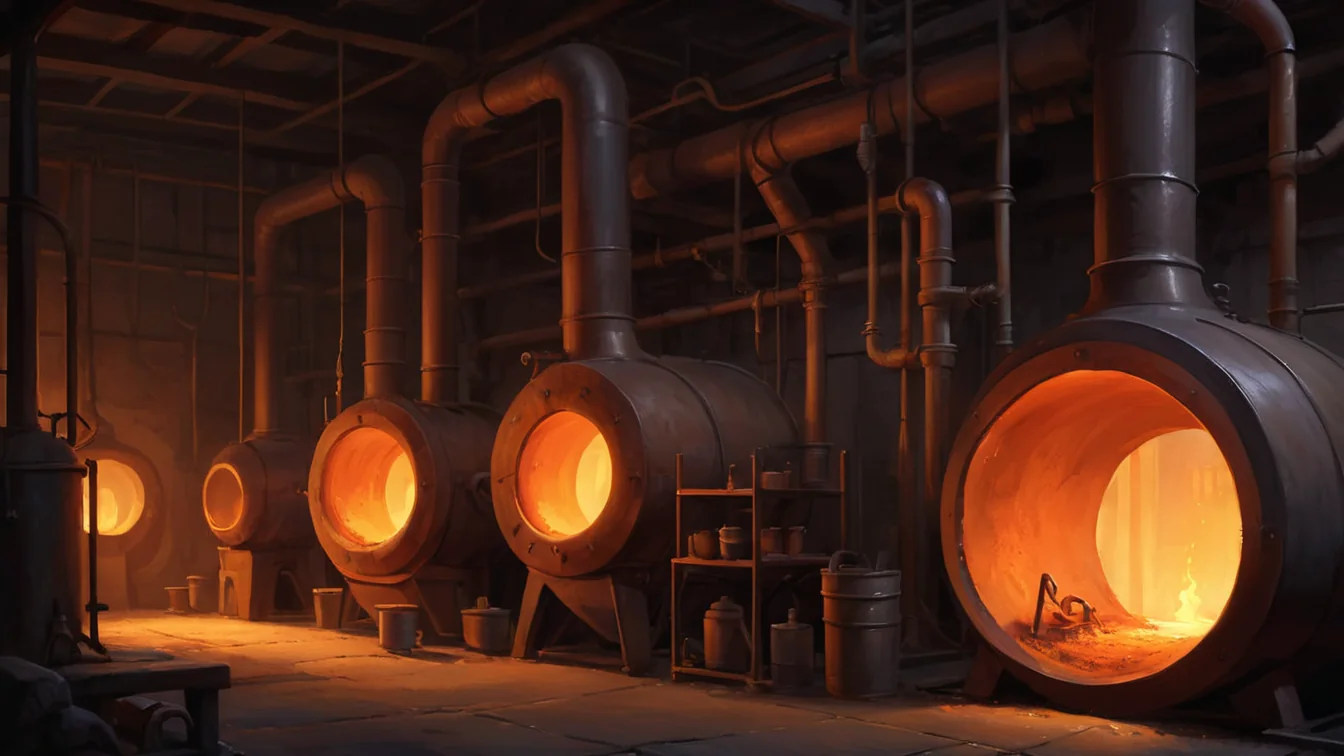
Walk along a beach and you are standing on the starting material for a window. Sand is made of tiny grains, and glass is see-through and hard. So how does a pile of sand become something you can look straight through?
The short answer: Most everyday glass is made by melting sand with soda and lime. Once the melt cools, its atoms lock into a disordered pattern rather than a regular crystal. That disorder is what makes glass a different kind of solid from a crystal.[1][2]
Start with sand
Sand is the main ingredient. The Purdue University chemistry resource on glass says that “Sand is still the most common ingredient from which glass is made.”[1] Rice University’s chemistry page on ceramics and glass notes that “the first glasses were made by melting sand at high temperature.”[3]
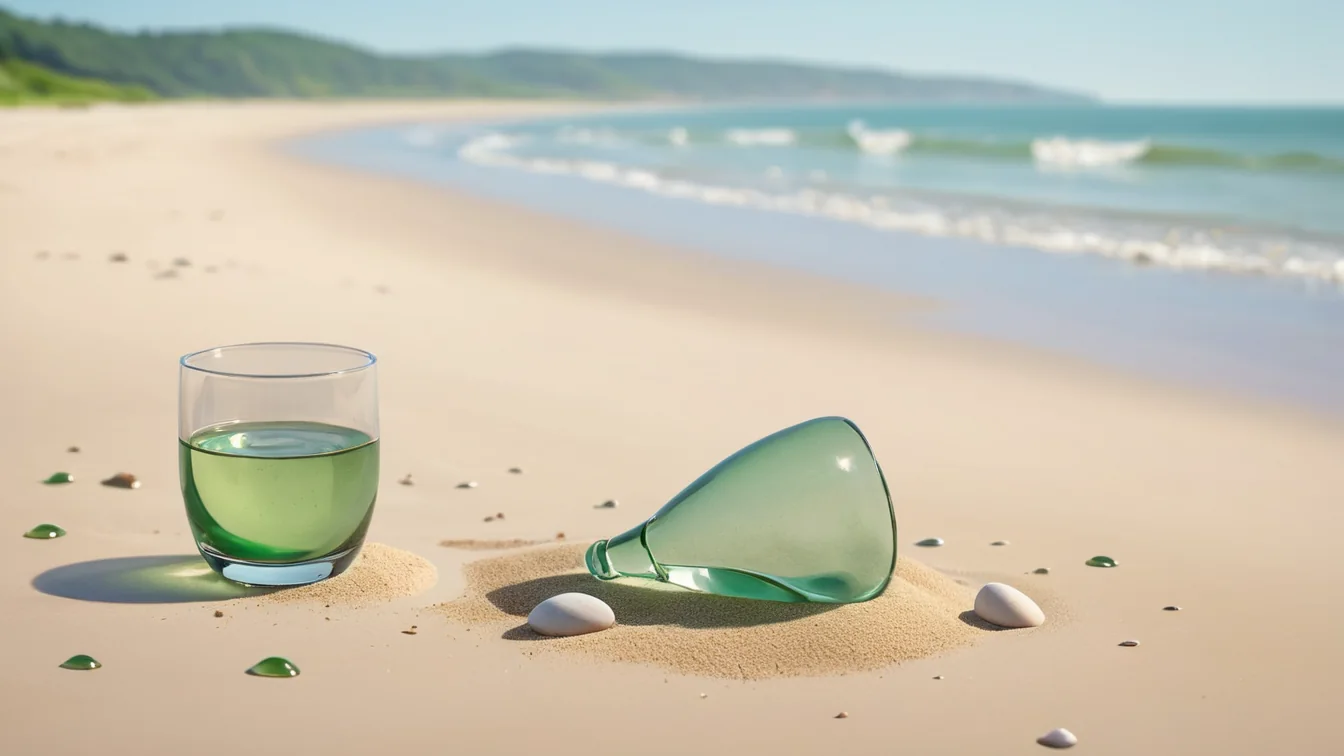
Sand is mostly silica. Pure silica is known as quartz glass, and the Rice page says it “has a very high melting point.”[3] That is the problem glassmakers have to solve: sand alone is very hard to melt.
Adding soda and lime
The solution is to add other ingredients. Purdue explains that “Modifiers (or fluxes) such as Na2O and CaO are added to the sand.”[1] Na2O is sodium oxide, which is the chemical name for soda. CaO is calcium oxide, which is the chemical name for lime. A flux is an ingredient, such as soda or lime, that makes the mixture more fluid when it is melted.
The most common type is soda-lime-silica glass, named after its three main ingredients.[5] The modifiers separate the silica units, which makes the mixture more fluid and more likely to form a glass when it is melted and then cooled. The sand provides the silica that forms the glass network itself.[1][3]
Melting the mixture
The mixture is then heated in a furnace. Purdue’s page describes the step simply: “heat the mixture of sand and modifiers until it melts.”[1] Furnaces for glass run very hot.
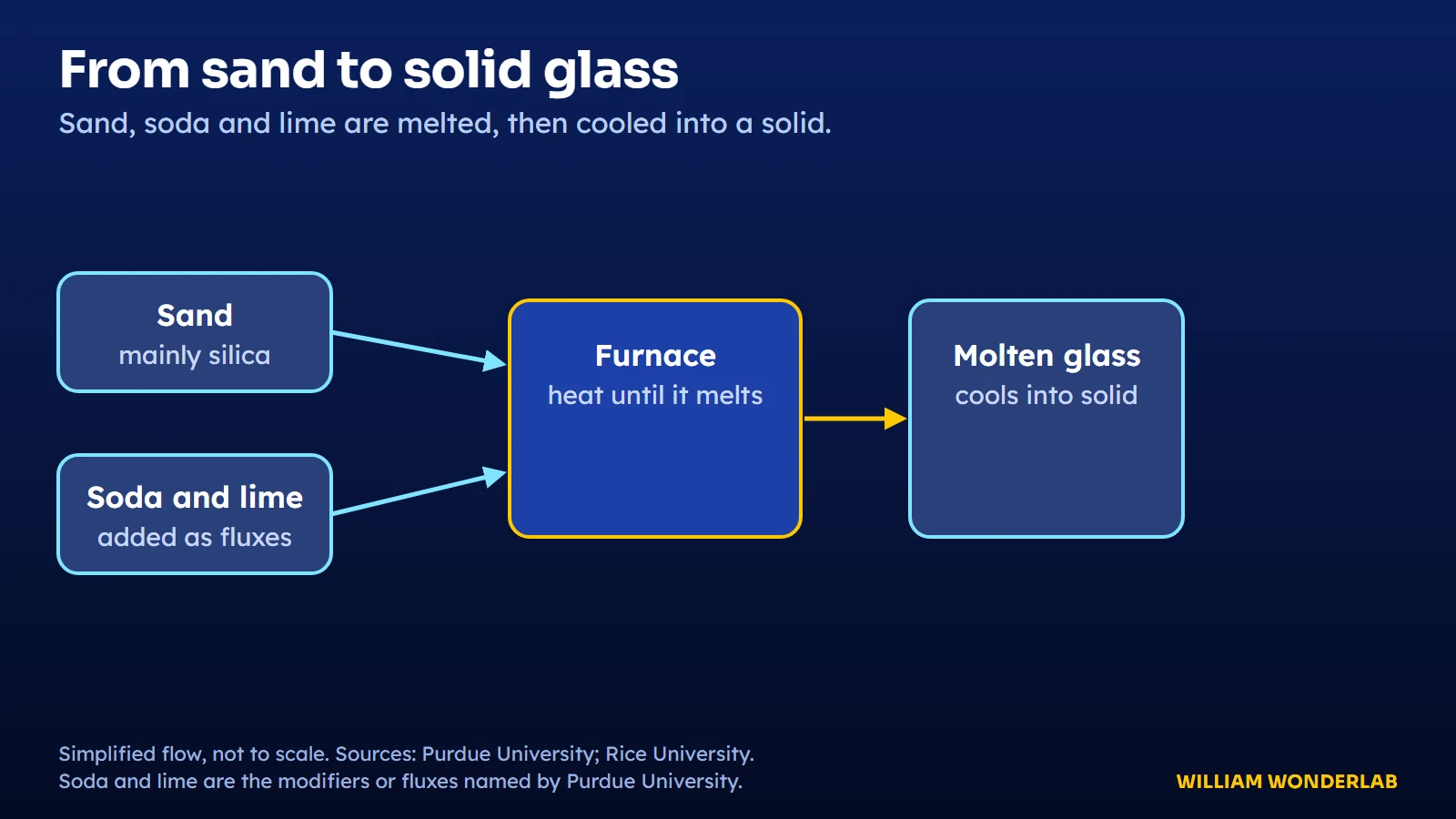
The diagram above shows the order of the steps. The ingredients go into the furnace, the melt is formed, and the molten glass is cooled into a solid.
Cooling without crystals
The key moment is cooling. According to the Royal Society of Chemistry, a melt-derived glass is made by cooling the liquid rapidly, so that crystals do not form.[4] If the atoms had time to line up in a regular pattern, the material would become a crystal instead.
Chemistry LibreTexts explains what happens to the atoms. “When the liquid is cooled, the macromolecular fragments cannot readily slide past one another.”[2] The silica network sets in place before the atoms can arrange themselves neatly. The result is “a collection of interconnected, randomly oriented tetrahedrons of oxygen atoms surrounding silicon atoms.”[2]
So glass is what chemists call amorphous, meaning it has no repeating crystal pattern. Purdue puts it simply: “First, and foremost, there is no long-range order.”[1]
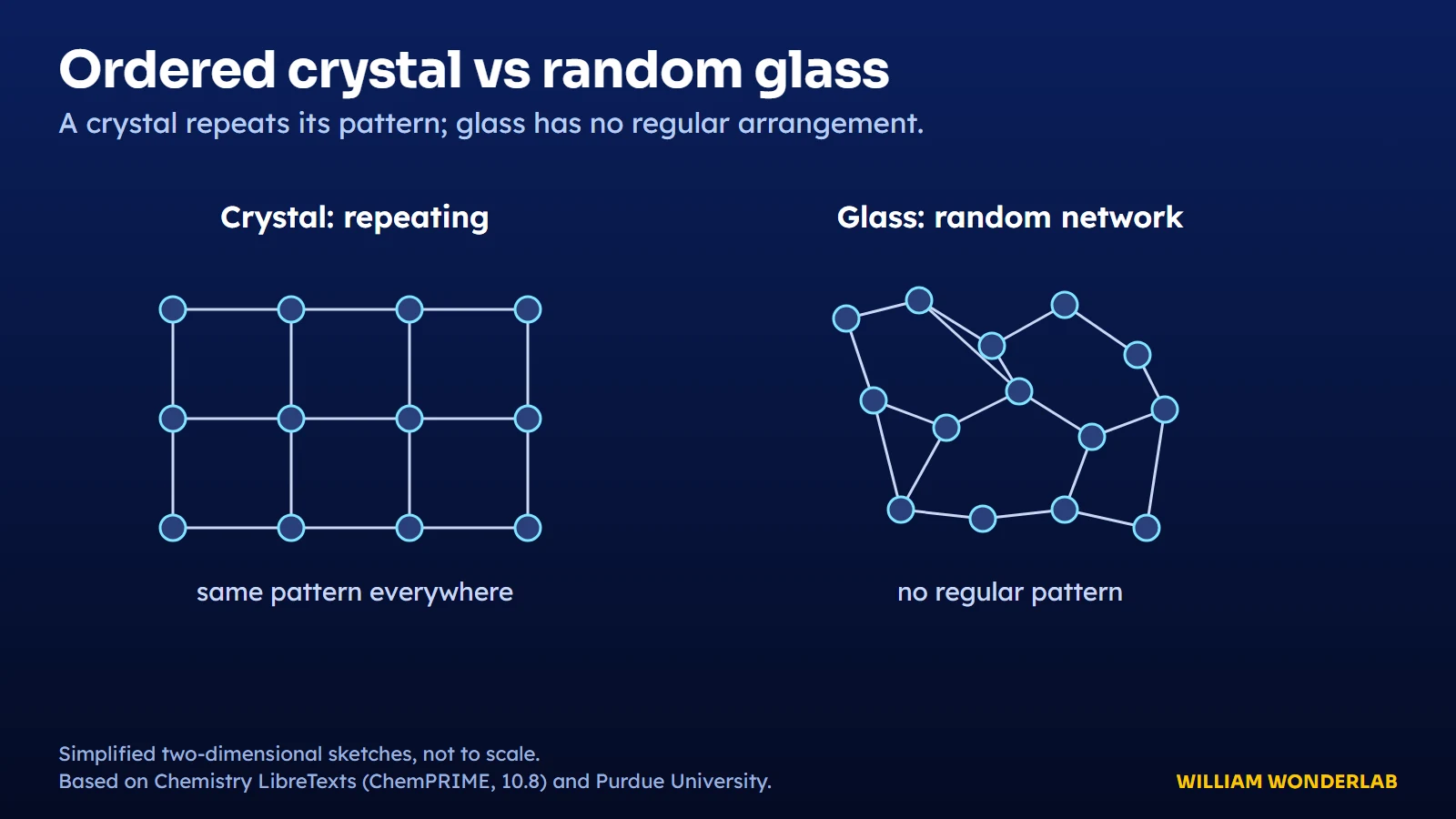
The network diagram is a simplified two-dimensional sketch. Real glass is three-dimensional, and the disorder is a matter of arrangement rather than a missing ingredient.
Try it: ordered or random?
This is a proposed at-home activity. Predict first: which set of beads will pack more neatly, the ones you lay out in rows or the ones you pour into a pile?
You need: about 20 dried beans or small beads (not food for young children), a flat tray, and a small cup.
- Predict which pattern will fit more beads into the same space: rows or a pile.
- Lay 20 beads on the tray in neat rows, like a crystal. Count how many fit in a square the size of a hand.
- Tip 20 beads from the cup onto the tray and spread them into a loose heap, like a glass. Compare how much space they fill.
- Write down what you noticed. Did the rows look more organised than the pile?
Safety first: Use dry beans or beads only, do this with an adult, and keep them away from young children, who may swallow them. Do not use anything sharp or fragile, and do not use any glass for this activity. Wash your hands after handling dried beans, especially if they are food. Keep the activity on a stable table.
Go deeper: silica and its network
The structure in more detail
Glass forms a three-dimensional framework. Chemistry LibreTexts describes silica glass as a network in which “there is no overall regular arrangement as in a crystal of quartz.”[2] Purdue notes that the modifiers are added to change the structure of the network.[1]
Why the mixture matters
Pure silica melts at a high temperature.[3] The modifiers separate the silica units, which makes the mixture more fluid and more likely to form a glass when it is melted and then cooled.[1] The glass still has to be cooled in a way that stops crystals forming.[4]
Frequently asked questions
Is glass a liquid or a solid?
Glass is usually called an amorphous solid. Purdue says there is “no long-range order”, which is what sets it apart from a crystal.[1][5]
What is the main ingredient in glass?
Sand. Purdue says it is “the most common ingredient from which glass is made.”[1]
Why add soda and lime to sand?
They act as fluxes. Purdue calls soda and lime modifiers or fluxes, and they separate the silica units so the mixture is more fluid.[1]
Why is glass not a crystal?
When the melt cools quickly, the atoms do not have time to line up into a regular crystal pattern.[2][4]
Can you make glass at home?
Making glass needs a furnace. The bead activity models order and disorder; it does not make glass.
The big idea
Melt, cool, and keep the disorder. Glass is mostly sand, with soda and lime added, which Purdue calls fluxes because they make the mixture more fluid. Cooled quickly, the atoms lock into a disordered network instead of a crystal, which gives glass its hard, clear character.
Related reading
More from William Wonderlab:
Explore more from scientists:
- 10.8: Amorphous Materials – Glasses (Chemistry LibreTexts, ChemPRIME)
- Glass and Other Ceramics (Purdue University, Chemical Education)
References
[1] Purdue University, Chemical Education, “Glass and Other Ceramics” (accessed 26 October 2026)
[2] Chemistry LibreTexts, ChemPRIME (Moore et al.), “10.8: Amorphous Materials – Glasses” (accessed 26 October 2026)
[3] Rice University, “Ceramics, Glasses & Glazes” (accessed 26 October 2026)
[4] Royal Society of Chemistry, Education, “Glass bones” (accessed 26 October 2026)
[5] Chemistry LibreTexts, Materials Science Supplemental Modules, “Glass (Amorphous Solids)” (accessed 26 October 2026)