Why Do Shadows Change During the Day?
Your shadow is long in the morning, short at midday and long again in the afternoon. The Sun's height in the sky decides how long it is.
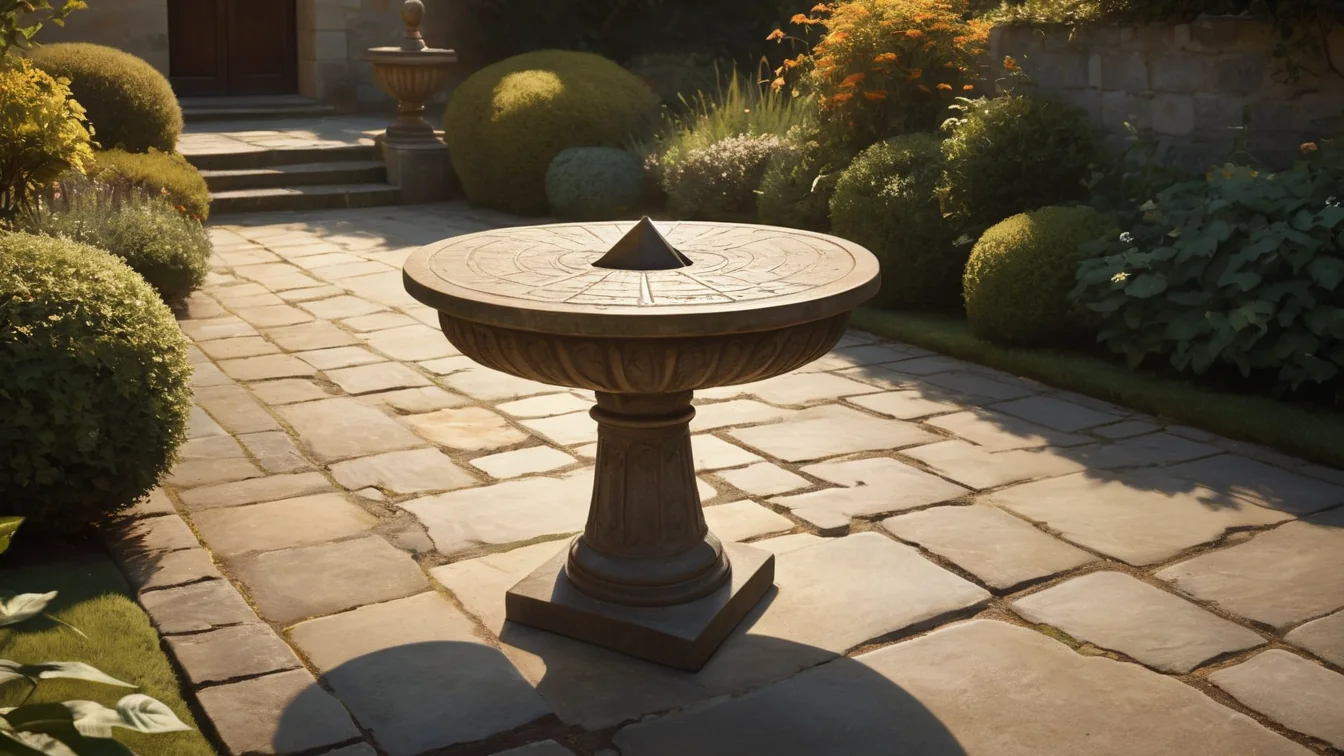
Watch your shadow on a sunny day and you will see it change. Early in the morning it stretches far behind you. At midday it shrinks to a small patch under your feet. In the afternoon it grows long again, pointing the other way. What is happening?
The short answer: The length of a shadow depends on how high the Sun is in the sky. When the Sun is low, shadows are long. When the Sun is high, shadows are short.[1] Earth turns during the day, so the Sun seems to move across the sky, and the Sun’s height changes all day long.[1]
The Sun is not moving, we are
It looks as if the Sun climbs into the sky, reaches the top and slides down again. Science Learning Hub, the New Zealand science education site, explains the reason: “From our vantage point on Earth, it appears that the Sun moves across the sky during the day.” The real cause is that Earth turns. As the Sun’s light falls on objects from a different angle, their shadows change.[1]
Science Learning Hub puts it directly: “When the Sun makes long and short shadows outdoors, it is the Earth, not the light source (Sun), that moves.”[1] So a shadow is a record of where you are standing on a turning planet.
Low Sun, long shadow
Think of a torch shining on a wall. If you hold it straight at the wall, the light makes a small, bright patch. If you tilt it so the beam is nearly flat, the shadow of an object on the wall becomes long and thin. Sunlight works the same way.
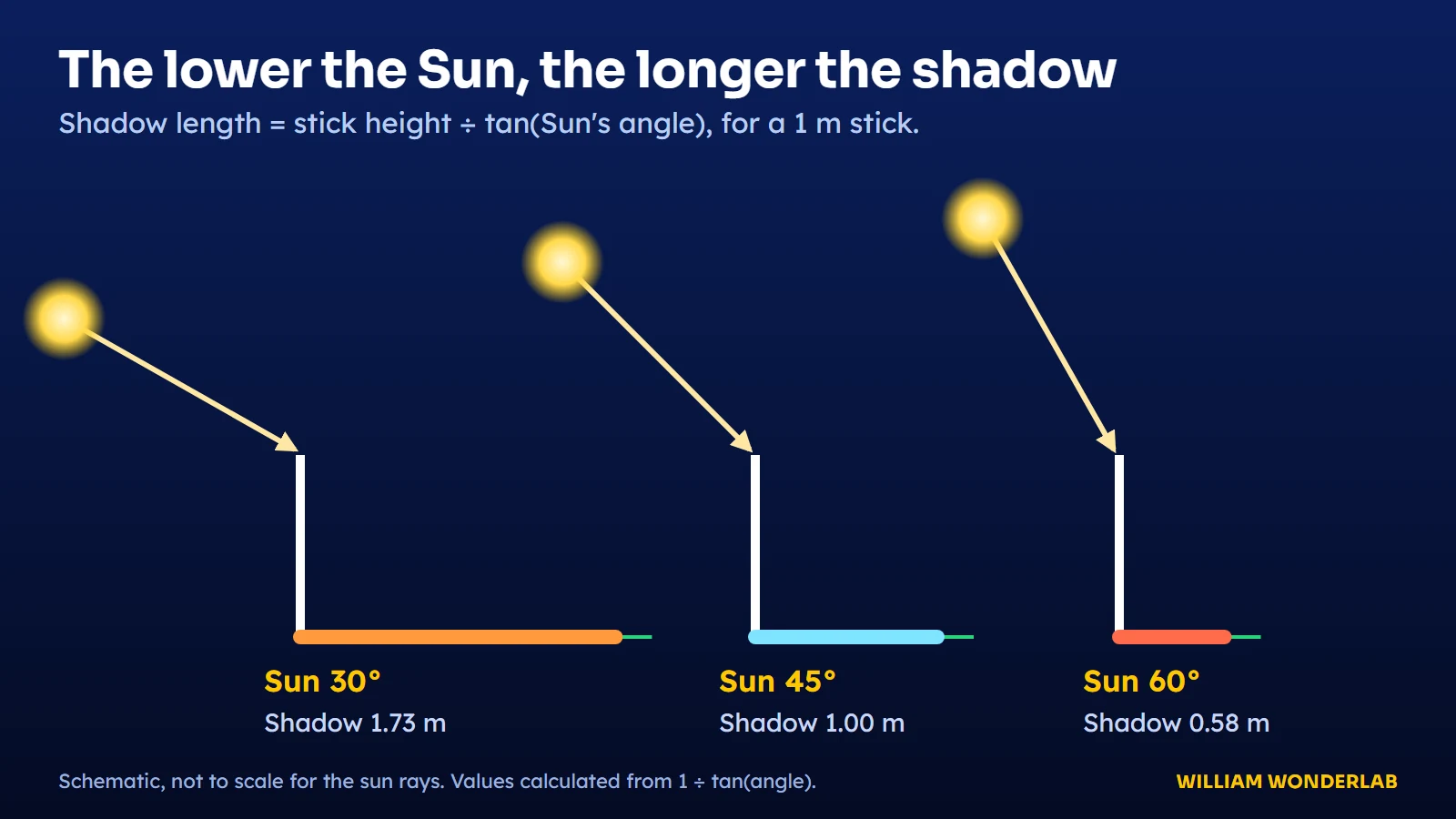
Science Learning Hub states: “When the Sun is low on the horizon, the shadows are long.” And: “When the Sun is high in the sky, the shadows are much shorter.”[1] The Sun’s height above the horizon is called its elevation, and it is the main thing that decides shadow length.
Why midday shadows are shortest
At midday the Sun is at its highest point for the day in your part of the sky, so its light comes down most steeply. Shadows are shortest then. In the morning and afternoon the Sun is lower, so the same object casts a longer shadow.
The Sun’s highest point also changes across the year. Earth’s axis is tilted by about 23.4 degrees (NASA’s Earth Fact Sheet gives 23.44 degrees), which is why the midday Sun is higher in summer than in winter.[2] You can read more about the tilt in our article on why Earth has seasons.
The sums behind shadow length
Here is the simple maths. If an object of height h stands on flat ground, and the Sun’s elevation is angle θ, the shadow length is:
shadow length = h ÷ tan(θ)
The tan (tangent) of an angle is a number from trigonometry. For a 1 metre stick:
- Sun at 30°: 1 ÷ tan(30°) = 1 ÷ 0.577 ≈ 1.73 m
- Sun at 45°: 1 ÷ tan(45°) = 1 ÷ 1.000 = 1.00 m
- Sun at 60°: 1 ÷ tan(60°) = 1 ÷ 1.732 ≈ 0.58 m
The pattern is clear: a smaller angle has a smaller tangent, and dividing by a smaller number gives a longer shadow.
Brisbane at noon
Brisbane lies at about 27.5 degrees south of the equator.[3] Using the noon formula, the noon Sun height is 90° minus the difference between your latitude and the Sun’s declination (the latitude where the Sun is directly overhead on that date).
In June, the Sun at noon sits about 39 degrees above the horizon. A 1 metre stick then casts a shadow of about 1.23 metres. In December, the noon Sun is about 86 degrees high, and the same stick casts a shadow of about 7 centimetres.
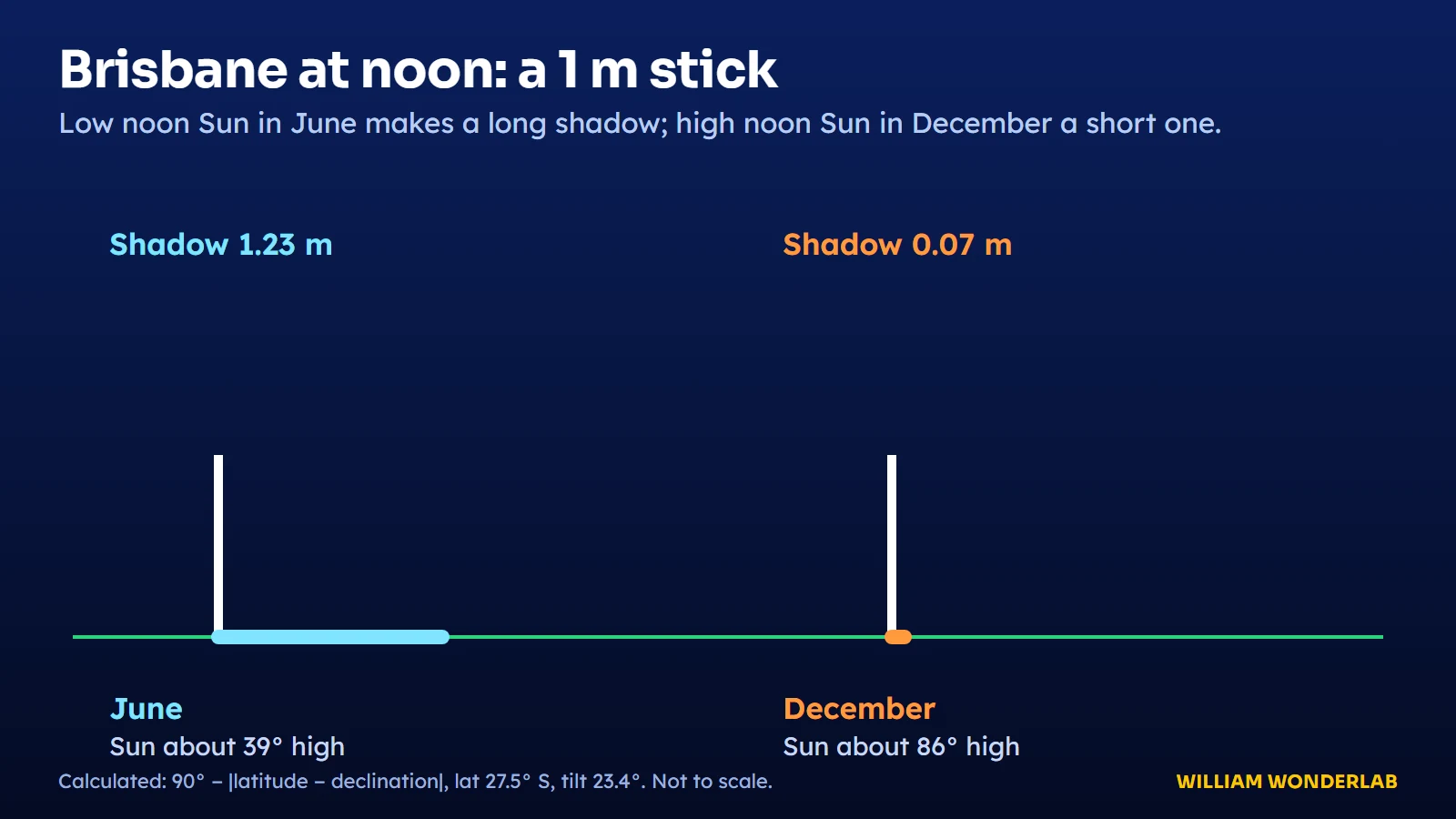
These numbers are calculated for this article from the latitude and tilt above. They show the pattern; they are not a weather forecast or a measurement of a particular day.
Try it: track your shadow
This is a proposed at-home activity. It works best on a clear day with a flat, sunny patch of ground.
You need: a straight stick or ruler about 30 cm long, a stone or a little sand to stand it upright, a piece of chalk, a tape measure, a notebook, and an adult to help.
- Stand the stick upright in the sunny patch, with a stone or sand packed around its base so it stays up.
- At a time you choose in the morning, mark the tip of the stick’s shadow with chalk. Write down the time and the shadow length.
- Repeat at about midday and again in the afternoon, using the same stick and the same spot.
- Measure each shadow from the base of the stick to the chalk mark.
- Predict first, then compare: which shadow was longest? Which was shortest?
What to expect: the morning and afternoon shadows should be longer than the midday one.
Safety first: Never look at the Sun, even briefly. Sunglasses do not protect your eyes when you look straight at it.[4] Use a chalk marker and a stick with a blunt end, and keep the stick away from faces. Be sun-safe the whole time you are outside: wear a hat, sunscreen and sunglasses that meet Australian Standards, and seek shade between measurements. An adult should supervise, and everyone should drink water.
Cancer Council Australia recommends the steps “Slip on some sun-protective clothing that covers as much skin as possible,” “Slap on a hat – broad brim or legionnaire style to protect your face, head, neck and ears,” “Seek shade,” and “Slide on some sunglasses – make sure they meet Australian Standards.”[5] Protecting your eyes matters whenever the UV level is 3 or above, and Cancer Council recommends that you do this at all times in those conditions.[4]
Go deeper: angles, tangents and real Suns
Why the tangent works
Imagine a right-angled triangle. The stick is one short side, the ground shadow is the other, and the Sun’s ray is the slanted side. The angle between the ray and the ground is the Sun’s elevation. The tangent of an angle is the ratio of the opposite side to the adjacent side, which is the stick height divided by the shadow length. Rearranging gives the formula above.
Frequently asked questions
Why are shadows longest near sunrise and sunset?
When the Sun is near the horizon, its light arrives at a shallow angle, so the shadow stretches a long way.[1]
Do shadows change only because the Sun moves?
Not exactly. It is Earth’s turning that changes the Sun’s apparent position, so the Earth moves rather than the light source.[1]
Why are shadows shorter in summer?
Earth’s axis is tilted, so the midday Sun is higher in summer. A higher Sun gives a shorter midday shadow.[2][3]
Can I look at the Sun to see where it is?
No. Looking at the Sun can damage your eyes, and sunglasses do not protect you when you look directly at it.[4] Use your shadow to judge direction instead.
Is a shadow always the same shape as the object?
Only when the ground is flat and the light is from a single point. Uneven ground and soft light change the shape.
The big idea
The Sun’s height sets the shadow. A low Sun makes long shadows and a high Sun makes short ones. Earth’s turning and tilt make the Sun’s height change during the day and across the year.
Related reading
More from William Wonderlab:
- Why Does Earth Have Seasons?
- Why Do Your Ears Pop on an Aeroplane?
- How Does a Magnifying Glass Make Things Look Bigger?
Explore more from scientists:
References
[1] Science Learning Hub (New Zealand), “Light and shadows” (accessed 25 October 2026)
[2] NASA, “Earth Fact Sheet” (NSSDC), last updated 15 November 2024 (accessed 25 October 2026)
[3] Geoscience Australia, gravity station record, University of Queensland, Brisbane (latitude -27.500066) (accessed 25 October 2026)
[4] Cancer Council Australia, “Fact sheet: Eye protection” (accessed 25 October 2026)
[5] Cancer Council Australia, “Preventing skin cancer” (accessed 25 October 2026)