Why Do Some Animals Glow in the Dark?
Some animals make their own light through a chemical reaction called bioluminescence. Australian glow-worms use their glow to catch insects.
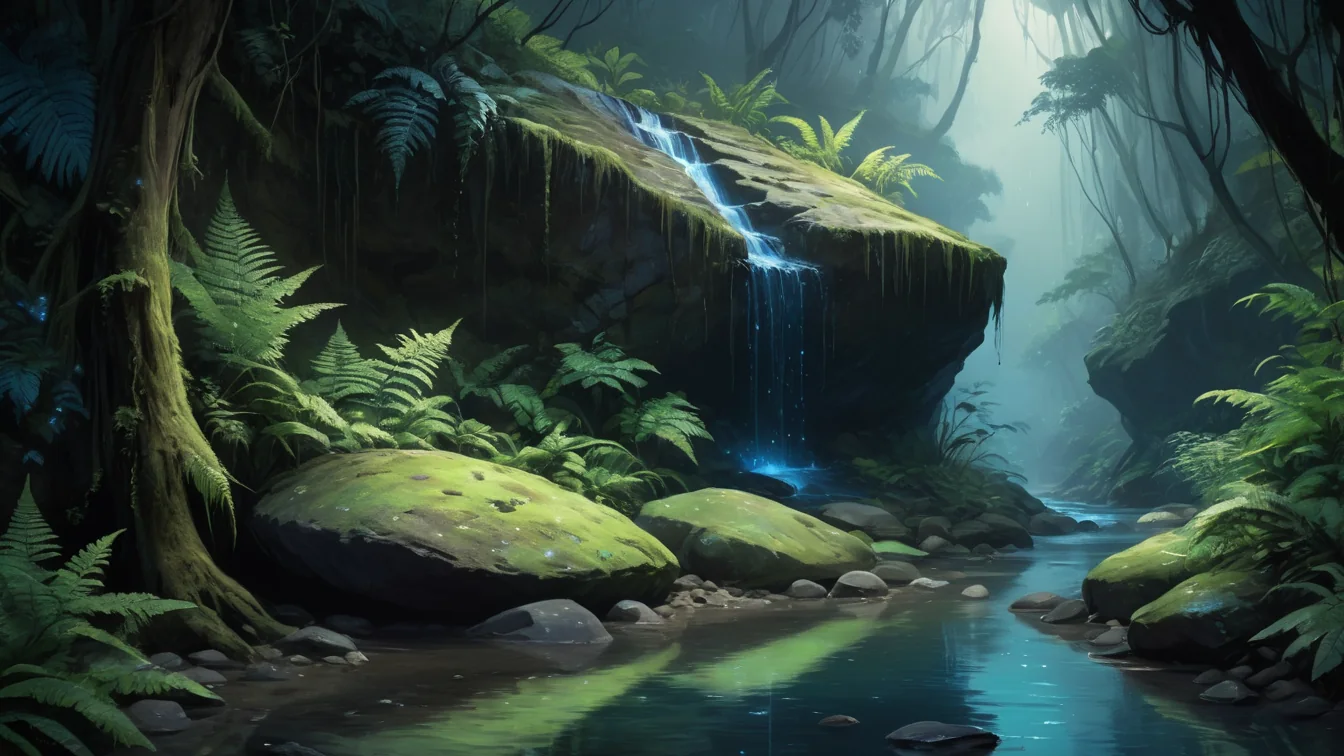
On a dark night, a cave ceiling can look like a sky full of stars. Those points of light are not stars. They are living animals making their own light. How does a creature glow without a bulb, a flame or a torch?
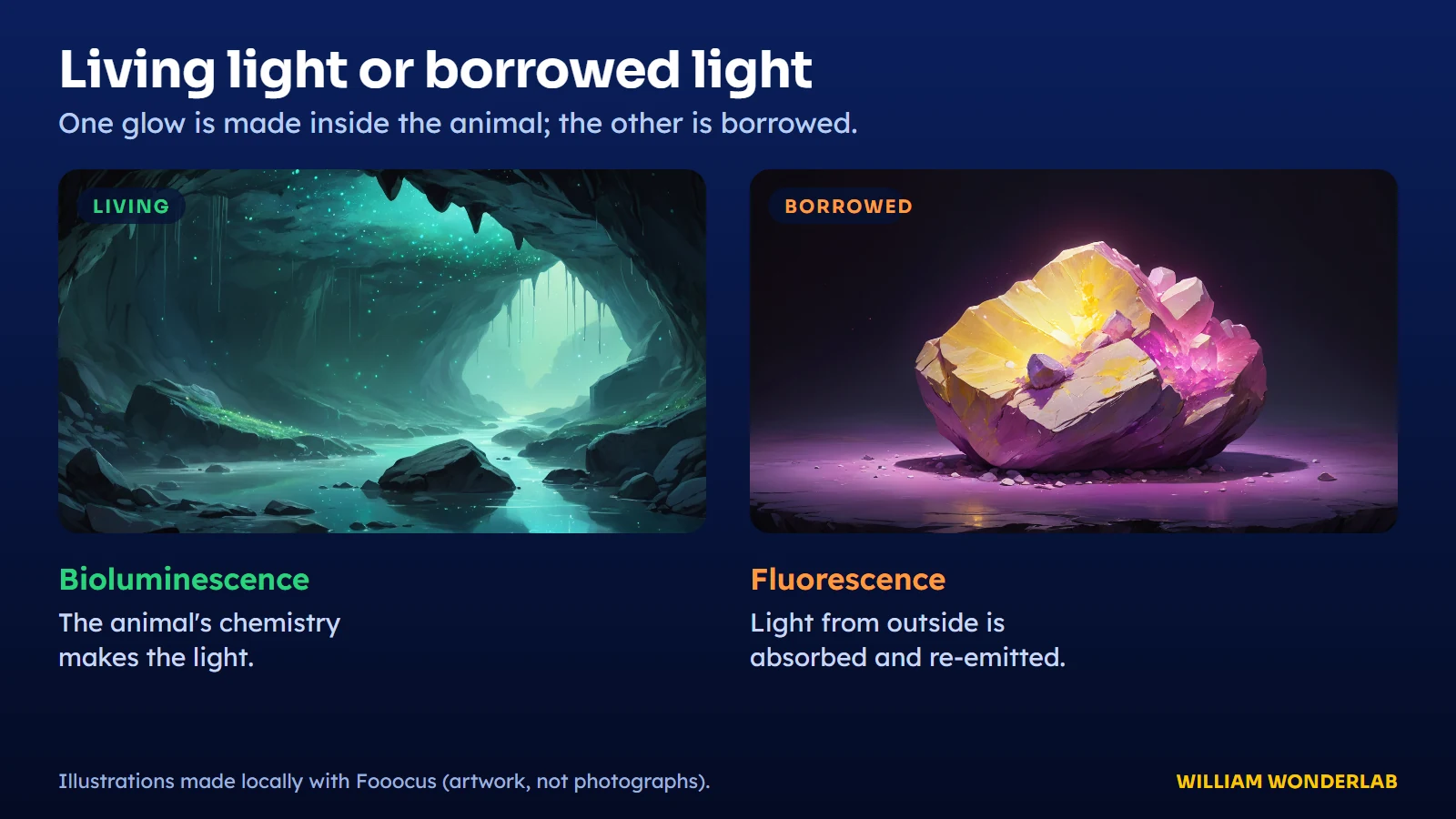
The short answer: Some animals glow through bioluminescence, which is light made by a chemical reaction inside a living thing. Many glowing animals use a substance called luciferin and an enzyme called luciferase. This is different from fluorescence, where a substance soaks up light and gives it back. Australian glow-worms, the larvae of fungus gnats, use their glow to lure insects into sticky threads.[1][2][3]
What bioluminescence is
Bioluminescence is a chemical trick. The University of California, Santa Barbara’s BL Web explains that “Bioluminescence is light produced by a chemical reaction within an organism.”[1] The US National Oceanic and Atmospheric Administration (NOAA) says it in simpler words: “Bioluminescence is a chemical process that allows living things to produce light.”[2]
So the light does not come from being warmed up or from sunlight. It comes from energy released in a reaction inside the animal’s body. The animal’s chemistry turns that energy into visible light.
The luciferin and luciferase recipe
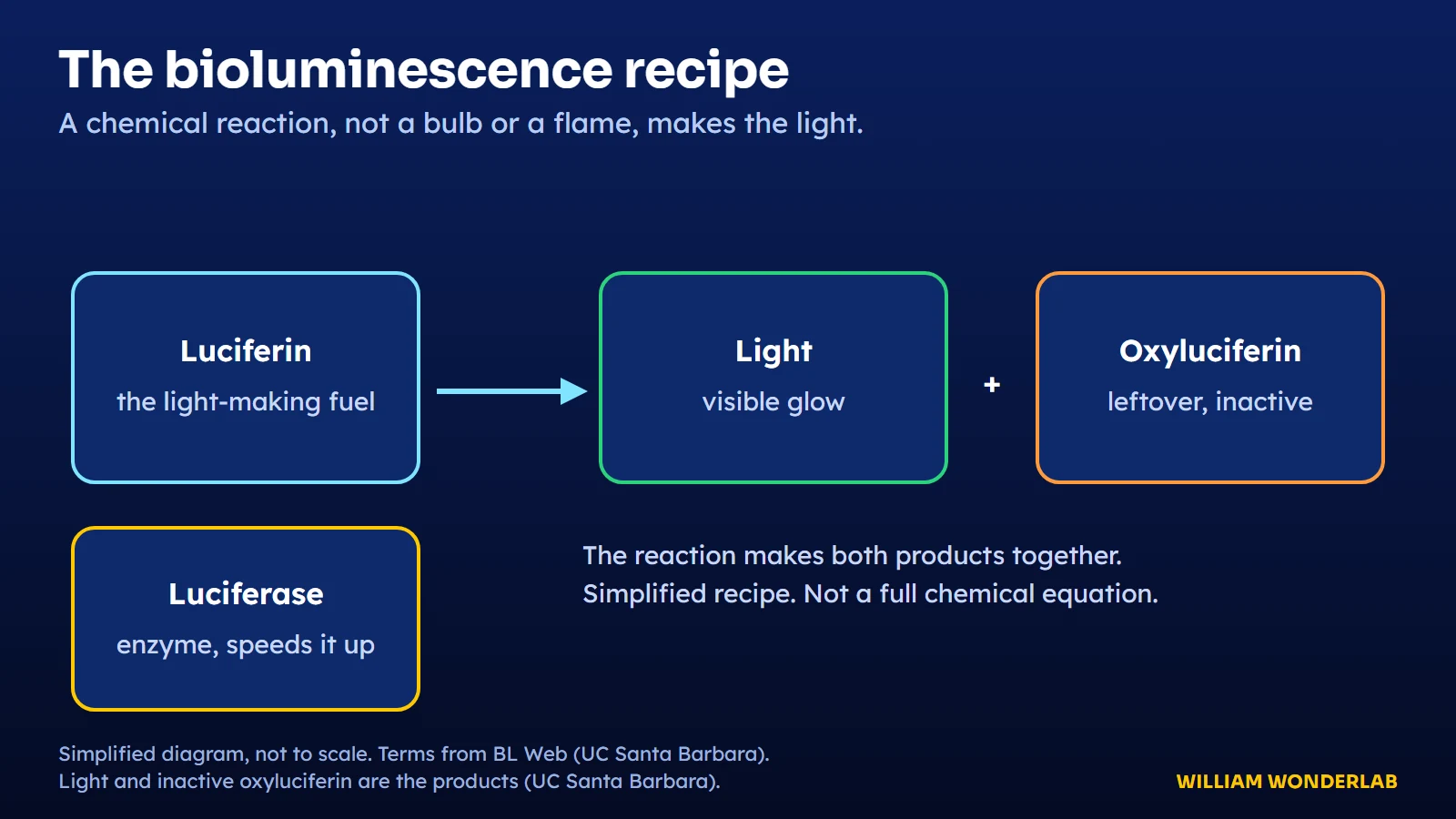
Scientists describe the reaction with two key ingredients:
- Luciferin is the substance that produces the light. BL Web says: “The one which produces the light is generically called a ‘luciferin.'”[1]
- Luciferase is an enzyme, a protein that speeds up a reaction. BL Web describes it as “the one that drives or catalyzes the reaction.”[1]
The reaction makes light and also a leftover product. BL Web says it produces “light and an inactive ‘oxyluciferin.'”[1] “Inactive” means the leftover molecule does not glow.
Think of it like a recipe. The luciferin is the ingredient that gets used up, and the luciferase is the helper that makes the recipe work quickly. (This is an everyday comparison, not a scientific model.)
Not every animal uses the same molecules. Researchers studying the New Zealand glow-worm, Arachnocampa luminosa, note that “many details remain elusive, including the identities of the luciferase and luciferin.”[4] In other words, even well-studied glow-worms still hold some open questions.
Glow-worms: the fungus gnat’s glowing larvae
Australian glow-worms are not worms. The NSW National Parks and Wildlife Service explains that “Glow worms are the larval life stage of small flying insects.”[3] The adults are small flies in the fungus gnat group. They live only a few days, mainly to mate and lay eggs.[3]
The glowing part is the larva. A study of a New Zealand glow-worm, Arachnocampa luminosa, found that the larva “luminesces from a small light organ located at the end of its tail.”[4] That study is of a New Zealand species, so its details are not automatically true for Australian glow-worms. The larva is also a predator. Sharpe and colleagues describe it as “the carnivorous larva of a fungus gnat.”[4]
How the glow catches dinner
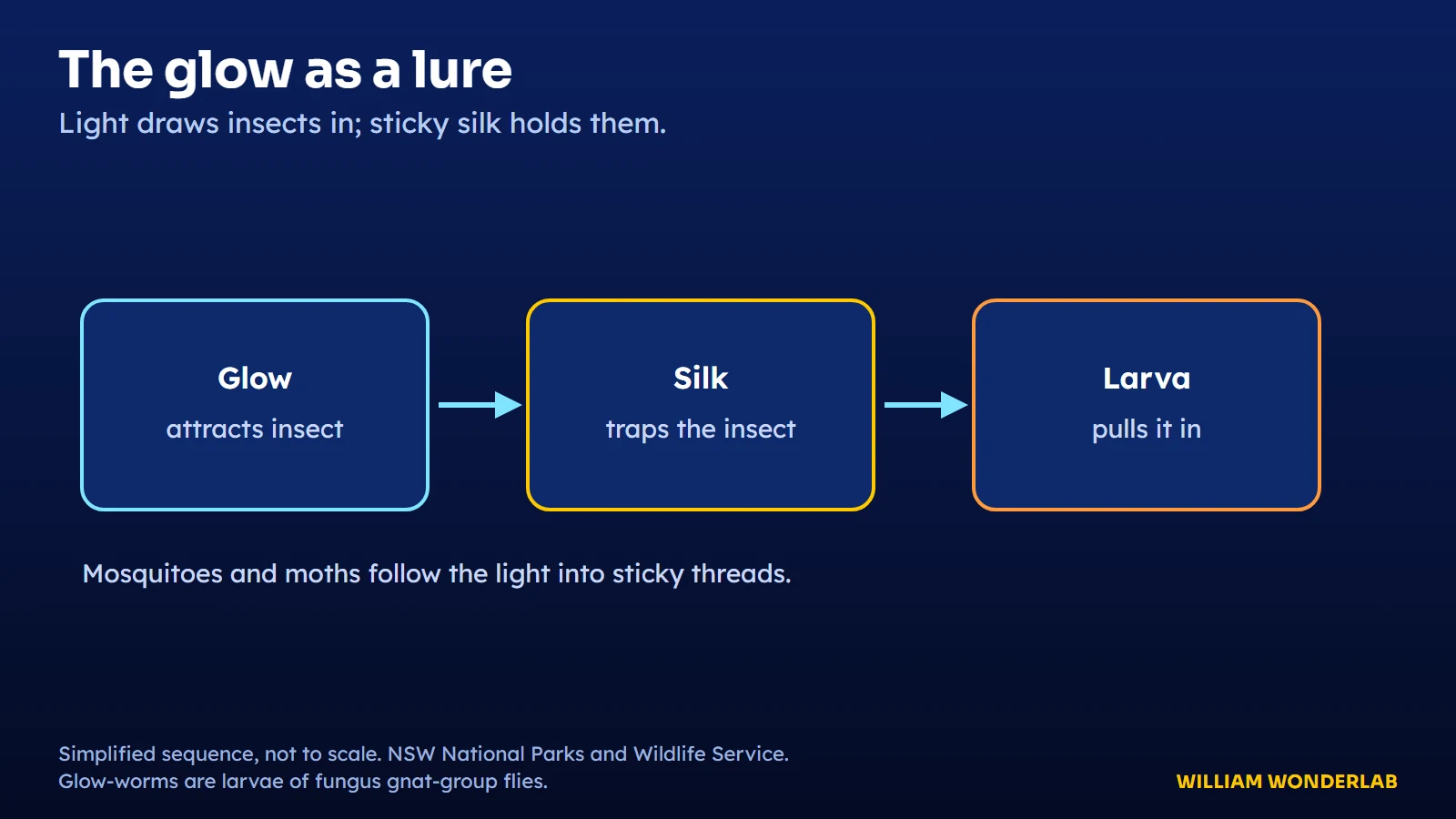
The light is bait. The NSW park service says prey such as mosquitoes and moths are drawn to the glow. Once an insect flies towards the light, it can become stuck in sticky silk threads hanging from the glow-worm’s nest. The larva then pulls the insect in to eat.[3]
Fluorescence: borrowing light
Bioluminescence is often confused with fluorescence, and the two are not the same. BL Web states that “Bioluminescence is not the same as ‘fluorescence’ or ‘phosphorescence.'”[1] It explains the difference this way: “In fluorescence, energy from a source of light is absorbed and reëmitted as another photon.”[1]
In plain words, fluorescence needs light to start with. A fluorescent object soaks up light from a lamp and sends it back out, often in a different colour. Bioluminescence does not need an outside light. The animal’s chemistry makes the glow.
Did you know? Even a well-studied glow-worm can keep secrets. Sharpe and colleagues reported that, for the New Zealand glow-worm they studied, the identities of its luciferase and luciferin were still unclear.[4]
Go deeper: the chemistry and the open questions
Why the reaction is hard to study
Many glowing animals use two named parts: the luciferin, which is used up to make the light, and the luciferase, which drives the reaction.[1] The Sharpe study notes that, for the New Zealand glow-worm, “many details remain elusive, including the identities of the luciferase and luciferin.”[4] That is a reminder that the chemistry of some glow-worms is still being worked out.
Why the glow is part of a hunting system
The NSW park service describes the glow as the lure, and the sticky threads as the trap.[3] Together they form a system that depends on both the animal’s chemistry and its behaviour.
Frequently asked questions
Are glow-worms really worms?
No. They are the larval stage of small flying insects in the fungus gnat group.[3]
Is bioluminescence the same as fluorescence?
No. Bioluminescence is made by a chemical reaction in the organism. Fluorescence absorbs light from a source and re-emits it.[1]
What is luciferin?
Luciferin is the substance that produces the light in bioluminescence. The luciferase enzyme speeds up its reaction.[1]
What do glow-worms use their light for?
They use it to attract prey, such as mosquitoes and moths, into sticky silk threads.[3]
The big idea
Living light is chemistry. Bioluminescence uses a reaction between luciferin and luciferase to make light inside an animal. Fluorescence borrows light from outside. Glow-worms turn their glow into a fishing lure.[1][3]
Related reading
More from William Wonderlab:
Explore more from scientists:
- Bioluminescence and luciferin, BL Web (University of California, Santa Barbara)
- What Is Bioluminescence? (NOAA Ocean Today)
- Glow worms (NSW National Parks and Wildlife Service)
References
[1] University of California, Santa Barbara, BL Web, “Bioluminescence and chemiluminescence” (chemistry page), Ecology, Evolution and Marine Biology (accessed 25 October 2026)
[2] NOAA Ocean Today, “What Is Bioluminescence? (Part 3)”, National Ocean Service (accessed 25 October 2026)
[3] NSW National Parks and Wildlife Service, “Glow worms” (accessed 25 October 2026)
[4] Sharpe, Dearden, Gimenez and Krause, “Comparative RNA seq analysis of the New Zealand glowworm Arachnocampa luminosa reveals bioluminescence-related genes”, BMC Genomics 16:825 (2015), via PubMed Central (accessed 25 October 2026)