Why Is the Sun So Hot?
The Sun is hot because its core reaches about 15 million degrees Celsius, where hydrogen is fused into helium and releases energy as heat and light.

Stand in the sunshine on a warm day and you can feel the Sun’s heat on your skin. But the Sun is not a fire, and it is not a solid ball of hot rock. It is a huge ball of gas. So how does it get so hot, and keep giving off heat and light for billions of years?
The short answer: The Sun is hot because its core is extremely hot, about 15 million degrees Celsius. In the core, hydrogen is squeezed and fused into helium. This process is called nuclear fusion, and it releases the energy that powers the Sun’s heat and light.[1][2]
A ball of hydrogen and helium
NASA describes the Sun as “a huge ball of hydrogen and helium held together by its own gravity.”[1] Gravity is the pull that every object with mass exerts on every other object. The Sun is so large that its own gravity pulls all of its gas towards the centre.
NASA also calls the Sun “a 4.5 billion-year-old yellow dwarf star.”[1] It is a star, which means it makes its own energy, rather than just reflecting light the way the Moon does.
Because the gas is pulled inward, the material in the middle is squeezed very hard, and the core becomes very hot.
The core is the hottest part
NASA says that “The hottest part of the Sun is its core, where temperatures top 27 million °F (15 million °C).”[1] Space Place gives the same figure: “It gets as hot as 27 million degrees Fahrenheit in the sun’s core.”[2] The Natural History Museum in London also says: “The core is the hottest part of the Sun, at 15 million degrees Celsius.”[3]
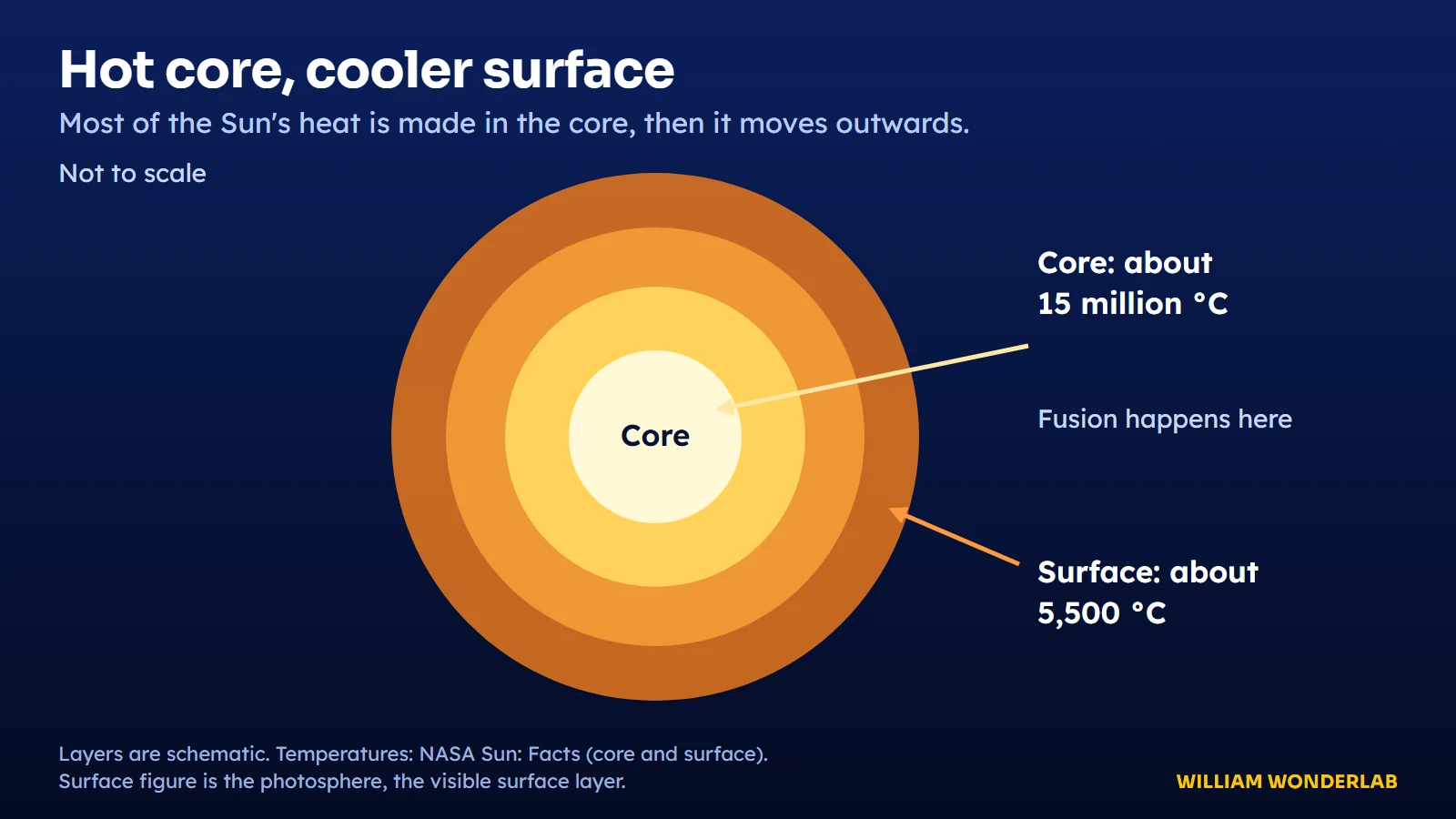
Outside the core, the Sun gets cooler. NASA describes the surface, the photosphere, as “a relatively cool 10,000 °F (5,500 °C).”[1] That is still very hot, but it is far cooler than the core. Most of the Sun’s heat is made in the core and then moves outwards.
Did you know? The Sun’s surface is about 5,500 °C, but its core is about 15 million °C. The heat is made deep inside, not at the bright surface you can see.[1]
Hydrogen becomes helium
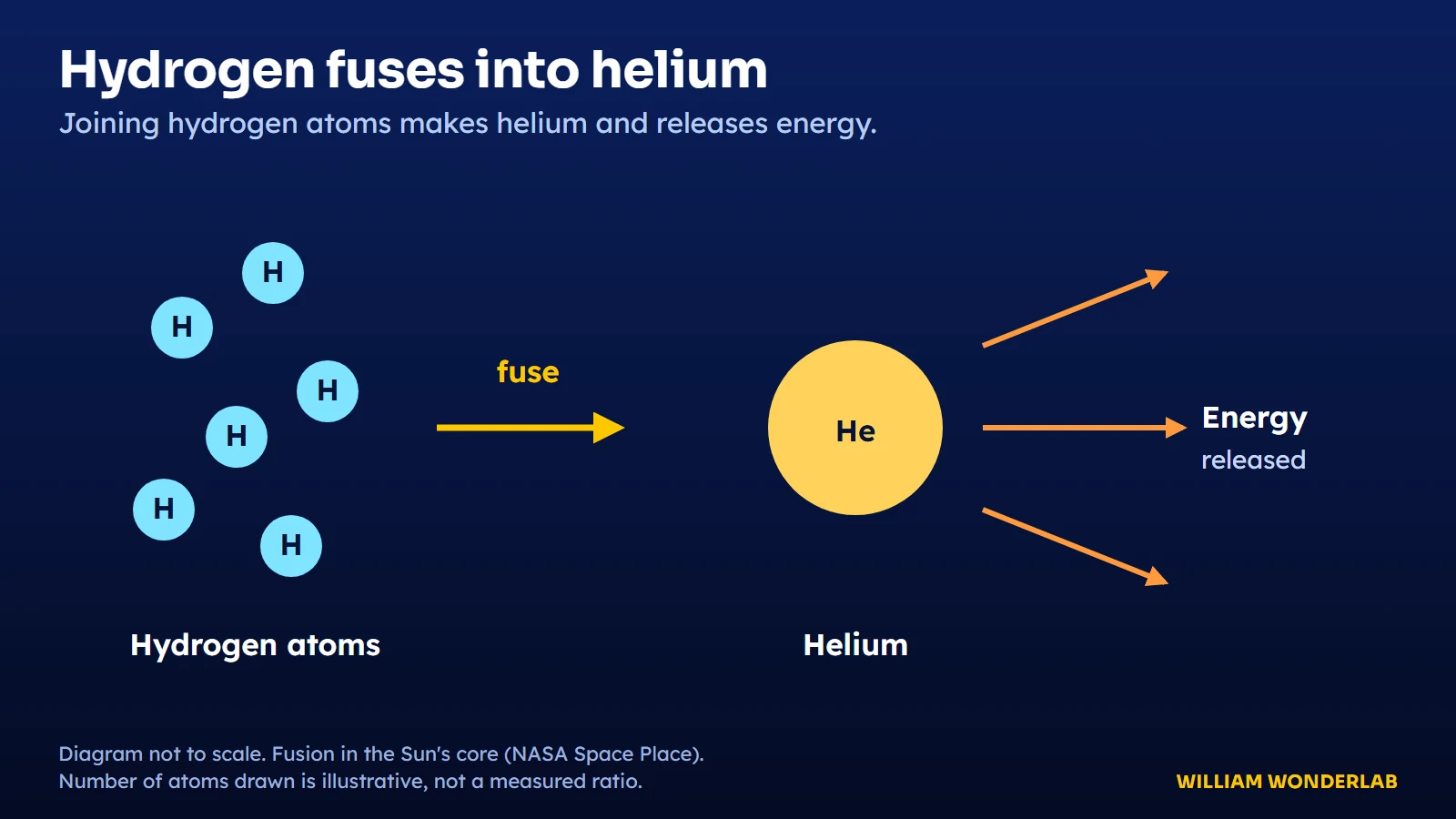
Inside the core, hydrogen atoms are pushed together with great force. Space Place explains: “the hydrogen atoms collide with enough force that they literally meld into a new element—helium.”[2]
This joining is called nuclear fusion. Fusion means joining small things into something bigger. Space Place says the process “releases energy while creating a chain reaction.”[2] NASA puts it this way: “Nuclear reactions here – where hydrogen is fused to form helium – power the Sun’s heat and light.”[1]
An everyday comparison helps. Think of two bouncy balls thrown together very hard. They can crash together and stick, and the crash gives off energy. The Sun’s hydrogen atoms do something similar, but on a scale far too small to see, and at a temperature of millions of degrees.
Why the energy reaches us
The energy made in the core travels outward through the Sun and eventually escapes as heat and light from its surface. Some of that light travels across space to Earth. NASA notes that “Without the Sun’s energy, life as we know it could not exist on our home planet.”[1]
That is why the Sun matters to plants and to the solar panels on many rooftops. Plants use sunlight to make food, as explained in How Do Plants Turn Sunlight Into Food?
Go deeper: why such high heat is needed
Why fusion needs extreme heat
Hydrogen nuclei carry a positive electric charge, so they push each other away. A physics textbook calls this Coulomb repulsion, and says it is “the major obstruction to fusion.”[4] The nuclei have to be pushed close enough together to fuse. The same textbook says: “One way to accomplish this is to heat fusion fuel to high temperatures.”[4] Heat makes particles move faster, so the very high temperature of the core gives the nuclei enough energy to get close.
How long the Sun has been shining
NASA describes the Sun as “a huge ball of hydrogen and helium held together by its own gravity,” and calls it “a 4.5 billion-year-old yellow dwarf star.”[1] Its fuel has therefore lasted for billions of years, which is why the Sun has been shining steadily for so long.
Frequently asked questions
Is the Sun on fire?
No. Fire needs oxygen and burns fuel. The Sun is made of hydrogen and helium, and its heat and light come from fusion in its core.[1][2]
How hot is the Sun’s core?
NASA says the core is about 27 million degrees Fahrenheit, or 15 million degrees Celsius.[1]
Is the Sun’s surface as hot as its core?
No. NASA gives the surface, the photosphere, as about 5,500 °C, which is far cooler than the core.[1]
What is nuclear fusion?
Nuclear fusion is the joining of hydrogen atoms into helium. The process releases energy, which is how the Sun powers its heat and light.[2]
The big idea
The Sun is hot because its core is extremely hot. Gravity squeezes the Sun’s material, the core reaches about 15 million °C, and hydrogen fuses into helium there. The energy from that fusion becomes the heat and light that reach us.
Related reading
More from William Wonderlab:
- Why Does the Moon Turn Red During a Lunar Eclipse?
- What Causes a Solar Eclipse?
- How Do Solar Panels Make Electricity?
Explore more from scientists:
References
[1] NASA Science, “Sun: Facts” (accessed 25 October 2026)
[2] NASA Space Place, “Where Does the Sun’s Energy Come From?” (accessed 25 October 2026)
[3] Natural History Museum, London, “The Sun” fact file (accessed 25 October 2026)
[4] LibreTexts, Introduction to Physics (Park), “15.9: Fusion” (accessed 25 October 2026)