What Is a Supernova?
A supernova is an enormous explosion that ends a star's life. Here is how a massive star's core collapses, and how a white dwarf can explode.

Most stars shine steadily for a very long time. But some end their lives with a blast so powerful that, for a short while, the blast outshines everything around it. Astronomers call this a supernova.
The short answer: A supernova is an enormous explosion that ends the life of a star. It happens in one of two main ways. In a massive star, the core collapses under its own gravity. In a white dwarf, the star exceeds its weight limit and explodes.[1][2]
What a supernova is
Inside a star, a process called nuclear fusion joins lighter atoms into heavier ones. ESA explains that iron forms this way in the cores of stars about eight times more massive than the Sun.[3]
A supernova is what happens when that balance breaks down in a violent way. The outside of the star is blown into space, and for a short time the explosion can be extremely bright. NASA’s Hubble Space Telescope imaged one supernova in the galaxy NGC 2403. In that picture, the explosion of a massive star blazes with the light of 200 million Suns.[4]
Two ways to make a supernova
Astronomers group supernovae by how they start. Here are the two main routes, shown as a simplified picture.

Route 1 happens in a massive star. Route 2 happens when a white dwarf, a dense star left over from a smaller star, reaches a limit and blows apart. The rest of this article looks at each route in turn.
Route 1: a massive star’s core collapses
A massive star builds heavier elements layer by layer. Its deepest part, the core, ends up made mostly of iron. Chandra X-ray Observatory notes that “the continued fusion of iron requires more energy than is available.”[2] In other words, making iron costs energy instead of releasing it, so the star loses the push that held its core up.
Think of a ball resting on a cushion of air. When the air can no longer hold the ball up, the ball drops. That is a simplified picture of what happens to the core. Once the core reaches about 1.4 times the mass of the Sun, a limit called the Chandrasekhar limit, the pressure that normally resists collapse can no longer stop it.[2]
The collapse is extremely fast. Chandra describes the core as collapsing “from a diameter of ~8000 kilometers to ~19 kilometers” in less than a second.[2] The outer layers are then thrown outward. ESA describes how the outer shells are blasted away, and how “a huge amount of material rich in dust and heavy metals, including iron” is blown out into interstellar space.[3]
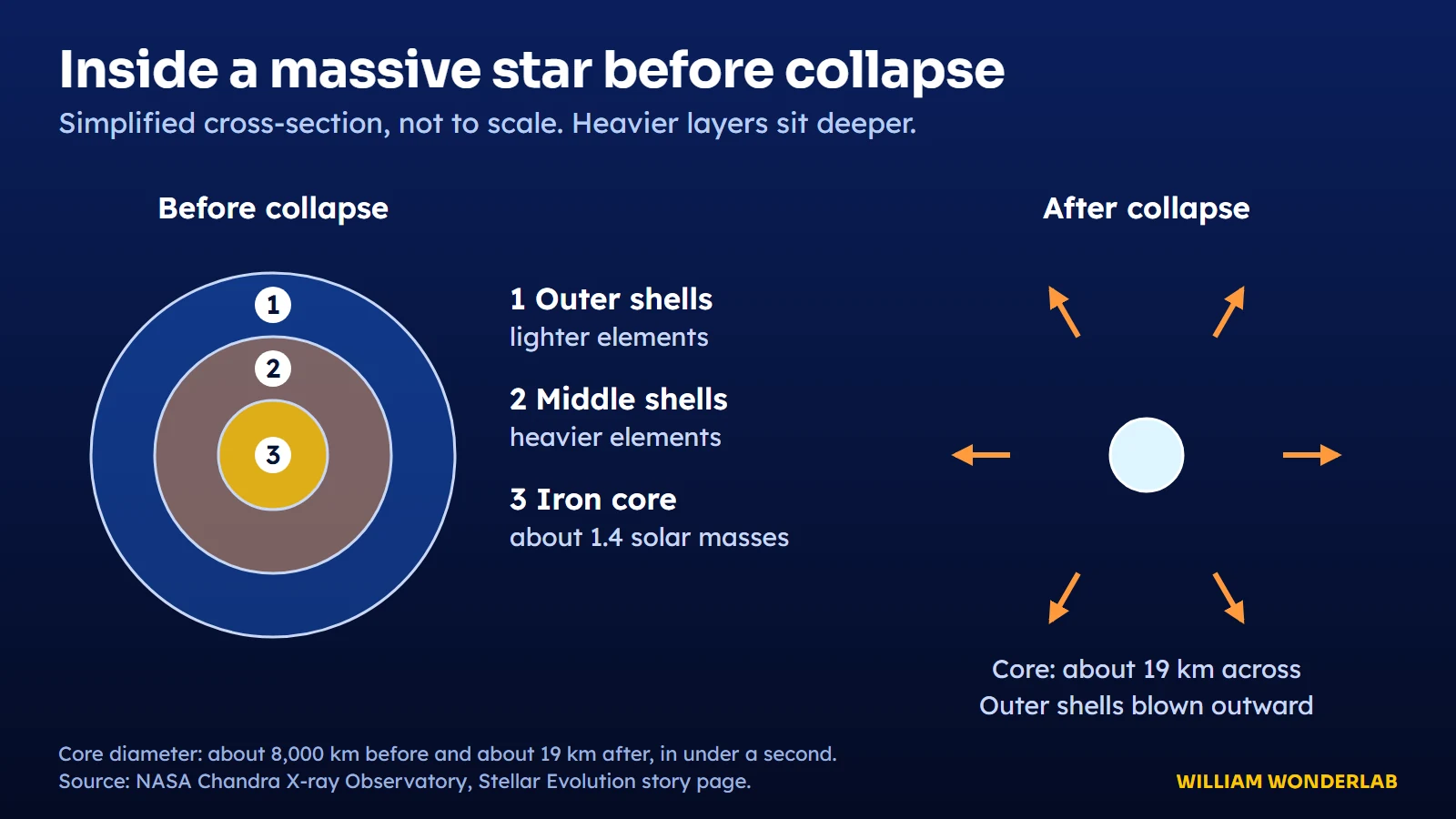
Most of the energy from the collapse does not stay in the star. Chandra says that most of it is carried off into space by neutrinos, which are tiny particles.[2]
Route 2: a white dwarf explodes
The second route usually involves a pair of stars. A white dwarf can gain mass by accretion, pulling in material from a companion star. Chandra notes that what pushes it over the edge is uncertain, and a merger between two white dwarfs is another possibility.[1]
Chandra’s writeup on this topic says that “most scientists agree” that a Type Ia supernova happens when a white dwarf “exceeds its weight limit, becomes unstable and explodes.”[1] Route 1 is often called core collapse, and Chandra classes it as a Type II supernova.[2] Route 2 is the Type Ia.[1]
Scientists are still working out the details of exactly how these explosions start, so it is best to treat the story as the current best picture.
Scattering the ingredients for new worlds
Supernovae do more than make light. They also spread material through space. ESA reports that the blast sends a huge amount of material rich in heavy metals, including iron, into space.[3] Chandra adds that the material is “spread out through the universe and through the galaxy.”[5]
This matters for planets. ESA says that our Solar System formed from a cloud of dust and gas that had been enriched by material from supernova explosions.[3] In other words, the gas and dust that later made the Sun and its planets had already been mixed with the remains of earlier stars.
Go deeper: the numbers
How much the core shrinks
The core’s diameter changes from about 8,000 km to about 19 km.[2] That is a shrink of about 420 times across. Here is the calculation:
- 8,000 km ÷ 19 km ≈ 421
If the core were a perfect sphere, its volume would shrink by about 421 × 421 × 421 ≈ 75 million times. Real cores are not perfect spheres, so treat that as a rough picture.
Why the Hubble comparison matters
The phrase “200 million Suns” describes light, not size.[4] The Sun is one ordinary star. In that Hubble image, one massive star’s explosion is described as blazing with the light of 200 million Suns. Its brightness is what makes a distant supernova visible from Earth.
Frequently asked questions
What is the difference between the two types?
The first is a massive star whose core collapses under its own gravity. The second is a white dwarf that exceeds its weight limit and explodes.[1][2]
Will the Sun become a supernova?
Not by the core-collapse route. ESA says iron forms in the cores of stars about eight times more massive than the Sun, and the Sun is much less massive than that.[3] A white dwarf needs to gain mass from a companion or a merger to explode (see Route 2).
Does a supernova make heavy elements?
Heavy elements such as iron are part of the material a supernova blasts into space.[3]
How bright can a supernova be?
In NASA’s Hubble image of NGC 2403, one massive star’s explosion blazes with the light of 200 million Suns.[4]
The big idea
A supernova is a star’s final blast. Either a massive star’s core collapses, or a white dwarf passes its weight limit. Both can release enough light to outshine everything nearby, and the explosion scatters material that may later help form new stars and planets.
Related reading
More from William Wonderlab:
Explore more from scientists:
- NASA Chandra X-ray Observatory: Stellar Evolution, cycles of formation and destruction
- NASA Hubble: A Bright Supernova in the Nearby Galaxy NGC 2403
- ESA: Supernovas blast iron into interstellar space
References
[1] NASA Chandra X-ray Observatory, “NASA’s Chandra Reveals Origin of Key Cosmic Explosions” (accessed 26 October 2026)
[2] NASA Chandra X-ray Observatory, “Stellar Evolution: Cycles of Formation and Destruction” (accessed 26 October 2026)
[3] European Space Agency (ESA), “Supernovas blast iron into interstellar space” (accessed 26 October 2026)
[4] NASA Hubble Space Telescope, “A Bright Supernova in the Nearby Galaxy NGC 2403” (accessed 26 October 2026)
[5] NASA Chandra X-ray Observatory, “Just Breathe: A Star’s Death Exhales Oxygen Into Space” (accessed 26 October 2026)